Borowy, the strict guardian of the coniferous forest
By Ralf Ittermann · last reviewed on
Borowy is spirit of Slavic tradition.
The forest lord who leads wrongdoers astray and rewards respect. The entry portrays Borowy as a strict guardian of the coniferous forest who misleads wrongdoers and rewards respect.
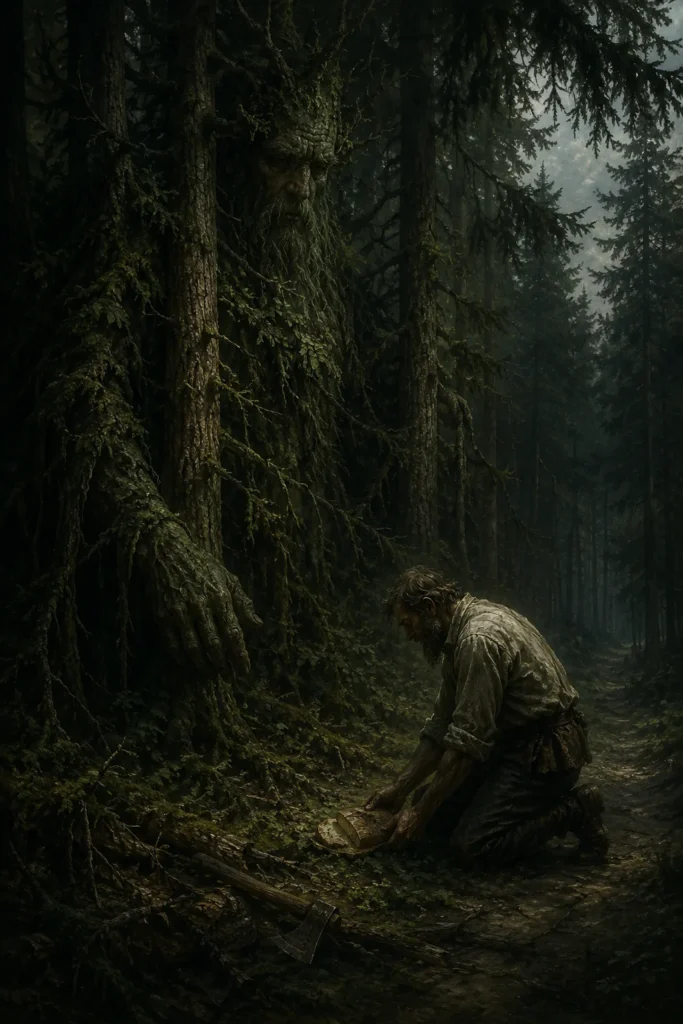
Borowy is the forest lord of Polish and East Slavic tradition, a protector of the forest and its animals. He punishes wrongdoers by making them lose their way and instilling fear, while those who approach the forest with respect are helped by him with a safe way home or hunting luck.
Borowy, Leśny and Boruta are the Polish and regional name variants of the same forest spirit, called Leshy in the East Slavic region. Only with Christianisation did Boruta turn from a name into the devil, linked to Łęczyca Castle.
Type: Forest lord and game keeper, West Slavic manifestation of the master of the forest
Origin: oral Polish and East Slavic tradition
Texts: folkloric collections, Boruta fixed in literature
Period: oral tradition down to Polish legend literature
Appearance: male, shapeshifting forest lord; as Boruta, a nobleman with small horns and claws
Area of origin and sources
Period of the Texts
The figure belongs to oral Polish and East Slavic tradition; it was above all the later figure of Boruta that was fixed in literature.
Area of Diffusion
Poland and the East Slavic region. The legend of Boruta is firmly linked to Łęczyca Castle in central Poland.
Sources
Well documented: the standard folkloristic works of Máchal and Moszyński, as well as the Polish legendary tradition of the Diabeł Boruta.
Name and variants
Polish: borowy, of the forest, from bor, coniferous forest; alongside Leśny, forest lord, from las, forest. Borowy, Leśny and Boruta refer to the same forest spirit; it is not an independent being but the West Slavic form of the Lord of the Forest.
Appearance and behaviour
Appearance
As a nature lord, Borowy is as changeable as the forest itself, able to alter his size and disguise himself as a human. The later Boruta figure as a nobleman in red robes shows the Christianisation and courtly refinement of the old forest spirit into a treasure-guarding devil; the small horns and claws are demonic attributes added later.
Effect
As Lord of the Forest, Borowy protects trees and animals. He punishes offences such as unnecessary felling, noise and disrespect by causing people to lose their way, by frightening them or through accidents, and rewards the respectful with a safe way home or good hunting fortune. As Boruta he guards a treasure in the dungeons of Łęczyca Castle and appears as a black dog, a billy goat, an owl or a giant fish.
Profile: Borowy
The key aspects of the forest lord at a glance.
West Slavic name variant of the Lord of the Forest; regionally Borowy is thought to be somewhat smaller and more mischievous than the great Leshy.
Woodcutters, hunters, forest users and hikers: anyone entering the forest moves within his domain.
Shape-shifting forest lord able to alter his size and disguise himself as a human; as Boruta a nobleman in red robes with small horns and claws.
Protection of trees and animals, punishment of offenders through losing their way, fright or accidents, reward of the respectful with a safe way home and good hunting fortune.
Respect in the forest, asking permission before taking wood or game, and offerings at the forest edge such as bread and eggs.
From forest lord to the devil Boruta
Borowy means of the forest, from bor, coniferous forest; Leśny means forest lord, from las, forest. Both names, along with the name Boruta, refer to the same forest spirit that the East Slavic region calls Leshy; Borowy is thus the West Slavic form of the Lord of the Forest, regionally thought to be somewhat smaller and more mischievous than the great Leshy.
After Christianisation, the name Boruta was reinterpreted as a devil and linked to Łęczyca Castle. The nature lord became a treasure-guarding devil in the guise of a nobleman, to whom small horns and claws were added. This transformation is a classic case of the Christian demonisation of a pagan nature lord.
Town symbol and classification
The Diabeł Boruta is a figure of identification for the town of Łęczyca and a town symbol. He is firmly established in Polish literature and legend, and Borowy and Leśny regularly appear in compilations of Slavic forest spirits.
From the perspective of religious studies, Borowy is a Lord of the Forest, a game warden and a border spirit between culture and wilderness. Two clarifications are important: Borowy is not an independent being but the West Slavic name variant of the Leshy. And the devil figure Boruta, complete with horns and claws, is a later Christian reinterpretation, not the old forest spirit itself.
Respect, offerings and the safe way home
Well documented are respect in the forest, meaning no unnecessary felling, no noise, and asking permission before taking wood or game, as well as offerings at the forest edge such as bread and eggs to keep the forest lord favourably disposed. Behaviours such as putting one’s clothing on backwards to ward off getting lost belong to the broader Leshy complex and can be applied to Borowy as well. Anyone who observes these rules has nothing to fear from the forest lord and can count on his help.
Borowy, Leshy and the forest lords of Europe
Borowy is the same being as the East Slavic Leshy, of which he is the West Slavic variant; the distinction is one of name and region, not of type. Related to him are the German Schrat and the Wild Man, as well as the master-of-animals type of the shamanistic game warden. On the field side, he corresponds to the Polevik as Lord of the Field, and the Romanian forest mother Muma Pădurii shows the female counterpart.
Frequently asked questions about Borowy
Is Borowy the same as the Leshy?
Yes, it is the Polish and regional name variant of the East Slavic forest lord Leshy. Regionally, Borowy is thought to be somewhat smaller and more mischievous.
Why is Boruta a devil?
After Christianisation, the pagan forest spirit was reinterpreted as the devil of Łęczyca Castle, complete with horns and claws added later.
How is he kept favourably disposed?
Through respectful behaviour in the forest, asking permission, and offerings such as bread and eggs at the forest edge.
Further links
Further reading:
- Slavic – all beings of Slavic tradition
- Leshy – the East Slavic forest lord whose variant Borowy is
- Polevik, Muma Pădurii – related nature and forest beings
- Smoke cleansing, Amulet, Salt – traditional protective means
- Protection Compass – protective means at a glance
Literature (selection)
Further standard works in the bibliography.
As the forest lord of Poland and the East Slavic region, Borowy stands for the respect the forest demands; the Leshy variant Boruta also shows how Christianisation turned a pagan nature lord into a treasure-guarding devil.