Muma Pădurii, guardian and terror of the primeval forest
By Ralf Ittermann · last reviewed on
Muma Pădurii is a spirit of Romanian tradition.
Guardian of the forest and children’s bogey in one figure.
Muma Pădurii, the mother of the forest, is an old, ugly forest witch of Romanian folklore, guardian of the forest and its animals. She frightens and leads children astray and robs the sick of their rest, yet is also invoked as mistress of the plants.
In her, the spirit of wild nature is embodied as a maternal figure of pre-Christian origin. As with the Iele, Slavic, Dacian and Roman-Latin layers of Romanian folklore combine in her; she is often compared to the Slavic Baba Yaga.
Type: Forest mother and mistress of animals, ambivalent female forest spirit
Origin: Romanian folk mythology with pre-Christian roots
Texts: Romanian standard collections (Pamfile, Kernbach)
Period: pre-Christian roots to the present
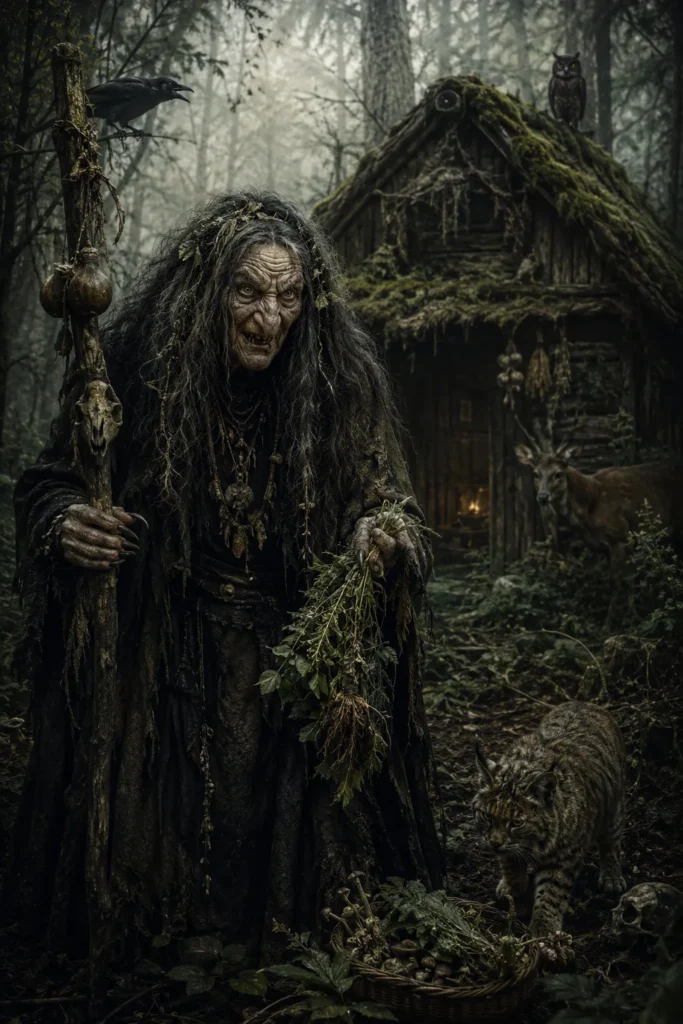
Appearance: old, ugly woman with a hideous face, sharp teeth and claws
Historical Classification
Period of the Texts
The figure belongs to Romanian folk mythology and carries pre-Christian roots; she becomes documented in writing in the folkloric collections.
Area of Diffusion
All of Romania, especially Transylvania and Moldavia, where the rituals concerning the forest mother are most densely attested.
Sources
Moderate source basis, thinner than for the Roman gods: the Romanian standard collections by Pamfile and Kernbach are the most reliable.
Name and variants
Romanian: Muma Pădurii, literally mother of the forest, from muma, mother, and pădure, forest. The name names the being’s nature directly: the spirit of wild nature in maternal form.
Form and effect
Appearance
She is usually an ugly, malicious or deranged old woman at the heart of the primeval forest, living in a hut or in an old tree, with a disfigured face, sharp teeth and claws that emphasise her predatory nature. She can change shape. Symbolically, she stands for the dark, unpredictable and at the same time protective side of the forest.
Effect
Muma Pădurii is two-faced: as protector she watches over animals and plants, brews potions, heals injured animals and the forest, and keeps intruders away by driving them to madness or frightening them. As a threat, she attacks children, abducts and enslaves them, leads them astray in the forest, and robs the sick and sleepless of their rest.
Profile: Muma Pădurii
The key aspects of the forest mother at a glance.
Romanian forest mother of pre-Christian origin, in whom Slavic, Dacian and Roman-Latin layers of folklore combine.
Animals and plants of the forest as her charges; children, the sick and the sleeping as the targets of her threatening side.
Old, ugly woman with a disfigured face, sharp teeth and claws, living in a hut or in an old tree, shape-shifting.
Guardian of the forest and healer of its animals; at the same time a children’s bogey who abducts, leads astray and robs the sick of their rest.
Incantations to protect sick children, the ritual of returning the child to the forest, and offerings at the forest edges.
Slavic, Dacian and Latin layers
The name Muma Pădurii literally means mother of the forest, from muma, mother, and pădure, forest. She embodies the spirit of wild nature as a maternal figure of pre-Christian origin and is often compared to the Slavic Baba Yaga.
As with the Iele, Slavic, Dacian and Roman-Latin layers of Romanian folklore combine in her. This layering explains her dual nature: the old mistress of nature and transition still shows through in the fairy-tale witch.
Reception and interpretation
Muma Pădurii is a fixed figure of Romanian fairy tales and folk narratives and a bogeyman used to frighten children. She is anchored in Romanian literature and folklore reception and today serves as a motif in fantasy and horror.
From a religious-studies perspective, Muma Pădurii is a forest mother and mistress of the animals and plants, at the same time an ambivalent female forest spirit and children’s bogey, in whom the diminished figure of an old mistress of nature and transition still shows through. Regarding the source basis, one clarification is due: the scholarly specialist literature is thinner than that on the Roman gods; the Romanian standard collections are above all the most reliable.
Incantations and the return to the forest
Firmly attested by sources are incantations and spells, especially for the protection and healing of sick, restless children, the ritual of returning the child to the forest, which is central to Transylvanian and Moldavian customs, and offerings left at the forest’s edge. At the same time, she is invoked positively as the mistress of plants when gathering healing herbs: whoever makes use of the forest turns to its mother.
Baba Yaga, Leshy and the type of the forest mother
Muma Pădurii corresponds most closely to the Slavic Baba Yaga, the old forest witch, and to the Slavic Leshy as the male counterpart of the lord-of-the-forest figure. She belongs to the religious-historical type of the forest mother and mistress of animals. Within Romania, the dancing Iele share the forest with her, but differ fundamentally: beautiful collective beings there, a single old forest mother here.
Frequently asked questions about Muma Pădurii
Is Muma Pădurii evil or good?
Both: she protects forest, animals and plants, but is dangerous to children and intruders.
How do you protect children from her?
Through incantations, protective rituals and the custom of symbolically returning the child to the forest, which is central to Transylvanian and Moldavian tradition.
Is she related to Baba Yaga?
Yes, she is often compared to the Slavic Baba Yaga and, like her, belongs to the type of the old mistress of the forest.
Further links
Literature (selection)
Further standard works in the bibliography.
As mother of the forest and Romanian forest witch at once, Muma Pădurii shows both faces of wild nature: the giving mistress of animals and plants, and the terror that keeps children away from the dark forest.