Pricolici is a demon of Romanian tradition.
The evil dead that roams and attacks as a wolf or dog.
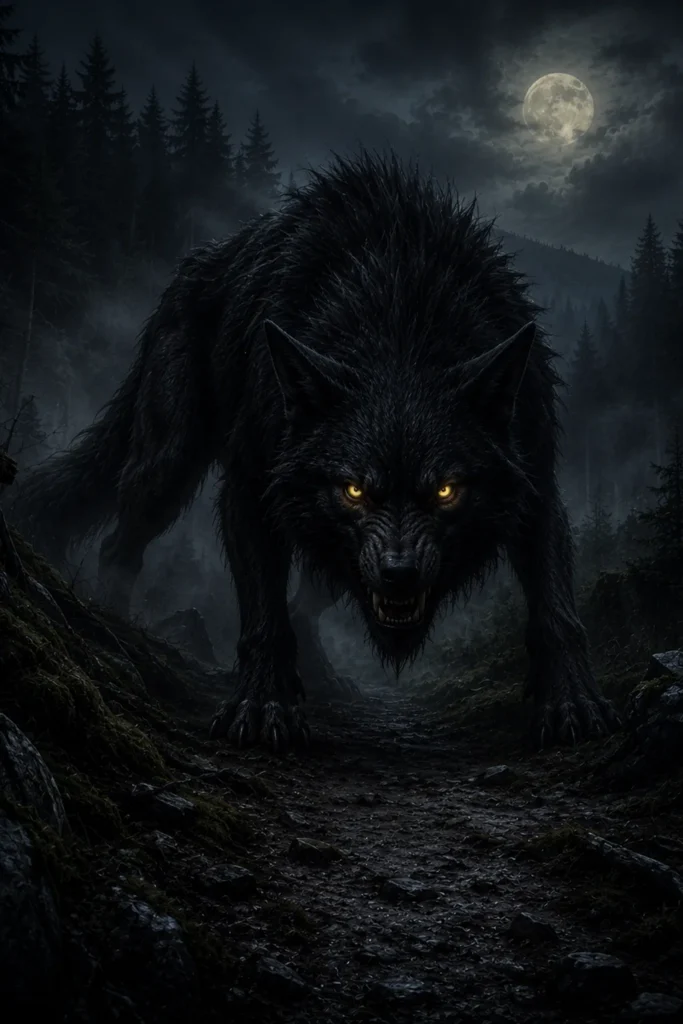
In Romanian folk belief, Pricolici is the spirit of an evil, violent man who, after death, returns not as a human but as a beast. Unlike the human-like Strigoi, it always rises in the shape of a wolf or dog and attacks lone travellers and livestock, silently and unexpectedly.
The Pricolici is closely related to the notion of the Vârcolac, the ordinary Romanian werewolf, and is understood as its undead escalation: as a Romanian werewolf, it combines werewolf belief with the belief in revenants of the Carpathian region. The tradition is well documented and extends into the present.
Type: Wolf-shaped werewolf-undead, spirit of an evil dead person
Origin: Romanian tradition of the rural Carpathian regions
Texts: Good folk tradition extending into the present, plus early collections and more recent studies
Period: Romanian tradition, reported into the present
Appearance: Wolf- or large-dog-like beast, less commonly a deformed human
Romanian tradition that extends into the present: even in modern rural reports, unusually large, aggressive wolves are interpreted as Pricolici.
Romania, especially the rural Carpathian regions, where belief in the werewolf and revenant remained particularly alive.
Good: a broad Romanian folk tradition, plus the early collections of Murgoci and Summers as well as more recent studies on Balkan vampire belief.
Romanian: Pricolici denotes the wolf-shaped werewolf-undead and stands alongside the Vârcolac, the ordinary werewolf of Romanian tradition: where the Vârcolac changes shape as a living human, the Pricolici returns as a dead person.
Appearance
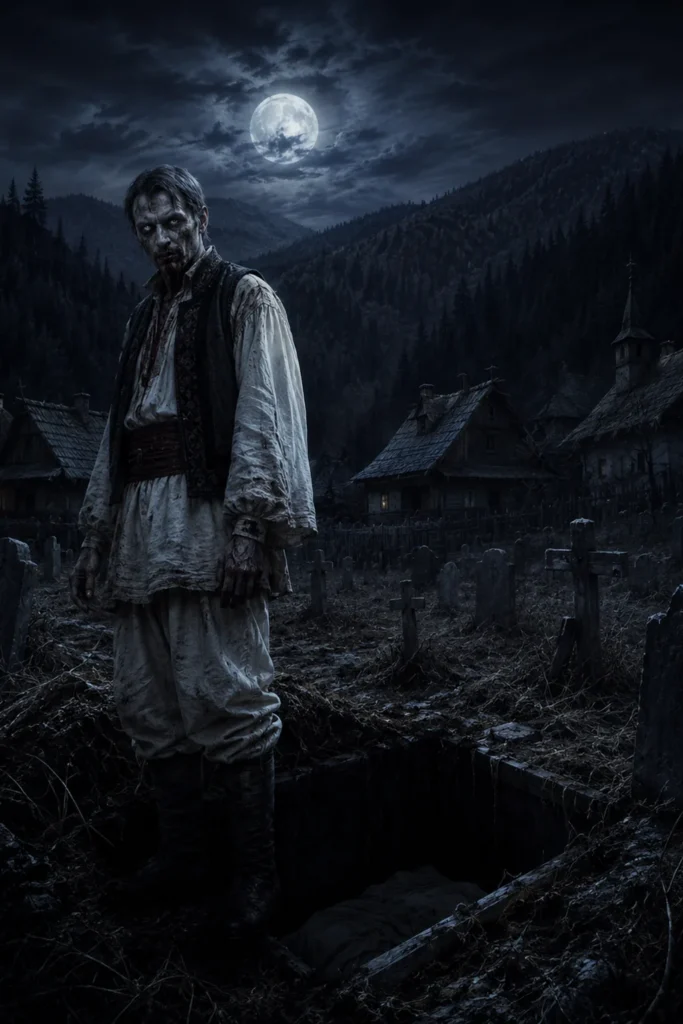
The Pricolici appears as a pure wolf or beast shape with bristling fur, quite unlike the human-like Strigoi. Less commonly, it shows itself as a deformed human who stands upright and imitates human gestures to lure victims.
Effect
It carries out deadly attacks on individuals: lone travellers and livestock. The attack occurs silently and unexpectedly. In modern rural reports, unusually large, aggressive wolves that attack in this way are interpreted as Pricolici.
The key aspects of the wolf-undead at a glance.
Romanian revenant belief of the Carpathian region, closely related to the werewolf belief surrounding the Vârcolac.
Lone travellers and livestock: the Pricolici seeks out individual, unprotected victims away from the community.
Wolf- or large-dog-like beast with bristling fur, less commonly a deformed, upright-walking human.
Deadly solo attacks: silent, unexpected, without the warning some other revenants give.
Exhumation and staking of the suspect, along with the usual means against the evil dead: iron, garlic and holy water.
Strigoi, the human-like counterpart, as well as Vukodlak and Vrykolakas as related werewolf-vampires of the Balkan region.
The Pricolici is the Romanian werewolf-undead and stands closely alongside the Vârcolac, the ordinary werewolf of Romanian tradition. While the living Vârcolac changes shape, the Pricolici has already died and returns in animal form; it thereby combines two ideas that elsewhere remain separate: the shapeshifter and the revenant.
One widespread tradition explains its origin from a child who was suckled a second time after weaning. More often, however, particularly evil, violent men become Pricolici after death, because their earthly brutality cannot be laid to rest with a simple prayer. Unlike the human-like Strigoi, the Pricolici never retains its human form.
The Pricolici is included in Emily Gerard’s influential catalogue of Transylvanian superstitions, which Bram Stoker also drew on for his Dracula. In modern Romanian as well as international horror and fantasy culture, it is still regarded today as the Romanian werewolf, combining the werewolf and vampire motifs in a single figure.
From a religious-studies perspective, the Pricolici shows the close interweaving of werewolf and vampire belief in the Balkan-Carpathian region: the same category of the evil, violently deceased dead can return either as a human-like bloodsucker, the Strigoi, or as a bestial creature, the Pricolici. Both are expressions of the same underlying problem, the bad death.
As with the evil dead in general, exhuming the suspect, staking, decapitation and burning the corpse and heart were considered effective means, along with a correctly performed burial from the outset, intended to prevent a return. Since the Pricolici is regarded as a werewolf-vampire undead, the same apotropaic means used against Strigoi and Vukodlak also apply: iron, whose blade is held against the bestial undead, garlic as a widespread Romanian means against the undead revenant, and holy water as a Christian sign against the evil dead.
The Pricolici is the Romanian counterpart to the South Slavic Vukodlak and the Greek Vrykolakas, in which werewolf and vampire likewise merge. It is also related to the human-like Strigoi and the Moroi, as well as to the Vârcolac, the ordinary Romanian werewolf. Within the Germanic-Norse framework, it is comparable to the physically powerful, bestial Draugr of Old Norse tradition.
Is the Pricolici a werewolf or a vampire?
Both at once: an undead, wolf-shaped evil dead being, as closely related to the werewolf Vârcolac as to the vampire revenant Strigoi. It combines the form of one with the fate of the other.
Who becomes a Pricolici?
Above all, particularly evil, violent men return after death as Pricolici. According to tradition, their earthly brutality cannot be laid to rest with a simple prayer.
How does it differ from the Strigoi?
The Strigoi retains human form after its return, whereas the Pricolici always rises as a wolf or dog. Both, however, are considered forms of the same evil, violently deceased dead.
Recommended internal links:
Further standard works in the bibliography.
As both Romanian werewolf and werewolf-undead, the Pricolici unites what elsewhere remains separate: it is not merely a shapeshifter, but an evil person who, in death, becomes a beast for good, and it is precisely in this form that it falls upon the living.
Against its influence, cross-cultural tradition names these protective means:
Compare in the Protection Compass →Recommended protective means
The simplest protective means in this collection: 41 layers of fine gold 999, platinum, silver and silicon, manufactured in Ruhla, Thuringia. It requires no activation, is bound to no person, and is effective within a radius of around 50 meters, even without being worn.
Related Beings

Lugh, Celtic master of all arts: his victory over Balor, the festival of Lughnasadh, and traces f...

Cherufe, the man-eating lava demon of the Mapuche in Chile. Origin, its volcanic associations and...

The Hobgoblin, originally the friendly house spirit of England. Origin, the shift towards an evil...

La Sirène, the mermaid Lwa of Haitian Vodou. Origin, the mirror, and the connection to Agwe and M...

The Yowie is a wild, hairy figure of dread from the Aboriginal forests of eastern Australia. A re...

Meža māte, the Latvian mother of the forest, rules over wild animals and woodland. Tradition of t...