Kalku, the sorcerer allied with the wekufe
By Ralf Ittermann · last reviewed on
Kalku is a demon of Mapuche tradition.
He consorts with the wekufe and summons dark servants. The entry portrays Kalku as a sorcerer allied with the wekufe, summoning dark servants to do his bidding.
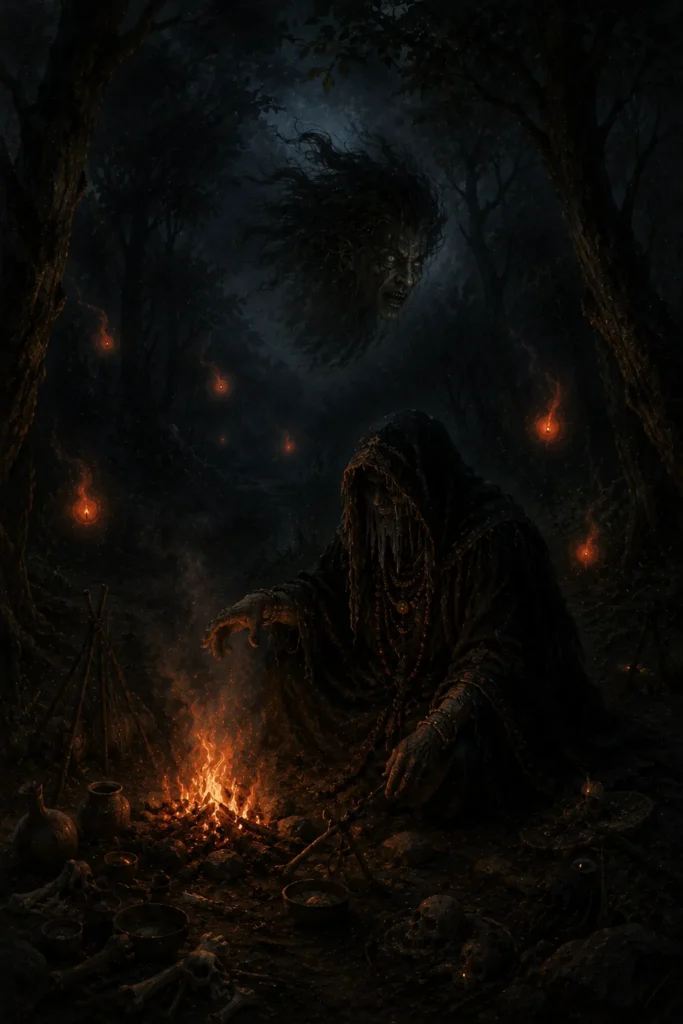
Kalku is the evil sorcerer or witch of the Mapuche in southern Chile and Argentina, the dark counterpart to the healing Machi. Through black magic, the Kalkutun, he consorts with the evil spirits, the wekufe, and summons servile beings such as the Anchimayen and the Chonchon to inflict targeted harm.
At his core, the Kalku is a living human, usually a woman, yet as a mediator to the spirit world he belongs firmly to the Mapuche world of ancestral spirits and the dead. He draws his powers from dreams and visions, and the role is often inherited. Even a Machi who breaks the order of the Admapu out of greed can become a Kalku.
Type: Evil sorcerer or witch, dark counterpart to the healing Machi
Origin: Mapuche religion of southern Chile and Argentina
Texts: Ethnographic and mythological overview works, chiefly Latcham and Guevara
Period: Mapuche religion, from oral tradition to modern reception
Appearance: human form, usually described as a woman, acting hidden and by night
Area of origin and sources
Period of the Texts
Belief in the Kalku belongs to Mapuche religion and is documented mainly in ethnography and mythological overview works, less in dated individual texts.
Area of Diffusion
The Mapuche regions of southern Chile and Argentina.
Sources
Good: chiefly the early ethnographic works of Latcham and Guevara.
Name and variants
Mapudungun: The term Kalku, written Calcu in Spanish, comes from Mapudungun and was in turn borrowed from the Andean Puquina. It denotes the counterpart to the Machi, whose name stands for the benevolent healer and shaman of the Mapuche.
Nature and effect
Appearance
The Kalku appears in human form, usually described as a woman, acting hidden and by night. He embodies the reverse side of spiritual power: where the Machi heals, the Kalku breaks with the order of the Admapu and becomes a symbol of socially feared power in envy, inheritance disputes and land conflict.
Effect
The Kalku manipulates the wekufe to inflict targeted harm on personal enemies and rivals. He employs servile beings, the Anchimayen as servant and the Chonchon, the flying severed head, as a manifestation of especially powerful Kalku, and is held responsible for acts of witchcraft in conflicts.
Profile: Kalku
The key aspects of the sorcerer at a glance.
Evil counterpart to the Machi in the Mapuche religion of southern Chile and Argentina.
Personal enemies and rivals against whom targeted harm is inflicted.
Human form, usually described as a woman, acting hidden and by night.
Black magic, the Kalkutun, in alliance with the wekufe and their servant spirits.
The healing Machi as counterforce, together with adherence to the order of the Admapu.
Anchimayen, his servant, and the structurally related Toyol of the Malay Bomoh.
From breaking with the Admapu to feared sorcerer
The term Kalku comes from Mapudungun, rendered in Spanish as Calcu, and itself derives from the Andean Puquina. It denotes the counterpart to the Machi, the benevolent healer and shaman of the Mapuche: where the Machi heals and protects, the Kalku deals with the wekufe, the evil spirits, and uses their help to inflict targeted harm.
The role is usually female and often inherited; the Kalku draws power from dreams and visions. Even a Machi can become a Kalku if, out of greed, she disregards the rules of the Admapu, the traditional order of the Mapuche. At its core the Kalku is a living human being, yet as a mediator to the spirit world it firmly belongs to the Mapuche world of spirits of the dead and spirits in general.
The sorcerer in games and storytelling
The Kalku is present in modern popular culture, including in video games, where it appears as a Mapuche sorcerer with Anchimayen and Chonchon as servants; Mapuche mythology as a whole is also taken up in animation and fiction.
From a religious-studies perspective the Kalku is an ambivalent figure of power within indigenous Mapuche cosmology, a borderline case between human and spirit conjurer and mediator to the wekufe world. It forms the negative pole opposite the Machi and is a fixed part of the conception of the world of spirits and the dead, despite being at its core human.
The Machi as counterforce
The central counterforce to the Kalku is the benevolent Machi, who is responsible for protection and healing from Kalku-inflicted harm; her herbs and remedies, including mugwort, are held in folk belief to offer protection. A worn amulet and salt are also considered a defence against the black magic. Adherence to the order of the Admapu excludes the Kalku. Concrete details of anti-Kalku rituals are only generally documented, but the principle of Machi against Kalku is clear.
Sorcerers and servant spirits compared
The Kalku corresponds to the general type of the sorcerer or witch who practises black magic with servant spirits. A direct structural parallel is the Malay Bomoh, the shaman who binds a servant spirit such as the Toyol. Within the Mapuche world, the Kalku faces its own servant, the Anchimayen, which it conjures to cause harm.
Frequently asked questions about Kalku
Kalku or Machi, what is the difference?
The Machi is the benevolent healer and shaman of the Mapuche, the Kalku her malevolent counterpart, who practises black magic.
Where does its power come from?
From dreams and visions and dealings with the wekufe; the role is often inherited and usually held by women.
Which servants does it conjure?
The Anchimayen as a servant, and the Chonchon, the flying severed head, as a manifestation of especially powerful Kalku.
Further links
Further reading:
- Anchimayen – the servant spirit conjured by Kalku
- Toyol – the servant spirit of the Malay Bomoh as a parallel figure
- Mugwort, amulet, salt – traditional protective means
- Protection Compass – an overview of protective means
Literature (selection)
Further standard works in the bibliography.
As a Mapuche sorcerer, Kalku remains to this day the dark counterpart to the Machi: black magic with Calku refers precisely to that Kalkutun by which it presses the wekufe into its service.