Toyol, the bound thief of its master
By Ralf Ittermann · last reviewed on
Toyol is a demon of Malay tradition.
Bound by its master and forced into secret theft. The profile portrays this demon as a thief bound to carry out its master’s bidding in secret.
Toyol is a child-like goblin spirit of Malaysia and Indonesia, conjured from the soul of a dead foetus or stillborn child. A master binds it through black magic and sends it out to secretly steal money and small valuables.
Unlike the murderous Tiyanak of the Philippines, the Toyol is not primarily deadly: the danger lies less in the being itself than in the thieving will of the master who conjures, feeds and controls it.
Type: Child-like goblin spirit in a master’s service
Origin: Malay and Indonesian folk belief around black magic
Texts: oral folk tradition, present in everyday magic and horror film
Period: oral to the present day, alive in modern horror film
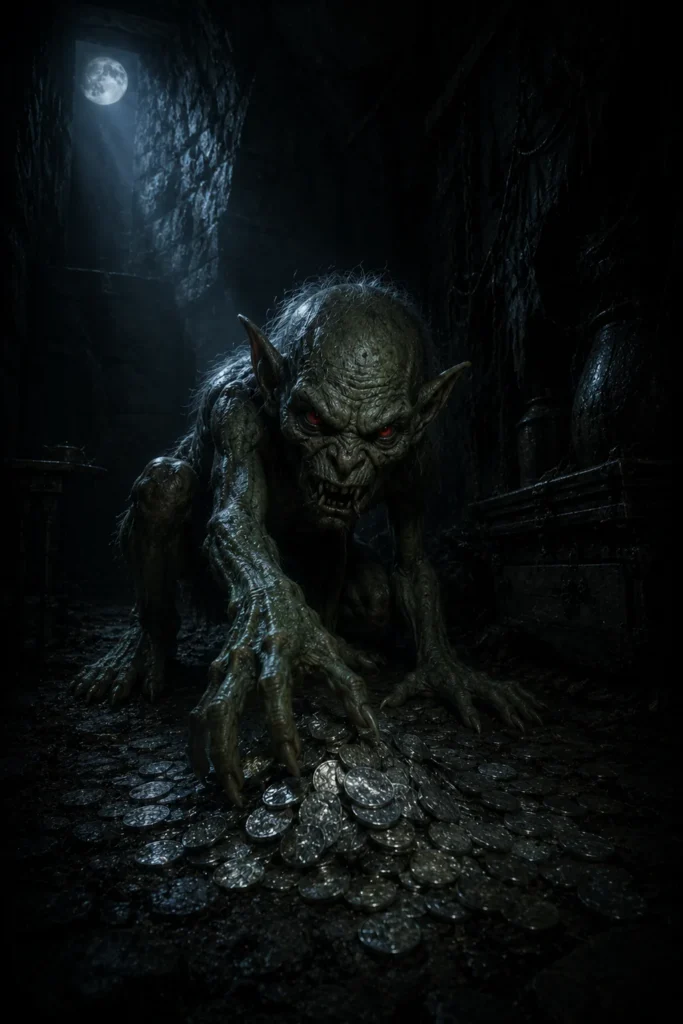
Appearance: small, naked child with sharp teeth and red eyes, goblin-like
Source context
Period of the Texts
Oral to the present day: the belief is part of the living everyday magic of Malaysia and Indonesia and has been taken up by modern horror film.
Area of Diffusion
Malaysia, where the being is called Toyol, and Indonesia, where it is known especially in Sundanese tradition as Tuyul.
Sources
Medium to thin: alongside Skeat’s early record of Malay magic, there is above all a broad folkloric and pop-cultural tradition; reliable academic monographs specifically on the Toyol are rare.
Name and variants
Malay/Indonesian: The name is Toyol in Malay, and Tuyul in Sundanese and Indonesian. Its master carries the title Bomoh in Malay or Dukun in Indonesian, depending on the language area.
Appearance
Appearance
The Toyol appears as a small, naked child, in folk belief with sharp teeth and red eyes, in the Indonesian variant often with green skin and pointed ears. It embodies the ambivalence of childlike innocence and demonic usefulness, the dead child as a tool of human greed.
Effect
The Toyol steals money and small valuables from neighbours and the wealthy on behalf of its master, and is not primarily murderous. It must be bound through incantations and supplied daily with milk, sweets and toys; neglect can cause it to turn against its owner or escape.
Profile: Toyol
The most important aspects of the goblin spirit at a glance.
Animistic spirit belief of Malaysia and Indonesia, linked to the black magic of the Bomoh or Dukun; practised in Islamic contexts as a frowned-upon but widespread folk practice.
Neighbours and wealthy people, from whom the Toyol steals money and small items on its master’s behalf.
Small, naked child with sharp teeth and red eyes, in Indonesia often green-skinned and pointy-eared.
Theft rather than murder: the Toyol secretly procures wealth for its master; the danger remains economic, not fatal.
Scattered small items such as beads, grains of rice or sweets distract the playful child and keep it from theft.
The dead foetus in the service of black magic
The name is Toyol in Malay, and Tuyul in Sundanese and Indonesian. The Toyol is an undead infant, conjured through black magic from the soul of a dead foetus or stillborn child. Its master is a shaman, a Bomoh in Malay or a Dukun in Indonesian, who binds it and employs it for his purposes.
The belief combines the animistic idea of spirits and service beings with black magic and is regarded in Islamic contexts as a frowned-upon but widespread folk practice. An impure and prematurely deceased child thus becomes a bound tool, its childlikeness standing in sharp contrast to its use by adults.
Horror boom and social interpretation
The Toyol is a fixture of Indonesian-Malay horror film and, alongside Pocong and Kuntilanak, ranks among the mainstay local figures of the horror boom.
The Toyol combines belief in the impure and prematurely deceased, the dead foetus, with black magic and ideas of service spirits. In social terms it can be read as an explanatory pattern for unaccountable wealth or loss in village communities: where a neighbour suddenly becomes prosperous, or another is inexplicably robbed, belief in the Toyol offers an explanation.
Distraction as the most effective protection
Well attested is distraction: since the Toyol is a playful child, it can be kept occupied and thus deterred from theft with small items scattered on the ground. Scattered salt is considered an effective means of distraction alongside beads, rice grains and sweets, a worn amulet serves as a warding sign against the thieving spirit, and mugwort stands for the herbs that, together with rice grains on the ground, are meant to distract the child-like being. The actual binding and control, however, lies with the master himself, through incantation and daily offerings of milk, sweets and toys.
Thieving goblin rather than blood-drinker
The Toyol differs fundamentally from the female blood-drinking figures of the Malay spirit world, the Pontianak, the Langsuir and the Penanggalan: it is a bound service spirit acting on behalf of a living master, not an independently hunting being. The Toyol is related to the Philippine Tiyanak, likewise the spirit of a dead child, which however actively kills, whereas the Toyol is thieving and not deadly. Its closest functional parallel is the Thai Kuman Thong, the conjured child spirit as a bringer of luck.
Frequently asked questions about the Toyol
What is a Toyol used for?
A master, a Bomoh or Dukun, conjures it to secretly steal money and small items.
Is the Toyol dangerous to humans?
Usually not directly deadly, unlike the Philippine Tiyanak; the danger comes more from the thieving master and the economic harm caused.
How is it kept from stealing?
By distracting it, as a child, with scattered sweets, beads or grains of rice.
Further links
Further reading:
- Tiyanak – the deadlier Philippine child spirit
- Pontianak, Langsuir, Penanggalan – the Malay blood-drinking women
- Salt, Amulet, Mugwort – traditional protective means
- Protection Compass – protective means at a glance
Literature (selection)
Further standard works in the bibliography.
As Tuyul, the Toyol remains a childlike goblin spirit caught between innocence and commissioned theft: bound to its master, fed with sweets and toys, and never quite fully tamed.