Penanggalan, the nocturnal bodiless head
By Ralf Ittermann · last reviewed on
Penanggalan is a demoness of Malay tradition.
At night her head detaches and seeks the blood of women in childbirth. The account centers on the bodiless head that hunts by night in search of blood.
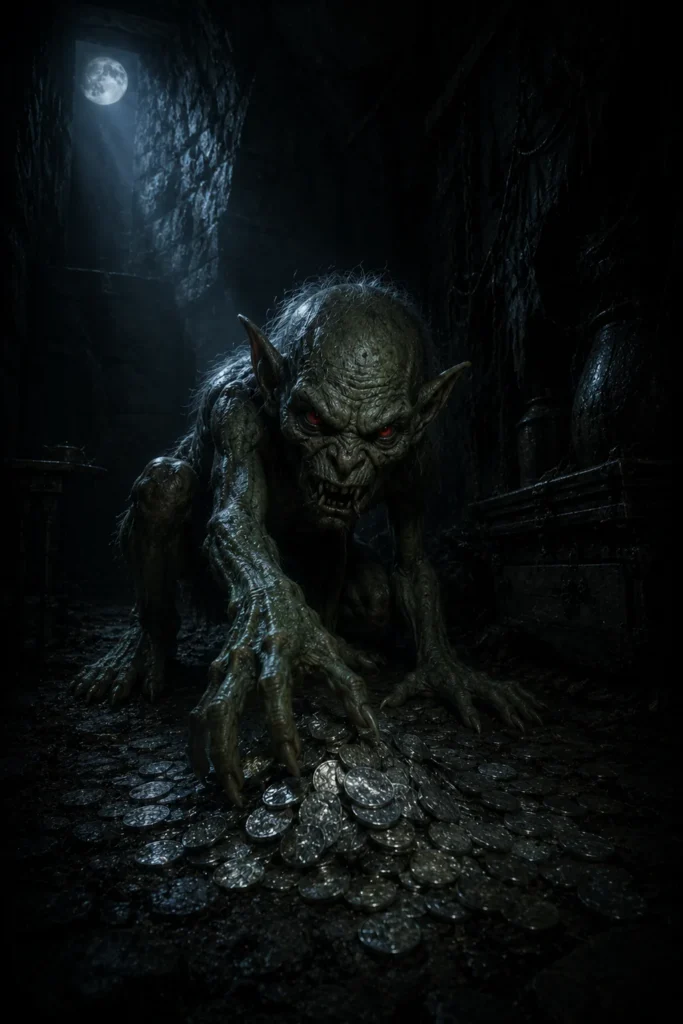
Penanggalan is a Malay witch whose head detaches from her body at night, trailing her hanging entrails as she flies off to suck the blood of women in childbirth and newborns. By day she lives as an inconspicuous woman, often disguised as a midwife, and upon returning places her innards in a vat of vinegar.
The textual period is historically documented, in the Hikayat Abdullah of 1849 and by Walter William Skeat around 1900; the area of distribution extends from Malaysia and Indonesia across the whole of Southeast Asia. From a distance the flying head resembles a flame, an image that blurs the boundary between human and monster.
Type: Flying woman’s head with trailing entrails
Origin: Malay folk belief, witchcraft and birth demonology
Texts: Hikayat Abdullah 1849, Walter William Skeat 1900
Period: historically documented, still alive today
Appearance: severed woman’s head with entrails, resembling a flame from a distance

Area of origin and sources
Period of the Texts
Historically documented: the Hikayat Abdullah of 1849 and Walter William Skeat’s field study of 1900 record the figure, which remains alive in folk belief to this day.
Area of Diffusion
Malaysia, Indonesia and the entire Southeast Asian region.
Sources
Good: besides Skeat and the Hikayat Abdullah, later mythological reference works also record the figure.
Name and variants
Malay: The name derives from tanggal, to detach, and directly names the core motif of the figure: the head that separates from the body.
Appearance
Appearance
From a distance the Penanggalan resembles a flickering flame: the severed head with the trailing entrails. After the nocturnal hunt she must soak her innards in vinegar so they shrink and fit back into her body, hence the telltale smell of vinegar that betrays her daytime disguise.
Effect
By day she poses as a midwife, recognisable by her avoidance of eye contact and by licking her lips. At night she flies beneath the pile-built houses and sucks the blood of women in childbirth with a long tongue. Anyone brushed by the dripping entrails carries away wounds that do not heal; the victims fall ill with an almost always fatal wasting sickness.
Profile: Penanggalan
The key aspects of the flying head at a glance.
Malay witchcraft and birth demonology, documented by Skeat and in the Hikayat Abdullah.
Pregnant women, women in childbirth and newborns, whom she stalks at night beneath the pile-built houses.
Severed woman’s head with trailing entrails, resembling a flame from a distance.
Theft of blood from women in childbirth, with an almost always fatal wasting sickness in the victims.
Thorny vines at windows, broken glass on walls, and scissors under the pillow of the woman in childbirth.
The witch in the vinegar vat
Unlike many spirits of the dead, the Penanggalan is not a classic undead being but a living witch who acquired the ability to detach her head herself through meditation in a vinegar vat. Walter William Skeat documented her around 1900 as a nocturnal birth spirit of Malaysia’s animist folk religion.
The Hikayat Abdullah of 1849 tells her origin as a concrete story: once she was an ordinary woman who used the magical arts of a demon, after which her head and neck, together with the entrails, could separate from her body and fly. Both sources present her as a self-taught, rather than an inherited, threat.
Between horror film and role-playing game
The Penanggalan and the related but distinct Balinese being Leak shaped Indonesian horror film, for instance Mystics in Bali from 1981, and still appear today in role-playing games, comics and video games. It is one of the best-known figures in the Southeast Asian world of spirits.
From a religious-studies perspective, the Penanggalan combines the notion of black magic, in which the witch acquires the ability herself, with the anxiety complex surrounding childbirth and the lying-in period. She represents an Islamically overlaid animism, in which of all people the midwife, the birth attendant, becomes a potential threat.
Thorns, shards and the vinegar vat
Well-attested are thorny plants such as mengkuang or pandanus, whose vines are laid around windows to snag the trailing entrails; a protective herb of comparable function used in warding off spirits is also mugwort. In addition, broken glass on top of walls and scissors made of iron under the pillow of the woman in childbirth serve as protection, as does salt at the openings of the house. For final destruction, glass shards are placed in the empty neck opening of the abandoned body, which is then blessed and burnt, or the head is prevented from returning before sunrise.
Flying heads of Southeast Asia
The Penanggalan corresponds to the Thai Krasue, the glowing flying woman’s head, and the Filipino Manananggal, which however detaches the entire upper body. Further relatives are Ahp, Kasu and Leyak, and related as a head-motif are the Japanese Nukekubi and Rokurokubi. Within the Malay spirit world she stands alongside the Pontianak and the Langsuir, who likewise concern women in childbed, as well as the Toyol as a further figure of the same tradition.
Frequently asked questions about the Penanggalan
Is the Penanggalan dead?
No, by day she is a living woman and witch who only detaches her head, together with the entrails, from her body at night.
Why does she smell of vinegar?
Because after her nocturnal hunt she steeps her entrails in vinegar so that they shrink and fit back into her body.
How is she kept away?
Through thorny plants at windows and glass shards on walls, which are meant to entangle the dangling entrails.
Further links
Further reading:
- Pontianak, Langsuir – Malay spirits associated with childbirth
- Krasue, Manananggal – related flying heads of Southeast Asia
- Pocong, Toyol – further figures of the Malay-Indonesian spirit world
- Mugwort, Iron, Salt – traditional protective means
- Protection Compass – overview of protective means
Literature (selection)
Further standard works in the bibliography.
As a flying woman’s head, the Penanggalan remains one of the most horrifying figures of the Malay spirit world: as a Malay witch she acquired the power to detach her head herself, and to this day carries the scent of vinegar from the night for it.