Pocong and the knot that holds the soul
By Ralf Ittermann · last reviewed on
Pocong is a spirit of Indonesian tradition.
Only when the knot is undone does the soul find rest. Pocong is depicted as a ghost bound in its burial shroud within Indonesian tradition.
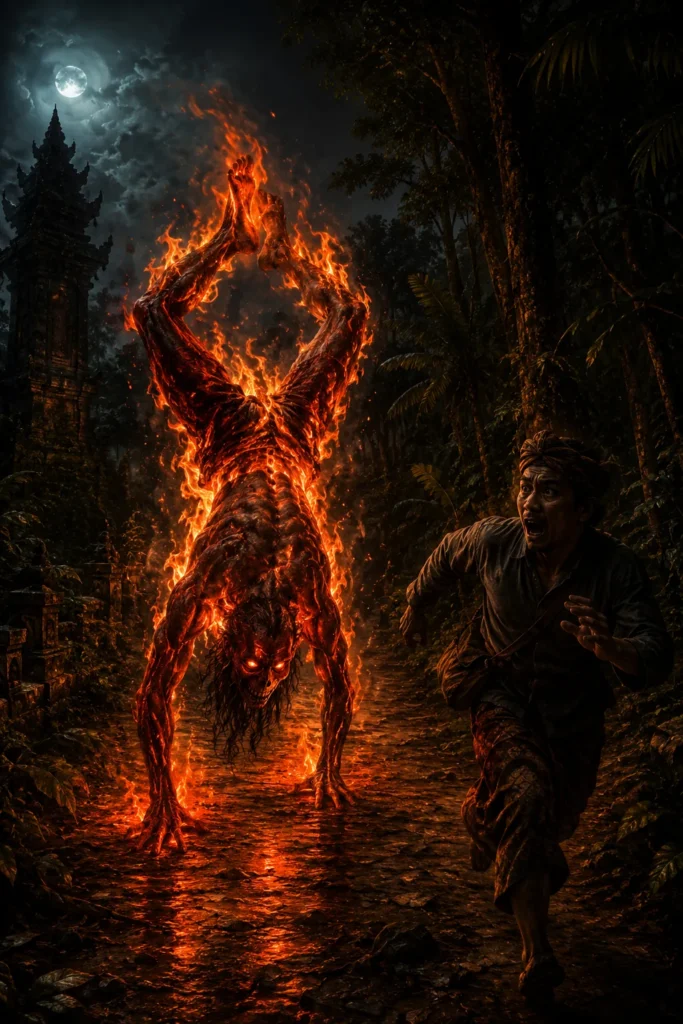
Pocong is the spirit of a deceased person, trapped in a white shroud knotted at the head, neck and feet. Because the feet are bound, it moves through the night hopping or floating.
It is regarded as a restless spirit whose funeral rite was not properly completed. According to folk belief, it is released once the knot of the shroud is undone, especially if this is done ritually after forty days.
Type: Spirit in a shroud, trapped by an unsolved funeral knot
Origin: Indonesian, chiefly Javanese folk belief, linked to Islamic burial practice
Texts: oral and modern popular-culture tradition, anchored in Islamic burial practice
Period: oral and modern, substantially carried by Indonesian horror cinema of recent decades
Appearance: an upright figure wrapped in a white shroud, knotted at the head, neck and feet, moving in a hopping motion

Area of origin and sources
Period of the Texts
Oral and modern popular-culture tradition: the belief is anchored in Islamic burial practice and has been substantially carried forward for decades by Indonesian horror cinema.
Area of Diffusion
Indonesia, chiefly the island of Java, as well as Malaysia.
Sources
Moderate: academic literature is thinner than for other female spirits of the region; the Pocong belongs primarily to modern Indonesian folk and film culture.
Name and variants
Indonesian: Pocong derives from the wrapped, bound corpse. Kain kafan denotes the Islamic white shroud in which the body is wrapped and knotted at the head, neck and feet.
Appearance and movement
Appearance
The Pocong appears as an upright figure, entirely wrapped in a white shroud knotted above the head, below the feet and around the neck. It is among the most iconic figures of the region: the bound body makes visible the motif of an unfinished transition.
Effect
Because the feet are bound, the Pocong moves by hopping. It is considered frightening rather than deadly; the central narrative revolves around its own release, not bloodlust or murder, which clearly distinguishes it from other spirits of the region.
Profile: Pocong
The key aspects of the shroud spirit at a glance.
A central figure of Indonesian folk and horror-film belief, rooted in the Islamic burial practice of Java and Malaysia.
Living people who chance upon the spirit at night; unlike many spirits of the dead, the Pocong does not pursue a specific victim.
An upright figure in a white shroud, knotted at the head, neck and feet, one of the best-known imagery motifs of Indonesian horror cinema.
A hopping or floating nocturnal appearance that frightens but, according to tradition, does not kill.
The ritual untying of the foot knot, especially after the forty-day period, is regarded as the only effective way for the soul to find rest.
Unlike the blood-drinking Pontianak, Langsuir and Penanggalan, the Pocong does not kill but seeks its own release.
The unsolved knot of the shroud
The name Pocong derives from the wrapped, bound corpse. The Pocong is directly linked to Islamic burial: the body is wrapped in kain kafan, the white shroud, which is knotted above the head, below the feet and around the neck. According to folk belief, these knots are meant to be undone after forty days so that the soul may ascend peacefully.
If the knot remains tied, the spirit is regarded as trapped within the body and appears as a Pocong. The idea thus connects the Islamic rite with an older Javanese belief in the soul: an outwardly correctly performed burial can fail through a single unsolved knot, leaving behind a restless spirit.
Pocong in Indonesian cinema
The Pocong is a central element of Indonesian horror cinema, with countless Pocong films across decades. The horror boom of Indonesian cinema is carried by local figures such as Pocong, Kuntilanak and Toyol.
From a religious-studies perspective, the Pocong is a textbook example of Islamic-inflected animism: an Islamic burial rite involving a shroud and a forty-day period merges with pre-Islamic Javanese belief in the soul. The Pocong embodies the fear of an incompletely performed ritual and of the restless dead.
The undone knot as release
The core motif is the untying of the knot: if the foot knot of the shroud is undone, ritually after forty days, the soul finds rest; an unsolved knot is regarded as the cause of the Pocong. Correctly performing the Islamic burial rite with consecrated water is the actual prevention. Until release, the light of a candle accompanies the wake, and a worn amulet is considered a protective sign for a nocturnal encounter with the restless spirit.
The Pocong alongside Jiangshi, Pontianak and Langsuir
The motif of the dead wrapped in a burial shroud, moving by hopping, has distant echoes of the Chinese jiangshi, the hopping corpse, but differs clearly from it through its Islamic burial context. Closer to its own region, yet clearly distinct, are the blood-sucking figures Pontianak, Langsuir and Penanggalan, who, unlike the Pocong, kill rather than merely frighten.
Frequently asked questions about the Pocong
Why does the Pocong hop?
Because its feet are tied together in the burial shroud, making normal walking impossible.
How is a Pocong released?
According to folk belief, through the ritual untying of the knot, especially after the forty-day period.
Is the Pocong a blood-sucker?
No, unlike Pontianak, Langsuir or Penanggalan, it is a restless spirit bound to the burial rite.
Further links
Further reading:
- Pontianak, Langsuir, Penanggalan – blood-sucking spirits for comparison
- Toyol – another figure of Indonesian horror film
- Holy Water, Protective Candle, Amulet – traditional protective means
- Protection Compass – overview of protective means
Literature (selection)
Further standard works in the bibliography.
As a spirit wrapped in a burial shroud, the Pocong remains a hopping spirit of release, not of revenge: a single unloosened knot holds it between the worlds until the forty days are fulfilled and the soul can finally ascend.