Varpulis, a storm wind without a source
By Ralf Ittermann · last reviewed on
Varpulis is allegedly a spirit of the Slavic tradition.
The storm wind beside Perun, unknown to any old source. Varpulis is regarded as a disputed storm figure of the Slavs, and the article sets out what the doubts about him rest on.
Varpulis is an alleged Slavic spirit or god of the storm wind, said to accompany the thunder god Perun. To be honest and important: Varpulis is, with high probability, an invention of modern popular mythology without any historical source.
Medieval sources, chronicles or serious folklore studies record him nowhere. The only circulating source is a humorous, popular website that provides no evidence of its own, along with its copies.
Type: Alleged storm-wind spirit, pseudo-deity
Origin: Modern popular encyclopedias, no historical source
Texts: no primary source; only a popular website and its copies
Period: modern
Appearance: no traditional iconography
Historical Classification
Period of the Texts
Varpulis appears only in modern popular encyclopedias; no historical source, chronicle or folkloric record exists.
Area of Diffusion
Allegedly Slavic or Baltic; the contradictory attributions, sometimes Czechia and Slovakia, sometimes Lithuania and Perun, are themselves evidence of construction.
Sources
Very weak: the only circulating source is a humorous, popular website without evidence; the scholarly literature does not list Varpulis.
Name and variants
Allegedly Baltic: The derivation of varpas, bell, as the roar of the storm is unsubstantiated and constructed after the fact. Linguistically, varpas would also be Baltic, not Slavic, which makes the classification as a Slavic god questionable in any case.
Description
Appearance
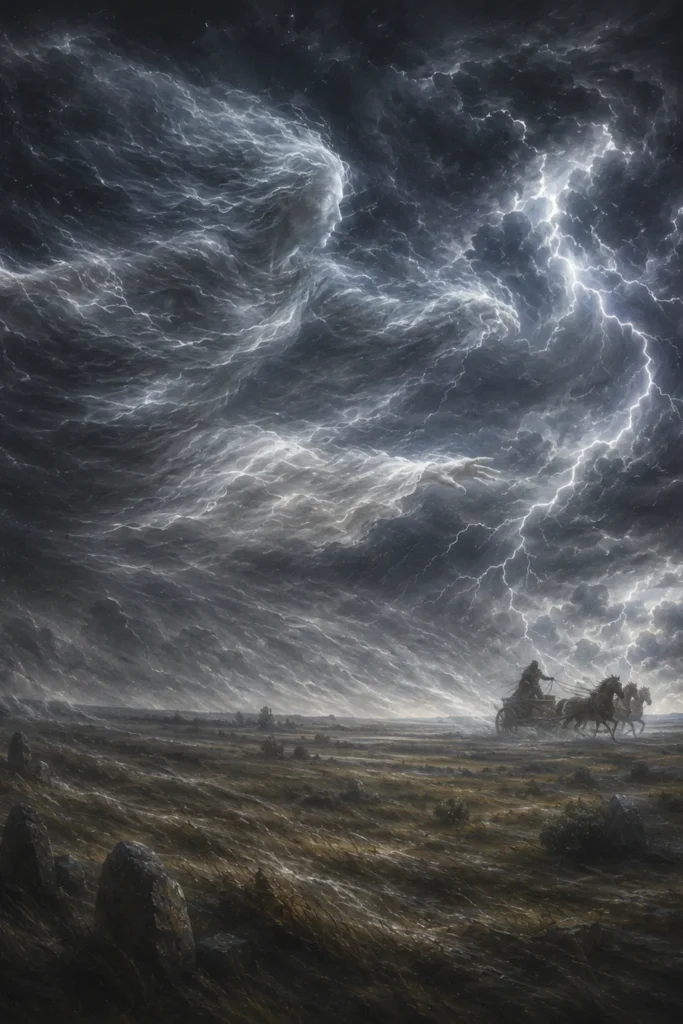
No traditional iconography exists. The only thing in circulation is the popular anecdote of a panting runner beside Perun’s chariot, without any source value.
Effect
Varpulis is allegedly a storm wind whose rumbling accompanies Perun’s thunderstorm; this claim stems solely from the popular website and its copies.
Profile: Varpulis
The key aspects of the disputed figure at a glance.
Modern popular mythology: an unsubstantiated encyclopedia invention that became a supposed deity through copying.
Internet encyclopedias, modern paganism and role-playing wikis: there, despite the dismal evidence, Varpulis is surprisingly present.
No traditional iconography; only the source-less anecdote of a panting runner beside Perun’s chariot.
Allegedly the rumbling of the storm wind accompanying Perun’s thunderstorm; none of this is substantiated.
Nothing is substantiated, because no genuine tradition exists; any statements about cult or protection would be invented.
Verifiable are Stribog from the Nestor Chronicle, as well as the Baltic Vėjopatis, lord of the wind, and Bangpūtys, the spirit of sea and storm.
An etymology from nowhere
The allegedly Baltic etymology of varpas, bell, as the roar of the storm is unsubstantiated and constructed after the fact; linguistically, varpas would be Baltic, not Slavic, which makes the classification as a Slavic god questionable in any case. There is no grounding in medieval sources, chronicles or serious folklore studies.
The only circulating source is a humorous, popular website that provides no evidence of its own. From there, the name migrated into encyclopedias, wikis and modern-pagan pages, a textbook example of how an unsubstantiated encyclopedia invention becomes a supposed deity through copying.
Assessment and reception
Despite the dismal evidence, Varpulis is surprisingly present in the internet and modern-pagan scene, in popular encyclopedias, role-playing wikis and even in music.
From a religious-studies perspective: Varpulis is, with high probability, an invention of popular mythology, not a substantiated Slavic deity; the English Wikipedia lists him among the pseudo-deities. The contradictory attributions, sometimes Czechia and Slovakia, sometimes Lithuania and Perun, are further evidence of construction. For verifiable wind content, Stribog is the reference.
Cult and protection: none found
Nothing is substantiated, because no genuine tradition exists. Any statements about cult or protection would be invented, and this page deliberately refrains from making them. Anyone seeking historically tangible protective customs against storms will find them among the verified wind figures of Slavic and Baltic folk belief.
The verified neighbours of the phantom
Anyone seeking a verifiable Slavic storm wind will find it in Stribog, genuinely attested in the Nestor Chronicle, or, with some reservation, in Pogwizd and Pochwist. Genuinely Baltic are Bangpūtys, the spirit of sea and storm, and Vėjopatis, lord of the wind. A counterpart in the same problematic field is Dogoda, the alleged mild west wind.
Frequently asked questions about Varpulis
Is Varpulis a genuine Slavic god?
According to current research, no. He is considered a pseudo-deity without a historical source.
Where does the name come from?
The allegedly Baltic derivation from varpas, bell, is unsubstantiated and constructed.
Which Slavic wind god is verified?
Stribog, attested in the Nestor Chronicle; genuinely Baltic are Bangpūtys and Vėjopatis.
Further links
Literature (selection)
Further standard works in the bibliography. Note: the works cited classify the pseudo-status and do not list Varpulis; no primary source for Varpulis exists.
As an alleged Slavic storm spirit, Varpulis is in truth a pseudo-deity of the wind: a modern invention whose career reveals more about copying on the internet than about the ancient beliefs of the Slavs.