Poludnica, the white woman of the midday hour
By Ralf Ittermann · last reviewed on
The Poludnica is a spirit of Slavic tradition.
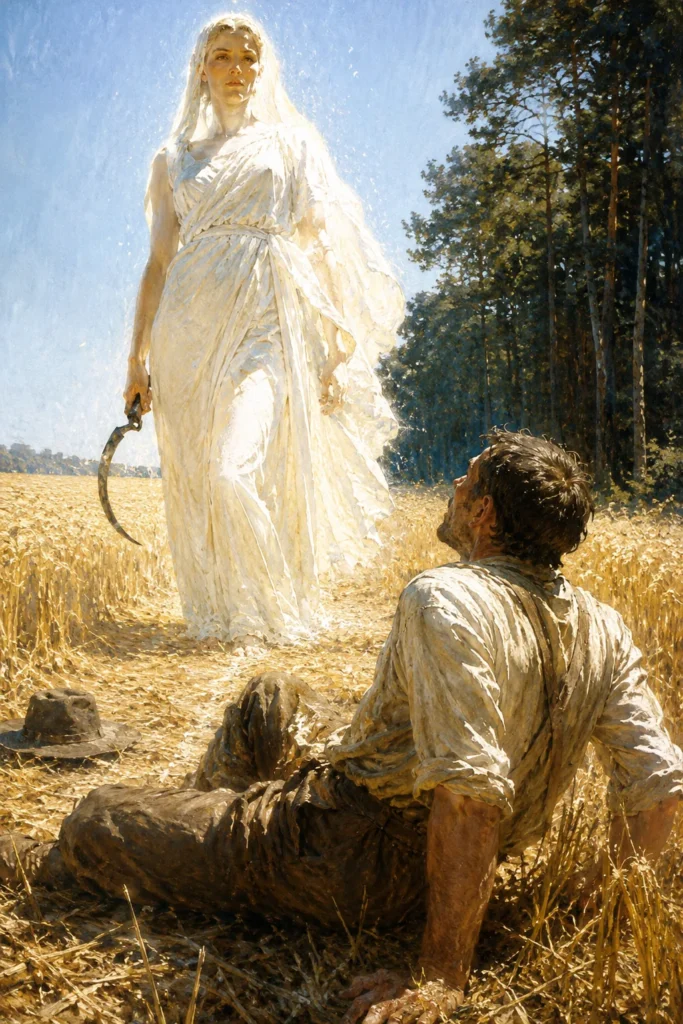
The white woman of the midday hour, with a sickle in the cornfield.
The Poludnica, the midday woman, is a female midday spirit of Slavic tradition who appears in the hot midday hour in fields and at the edges of forests. As a white woman with a sickle, she strikes field workers with heatstroke and madness and poses riddles to them.
Her name comes from the Proto-Slavic poludьne, midday, literally half day. In folk piety, the midday hour is considered a ghostly threshold time like midnight, a moment when order becomes permeable.
Type: Female midday spirit, personification of the midday hour
Origin: Slavic folk tradition, written down from the 19th century
Texts: folkloric collections, literary in Erben
Period: oral tradition through to literary fixation in the 19th century
Appearance: young or old woman in a white, floor-length gown, sometimes with a sickle
Source context
Period of the Texts
Slavic folk tradition was written down from the 19th century onwards; the figure is literarily fixed in Karel Jaromír Erben’s ballad Polednice.
Area of Diffusion
Pan-Slavic with regional name forms; the West Slavic tradition is particularly dense. In Belarus and Ukraine she appears as a guardian of field boundaries.
Sources
Well documented, densely attested in West Slavic sources: Máchal’s handbook of Slavic mythology and Erben’s Kytice are the key references.
Name and variants
Slavic: The name comes from the Proto-Slavic poludьne, midday, literally half day, with regional forms such as Południca in Polish and Polednice in Czech.
Appearance
Appearance
The Poludnica appears as a young or old woman in a white, floor-length gown, sometimes carrying a sickle, in the hot midday hour in fields and at field edges. The white gown stands at once for heat shimmer, ghost and purity; sickle and scythe point doubly to harvest and death, the reaper symbolism.
Effect
She strikes field workers with heatstroke, neck and head pain, sometimes with madness. She poses riddles or draws people into conversation; whoever cannot answer or loses concentration is struck or beheaded. In some versions she asks girls to dance until evening.
Profile: Poludnica
The key aspects of the Midday Woman at a glance.
Personification spirit of the midday hour within the Slavic nature-spirit complex, in which day and field boundaries are guarded by spirit beings.
Field workers in the midday heat and children: as a bogeyman figure she was used for folk-pedagogical purposes.
Young or old woman in a white, floor-length gown, sometimes carrying a sickle, in the glaring light of the midday hour in the field.
Heatstroke, headache and madness for workers at midday; riddles and conversations whose failure ends in a blow or beheading.
Observe the midday rest between roughly twelve and two in the afternoon; whoever encounters her must solve the riddles or keep the conversation going until the hour ends.
The Christian monastic noonday demon from Psalm 91 and the Polevik as a directly related field spirit.
The personification of the midday hour
The name Poludnica comes from Proto-Slavic poludьne, meaning midday, literally half-day, with regional forms such as Południca in Polish and Polednice in Czech. The Poludnica is a personification spirit of the midday hour and belongs to the Slavic nature-spirit complex, in which day and field boundaries are guarded by spirit beings.
In Belarus and Ukraine she appears as a guardian of field boundaries, placing her close to the Polevik; the difference lies in her binding to the midday hour, whereas the Polevik is bound to the field. No plot of land belongs to her, but an hour does.
From Erben to Dvořák: reception and classification
Karel Jaromír Erben’s ballad Polednice from Kytice of 1853 was set to music by Antonín Dvořák in 1896 as the symphonic poem The Noon Witch. In the ballad a mother threatens her child with the noon witch, the witch actually appears, and the mother accidentally crushes the child while trying to protect it.
In religious studies, the Poludnica is a classic threshold and boundary demon between field and forest, morning and afternoon, order and chaos. She is at once a midday demon, an agrarian guardian of the work-rest, and a bogeyman figure. In tradition she is a demon and field spirit; some interpretations see behind her a diminished agrarian protective deity.
Midday rest as protection
The most effective and well-documented form of protection is to observe the midday rest and not work in the field between roughly twelve and two in the afternoon, leaving the hot hour to the Poludnica. Whoever encounters her nonetheless must pass the riddles by answering correctly or keep the conversation going until the midday hour has passed. The figure was also used for folk-pedagogical purposes as a bogeyman: the threat of the Midday Woman kept children away from the hot field.
Midday demons and field spirits compared
The Poludnica corresponds to the Christian monastic noonday demon from Psalm 91, the daemonium meridianum, which personifies the midday sluggishness of monks; Jewish tradition knows its own figure of the noonday demon in Ketev Meriri. She is directly related to the Polevik, the male, place-bound field spirit. As a bogeyman woman she is close to the German Roggenmuhme, and through the female fright-type she touches upon the Dziwożona, the wild woman of swamp and thicket.
Frequently asked questions about the Poludnica
Why midday specifically?
The hot midday hour was the most dangerous working time because of heatstroke and was considered a ghostly threshold time, like midnight.
Is she a spirit or a goddess?
In tradition a demon and field spirit; some interpretations see behind her a diminished agrarian protective deity.
How does one survive the encounter?
By observing the midday rest or passing her riddles until the midday hour has passed.
Further links
Further reading:
- Slavic – all beings of Slavic tradition
- Polevik – the place-bound field spirit at her side
- Rusalka, Dziwożona – related female figures
- Circle of protection, Mugwort, Amulet – traditional protective means
- Protection Compass – protective means at a glance
Literature (selection)
Further standard works in the bibliography.
As the Midday Woman, the Poludnica is a Slavic field spirit of a particular kind: no plot of land belongs to her, but an hour does, and within that single glaring hour it is decided whether the encounter ends with a riddle or with the strike of the sickle.