Vellamo, mistress of the shore cows and of fishing
By Ralf Ittermann · last reviewed on
Vellamo is goddess of the Finnish (Kalevala) tradition.
She combs her hair on the rock and grants fishermen a rich catch.
Vellamo is the Finnish mistress of the water, of lakes and seas, and the consort of Ahti. Together the pair rule over the underwater castle Ahtola on the seabed.
As bringer of the catch, she sent fishermen her cattle, the fish, into their nets; whoever caught sight of her while fishing was assured a rich catch. As early as 1551, the reformer Mikael Agricola names the mother of the water, long before the name Vellamo itself became established.
Type: Goddess, Mistress of the Waters
Origin: Rune songs, first attested in 1551 as Mother of the Water by Agricola, literary in the Kalevala in 1835 and 1849
Texts: numerous fishing charms, only a few mentions in the Kalevala
Period: Rune songs to the present day
Appearance: Mistress of the Waters in a shift of reeds, combing her hair on a rock

Source context
Period of the Texts
From the rune songs to the Kalevala: as early as 1551, Mikael Agricola names the Mother of the Water, while the name Vellamo itself only became established later; in 1835, and in the expanded 1849 edition, Elias Lönnrot included the figure in the Kalevala.
Area of Diffusion
Finland and Karelia. Her seat is the underwater castle Ahtola on the sea floor, which she inhabits together with Ahti.
Sources
Numerous fishing charms attest widely to her cult, while the Kalevala itself mentions her only a few times.
Name and variants
Finnish: Vellamo embodies female rulership of the water, the mistress or mother of the water. As early as 1551 Agricola names the Mother of the Water, while the name Vellamo itself only became established later; the etymology probably traces back to a verb for the surging and welling of water.
Appearance and symbolism
Appearance
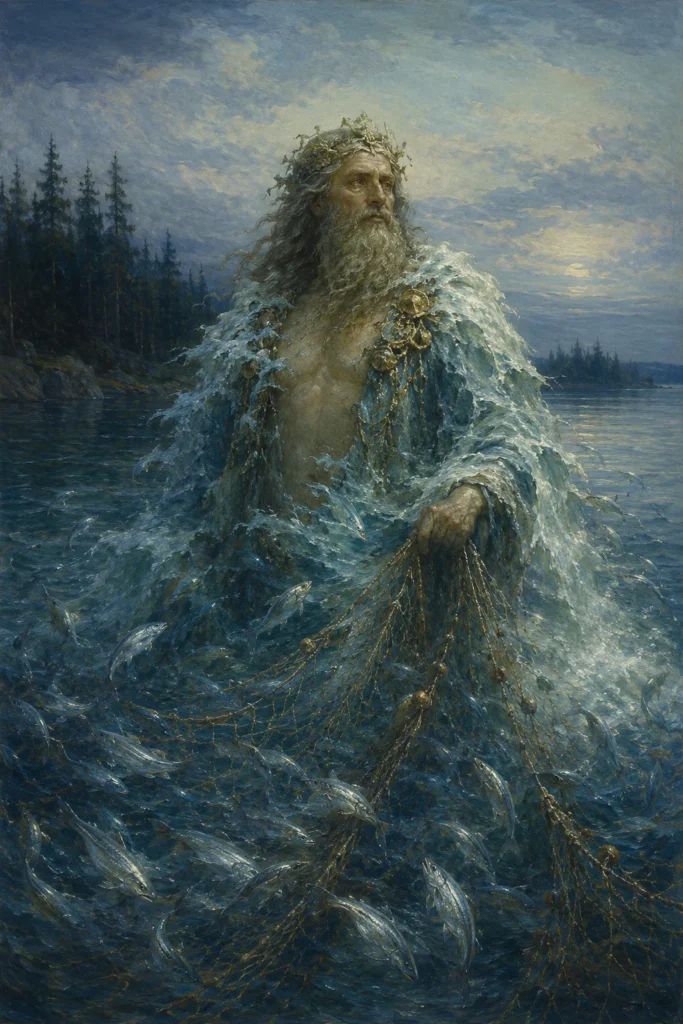
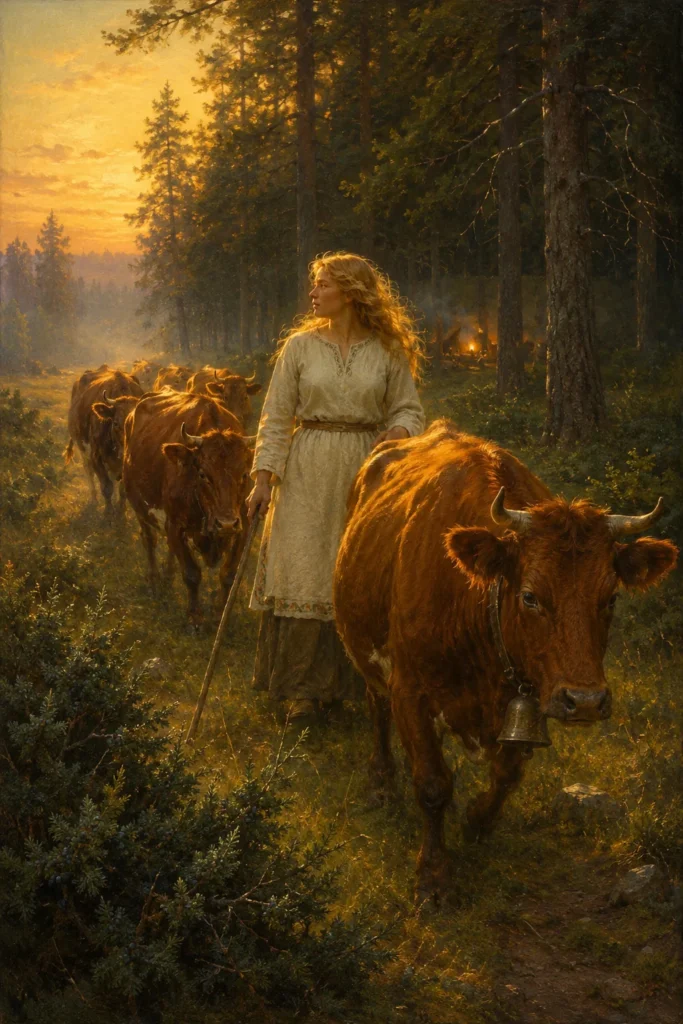
Vellamo is depicted as a beautiful mistress of the waters in a garment of reeds or sea foam, sitting on a rock and combing her hair. Her symbolic animal is the cow: she owns shore cows, which also symbolise the fish, the wealth of the water, that she can grant to people.
Effect
Vellamo is a bringer of catches and a benefactress. She sends fish into the nets, gives cattle to the poor and guarantees a rich catch when she is sighted. In the rune songs she comes ashore and listens to Väinämöinen playing the kantele; towards humans she is consistently benevolent.
Profile: Vellamo
The key aspects of the mistress of the waters at a glance.
Mistress of the waters of the Finnish rune songs and the Kalevala, attested since 1551 by Agricola as the Mother of the Water.
Lakes, seas and the abundance of fish: she sends fish into the nets and gives cattle to the poor.
Beautiful mistress of the waters in a garment of reeds, combing her hair on a rock, accompanied by her symbolic shore cows.
Fishing luck and prosperity: whoever sees her while fishing is assured a rich catch.
Fishing charms and invocations by fishermen, as well as walking around a shore cow with iron in order to win it.
The Mother of the Water and her husband Ahti
Vellamo embodies female rulership of the water, the mistress or mother of the water. As early as 1551 the reformer Mikael Agricola names the Mother of the Water, while the name Vellamo itself only became established later; the etymology probably traces back to a verb for the surging and welling of water.
Vellamo is the wife of Ahti; together the pair rule over the underwater castle Ahtola, and in the fishing charms both are asked to drive their cattle, the fish, into the nets. The tradition is inconsistent on one point, for in some rune songs a watery maiden also appears as Ahti’s only child, which is why some interpretations regard her as a daughter rather than a wife. Elias Lönnrot used this fish-maiden narrative as one source for the Kalevala figure Aino.
From fishing charm to maritime centre
Vellamo is the namesake of the Vellamo Maritime Centre in Kotka. As a female given name and in cultural projects she is present, and as mistress of the waters she is a firm part of the Kalevala reception.
In religious studies, Vellamo is the female mistress of the water domain within the Finnish haltija system, the counterpart to Ahti as a lord spirit. Her type, the Mother of the Water, attests to a shared Finno-Ugric conception of a female ruler of the water element, paralleled by the Estonian Vete-ema and the Mordvin Ved-ava.
Fishing charms and invocation
The traditional way of dealing with Vellamo is the fishing charm and invocation. Fishermen invoked her with the handed-down formulas, and the rite of walking around a shore cow with an iron object was regarded as a means of winning her cattle. Sighting her while seine-net fishing was a good omen. Protection lay in a proper, reverent relationship with the mistress of the waters; a worn amulet for travelling on the water and salt as an old cleansing agent served as supplementary means.
The water-ruling pair and their opposing powers
Vellamo and Ahti form the Finnish water-ruling pair. Their Finno-Ugric counterparts are the Estonian Vete-ema and the Mordvin Ved-ava, both water mothers. According to a Karelian rune song, the water spirit Näkki, related to the Scandinavian Näcken, is her child, yet unlike this lurking cautionary figure, Vellamo herself remains consistently benevolent. She likewise stands clearly apart from the malicious Vesihiisi and the chaotic Iku-Turso, both regarded as hostile opposing powers to the ruling pair. Among the female water figures of Europe, she also stands alongside the Slavic Rusalka and the Germanic Nix.
Frequently asked questions about Vellamo
Is Vellamo Ahti’s wife or daughter?
She is predominantly regarded as Ahti’s wife. Some rune songs, via the fish-maiden, also suggest a daughter interpretation; the tradition is inconsistent on this point.
Why are cows associated with Vellamo?
Her shore cows are an image for the abundance of fish that she can grant to people. According to legend, whoever walked around such a cow with iron could win it.
Does Vellamo appear prominently in the Kalevala?
No, she is mentioned only a few times and carries no major plot role. In the fishermen’s fishing charms, however, she is central.
Further links
Further reading:
- Ahti – her husband, joint rulership over Ahtola
- Näkki – the water spirit who is her child according to one rune song
- Näcken – the Scandinavian relative of Näkki
- Iku-Turso, Vesihiisi – the hostile opposing powers of the water
- Ved-ava – the Mordvin water mother
- Iron and Cold Iron, Amulet, Salt as Protection – traditional protective means
Literature (selection)
Further standard works in the bibliography.
Vellamo, goddess of the water: this is how her nature can be briefly summarised, the mistress of lakes and seas, who sends fish into the fishermen’s nets and gives cattle to the poor. As a Finnish water goddess, unlike her dangerous son Näkki, she consistently stands for benevolence and a rich catch.