Vesihiisi, the formless Hiisi of the water depths
By Ralf Ittermann · last reviewed on
Vesihiisi is a demon of the Finnish (Kalevala) tradition.
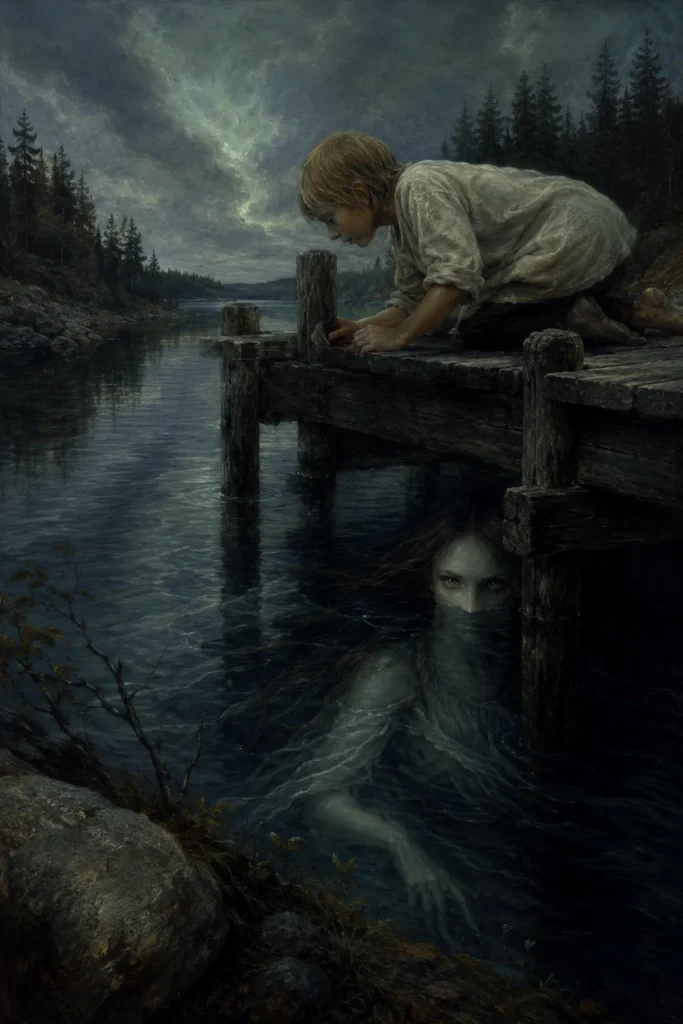
He grabs swimmers from below and lures children into murky water. The account describes a formless Hiisi dwelling in the water depths, seizing swimmers from below.
The Vesihiisi is the water variant of the Hiisi, a malevolent spirit of Finnish tradition. As a demon of the deep, it lurks in deep waters, grabs swimmers from below and lures children into muddy water; it embodies the hostile, deadly side of the water.
The Hiisi was originally a spirit of the hill forests and sacred groves. Only the later Christian-influenced tradition increasingly interpreted it as demonic and devilish, and in the incantations forest, water, mountain and earth Hiisi were distinguished as separate figures. The tradition concerning the shape itself is thin: the Vesihiisi remains more a principle of the hostile depths than a fixed figure.
Type: Malevolent water demon of the deep, water variant of the Hiisi
Origin: Finnish folk tradition, classified within the Hiisi system of nature spirits
Texts: Incantations (loitsut) and legends, solidly attested as part of the Hiisi system
Period: Traditionally handed down, still alive today in a tongue-twister
Appearance: More a principle than a fixed figure, a dark power of the watery deep
Area of origin and sources
Period of the Texts
The Vesihiisi belongs to the oral Finnish folk tradition and to the incantations, the loitsut, in which the system of Hiisi spirits is attested. The independent evidence is thin, but the name lives on today in a well-known tongue-twister.
Area of Diffusion
The Vesihiisi is found throughout Finland, without the tradition particularly highlighting individual regions; it belongs to the nationwide system of Hiisi spirits.
Sources
The Vesihiisi is solidly attested as part of the Hiisi system, while the independent material on its shape remains thin; the evidence rests on standard works such as Harva, Haavio and Siikala.
Name and variants
Finnish: vesi means water, hiisi a mostly malevolent spirit: Vesihiisi is literally the water-Hiisi, the water variant of this spirit alongside the forest, mountain and earth Hiisi in the system of incantations.
Appearance and effect
Appearance
The tradition concerning the shape of the Vesihiisi is thin and inconsistent; it is more readily grasped as a principle, as an evil water spirit of the deep, than through any fixed appearance. Symbolically it stands for the deadly, hostile depth of the water, for water as a place of danger and ruin. This very vagueness is part of what makes it threatening, for the demon remains elusive.
Effect
The Vesihiisi lurks in deep waters, can grab swimmers from below and, like the Näkki, likes to lure children into muddy water. In this it shares the warning function against drowning and personifies the concrete danger of the deep. Its effect is that of a hostile power reaching out of the murky water.
Profile: Vesihiisi
The most important aspects of the water demon at a glance.
Water variant of the Hiisi in the Finnish incantation system, alongside the forest, mountain and earth Hiisi.
Swimmers and children at deep, murky waters, whom it grabs from below or lures into the water.
Handed down without a fixed appearance, thought of more as a dark principle of the watery deep than as a set figure.
Hostile power of the watery deep, a warning figure against drowning in lakes and still waters.
Banishing and incantation spells of the Hiisi system, as also work against the Näkki, as well as avoiding the depths.
From the sacred grove to the demon of the deep
Vesihiisi literally means water-Hiisi and denotes the water variant of the Hiisi, a mostly malevolent spirit of Finnish tradition. Originally the Hiisi was a spirit of the hill forests and sacred groves; only the later Christian-influenced tradition increasingly interpreted it as demonic and devilish. In the incantations of Finnish tradition several Hiisi are distinguished: the forest Hiisi, the water Hiisi, the mountain Hiisi and the earth Hiisi. The Vesihiisi is the water-Hiisi of this system.
Its relationship to the Näkki is close, for Näkki is in some sources itself called Vesihiisi or Vetehinen. The Vesihiisi, however, more strongly emphasises the demonic, evil side and its fixed place within the Hiisi system, while the Näkki is regarded as a more independent figure of bridges and footbridges.
From legendary being to tongue-twister
In Finland today the Vesihiisi is present above all through a well-known tongue-twister, in which the water-Hiisi hisses while parading; the rhyme serves purely as a pronunciation exercise for the S sound. As a result, the word is more familiar in everyday life than the actual legendary figure, whose demonic meaning fades into the background.
From a religious-studies perspective, the Vesihiisi is a textbook case of the Christian reinterpretation of pre-Christian spirit beliefs: the spirit of a sacred grove, the Hiisi, became a demon. The division into forest, water, mountain and earth Hiisi shows the animistic structure of Finnish nature religion, in which each realm of nature has its own spirit assigned to it.
Protection through banishing spell and avoidance
Since the Vesihiisi is located within the Hiisi system of the incantations, the loitsut, invocation and banishing spells belong to the traditional repertoire of protection. The water spells handed down for the Näkki are considered to work here as well. Independent Vesihiisi formulas are only thinly attested in the accessible literature, so protection rests on the general Hiisi incantation material and on avoiding deep waters. Cold iron was regarded in Nordic tradition as a defence against beings of the hostile deep, a drawn protective circle by the water corresponded to defence through incantation, and salt served as an old purifying and protective means when dealing with the powers of the water.
Näkki, Ahti and Vellamo: closeness and distinction
The Vesihiisi overlaps closely with the Näkki and the Vetehinen, terms some sources use synonymously, yet the Vesihiisi more strongly emphasises the demonic, evil side and its classification within the Hiisi system. Within Finland it is clearly distinguished from the benevolent water deities Ahti and Vellamo, who as a ruling pair benevolently govern the water, whereas the Vesihiisi embodies its hostile depths. As an evil water demon of the deep it stands close to the Russian water spirit Vodyanoy, as a seductive, deadly being to the Slavic Rusalka and the Germanic Nix, and as a demonic nature spirit it touches upon the circle around the forest spirit Leshy.
Frequently asked questions about the Vesihiisi
Is Vesihiisi the same as Näkki?
Not quite. The two overlap, since Näkki is sometimes called Vesihiisi, but the Vesihiisi emphasises its classification within the demonic Hiisi system and the evil depths.
Where does the famous tongue-twister come from?
It uses the being’s name as a pronunciation exercise for the S sound, with the demonic meaning fading into the background. In everyday life the word is thus better known than the legendary figure itself.
How does one protect oneself against it?
Through banishing and incantation spells of the Hiisi system, which also work functionally against the Näkki, as well as by avoiding deep waters.
Further links
Further reading:
- Näkki – the closely related Finnish water spirit of bridges and footbridges
- Ahti, Vellamo – the benevolent water deities from whom the Vesihiisi is distinguished
- Iron, Protective circle, Salt – traditional protective means
- Protection Compass – protective means at a glance
Literature (selection)
Further standard works in the bibliography.
To describe him merely as the Vesihiisi water demon of Finnish legend captures only half the truth: he remains above all a Finnish Hiisi of the water depths, whose warning is more serious than the tongue twister that today makes his name better known than the legendary figure itself.