Ahti, the golden lord of the Finnish waters
By Ralf Ittermann · last reviewed on
Ahti is a god of Finnish (Kalevala) tradition.
Golden lord of the water, giver of catch and rescue. The profile honors him as golden lord of the Finnish waters, granter of catch and safe passage.
Ahti is the Finnish god of water, of lakes, rivers and the sea, and lord of the fish. Together with his consort Vellamo, he rules over the underwater world in the castle of Ahtola at the bottom of the sea; fishermen invoked him for a good catch.
As early as 1551, Mikael Agricola mentions him in his list of gods; a literary form followed in the Kalevala of 1835 and 1849. The runic-song tradition is chiefly attested in the Kainuu region, where a recorded invocation formula asks Ahti for perch.
Type: God of water and lord of fish
Origin: Finnish runic-song tradition, first mentioned by Agricola in 1551
Texts: Runic songs, given literary form in the Kalevala of 1835 and 1849
Period: 16th century to the present
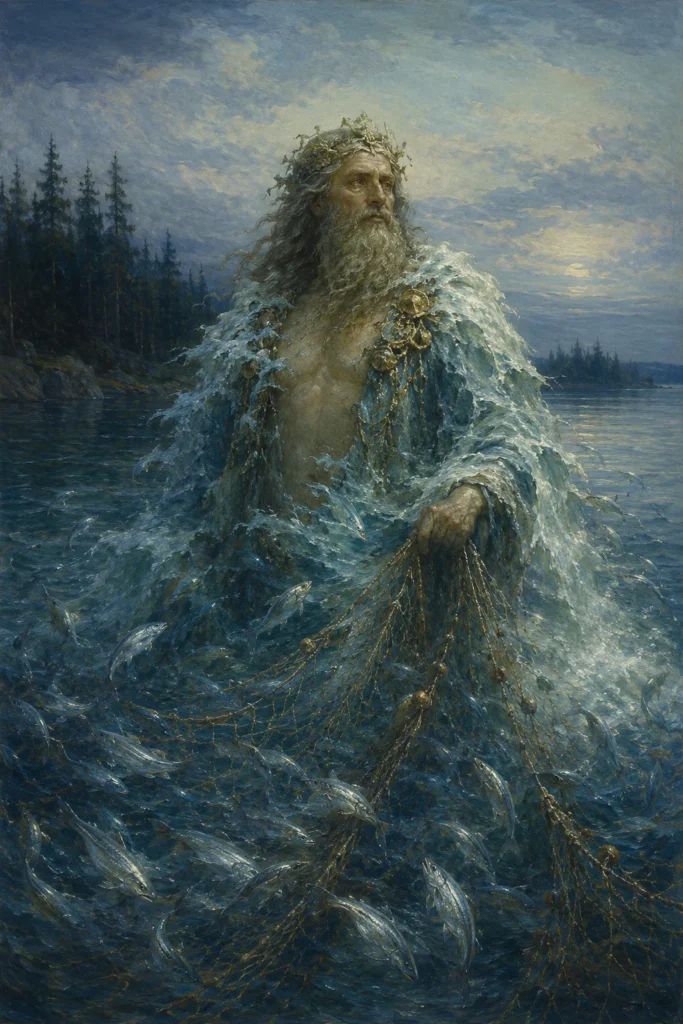
Appearance: golden king of the sea in a cloak of foam
Source context
Period of the Texts
Attested since 1551, when Mikael Agricola first mentions him; given literary form in the Kalevala of 1835 and 1849 and part of Finnish national mythology to this day.
Area of Diffusion
Finland and Karelia, with the tradition concentrated in the region of Kainuu.
Sources
The runic-song tradition is well attested in Kainuu, but sparse outside the region.
Name and variants
Finnish: The etymology of Ahti is disputed; suggestions include a derivation from the verb for hanging up fishing nets and a connection to a word for the seal. In the Kalevala the god bears the name Ahto, to avoid confusion with the hero figure Ahti Saarelainen, that is, Lemminkäinen.
Form and effect
Appearance
Ahti is imagined as ruler of the sea in a cloak of foam, as the golden king of the sea. In healing charms he appears in fanned-out form as Ahti of the sea, of the water, of the forest, of the land and of the wind; the sacred power of the water Ahti had to be ritually bought with gold and silver.
Effect
Ahti brings fish into the nets and secures good fortune in fishing; as ruler of the water he also commands the seals. In one Kalevala tale, Ahto dives out of pity to recover a shepherd’s lost knife and rewards his honesty with three knives. Towards humans he is benevolent, a giver and helper, invoked by shipwrecked fishermen for rescue.
Profile: Ahti
The key aspects of the water god at a glance.
Lordly spirit of the water in Finnish runic-song tradition, first mentioned by Mikael Agricola in 1551 and given literary form in the Kalevala.
Lakes, rivers and the sea, together with the fish and seals within them; invoked by fishermen and seal hunters for good fortune in the catch.
Golden king of the sea in a cloak of foam, in healing charms fanned out as Ahti of the sea, of the water, of the forest, of the land and of the wind.
Giver of the fish catch and rescuer of shipwrecked fishermen, benevolent towards humans who invoke him reverently.
Invocation with runic-song formulas for good fortune in fishing, later overlaid by invocation of Saint Andrew and Saint Peter; holy water was bought with gold and silver.
From Agricola to the Kalevala god Ahto
Ahti, in the Kalevala in the form Ahto, is the lord spirit of water in Finnish nature religion. As early as 1551, Mikael Agricola names him in his list of gods with the line that Ahti brought fish out of the water, the earliest written record of the figure. Later, Daniel Juslenius equated him with the Roman Neptune, and Christfried Ganander described him in 1789 in his Mythologia Fennica as a sea-haltija.
Ahti and Vellamo live together at the bottom of the sea in the underwater castle Ahtola and form the ruling pair of the water. The recorded invocation formula from Kainuu asks Ahti for perch; in the later Christianised version, Saints Andrew and Peter take his place. In the Kalevala the god bears the name Ahto, in order to distinguish him from the separate heroic figure Ahti Saarelainen, that is, Lemminkäinen.
National mythology and first name
Through the Kalevala, Ahti is a fixed part of Finnish national mythology. The name is a common male first name in Finland, for instance that of the politician Ahti Karjalainen, and the underwater world Ahtola lives on in literature and culture.
Ahti belongs to the Finnish system of the haltijat, the guardian and lord spirits of the realms of nature. He is the lord spirit of water, the counterpart to Tapio as lord of the forest and to Vellamo as lady of the water. Whether he was originally conceived as a personal god or merely as a collective term for the haltija of the water remains open in scholarship.
Invocation instead of warding off
The traditional way of dealing with Ahti is invocation and catch-magic, not warding off or banishing. Fishermen invoked him with the traditional rune-song formulas for good fishing luck; an amulet was regarded as a worn protective sign for a journey on the water, in the sense of invoking a catch and a safe return. Holy water was ritually bought with gold and silver, and salt served as an old purifying and protective means in dealing with the powers of the water. Shipwrecked people asked Ahti for rescue, while bells were regarded as a warning and protective sound on the water. Protection thus lay in the right, reverent relationship with the lord of the water.
Poseidon, Nix and the Finno-Ugric water mothers
Early scholars equated Ahti with Poseidon, and as lord of the water he stands alongside the Germanic Nix. The Estonian Vete-ema and the Mordvin Ved-ava are Finno-Ugric water mothers of the same circle of ideas.
Frequently asked questions about Ahti
Why is Ahti called Ahto in the Kalevala?
To avoid confusion with the separate Kalevala figure Ahti Saarelainen, that is, Lemminkäinen, the water god bears the alternative form Ahto there.
Was Ahti worshipped?
Yes, fishermen and seal hunters invoked him for good fishing luck. The older rune-song ritual was later overlaid by the invocation of Saints Andrew and Peter.
Where does Ahti live?
At the bottom of the sea, in the underwater castle Ahtola, together with his consort Vellamo, the lady of the water.
Further links
Literature (selection)
Further standard works in the bibliography.
Whether called Ahti god of the water or simply known as the Finnish water god: it always refers to the same benevolent lord of the fish, who, from the rune songs to the Kalevala, has granted fishermen and seal hunters a catch and rescue.