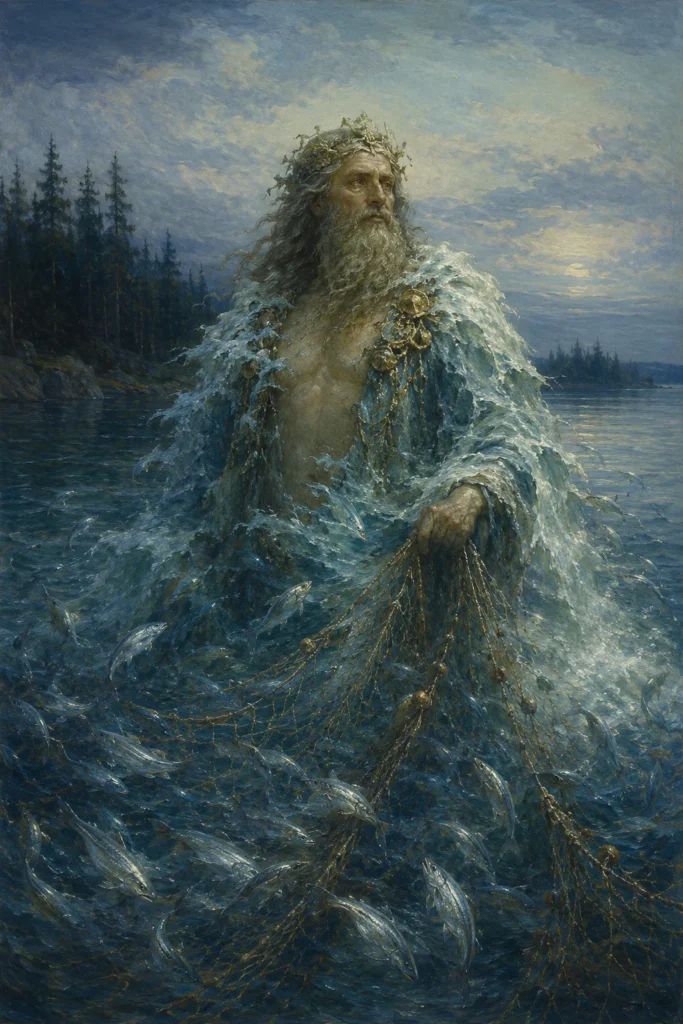
Nyyrikki, the wayfinder with the red hat
By Ralf Ittermann · last reviewed on
Nyyrikki is a god of Finnish tradition.
Tapio’s son, who carves trail marks and lays bridges.
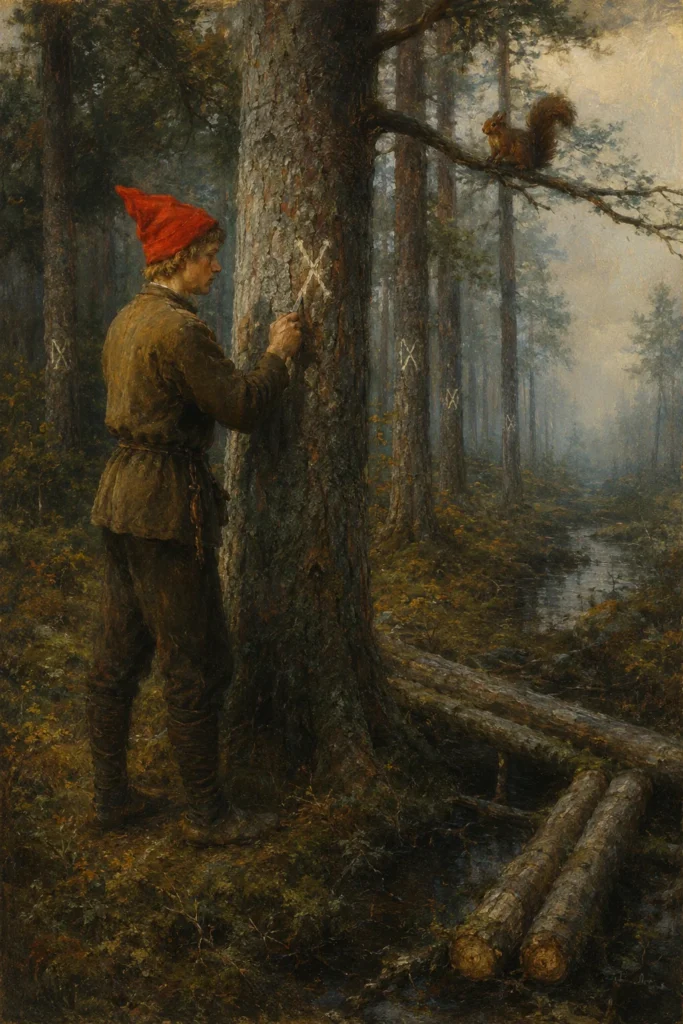
Nyyrikki is the son of Tapio and the forest mistress Mielikki. In the Kalevala, Nyyrikki is both a god of the hunt and a wayfinder: he carves marks into trees and erects cairns on the heights so that the hunter can find his way in the unfamiliar forest, and he lays bridges over the marsh for the cattle.
He is first attested in 1551 by Mikael Agricola as Nyrckes, who ‘gave the squirrels from the forest’. The rune songs know the hunter’s helper under varying names; it was Elias Lönnrot who first condensed the scattered tradition into a fixed figure.
Type: god of the hunt, helper of hunters and herders
Origin: Karelia and Ostrobothnia, first attested 1551 by Agricola
Texts: Agricola (as Nyrckes), rune songs (SKVR), Kalevala 1835/1849
Period: documented from the 16th to the 19th century
Appearance: ‘a pure man with a red hat’, in the cattle blessings ‘the blue-cloaked son of the thicket’
Historical Classification
Period of the Texts
First attested in 1551 in Agricola’s preface to the Psalter, followed by rune songs of the 18th and 19th centuries and the Kalevala of 1835/1849.
Area of Diffusion
Karelia with the name forms Nyypetti, Vilpus and Virpus, as well as Ostrobothnia with Pinneus or Pinneys; the name forms vary widely.
Sources
Means: Agricola’s list of gods, scattered hunting and cattle-blessing songs from the SKVR collection, and Kalevala cantos 14, 32 and 46.
Name and variants
Finnish: Nyyrikki. The etymology is disputed: the ending -kki is actually feminine, and phonetically similar forms such as Myyrikki or Tyytikki denote a daughter of Tapio. Kaarle Krohn considered a derivation from Jyrki (St George), Uno Harva a forgotten word for the squirrel, Martti Haavio the name of the flayed apostle Bartholomew (from nylkeä, ‘to skin’); Vilpus, according to Anna-Leena Siikala, derives from the apostle Philip.
Nature and effect
Appearance
The Kalevala gives Nyyrikki a memorable image: ‘Nyyrikki, Tapio’s son, a pure man with a red hat’ (mies puhas, punakypärä) it says in the 14th and 46th cantos; the cattle blessing of the 32nd canto calls him the ‘blue-cloaked son of the thicket’ (siniviitta viian poika). The red hat links him to the world of the Haltija beings, for whom pointed caps serve as a mark of identity; the attribute ‘pure’ marks him out as a fitting mediator between humans and the forest.
Effect
His tools are the notch and the trail mark: he carves signs into the trunks and builds stone cairns on the hills. Nyyrikki guides the hunter, but he does not drive the game himself; that is the task of his sister Tuulikki. His effect is practical and quiet: where he helps, the hunter finds the path and the catch, and the cattle find the ford.
Profile: Nyyrikki
The key aspects of the hunter’s helper at a glance.
Son of the forest household in the Finnish-Karelian hunting-song tradition, attested as the giver of squirrels since Agricola in 1551.
Hunters of squirrels, hares, birds and reindeer, as well as herders whose cattle should reach the pasture and return home with dry hooves.
A pure man with a red hat, blue-cloaked in the cattle blessings; he becomes tangible through his tools, the notch in the trunk and the mark on the height.
He makes the forest passable: trail marks along the lands, cairns on the heights, long spruces as bridges over the muddy places.
Invocation before setting out and first-fruit offerings at the sacrificial spruce; regionally, a pine called ‘Nyryn näre’ served as the altar tree.
Nyrckes, Vilpus, Pinneus: a god of many names
Mikael Agricola, in the preface to his Finnish Psalter of 1551, lists among the gods of the Häme region a Nyrckes, who granted the squirrels from the forest. The rune songs of Karelia and Ostrobothnia know a ‘son of Tapio’ under varying names: Nyypetti in North Karelian reindeer-hunting songs, Vilpus and Virpus in Ladoga Karelia, Pinneus or Pinneys in Ostrobothnian bird-hunting songs; a White Karelian charm calls on ‘Nyyrikki, lord of the hares’. Elias Lönnrot condensed this scattered tradition in the Kalevala into the fixed figure of the hunter’s helper.
In the 14th canto, Lemminkäinen prays while hunting elk: ‘Carve marks along the lands, set up cairns on the heights, so that I, unknowing, may find my way when I search for my prey.’ In the cattle blessing of the 32nd canto, Nyyrikki is asked to lay long spruces trunk-end first across wet ground, so that the cattle may reach the pasture and return home with dry hooves; at the bear feast of the 46th canto he sits at the table when Väinämöinen invites Tapio’s folk to celebrate the slain bear.
Afterlife and research questions
Through Agricola’s list of gods and the Kalevala, Nyyrikki became a fixed part of the Finnish educational canon; the commentaries of the Kalevala translations, such as that by Hans Fromm in 1967, anchored him in German-speaking regions as well. In today’s nature-religious scene of Finland he is regarded as the hunters’ point of contact, and his name appears in the names of hunting associations and products; compared with Tapio and Mielikki, his reception has remained narrower, which corresponds to the thinner source material.
From a religious-studies perspective, Nyyrikki is a good example of how formulaic invocations gave rise to individual figures: the rune songs needed a ‘son of Tapio’ with an alliterating name, and depending on the region, Nyypetti, Vilpus or Pinneus filled that position. The feminine name ending and the overlap with daughter names such as Myyrikki show that the family roles were ordered retrospectively, finally fixed by Lönnrot. The older association with the biblical hunter Nimrod is considered unfounded.
Invocation before setting out
Nyyrikki was honoured, not warded off. The invocation before setting out, as literally handed down in the hunting songs, was the most important form; it belonged to the same sequence as the requests to Tapio and Mielikki. First-catch offerings went to the sacrificial spruce (Tapionpöytä), at which the whole forest family was remembered; regionally a pine also served as the altar tree, called ‘Nyryn näre’, whose name is associated with him. Anyone who lost their way in the forest interpreted this as favour withheld and sought to regain it through greeting and gifts.
Hunting helpers in cultural comparison
As a divine hunting helper, Nyyrikki is close to the Roman Diana and the Greek Artemis, who allot prey to hunters; the Celtic Cernunnos represents the type of the lord of animals, to whom the game is subject. The Slavic Leshy forms the counterpart with the reverse sign: he confuses paths, while Nyyrikki marks them. In Christian folk piety, Saint Hubert took on the role of the patron of hunters; research also suspects such saints’ names behind several name forms of the Finnish forest family.
Frequently asked questions about Nyyrikki
What was Nyyrikki responsible for?
He helped with finding, not with driving: he notched trail markers into trees, set marks on ridgelines and laid spruce trunks as bridges over bog. Hunters invoked him to find path and hunting ground in unfamiliar terrain, herders for the safe cattle path; driving the game towards the hunter was the task of his sister Tuulikki.
Why does a god bear the feminine name ending -kki?
The ending -kki is feminine in Finnish, and almost identical names such as Myyrikki denote a daughter of Tapio. Research explains this through the formulaic character of the rune songs: the name had to fit the metre and the alliteration, the gender assignment followed the respective song; Lönnrot finally fixed the role of the son in the Kalevala.
Is the epithet Pinneus an ancient figure?
No. Pinneus, also Pinneys, is an Ostrobothnian name form of the ‘son of Tapio’ from bird-hunting songs, not a Greek or Latin name. The occasional association with the biblical Nimrod is considered unfounded in research.
Further links
Further reading:
Literature (selection)
Further standard works in the bibliography.
As the son of Tapio and Finnish god of the hunt, Nyyrikki stands for the passability of the forest, for the difference between getting lost and arriving: a quiet help that one notices only once it fails to appear.