iWell Guard

Tellervo, herder between forest household and pasture

Tellervo is goddess of Finnish tradition.

Tapio’s daughter, who tends and guides home the grazing livestock.

GoddessFinland

Table of Contents

Tellervo, goddess of Finnish tradition
Tellervo

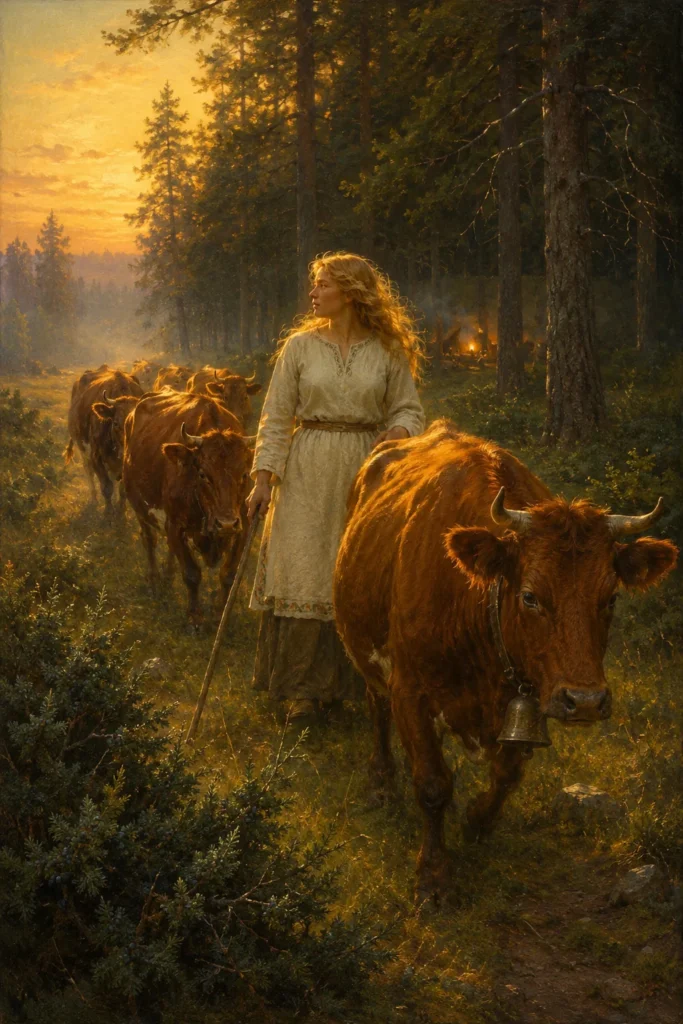
Tellervo is the forest daughter of Finnish mythology, ‘Tapion neiti’, the maiden of Tapio, and in the cattle blessings the guardian of the livestock driven to forest pasture. She tends the herd, grooms it and brings it home heavy with milk in the evening.

For herders, Tellervo was the goddess of safe forest pasture: the cattle graze in Tapio’s realm, and a being of this realm vouches that they return unharmed. Her tradition is closely limited regionally, but firmly anchored in the Kalevala.

At a glance: Tellervo

Type: Forest daughter and guardian of grazing livestock
Origin: Kainuu, North Karelia, the Karelian Isthmus and White Karelia
Texts: Rune songs (SKVR), Kalevala 1835/1849, Kanteletar 1840
Period: documented in the 18th/19th century
Appearance: young woman of the forest in a mist-thin shift, with yellow hair

Source context

Period of the Texts

Rune songs of the 18th and 19th centuries, plus Ganander’s Hillervo entry of 1786, the Kalevala of 1835/1849 and a song from the Kanteletar of 1840.

Area of Diffusion

Only Kainuu, North Karelia, the Karelian Isthmus and White Karelia; her tradition is narrow and regionally limited.

Sources

Narrow: regional rune songs of the SKVR collection, Kalevala songs 14, 32 and 46, as well as the Kanteletar song on ‘Tellervo, Tapion neiti’.

Name and variants

Finnish: Tellervo. Several theories exist regarding the name: Kaarle Krohn derived it via the alliteration with Tapio from Pellervo, while Matthias Alexander Castrén and Martti Haavio connected it with Hillervo, that ‘mother of the otters’ recorded by Christfrid Ganander in 1786, whom Haavio originally interpreted as the mother of polecats. The origin cannot be determined with certainty.

Description

Appearance

The cattle blessing of the 32nd song describes her affectionately: ‘Tellervo, Tapio’s maiden, plump girl of the forest, in a mist shift with fine hem, with yellow, lovely hair.’ The delicate shift of mist and the bright hair depict a girlish, friendly forest being without the ambivalence of the great forest lords; her epithet ‘Tapion paimen’, herder of Tapio, names her core role.

Effect

Tellervo is asked to tend the herd ‘with beautiful hands’, to groom it until the coat shines like lynx fur, and to guide it home in the evening full and rich in milk. During the bear hunt she acts as gatekeeper of the forest household: she chains up the dogs so that the hunter may approach unhindered, and together with Mielikki marks the way to the den. In North Karelia, requests for help were addressed to her when an illness was interpreted as ‘sent by the forest’.

Profile: Tellervo

The key aspects of the livestock guardian at a glance.

Cultural Context

A virginal guardian within the forest dominion, a position occupied repeatedly in the Baltic-Finnish haltija religion; in the Kalevala part of Tapio’s household.

Responsible for

The grazing cattle on the forest pasture, regionally also bear hunters, and the sick, whose ailments were interpreted as ‘having come from the forest’.

Depiction

A young woman of the forest in a fine, mist-soft shift, with yellow hair; the songs call her a ‘plump forest maiden’.

Function

Herding, grooming, guiding home: by evening the herd is said to carry ‘a rippling spring on its back, a pool of milk on its rump’.

Cult

The sung cattle blessing at the spring pasture drive; in Kainuu the forest family was offered the first portion of cheese made from the milk of a freshly calved cow at the sacrificial spruce.

Parallels

The Slavic cattle god Veles and the Leshy of pasture agreements; in household worship her functional counterpart is the Domovoi.

A regional figure becomes a national symbol

Tellervo appears in rune songs from Kainuu, North Karelia, the Karelian Isthmus and White Karelia, each with her own task: in Kainuu and White Karelia she helps with the bear hunt, in North Karelia she is invoked against an illness ‘that came from the forest’, and on the Isthmus she protects the cattle. Elias Lönnrot included her in the Kalevala: in canto 14 she belongs to the golden-gleaming household of Tapio’s farmsteads, in canto 32 she is the actual addressee of the great cattle blessing, and in canto 46 she ties up the farm dogs and, together with Mielikki, marks the trail to the bear’s den.

At one point the same canto even calls her ‘Tapio’s wife’, so the roles vary. The Kanteletar of 1840 also contains a song about ‘Tellervo, Tapion neiti’, which kept the figure in circulation outside the Kalevala. If the herd fails to find its way home, the cattle blessing states that forest maidens are to drive it home with a switch of rowan or juniper wood.

Monument, name and interpretation

In Helsinki, the bronze statue ‘Tellervo, Tapion tytär’ by Yrjö Liipola has stood in Kolmikulma Park since 1929; Liipola had originally created the figure as Diana and gave her the Finnish name only when the work was moved to Finland, which is why the park is popularly known as Dianapuisto. Tellervo is also a common Finnish female given name; among others, it was borne by the president’s wife Tellervo Koivisto.

From a religious-studies perspective, Tellervo represents the type of the virginal guardian within a forest dominion. Her fluctuating status, sometimes daughter, sometimes wife, sometimes herder, shows how little the rune songs relied on fixed genealogies; these only became fixed through Lönnrot’s editorial work. The connection to Hillervo, the ‘mother of otters’, touches on the concept of the emuu, the mythical primal mother of an animal species, making Tellervo an instructive example of name migration and role shift in oral tradition.

The cattle blessing of the spring pasture drive

The core practice was the sung cattle blessing at the spring pasture drive, whose literary model form is preserved in canto 32 of the Kalevala; it combined the plea to Tellervo with a formal peace agreement with the bear. Alongside this stood practical customs: bells on the lead cattle, so that herd and herder could find one another, juniper smoke at the drive-out, and in the evening a fire on the farmstead to guide the returning cattle home, as the blessing explicitly mentions. In Kainuu the forest family was offered the first portion of cheese made from the milk of a freshly calved cow at the sacrificial spruce, a thank-offering for the herd’s safekeeping.

Cattle protectors and shepherd gods

The link between forest and cattle protection is one Tellervo shares with the Slavic cattle god Veles and with the Leshy, with whom, according to legend, Russian shepherds struck pasture agreements. As a virginal mistress of the animals she recalls Artemis and Diana, who were likewise entrusted with the unharmed young life of herds and wild animals. In household worship her functional counterpart is the Domovoi, who protects the cattle in the byre, while Tellervo takes charge of them beyond the fence.

Frequently asked questions about Tellervo

Is Tellervo Tapio’s daughter or his wife?

Both occur. The usual epithet is ‘Tapion neiti’, Tapio’s maiden or daughter, yet canto 46 of the Kalevala at one point calls her ‘Tapion vaimo’, Tapio’s wife. Scholarship reads this as ordinary role-blurring typical of oral poetry, not as a contradiction; fixed genealogies only arose with Lönnrot’s editorial work.

What exactly did Tellervo help with?

Her core task was protecting the grazing cattle: herding, grooming, guiding them home in the evening. She also regionally assisted with the bear hunt by tying up the forest farmstead’s dogs and marking the trail, and in North Karelia she was invoked against illnesses interpreted as ‘having come from the forest’.

Why is her tradition so limited?

Rune songs featuring Tellervo were recorded only in Kainuu, North Karelia, White Karelia and the Karelian Isthmus. Her present-day fame is owed to the Kalevala and the Kanteletar, which elevated the regional songs into the national canon.

Further links

Recommended internal links:

Literature (selection)

A selection of key sources and studies:
  • Elias Lönnrot: Kalevala. 1849 (German translation by Anton Schiefner 1852; new translation by Lore and Hans Fromm 1967).
  • Haavio, Martti: Suomalainen mytologia. Helsinki 1967.
  • Castrén, M. A.: Vorlesungen über die finnische Mythologie. St. Petersburg 1853.
  • Ganander, Christfrid: Mythologia Fennica. Åbo 1789.

Further standard works in the bibliography.

As Tapion neiti and the Finnish cattle goddess of the forest pasture, Tellervo stands for the pact between farm and forest: the most valuable thing a household owned was entrusted to Tapio’s realm, and his daughter guaranteed its safe return.

Classification & Protection

ILEVEL
The Protection Compass assigns this being to influence level I, Minor influence.

Against its influence, cross-cultural tradition names these protective means:

Compare in the Protection Compass →

Recommended protective means

iWell Guard

The simplest protective means in this collection: 41 layers of fine gold 999, platinum, silver and silicon, manufactured in Ruhla, Thuringia. It requires no activation, is bound to no person, and is effective within a radius of around 50 meters, even without being worn.

All protective means at a glance →