Mielikki, the Lady with the Golden Keys
By Ralf Ittermann · last reviewed on
Mielikki is a goddess of Finnish tradition.
Lady of the Forest, who opens the storehouse of the game.
Mielikki is the Lady of the Forest (metsän emäntä), wife of the Forest King Tapio and mother of Nyyrikki, Tellervo and Tuulikki. She keeps the keys to the forest’s storehouse and thus decides the hunter’s luck.
For hunters, Mielikki was the goddess of hunting luck: she makes ‘gold and silver’, that is the game, wander before the hunter, opening the storehouse or keeping it locked. In the rune songs she was invoked more often than her husband.
Type: Lady of the Forest, giver of hunting luck
Origin: Finland and Karelia, layer of the forest haltijat
Texts: rune songs (SKVR), Ganander 1789, Kalevala 1835/1849
Period: documented in the 18th/19th century
Appearance: woman of the forest, golden adorned in good times, grey and poor in lean ones

Origin and sources
Period of the Texts
The evidence comes from the Finnish-Karelian rune songs of the 18th and 19th centuries, along with Ganander 1789 and the Kalevala of 1835/1849.
Area of Diffusion
Throughout Finland and Karelia, under many regional names such as Mimerkki, Mielus, Annikki and Metsätär; among the Forest Finns of Scandinavia she survived as Mehänemäntä.
Sources
Good: the rune song collection SKVR, Ganander’s Mythologia Fennica and the Kalevala; in hunting prayers she is invoked more often than Tapio.
Name and variants
Finnish: Mielikki, related to the word field mieli and mieltyä: the Lady is meant to become ‘favourably disposed’ towards the hunter, as expressed by the prayer formula ‘mielly metsä, kostu korpi’ (be gentle, forest, soften, wildwood); an older interpretation connected the name to mielu, ‘luck’. Variant forms are Mimerkki, Mielus, Metsätär and Annikki, the latter influenced by Saint Anna; in 1789 Ganander names the forest lady Tapiotar, ‘great mother of feathered game’.
Appearance and behaviour
Appearance
The rune songs describe Mielikki as two-faced, and this duality is an omen: if the forest lady appears golden adorned, with gold rings on her hands, gold pendants in her hair and pearls at her throat, she will be generous; if she appears grey, in workaday rags and with rings of brushwood, the hunt will remain poor. Alongside these are colour attributes such as a blue cloak and blue stockings, marking her as a being of the deep forest; her epithets are pervaded by honey and mead (‘metinen emäntä’, the honey-sweet lady).
Effect
Mielikki grants hunting luck, especially with small game and forest birds, the ‘mother’s grain’ (emon vilja). The later tradition also knows her as a skilled healer of forest animals, tending the paws of creatures that have escaped traps and gathering up fledglings fallen from the nest. Symbolically she embodies the forest’s own favour, which cannot be forced but only won.
Profile: Mielikki
The key aspects of the forest mistress at a glance.
Layer of the forest haltijat, the guardian dominions of the forest; in the Kalevala wife of Tapio and mistress of the household of Metsola.
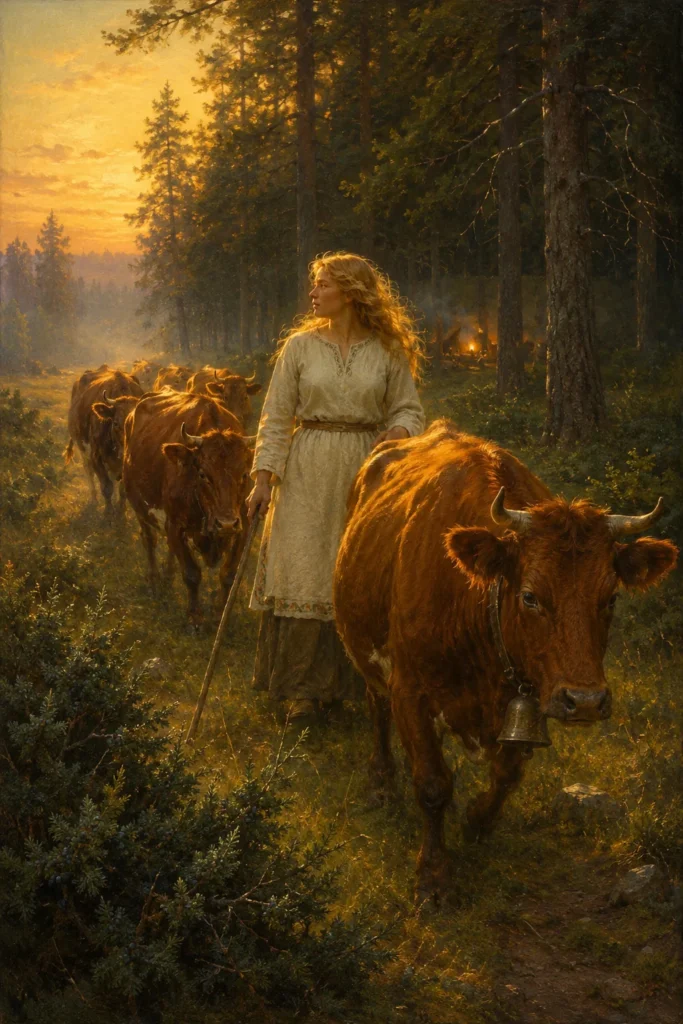
Hunting luck, especially small game and bird hunting, along with the protection of grazing livestock: in the 32nd song she sends her maids to the herd as the ‘Old Woman of the Herds’.
Woman of the forest with golden adornment in generous times, grey and poor in lean ones; along with a blue cloak and blue stockings as a mark of the deep forest.
She keeps the golden keys on a ring at her hip and opens Tapio’s storehouse, as Lemminkäinen asks of her in the 14th song.
First-fruit offerings at the topless sacrificial spruce, which among the Forest Finns was expressly called the ‘chamber of the forest lady’ (metsänemännän tupa); along with the symbolic exchange of gifts in the hunting songs.
From hunting songs to mistress of Metsola's household
Mielikki belongs to the layer of the forest haltijat, as handed down by the Finnish-Karelian rune songs of the 18th and 19th centuries. Elias Lönnrot made her the wife of Tapio in the Kalevala and mistress of the household of Metsola: in the 14th song Lemminkäinen asks her to take the golden keys from the ring at her hip and open Tapio’s storehouse; in the 32nd song she sends her maids to protect the grazing livestock; in the 46th song she is the foster mother of the bear.
In the bear myth she gathers up the wool cast upon the waters, from which the bear is to be born, rocks it in a cradle with golden chains beneath a flowering spruce, and withholds teeth and claws from it until it swears on her knee to do no evil; only then does she fashion claws for it from the silver branch of the pine and the golden branch of the spruce. Among the Forest Finns of Scandinavia she survived as Mehänemäntä, and the Finns of northern Sweden transferred her title to the Swedish forest being Skogsrå.
Reception and research
A mountain on Venus, Mielikki Mons, bears her name, as do many Finnish women given the first name Mielikki. In the fantasy role-playing world of the Forgotten Realms, Mielikki was adopted as a forest goddess, which made the name known internationally; Finland’s neopagan scene venerates her as an embodiment of the giving forest.
In religious studies, Mielikki represents the type of the ‘forest mother’ widespread across northern Eurasia. A notable finding of research is that the female forest lady was more important in prayer practice than the male forest king; the hunting songs feminise the forest and court its favour. Martti Haavio read the entire forest family as expressions of a distributor of fortunes, that is, of hunting luck. The fixed role as Tapio’s wife is Lönnrot’s systematisation; the oral tradition itself shows fluid transitions between the forest’s lady, daughter and daughter-in-law.
Exchange of gifts with the forest lady
Dealings with Mielikki consisted of honouring her and exchanging gifts, not of warding her off. Hunters invoked her before setting out and symbolically offered her gold and silver in exchange for quarry, as shown in the 14th song. Offerings were made at the topless-grown spruce, called Tapionpöytä in Finland and expressly named the ‘chamber of the forest lady’ among the Forest Finns; there people brought the first fruits of the catch. Anyone who read her appearance in the forest as an omen would postpone the hunt if she appeared in poor form; the blessing for livestock in the 32nd song shows the plea for her maids as guardians of the herd during forest grazing.
Forest mothers and mistresses of animals
As Lady of the Animals, Mielikki is close to the Greek Artemis and the Roman Diana, who likewise grant hunting success and protect wild animals. The Baltic-Finnic surroundings know direct counterparts: the Estonian Metsaema and the Erzya Vir-ava, both ‘forest mothers’. The Scandinavian forest being Skogsrå was given her title by Finnish-speaking settlers. The Slavic Leshy corresponds more closely to her husband, but shares the same dual role of giving and withholding.
Frequently asked questions about Mielikki
Why was Mielikki invoked more often than Tapio?
The hunting songs understand the forest as a household, and it is the mistress of the house who decides over stores and gifts. That is why requests for game, for the golden keys, and for the opening of the storeroom are addressed to her; this finding comes from the analysis of the rune-song collections and is considered established in research.
What role does Mielikki have with the bear?
In the 46th canto of the Kalevala she is the foster mother of the bear: she takes the wool from the waters, cradles the cub beneath the spruce, and gives it claws and teeth only after it has sworn to do no evil. This keeps the bear bound to the household order of the forest, which the cattle blessings invoke.
Is Mielikki a healing goddess for humans?
The sources show her as a healer of forest animals, not as a healer of human illness. The widespread claim that she also helps humans with herbal knowledge belongs to more recent popular tradition and should be read with corresponding caution.
Further links
Further reading:
Literature (selection)
Further standard works in the bibliography.
As a Finnish forest goddess, Mielikki embodies the favour of the forest itself: the mistress of the forest, in both the Kalevala and the older hunting songs, opens her storeroom only to those who politely ask for its gifts.