iWell Guard

Ilmarinen, smith of the sky and the Sampo

Ilmarinen is a god of the Finnish tradition.

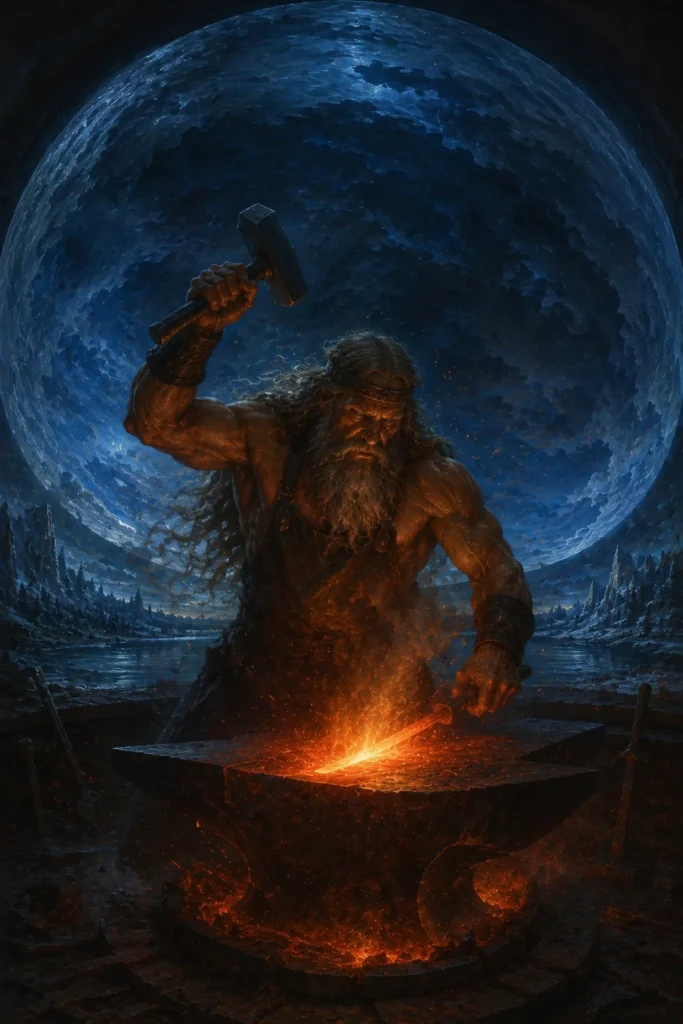
The smith who forged the vault of the sky without leaving a hammer mark.

GodFinland

Table of Contents

Ilmarinen, the sky smith of the Kalevala
Ilmarinen

Ilmarinen is the sky and air smith of Finnish mythology, who forged the vault of the sky and the wondrous object Sampo. His name marks him as an air and sky being; in epic tradition, however, he is primarily the smith hero.

The central source is the national epic Kalevala, which Elias Lönnrot compiled in 1835 and 1849 from oral rune-song tradition, alongside older magic and incantation songs, in which Ilmarinen is invoked, for instance, as the originator of iron and fire.

At a glance: Ilmarinen

Type: Sky and air smith, originally an air and weather god
Origin: Finland and Karelia
Texts: Kalevala (1835 and 1849), older rune songs and magic songs
Period: Kalevala redaction with older oral tradition
Appearance: master smith, the eternal hammerer

Context of Tradition

Period of the Texts

The Kalevala of 1835 and 1849 is the central source, behind which stand older rune songs as well as magic and incantation songs.

Area of Diffusion

Finland and Karelia, the heartland of rune-song, from which Lönnrot compiled his collection.

Sources

Good: the Kalevala and the magic songs; alongside Finnish mythology research from Haavio to Siikala.

Name and variants

Finnish: The name belongs to ilma, air, weather and sky; reconstructed, this yields Ilmari, an air or sky being, with the Kalevala diminutive form Ilmarinen. Even the name thus carries the sky within it, which the smith himself fashions in the epic.

Nature and effect

Appearance

Ilmarinen is the master smith, the eternal hammerer; in the Kalevala a hero of human form, and as an older weather and air god without a fixed iconography.

Effect

Ilmarinen forged the vault of the sky so skilfully that no trace of hammer or tongs can be seen, as well as the Sampo, a wondrous mill and bringer of good fortune. Etymology and the older layer mark him as an air and sky deity, the creator of the sky; in weather control he was partly overshadowed by the thunder and weather god Ukko. Primarily, however, he is the smith hero.

Profile: Ilmarinen

The key aspects of the sky smith at a glance.

Cultural Context

Central figure of Finnish epic poetry: smith hero of the Kalevala with an older layer as an air and sky god.

Responsible for

The forging of the impossible: the vault of the sky and Sampo; in healing spells he is regarded as the originator of iron and fire.

Depiction

Master smith at the forge, the eternal hammerer; as an older weather and air god without a fixed iconography.

Sphere of Influence

Creative and culture-bringing: sky, Sampo and smithcraft; weather control receded behind Ukko.

Practice

Invoked in incantation songs, for instance in healing spells against burns; an actual cult is not reliably attested.

Comparables

Typologically comparable to Hephaestus, Vulcan and Wayland as smiths; the Estonian Ilmarine as a direct counterpart; alongside the wind maid Tuuletar.

From the air being Ilmari to the smith hero of the Kalevala

The name belongs to Finnish ilma, air, weather and sky; reconstructed, this yields Ilmari, an air or sky being, with the Kalevala diminutive form Ilmarinen. The central source is the national epic Kalevala, which Elias Lönnrot compiled in 1835 and 1849 from oral rune-song tradition, alongside older magic and incantation songs.

This layering holds the key to the figure: the etymological, archaic layer shows the air and sky god, the creator of the sky; the epic shows the master smith, who fashioned the vault of the sky so skilfully that no trace of hammer or tongs can be seen, and who created the Sampo, a wondrous mill and bringer of good fortune. In weather control, Ilmarinen was partly overshadowed by the thunder and weather god Ukko.

Afterlife in Finnish national consciousness

Ilmarinen has given his name to, among others, Finnish warships, companies and a pension insurer, and is firmly anchored in Finnish national consciousness.

In terms of religious studies, Ilmarinen is culture-bringing and creative, without any threatening trait. Three clarifications are important: he is not primarily a wind god, the air aspect is the etymological, archaic layer, while the smith dominates in the epic. The Kalevala is an editorial work by Lönnrot, not a uniform original text. And he is not to be confused with the air maiden Ilmatar.

Invocation in healing magic rather than temple cult

In incantation songs, Ilmarinen is invoked, for instance as the originator of iron and fire in healing spells against burns. An actual cult is not reliably attested; the tradition is literary-magical rather than institutional-cultic. Whoever invoked the smith was not seeking a temple door, but the power of the word in the magic song.

Smiths and sky gods in comparison

As a smith, Ilmarinen is typologically related to Hephaestus and Vulcan, as well as to Wayland; as a sky creator, to Indo-European sky gods. The Estonian Ilmarine is his direct counterpart. Within Finnish tradition, he stands alongside the wind beings around Tuuletar, with whom he shares the common sphere of air, not function.

Frequently asked questions about Ilmarinen

What does the name Ilmarinen mean?

It belongs to ilma, air, weather and sky; Ilmarinen is an air and sky being.

Is Ilmarinen primarily a wind god?

No. The air aspect is the archaic layer; in epic tradition he is primarily the master smith.

What did he forge?

The vault of the sky, so skilfully that no trace of a hammer can be seen, and the Sampo, a wondrous mill and bringer of good fortune.

Further links

Recommended internal links:

Literature (selection)

A selection of key sources and studies:
  • Lönnrot, Elias: Kalevala. Helsinki 1849.
  • Haavio, Martti: Suomalainen mytologia. Helsinki 1967.
  • Siikala, Anna-Leena: Mythic Images and Shamanism. Helsinki 2002.

Further standard works in the bibliography.

As the Finnish sky smith, Ilmarinen is first and foremost the hero at the forge; as an older air god of the Kalevala tradition, his name at the same time preserves the memory of the sky, which he himself fashioned in the epic.

Classification & Protection

ILEVEL
The Protection Compass assigns this being to influence level I, Minor influence.

Against its influence, cross-cultural tradition names these protective means:

Compare in the Protection Compass →

Recommended protective means

iWell Guard

The simplest protective means in this collection: 41 layers of fine gold 999, platinum, silver and silicon, manufactured in Ruhla, Thuringia. It requires no activation, is bound to no person, and is effective within a radius of around 50 meters, even without being worn.

All protective means at a glance →