Tuuletar, the wind maid of the Finnish magic songs
By Ralf Ittermann · last reviewed on
Tuuletar is a female spirit of Finnish tradition.
The wind maid, who blows away illness and pain. Tuuletar belongs to the Finnish magic songs, where she blows away illness and pain.
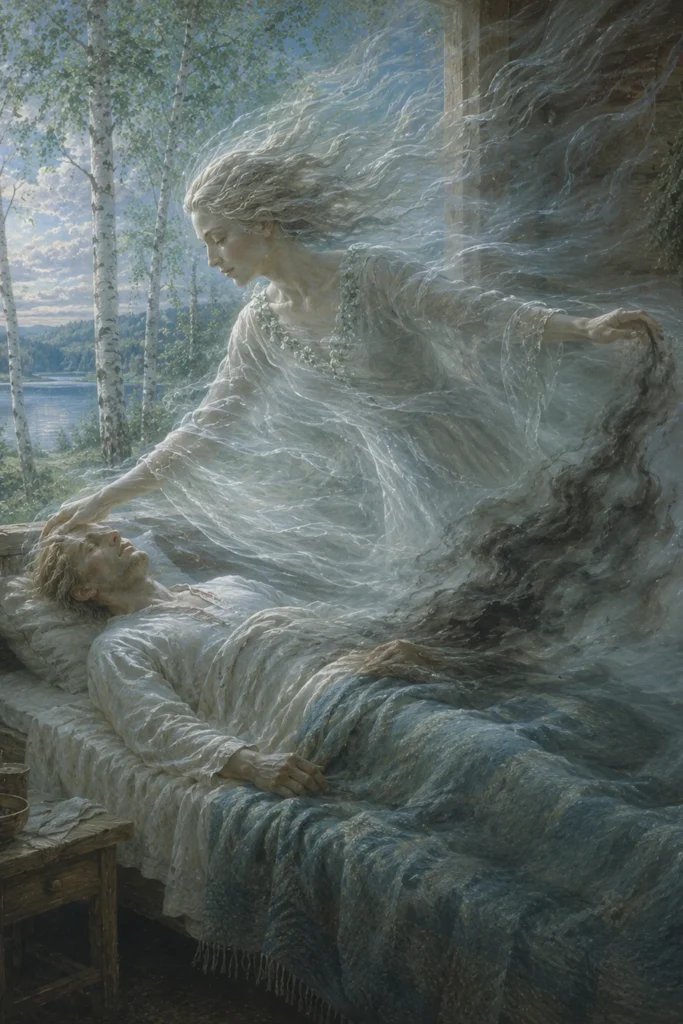
Tuuletar is a female wind spirit of Finnish mythology, the mistress or genie of the winds. In healing and warding spells, a wind maid is invoked to blow away illness, pain or suffering; often the Tuulettaret appear as collective wind maids.
Tuuletar is attested in folk poetry and magic spells as well as in Lönnrot’s collections Kalevala and Kanteletar, where the Tuulettaret appear as personified powers of the wind.
Type: Female air and wind spirit, genie of the winds
Origin: Finland and Karelia
Texts: folk poetry, magic spells, Kalevala and Kanteletar
Period: Finnish folk poetry and Kalevala redaction
Appearance: without fixed form, personified wind power
Source context
Period of the Texts
Tuuletar belongs to Finnish folk poetry and incantations; she is also documented in Lönnrot’s collections Kalevala and Kanteletar.
Area of Diffusion
Finland and Karelia, the landscapes of rune singing and the incantation tradition.
Sources
Moderate: folk poetry and incantations carry the figure; the fixed attribution by name varies across sources.
Name and variants
Finnish: tuuli means wind, the suffix -tar forms female beings, as with Ilmatar or Kuutar, the moon maid; Tuuletar means wind goddess or wind maid. The plural Tuulettaret denotes the wind maids as a collective.
Appearance and behaviour
Appearance
Tuuletar is a female air and wind spirit without fixed iconography, a nature genie who directs the winds.
Effect
As mistress or genie of the winds, a wind maid is invoked in healing and warding spells to blow away illness, pain or suffering, a widespread motif in Finnish incantations, the loitsut. The specific attribution of this healing function by name to Tuuletar varies across sources; the motif that the wind carries away pain is well attested, while the fixed personification as Tuuletar is in part editorially reinforced.
Profile: Tuuletar
The key aspects of the wind maid at a glance.
Female -tar genie of Finnish folk religion, alongside Ilmatar and Kuutar; present in folk poetry and incantations.
The sick and suffering: in healing and warding spells the wind maid is meant to blow away illness, pain or suffering.
Without fixed form: a personified wind force, conceived as mistress or genie of the winds.
Directs the winds; in the loitsut, the Finnish incantations, the wind carries away illness and pain.
Functional-magical invocation in healing spells; institutional veneration or a sacrificial cult is not attested.
Ilmatar, the air maiden, and the female -tar genies; typologically the Greek Aura and the wind maids of other cultures.
The wind maid within the structure of the -tar genies
Finnish tuuli means wind, the suffix -tar forms female beings, as with Ilmatar or Kuutar, the moon maid; Tuuletar means wind goddess or wind maid. She is documented in folk poetry and incantations as well as in Lönnrot’s collections Kalevala and Kanteletar; the Tuulettaret appear as personified wind forces.
Her core lies in healing magic: a wind maid is invoked to blow away illness, pain or suffering. Here a source-critical distinction is needed: the motif that the wind carries away pain is well attested; the fixed personification by name as Tuuletar, by contrast, is in part editorially reinforced and varies across sources.
Reception and classification
Tuuletar is the namesake of a Finnish vocal group, which should not be confused with the mythological being.
From a religious-studies perspective, Tuuletar is predominantly helpful and healing, in the sense of blowing away pain, and carries no threatening connotation. An important clarification: Tuuletar, the wind goddess, is not identical with Tuulikki, the forest goddess and daughter of the forest god Tapio; her name also contains tuuli, but she is a forest deity, not a wind being. Likewise, she should be distinguished from Ilmatar and the collective of the Tuulettaret.
Invocation rather than cult
There is no institutional veneration; Tuuletar is present within the practical tradition of incantation, as an invocation in healing magic. Speaking of a cult would be too much; this is a functional-magical invocation, not an attested sacrificial cult. The wind that the wind maid directs was meant to carry away whatever troubled a person.
Wind maids and air women in comparison
Tuuletar stands alongside Ilmatar, the air maiden, and the female -tar genies of Finnish tradition; typologically she is comparable to the Greek wind nymphs around Aura and the wind maids of other cultures. From the same tradition comes the sky smith Ilmarinen, whose name likewise belongs to the air, but whose role is that of a smith hero.
Frequently asked questions about Tuuletar
What does Tuuletar mean?
Wind goddess or wind maid, from tuuli, wind, and the female suffix -tar.
What does Tuuletar do?
She directs the winds and is invoked in healing spells to blow away illness and pain.
Is Tuuletar the same as Tuulikki?
No. Tuulikki is the forest goddess and daughter of the forest god Tapio, not a wind being.
Further links
Further reading:
- Ilmarinen – the sky smith of Finnish epic poetry
- Aura – the Greek wind nymph as a typological counterpart
- Amulet, Sage, Protective candle – traditional protective means
- Protection Compass – protective means at a glance
Literature (selection)
Further standard works in the bibliography.
As a Finnish wind spirit, Tuuletar is among the quietest helpers of Nordic folk religion: the wind maid of the incantations has no temple and no image, but the task of carrying away, with the wind, whatever causes pain.