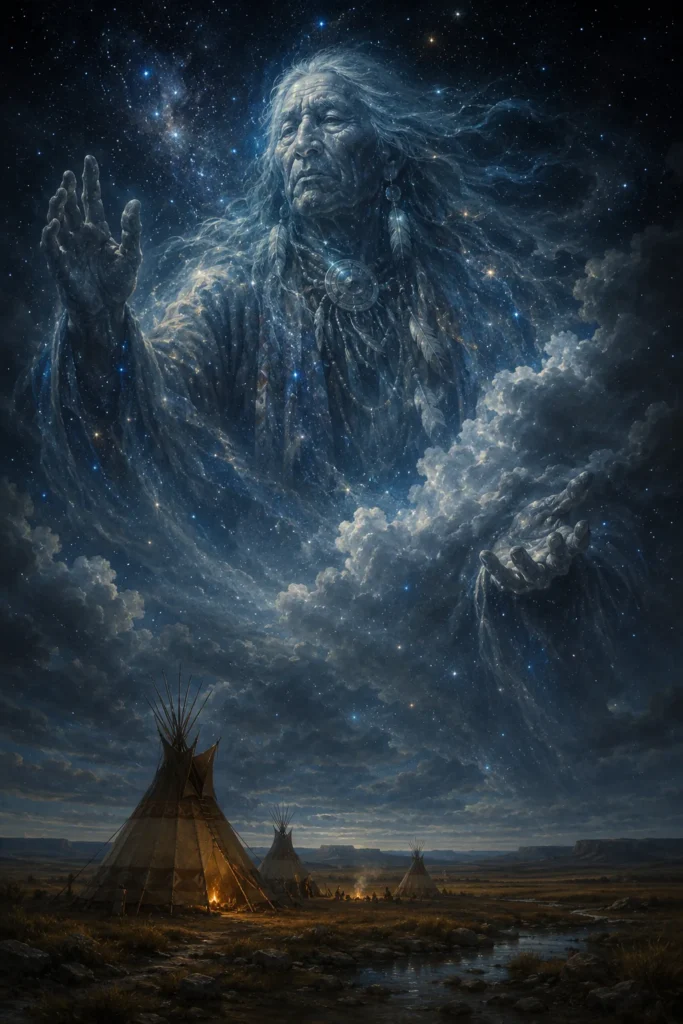
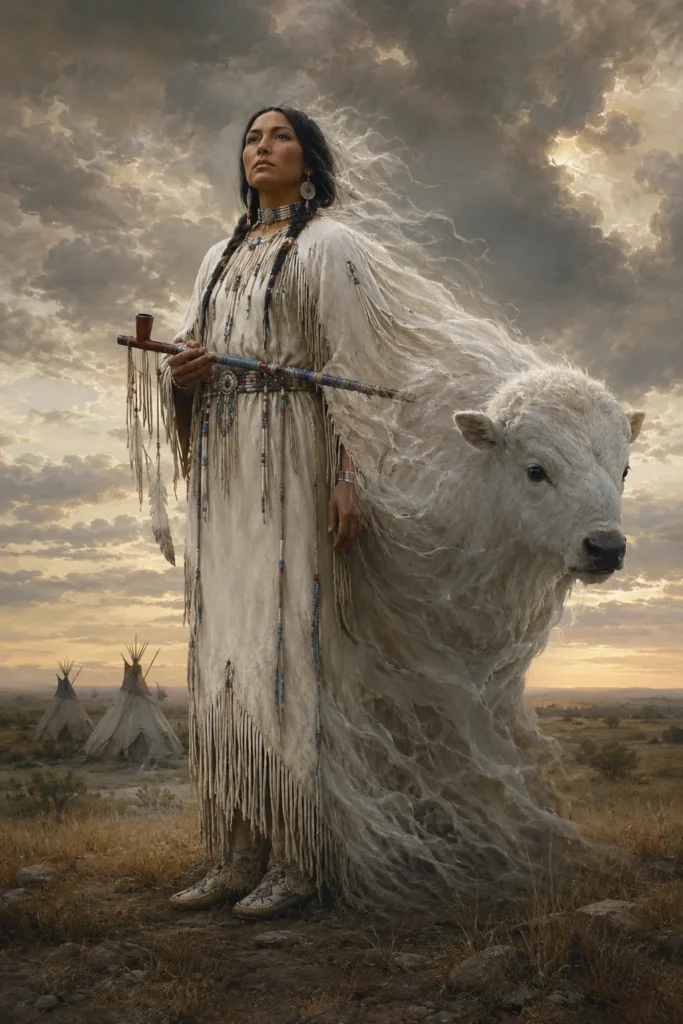
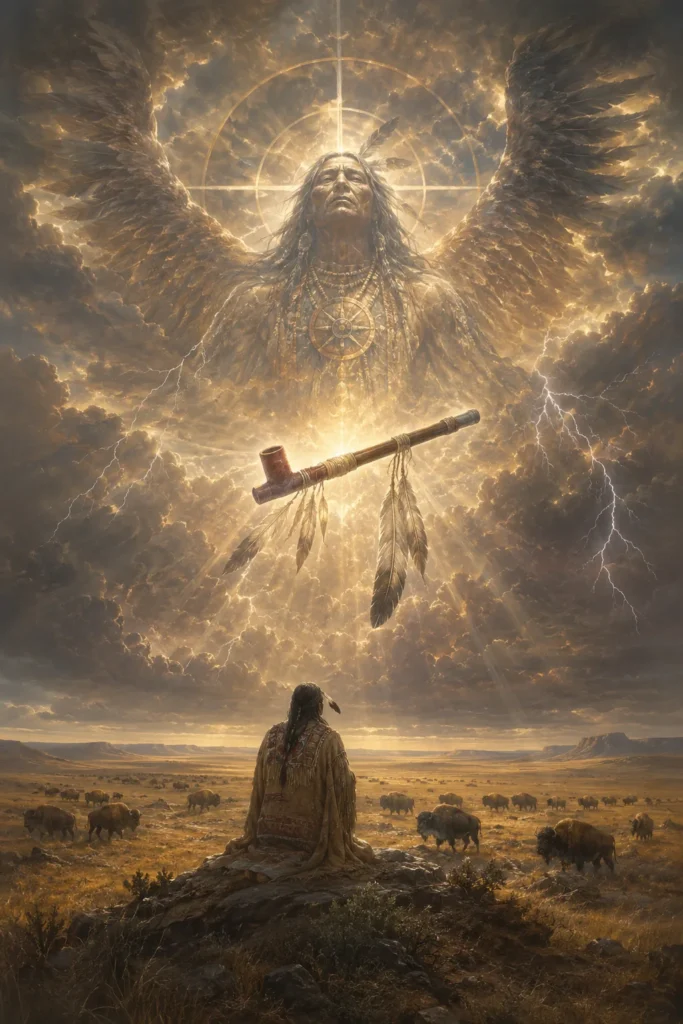
Tunkasila (Lakota Thunkasila, Grandfather) is the reverent form of address for the sacred in the Lakota tradition. It is used equally for Wakan Tanka, for the Four Grandfathers of the Sky, and for the personified point of reference in prayer.
Tunkasila is not an independent being-figure within the Lakota religious system, but rather a theologically significant form of address. The word tunkasila simply means Grandfather and is used in everyday language for the biological grandfather as well as for older male relatives.
In religious speech, the form of address is extended to the sacred, thereby establishing a specific kinship relationship with the sacred.
From a religious-studies perspective, the Tunkasila concept is a central element of Lakota kinship theology. Lakota prayers do not shape the sacred as a distant, remote supreme being, but rather as a close family person with whom one stands in a kinship relationship.
This element has been repeatedly highlighted by Joseph Epes Brown, Vine Deloria Jr., and the Lakota theologian Doris Leader Charge as a central distinction from the Western monotheistic tradition.
Lakota prayer practice contains two central kinship forms of address: Tunkasila (Grandfather) for male and in particular for higher sky beings, Unci (Grandmother) for female and in particular for earth beings (see also Spider Grandmother). This dual form of address reflects the gender-bipolar structure of the Lakota sacred and is an independent theological element.
The Tunkasila tradition stands in a complementary relationship to the female Unci tradition. The Grandmother form of address applies in particular to earth beings, to the Spider Grandmother tradition of the western Lakota, and to higher female numinosity in general.
This gender-bipolar dual theology is a central structural feature of Lakota religion that distinguishes it from the gender-monotypic principal deities of the Abrahamic religions. Joseph Epes Brown and Severt Young Bear have described this gender bipolarity as an equal complementarity, not as a hierarchically ordered gender theology.
The Lakota term thunkasila is composed of thunka (stem) and sila (a relational marker for male ancestors). This yields the literal meaning male kinsman or male ancestor. When applied to the sacred, it establishes the notion of a transgenerational family relationship: the sacred is not distant, but rather a higher-ranking relative.
Lakota kinship terminology is highly complex overall. Unlike modern American English, which has only one term for the biological grandfather, Lakota has different terms for different categories of grandfathers (e.g., tunkasila for the paternal grandfather and kakaala for the maternal grandfather).
Applying the more general form tunkasila to the sacred generalizes the grandfather relationship and transforms it into a supra-biological point of reference.
An important theological observation is that tunkasila is often used in the plural form tunkasilas or tunkasilapi, which designates the Grandfathers. In this plural form, the address refers in particular to the Four Grandfathers, the Four Directions, which as personified wakan beings represent the cosmic structuring of the world.
In the more specific theological application, Tunkasila and the plural Tunkasilas designate the Four Grandfathers of the Directions. These are: Wiyohpeyata (West, Thunder), Waziyata (North, Bison, Power), Wiyohinyanpata (East, White Swan, Mind) and Itokagata (South, Crane, Life Growth).
Each of the Four is assigned a color (Black, Red, Yellow, White), a wakan animal, and a specific function in the cosmic order.
The Four Grandfathers are explicitly invoked at the beginning of every Lakota ritual.
This is accomplished by presenting the sacred pipe chanunpa toward all Four Directions, by casting small pinches of tobacco in all Four Directions, or by the verbal invocation using the standard formula Mitakuye Oyasin (All My Relations), which includes all relatives, visible and invisible, in the ritual.
This Four Directions structure is the organizing foundational structure of all Lakota theology.
It determines not only prayer, but also the ritual topography of the Sweat Lodge (which is oriented toward the Four Directions), the temporal structuring of the major rituals (four days of Sun Dance, four nights of Vision Quest), and the symbolic structuring of healing practice.
Joseph Epes Brown described the central significance of the Four Directions structure in detail in The Sacred Pipe.
The color symbolism of the Four Grandfathers varies according to reservation tradition. In the most common variant, as preserved in Black Elk texts, West is black, North is red, East is yellow, South is white. In other Lakota traditions, West is arranged as red, North as white, East as yellow, South as black.
These regional variants have been repeatedly observed in ethnological research and reflect the genealogical diversity of the Lakota tradition. James Walker documented in the Sword texts a structuring that differs in many details, which is to be regarded as an alternative main line of Lakota theology.

The function of the Tunkasila form of address in Lakota prayer is deeply differentiated. A standard Lakota prayer formula begins with Tunkasila Wakan Tanka, unsi unkila (Grandfather Great Holy, have pity on us), addressing the sacred in the direct kinship form of address.
This form of address establishes an emotional closeness to the sacred that in the Western tradition corresponds more closely to the Father address of the Christian prayer (Our Father).
The Grandfather address differs from the parental Father model through an additional element: generational distance. The grandfather is not the immediate educator (that would be the father), but one generation further removed, dignified, wise, teaching, yet not directly intervening.
This generational distance allows for a respectful closeness without authoritarian directness, which shapes the specific Lakota prayer tonality.
An important Lakota prayer element is the invocation of the principal wakan beings by their specific Tunkasila epithets: Wakinyan Tunkasila (Thunder Grandfather, see Thunderbird), Tatanka Tunkasila (Buffalo Grandfather), Inyan Tunkasila (Stone Grandfather). These multiple Tunkasila forms of address show that the Grandfather address can be flexibly applied to all higher-ranking wakan beings.
The Mitakuye Oyasin formula, with which every Lakota prayer act concludes, is a central theological statement. It means literally All My Relations and includes not only human family relatives, but also wakan relatives, animal relatives, plant relatives, and stone relatives in the prayer.
This radical extension of the concept of kinship to the entire cosmic inventory is a genuinely Lakota theology construction and is one of the most distinctive features of Lakota religion in comparison with monotheistic traditions.
The Tunkasila form of address is present throughout the ritual process of the Lakota tradition. In the Inipi (Sweat Lodge), it is invoked multiple times at the beginning of each of the four endurance phases.
In the Hanblechiyapi (Vision Quest), it is the constantly repeated prayer element of the solitary vigil. In the Wiwanyag Wachipi (Sun Dance), it is invoked on each of the four days with different emphasis.
An important ritual application is the Cetan Wakan prayer, the Sacred Bird prayer, in which the Sacred Bird (often the eagle) is invoked as a messenger between humans and Tunkasila.
The eagle is said to carry the human prayer to the Grandfather in the Sky and bring back the answer. This bird-messenger concept is a common element of numerous indigenous American religions and forms an important element of mediating theology between humans and the sacred.
In modern indigenous movements, particularly in Pan-Indian gatherings (such as the American Indian Movement since the 1970s), the Tunkasila form of address has become one of the best-known prayer forms in North American indigenous religions. It is widely used in public Sun Dance ceremonies, in AIM activist gatherings, and in contemporary Native American spirituality.
The Cetan Wakan eagle-feather tradition is prescribed in detail. Only certain eagle species, the golden eagle (wanblee) and not the common buzzard, provide the sacred feathers. These feathers are exchanged only in ritual form; they may not be bought or sold, but must be transferred ritually or acquired through a vision.
The federal law Bald and Golden Eagle Protection Act (1940, amended several times) permits only recognized indigenous tribal members to possess eagle feathers for ritual purposes; all eagle killings are strictly regulated. This legal framework of protection is a unique example of governmental recognition of indigenous religiosity in American law.
The protection-related practice in relation to Tunkasila is the general practice of the Lakota prayer tradition. When someone faces an emergency, illness, threat, or harmful spirits, they call upon the Grandfather, often with the standard formula Tunkasila, unsi unkila.
This is done by smoking the sacred pipe, by smudging with buffalo sage or sweetgrass, or by simple verbal invocation.
A specific protective practice is the Naming Ceremony ritual, in which a child or an adult receives a sacred Lakota name. This name is determined through a vision or by an experienced healer and is conferred with an extensive invocation of the Four Tunkasilas and the Tunkasila-Wakan-Tanka.
The sacred name accompanies the child or adult throughout their entire life and is considered the most important protection against harmful spirits and accidents.
Another important protective practice is the wearing of small eagle feathers (wanblee wapaha) as eagle-feather adornment, which may only be worn by persons who have been meritoriously initiated.
The eagle feather symbolizes the connection to the Grandfather in the Sky and is regarded as an effective apotropaic protection. In traditional Lakota practice, the bestowal of an eagle feather was connected with a complex ritual event that continues to be practiced in some reservation communities to this day.
The kinship form of address for the sacred is a widespread religious-historical phenomenon. Structurally comparable are the Christian Our Father address (though with Father rather than Grandfather), the Jewish Avinu Malkenu address (Our Father, Our King), and the Islamic Rabbana address (Our Lord).
Important, however, is the cultural-historical specificity of the Lakota tradition: the Grandfather address is not a Father address but a Grandfather address; it respects a generational distance that the Western Father address does not carry.
This distinction has been repeatedly highlighted by Vine Deloria Jr. as a central element of Lakota theology that argues against a hasty equation with the Christian God the Father.
Within the American indigenous traditions, the Grandfather form of address is widespread. Among Algonquian-speaking peoples the expression is Gitchi Manitou (Great Spirit) with a similarly generation-distanced connotation.
Among the Cherokee, Choctaw, Cheyenne, and Crow there are respective Grandfather forms of address that are structurally comparable. The pan-Indian spread of Tunkasila in the modern Pan-Indian movement has, however, generalized the specifically Lakota usage and in some cases made it less precise.
Within the broader Plains Indian tradition, the Cheyenne Grandfather address is particularly similar. The Cheyenne address the high god Maheo as Old Man and sometimes as Grandfather. Among the Crow, the corresponding address is Akbatatdia, the Sacred Transmitter, who likewise stands in a Grandfather connotation.
The structural convergence of these Plains Grandfather theologies suggests a cultural-historical kinship that likely developed in the close inter-tribal relationships of the Plains region in the 17th and 18th centuries.
The Tunkasila form of address remains undiminished in present-day Lakota practice and is regularly used in reservation communities and in the growing urban Lakota diaspora. It is one of the few elements of Lakota theology that is translated directly into American English, as Grandfather, making it accessible to non-Lakota speakers as well.
In academic research, Vine Deloria Jr., Joseph Epes Brown, Aase Hultkrantz, Raymond DeMallie, and the Lakota theologian Doris Leader Charge have systematically described the Tunkasila tradition. The central theological point, the kinship relationship with the sacred, has been recognized as an important contribution of indigenous American theology to global religious history.
From a religious-studies perspective, the Tunkasila form of address is an important example of the distinctiveness of indigenous American religiosity in relation to pre-established European religious categories.
Unlike the simple Great Spirit concept of popular Native American literature, which represents a simplified Christianizing reading of Lakota theology, the Tunkasila form of address conveys a specifically Lakota kinship theology that deserves separate attention in comparative religious studies.
The iWell Guard reference to the Lakota tradition describes these findings from a religious-historical perspective, without making claims about efficacy or spiritual recommendations.
An important research strand in recent years addresses the question of Lakota linguistic theology. The Tunkasila form of address is embedded in a comprehensive Lakota language whose grammatical structures (verb system, kinship terminology, wakan concepts) carry the religious content.
If the Lakota language is lost, and it faces considerable danger through language loss among younger generations, the genuine theological depth of the Tunkasila tradition is also lost. The Lakota language revitalization programs in reservation schools since the 1990s are therefore also a religious-theological concern.
The following selection lists central works on Lakota religion and comparative religious studies concerning the Tunkasila tradition.
The designation Tȟuŋkášila, literally Grandfather, is understood by the Lakota less as the proper name of a discrete deity than as a reverential form of address used in prayer.
It can refer to Wakȟáŋ Tȟáŋka, the great sacred mystery, but also to individual sacred powers and to the spirits of the ancestors. This flexibility of the term is decisive for an adequate understanding and distinguishes Lakota religion fundamentally from pantheon systems with clearly delineated individual deities.
In the transmitted prayers, for example in the texts associated with the holy man Black Elk, the address Tȟuŋkášila appears repeatedly, often in connection with orientation toward the four cardinal directions, upward toward the sky, and downward toward the earth.
The person praying addresses the Grandfather in each direction, thereby placing themselves at the center of an ordered sacred world.
The German translation as Grandfather Sky narrows this finding because it suggests a fixed celestial deity.
In the Lakota tradition, the distinction between a Grandfather Sky and a Grandmother Earth, Uŋčí Makȟá, is indeed familiar, yet both belong to a relational fabric in which the sacred is not broken down into individual figures, but conceived as a kinship-connected whole.
From a religious-studies perspective, it is therefore important to read Tȟuŋkášila primarily as a prayer form of address and expression of a kinship cosmology, and not as an isolated sky god modeled on European patterns.
The textually transmitted knowledge about the religious ideas of the Lakota, which includes the concept of the Grandfather, derives to a considerable extent from a small number of collectors of the late 19th and early 20th centuries.
The most important of these is James R. Walker, a physician who worked on the Pine Ridge Reservation from 1896 onward and collaborated over many years with holy men such as George Sword, Thomas Tyon, and Little Wound.
His records were not critically edited until late, from the 1980s onward, by Raymond DeMallie and Elaine Jahner, and published under titles such as Lakota Belief and Ritual.
Walker’s material is rich but not unproblematic. He sometimes organized the statements of his informants into a systematic doctrinal edifice that articulated the hierarchy of sacred powers more fully than may have corresponded to lived religion.
Later research has pointed out that Walker brought his own ordering assumptions to the material, and that some of his informants may not have communicated everything to him, or not everything without modification.
A second central source is the material going back to Black Elk, transmitted through John Neihardt in Black Elk Speaks (1932) and through Joseph Epes Brown in The Sacred Pipe (1953). Here too, the mediating role of the non-indigenous authors must be considered.
From a religious-studies perspective, statements about Tȟuŋkášila are therefore filtered through a narrow source base shaped by mediation and systematization. More recent research, including DeMallie’s work, draws out the internal Lakota perspective more strongly and urges caution toward the closed systems of the early collectors.
Related key terms: Tunkasila Thunkasila Grandfather Lakota Four Directions Mitakuye Oyasin.
iWell Guard draws on the cultural-historical tradition of wearable protective objects, in the tradition of Native American and many other cultures worldwide. 41 levels, real gold, platinum, silver, crafted in Germany. 30-day return policy.
Personal experiences may vary. Not a medical product. No healing claims.