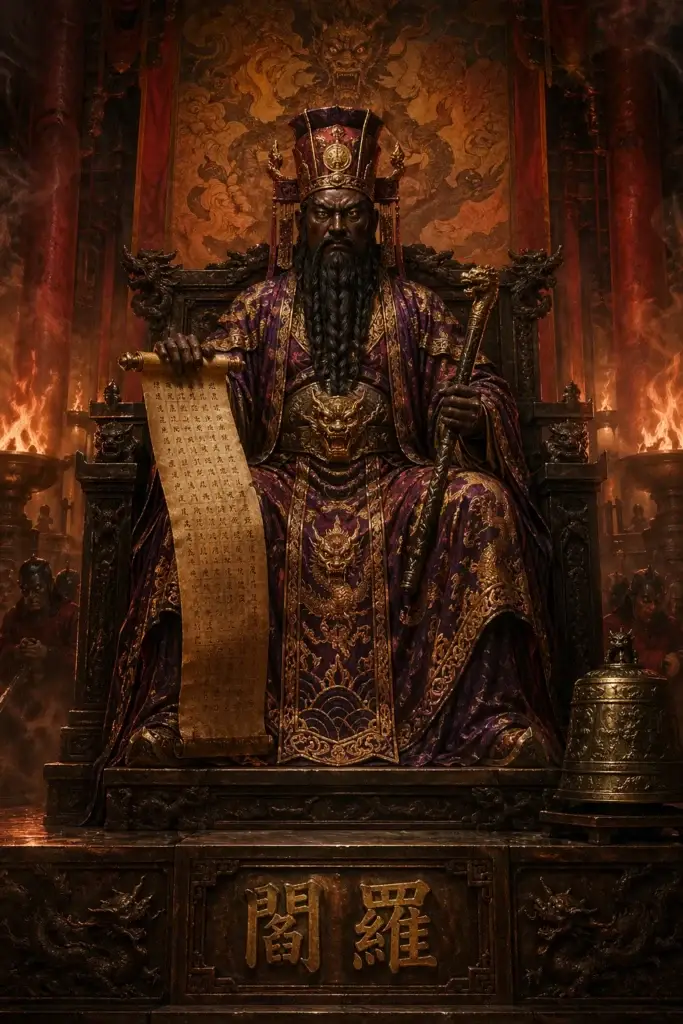
Zhurong, fire god and regent of the south
By Ralf Ittermann · last reviewed on
Zhurong is a god of the Chinese tradition.
Bringer of fire and vanquisher of the water god Gonggong.
Zhurong is the Chinese fire god and god of the south, to whom fire is assigned in the Five Phases system. He brought controlled fire to humankind and is known above all for his battle against the water god Gonggong, who caused the collapse of the pillar of the world mountain.
He is attested in several ancient primary sources, including the Shanhaijing and the Huainanzi. His cult was real: fire god temples and state offerings to the directional deities assigned him the south and fire.
Type: Fire god, god and regent of the south, culture bringer of fire
Origin: ancient Chinese mythology and state religion
Texts: Shanhaijing, Huainanzi, historical and ritual texts
Period: ancient Chinese classics to the present
Appearance: a being with a human face, riding two dragons

Region of origin and sources
Period of the Texts
The evidence comes from the ancient Chinese classics, above all the Shanhaijing and the Huainanzi with its Tianwen chapter.
Area of Diffusion
China; as a directional god, Zhurong belongs to the south, and the peak of the southern mountain Hengshan bears his name.
Sources
Well documented: several ancient primary sources, plus historical and ritual texts and modern sinology ranging from Birrell to the Huainanzi translation.
Name and variants
Chinese: The name Zhùróng combines a character for a blessing formula and celebrant with a character for embers and rising smoke; an epithet is Zhu Ming, the Red-Bright One. The name Chongli denotes an official who is sometimes equated with Zhurong, though this relationship is inconsistently recorded.
Appearance
Appearance
In the Shanhaijing, Zhurong is described as a being with a human face and an animal body, riding two dragons; the tradition varies. He is associated with the colour red, the south, summer and fire, and in some narratives rides a fire dragon.
Effect
Zhurong brings and masters fire, thereby founding culture through humankind’s controlled fire. His central myth is the victory over the water god Gonggong, whose fit of rage shifted the order of heaven and earth.
Profile: Zhurong
The key aspects of the fire god at a glance.
Ancient Chinese fire and directional god, assigned to the south, summer and fire in the Five Phases system; regarded as an assistant or aspect of the Red Emperor Yan Di.
Humankind’s controlled fire, the south and summer; also fire prevention in state and folk cult.
A being with a human face and an animal body, riding two dragons; associated with red, the south and the fire dragon.
Culture bringer of fire and cosmic fighter: his victory over Gonggong explains the tilt of heaven and earth.
Fire god temples, state offerings to the directional deities and sacrificial ceremonies for fire prevention, seasonally located in summer and the south.
The battle against Gonggong and the world pillar Buzhou
The name Zhùróng combines a character for a blessing formula and celebrant with a character for embers and rising smoke. Sources include the Shanhaijing, the Huainanzi with its Tianwen chapter, as well as historical and ritual texts; Zhurong is regarded as an assistant or aspect of the Red Emperor Yan Di.
His central myth is the battle against the water god Gonggong: in the Huainanzi, Gonggong fights Zhuanxu, and in other sources Zhurong defeats him. Enraged, Gonggong rams his head against the world pillar Buzhou, causing the sky to tilt to the northwest and the earth to sink to the southeast. The narrative thus explains the courses of the stars and the rivers of China and sets fire, as a victorious, ordering force, against chaotic water.
From state offerings to the Mars rover
Zhurong remains present today: China’s Mars rover Zhurong, launched in 2021, is named after him. He appears in the novel Fengshen Yanyi, in opera, in comics and in games.
From a religious studies perspective, Zhurong is a classic example of the ordering, culture-founding fire god. It should be noted that his equation with Chongli is not consistent, that Gonggong’s opponent in the sources is not always Zhurong but sometimes Zhuanxu, and that Zhurong is sometimes listed as an independent god, sometimes as Yan Di’s minister.
State offerings, temples and Mount Hengshan
The cult is real and substantially attested. Zhurong, also known as Huoshen, was worshipped as a fire god; there were fire god temples and state offerings to the directional deities, in which the south and fire were assigned to Zhurong. Sacrificial ceremonies for fire prevention and for the proper governance of fire have been handed down, seasonally located in summer and the south. The southern mountain Hengshan is associated with him; its peak bears the name Zhurong.
Fire against water: parallels and distinctions
Within China, Zhurong is closely linked with Hui Lu, Huoshen and the fire bird complex; what distinguishes him from Hui Lu is that the cultic and state substance of fire god belief lies with Zhurong. Structurally, he embodies the opposition of fire and water, comparable to other fire-against-water battles. As a cosmic fire figure he resembles Surtr, yet he is culture-founding and ordering, not world-destroying.
Frequently asked questions about Zhurong
Who is Zhurong?
The Chinese fire god and god of the south, to whom fire is assigned in the Five Phases system. He is regarded as the culture bringer of controlled fire.
Whom did he fight against?
Against the water god Gonggong. His defeat caused the world pillar Buzhou to collapse, after which the sky tilted and the earth sank.
Is the Mars rover named after him?
Yes. China’s Mars rover Zhurong, launched in 2021, bears his name.
Further links
Further reading:
- China – all beings of Chinese belief
- Hui Lu – the fire sorcerer with the gourd full of fire birds
- Surtr – the Norse fire giant as a counterpart
- Protective candle, smoke cleansing, amulet – traditional protective means
Literature (selection)
Further standard works in the bibliography.
As the Chinese fire god and god of the south, Zhurong embodies fire as an ordering power: he brought controlled flame to humankind, defeated water, and has remained a name for the taming power of fire from the state sacrifices of antiquity to the Mars rover of 2021.