Ülgen (Old Turkic Ülgän) is, in the South Siberian-Tengrist faith, the creator and god of light of the upper world, guardian of the white shamans, and mythological counterpart of the underworld ruler Erlik Khan.
Uelgen, the Altai god of light, is regarded in Altai shamanism as creator and supreme high deity of the upper world.
Ülgen is a specialization of the high-deity complex Tengri within the Altaic, Telengit, Shor, and Tuvan religion.
While Tengri encompasses the entire vault of heaven, Ülgen inhabits the uppermost nine heavens and is regarded as a personally addressable creator agent. Anokhin described him in 1924 as “the high god of the Altai peoples who is actually invoked.”
Within the Siberian-Tengrist tradition, Ülgen is the upper apex of a multi-tiered pantheon of gods; Erlik Khan is his dual counterpart, Yer-Sub his earth-bound complement.
The religious-sociological significance of Ülgen is that, unlike the remote Tengri, he represents an active creator agent who can be directly invoked.
He thereby fills a gap that the deus otiosus Tengri leaves open; in this function he is typologically more comparable to the Greek Zeus or the Norse Odin than to the immeasurable sky itself.
The word ülgän / ülgen is Old Turkic and is associated in scholarship with the meanings “great, sublime, mighty”; in some lexicons also “the distributor, the apportioner” (from ülē- “to divide, to distribute”), which fits the conception that he distributes life-portions to human beings. Related forms are Khakas Ülgän, Shor Ülgen.
Among the Mongols, no direct equivalent appears; there the role is partly taken over by Möngke Tngri and partly by Bodhisattvas of Buddhist influence such as Khormusta. This asymmetry makes Ülgen a specifically South Siberian-Turkic phenomenon.
An alternative etymology connects the name with üligen, “the bestowing one,” which fits the mythological conception that Ülgen distributes wealth and fertility. Both etymologies are linguistically compatible and may have historically reinforced each other.
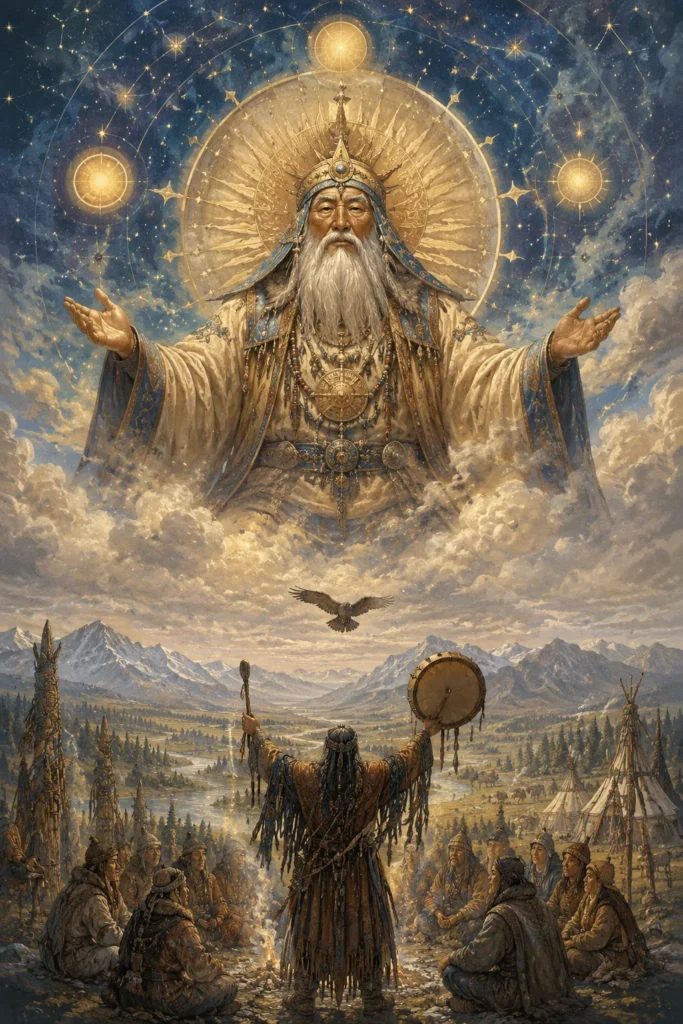
Ülgen is described as an elderly, white-bearded man on a golden throne in the uppermost heaven. He wears a cloak embroidered with the sun and moon, holds in his right hand a luminous bow made of rainbow material and in his left a cup full of mare’s milk. His messenger is the white eagle.
In the Altaic drum diagrams recorded by Anokhin and Potapov, Ülgen stands at the very top; below him branch nine daughters (the Kysh-Kyz) and nine sons who govern individual celestial domains.
This mythology of nine sons and daughters is a classic Siberian high-deity iconography that recurs in the tradition of Erlik Khan as well, though mirrored downward.
In the modern Altai Republic context, the iconography of Ülgen has been consolidated; a well-known mural in the cultural center of Gorno-Altaysk depicts him in the standard white-bearded form. This modern iconography draws on Anokhin’s ethnographic sketches and creates a coherent visual form that never existed in quite such unified fashion in the historical material.
The Altaic creation narrative describes Ülgen drifting alone on the primordial waters, commissioning a bird (sometimes a duck, sometimes Erlik in bird form) to fetch mud from the bottom, and shaping the earth from it. After Erlik has become separate, Ülgen creates the first human being from clay and animates him by placing the sun inside his head, a motif that has parallels in Christian creation thought but was certainly formulated independently.
A second narrative describes the erection of the world tree, a cosmic larch whose roots reach into Erlik’s realm and whose crown meets beneath Ülgen’s throne. Along this axis the white shaman moves during his upward journey. Mircea Eliade made this motif the central category of his shamanism model under the term “Axis Mundi.”
A third narrative describes a dispute between Ülgen and Erlik over the first human being: Erlik attempts to breathe his breath into the clay body, but Ülgen acts first. In his fury, Erlik creates the first diseases and mosquitoes, a typical etiological myth that explains the existence of evil without moral dualism.
The Ülgen cult was a public spring cult in the Altaic highlands.
On a sacred mountain in May a young light-colored horse (white or pale yellow) was sacrificed; shamans “rode through the nine heavens” in ecstatic sessions and conveyed the requests of the tribe to Ülgen. Anokhin documented one such session in detail (1909, published 1924).
In the personal sphere, Ülgen was the central invocation of the white shamans (aq kam), while the black shamans turned to Erlik Khan. His feast day often fell on the summer solstice celebration and overlapped with the later Naadam complex of Mongolia.
A special form of Ülgen veneration was the tagyl ritual: on a flat rock a small stone altar was erected and tended with mare’s milk and butter pastries.
Such rock altars are archaeologically partially preserved in the South Siberian highlands and may reach back to the Bronze Age, without the religious identification necessarily being continuous.
Protective practice within the Ülgen complex was positively connoted: the emphasis was less on warding off than on “setting things in order.” Apotropaic elements included tying white cloth strips (kyira) to larches at mountain passes, erecting small stone pyramids (obo), and avoiding noise and conflict on the passes.
In the case of a child’s illness, a white shaman could be called upon to ask Ülgen for the “return of a life-portion.” In conceptual terms this is a cosmic appeal for order, not a promise of healing.
From a religious-studies perspective, this practice belongs to the category of “restoration rituals” documented in many other indigenous traditions as well.
Central to understanding this is the distinction: Ülgen was the addressee of petitions, not the healer himself. Healing was the responsibility of the shaman as intermediary, an important religious-sociological distinction that Roberte Hamayon (1990) articulated sharply in her critique of Eliade’s model.
Structurally comparable to the Germanic Tyr, the Vedic Varuna in his light function, the Roman Iuppiter as god of law and order, and, in Siberia, the Yakut Aar Tojon.
From a phenomenology-of-religion perspective, it is notable that Ülgen, unlike the remote Tengri, possesses a concrete creation narrative without thereby becoming a creator-demiurge in the manner of Yaldabaoth in Gnosticism.
A close parallel is found in the Finnish Ukko, who likewise functions as a “more active high deity” beneath an abstract celestial layer. The Finnish Kalevala scholar Juha Pentikäinen drew typological comparisons between Siberian and Finno-Ugric high deities in Shamanism and Culture (1998).
The specifically Altaic feature is the strict division into “white” and “black” shamans with separate invocation addresses. This model is rare in Siberian comparison and makes Ülgen particularly interesting from the standpoint of the phenomenology of religion.
In modern Altaic cultural work, Ülgen has been reclaimed; he adorns postage stamps, folk festivals, and school textbooks of the Altai Republic. Scholarly standard treatments include: Anokhin (1924), L. P. Potapov (Altaiskij schamanizm, 1991), Mircea Eliade (1951), Vladimir Basilov (1984), and more recently Andrei Znamenski (2007).
The Finnish scholar of religion Juha Pentikäinen (Shamanism and Culture, 1998) situates Ülgen within a broader circumpolar series of light deities.
In the contemporary Altai context, the Ülgen cult exists in tension: on one hand it is positioned as “genuine indigenous religion” in contrast to Russian Christianity, while on the other hand it is itself overlaid with New Age elements not grounded in the ethnographic tradition.
Andrei Znamenski has analyzed this tension in detail in his Oxford volume.
A separate research strand concerns the archaeological traces of Ülgen-centered rituals; M. P. Gryaznov and V. D. Kubarev have documented rock images in Tuva and the Altai that have been interpreted as Ülgen riders, though the identification remains uncertain.
Three research debates shape Ülgen studies. First: is Ülgen a split from Tengri or an independent Altaic layer? Anokhin and Potapov tended toward the former reading, Roux and Hamayon toward the latter.
Second: how continuous is the veneration of Ülgen from the pre-Islamic period through the 19th and 20th centuries? Written sources are largely absent; the ethnographic tradition has only been systematically recorded since Radloff in the 1860s.
Third: what share does Russian collecting activity itself have in consolidating the image of Ülgen? Andrei Znamenski has offered an important self-critical reflection here: much of what we know about Ülgen is also a product of Tsarist and Soviet ethnography and not solely of the Altaic insider perspective.
A systematic comparison of Ülgen with other Siberian high deities is illuminating from a religious-studies perspective.
Compared to the Tungusic Buga, Ülgen is distinctly more personal and endowed with a richer mythology; compared to the Yakut Ürün Aar Tojon, he is conceived as more actively creative. Compared to the Mongolian Khormusta, the Iranian-Buddhist layers are absent.
These comparisons show that South Siberian religion is not a homogeneous stratum but rather a spectrum of differently profiled high-deity figures, each with its own mythology, iconography, and ritual practice. Vladimir Basilov offered a first systematic comparative study in Shamanism in Siberia (1984).
From the standpoint of the phenomenology of religion, Ülgen is especially interesting because he fills the gap between the remote Tengri and the specific specialized deities. This intermediary role makes him one of the “most vital” high deities of Siberia.
Those wishing to study the Ülgen complex in its breadth will find on the overview page Siberian-Tengrist Tradition the most important cross-references to related figures such as Tengri, Erlik Khan, and the protective mother figure Umai.
A. V. Anokhin’s Materials on the Shamanism of the Altai Peoples (1924) is the most important primary source and provides detailed descriptions of six complete shamanic sessions that he personally documented. L. P. Potapov’s Altaiskij schamanizm (1991) is the most important Soviet-Russian synthesis.
For the circumpolar context, reference is made to Juha Pentikäinen’s Shamanism and Culture (1998), which situates Ülgen within a broader series of light deities from Scandinavia to Siberia.
Ülgen is an instructive example of the phenomenology-of-religion category “god of light,” which Wilhelm Schmidt elaborated in his high-deity doctrine and which Friedrich Heiler later developed in Erscheinungsformen und Wesen der Religion (1961). Characteristic is the association of light, height, creation, and ethical order.
Compared to other deities of light, such as the Vedic Surya, the Egyptian Ra, and the Zoroastrian Hvar Khshaeta, Ülgen lacks direct identification with the solar disk; he is more the “luminous high deity” behind the astral phenomena.
This places him typologically closer to Indo-European high deities such as Varuna or Tyr than to Indo-Iranian solar deities.
The connection with the world tree is a core motif that decisively shaped Eliade’s concept of the “Axis Mundi.” Even if Eliade’s theory is now viewed critically, the material from the Ülgen complex remains one of the most compelling examples of vertical cosmic mediation structures.
Ülgen research raises several methodological problems. First: Altaic religion was recorded in the 19th century mainly by Russian Orthodox missionaries and somewhat later by Russian ethnographers. Both groups had interpretive preconceptions that distort the transmitted picture.
Second: Anokhin’s detailed session protocols (1909) are an outstanding source, but they are shaped by the presence of the observer himself. The methodological discussion around “participant observation” in the ethnology of religion bears directly on Anokhin’s material.
Third: the contemporary re-Tengrization in the Altai Republic is constructing a consolidated Ülgen image tradition that never existed in such closed form in the historical material. This construction is of sociological-religious interest, but should not be confused with the historical layer.
A central religious-symbolic concept in the Ülgen complex is the world tree, the baj-terek: a cosmic larch or birch whose roots reach into the underworld and whose crown meets beneath Ülgen’s throne. Along this axis the white shaman performs his ascent.
Mircea Eliade made this motif the central category of his shamanism model and systematically developed it under the term “Axis Mundi” in Le sacré et le profane (1957) and Le chamanisme (1951).
Even if Eliade’s model is now viewed critically, the Ülgen world tree remains one of the most compelling examples of vertical cosmic mediation structure in an indigenous religion.
Contemporary Altaic artists take up the world tree concept; it appears on numerous murals, souvenirs, and in folk-art exhibitions. This reception is of sociological-religious interest because it transforms a religious motif into a marker of cultural identity.
Contemporary Ülgen research stands within several productive tensions. On one side is the established Russian-Soviet school (Potapov, Tokarev), working with its wealth of empirical material; on the other is Western phenomenology of religion (Eliade, Pentikäinen), searching for general religious structures.
Both schools complement each other without being coextensive. Roberte Hamayon made their tension explicit in La chasse à l’âme (1990), arguing for a third, socio-economically grounded reading.
Andrei Znamenski, in his works since 2003, has systematically addressed the methodological problems of shamanism research: how much of the research image is itself an effect of the research? This reflexive turn now also shapes Ülgen scholarship. For young scholars of religion, this is an instructive example.
The deity Ülgen, also written Ülgän or Bai Ülgen, is known primarily from the religion of the Turkic-speaking peoples of the Altai Mountains. The most important descriptions derive from the ethnography of the 19th and early 20th centuries.
Particular significance attaches to the work of the scholar Wilhelm Radloff and of the missionary and linguist Vasily Verbitsky, who were active among the Altai peoples in the 19th century and collected texts, prayers, and descriptions of ritual practice.
In these sources Ülgen appears as a high, benevolent sky god who resides in one of the upper celestial layers. In many traditions he is contrasted with Erlik, the lord of the underworld.
Ülgen is associated with creation, fertility, livestock, and the well-being of human beings. Unlike a remote, inactive sky god, Ülgen was the addressee of concrete rituals; animal sacrifices were offered to him, especially horses, and the shamanic specialist entered into contact with him through ritual songs.
When using these sources it should be borne in mind that Verbitsky was a missionary who viewed Altaic religion from a Christian perspective, while Radloff was more interested in linguistics and ethnology. Both also documented a religion already influenced by contact with Buddhism, Christianity, and Russian rule.
Some scholars have even suspected a possible Iranian-Zoroastrian or Christian influence in the dualistic juxtaposition of Ülgen and Erlik. This question has not been conclusively resolved, but it cautions against accepting the transmitted image of Ülgen uncritically as ancient and uninfluenced. Related sky deities are also known in neighboring Inner Asian cultures.

Among the most impressive testimonies of Altaic religion is the description of a ritual journey to heaven to reach Ülgen, as transmitted among others by Wilhelm Radloff and as the scholar of religion Mircea Eliade subsequently treated in detail in his study of shamanism.
The ritual served the purpose of presenting a horse sacrifice to Ülgen and was intended to secure his goodwill for the community.
The sequence of events as described in the sources is multi-staged. Following preparations that included the selection and ritual treatment of the sacrificial animal, the shamanic specialist symbolically ascended a series of notches cut into a birch tree representing the successive celestial layers.
In ritual songs he described the ascent from layer to layer, encountered various beings along the way, and finally approached the seat of Ülgen. At this point he presented the community’s petitions and sought to gain information about the future from the responses, such as the coming harvest or the increase of the herds.
Caution is appropriate when evaluating this account. The text that Radloff recorded is a concrete performance bound to a specific place and time, not a timeless script. Eliade generalized it as a model example of the shamanic heavenly journey, but later research has criticized his tendency toward unification.
What can be stated is that Ülgen in Altaic practice was not merely a theological concept but the destination of an elaborate ritual act in which the layering of the heavens and the specialist’s ascent were concretely staged.
Characteristic of the transmitted image of Ülgen is his close connection with the counterpart figure Erlik. In numerous Altaic narratives the two appear as a complementary pair: Ülgen above in the sky, associated with light, creation, and life; Erlik below, with the underworld, illness, and death.
Some creation narratives have both participate in the making of the world, with Erlik’s contribution often bringing the imperfect or harmful into existence.
This dualistic structure has occupied scholarship intensively. One question is whether the pronounced dualism is an original feature of Altaic religion or whether it was reinforced through contacts with dualistic religious systems, perhaps with Zoroastrian ideas via the Inner Asian trade routes or with Christian notions of God and the devil through the Russian mission.
A definitive answer is not possible, since the sources date only from a period in which such contacts had long existed.
It is also important not to misunderstand the opposition between Ülgen and Erlik as a simple struggle between good and evil. In many narratives Erlik is not a pure adversary but a necessary part of the world order, with whom one had to come to terms just as with Ülgen.
Shamanic specialists communicated with both the upper and the lower world. The relationship between the two powers is therefore better described as a tension-filled complementarity than as moral dualism.
For the classification of Ülgen, it follows that his significance is only fully apparent in relation to Erlik: he is the celestial pole of a two-pole interpretation of the world.
The Altaic god of light is rendered in the sources with two common transliterations: Ülgen in the standard Turkological form and Uelgen in German-language texts without special characters.
Both spellings refer to the same figure, who appears in the records of Wilhelm Radloff and later Siberian religious scholarship as creator of the upper world and counterpart of the subterranean Erlik. The dual spelling facilitates locating references in older bibliographies and digital catalogs where umlauts are processed differently.
The Altaic creation myth presents Ülgen as the luminous lord of the upper world, whose adversary Erlik rules the underworld; the ethnographic records of Wilhelm Radloff in the nineteenth century document the pantheon in detail.
Related key terms: Ülgen Aq Kam white shamans nine heavens Altaic creation.
iWell Guard draws on the cultural-historical tradition of wearable protective objects, in the tradition of Siberia / Tengrism and many other cultures worldwide. 41 layers, real gold, platinum, silver, crafted in Germany. 30-day return policy.
Personal experiences may vary. Not a medical device. No promise of healing.
Against its influence, cross-cultural tradition names these protective means:
Compare in the Protection Compass →Recommended protective means
The simplest protective means in this collection: 41 layers of fine gold 999, platinum, silver and silicon, manufactured in Ruhla, Thuringia. It requires no activation, is bound to no person, and is effective within a radius of around 50 meters, even without being worn.
Related Beings

Enji (Zjarri, I Verbti), the reconstructed fire god of Albanian tradition. Origin, the hearth cul...

The written transmission about Mikail reaches back several centuries into the past, very probably...

Machen Pomra (Amnye Machen), the warlike mountain god of Amdo. Origin, the Kora pilgrimage mounta...

Sin, Sumerian Nanna, was the Mesopotamian moon god with cult centers in Ur and Harran, keeper of ...

The written record of Morrigan reaches back several centuries into the past, very probably restin...

In the Hurrian-Hittite Kumarbi Cycle, Anu is the second king of heaven before Kumarbi. A religiou...