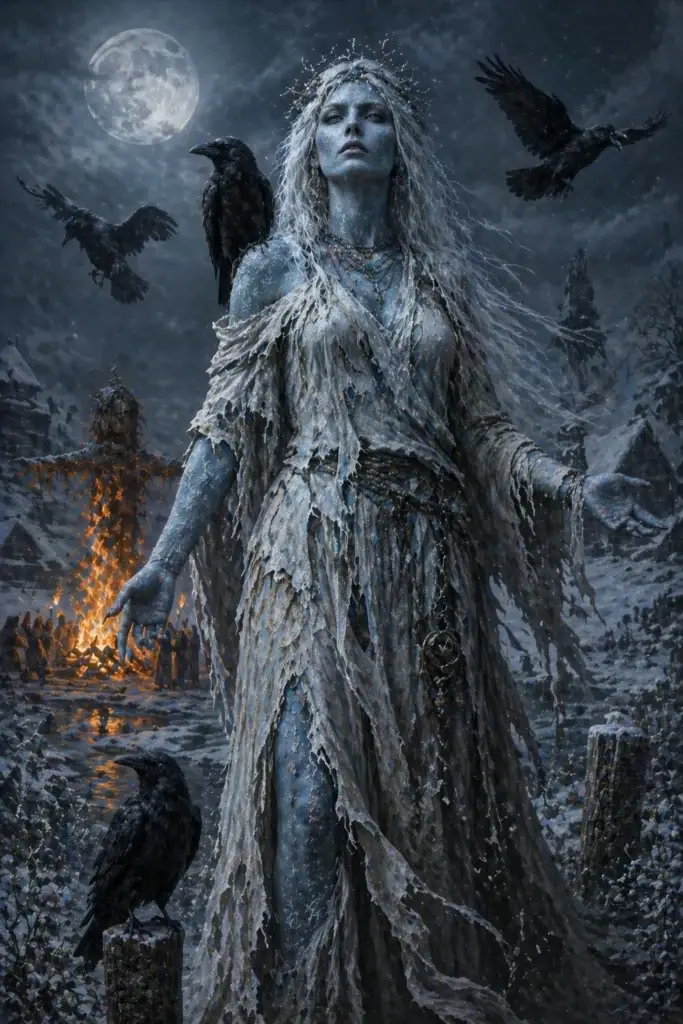
Voltumna: Federal God of the Etruscan League and Divine Patron of the Twelve Cities
By Ralf Ittermann · last reviewed on
Voltumna (in Latin also Vertumnus, in Etruscan Veltha or Velthune) is the highest federal god of the Etruscan league comprising twelve cities.
His sanctuary, the Fanum Voltumnae, lay near Volsinii and was the site of the annual assembly of the Etruscan league. This account describes his religious-political and cultic position within the Etruscan state.
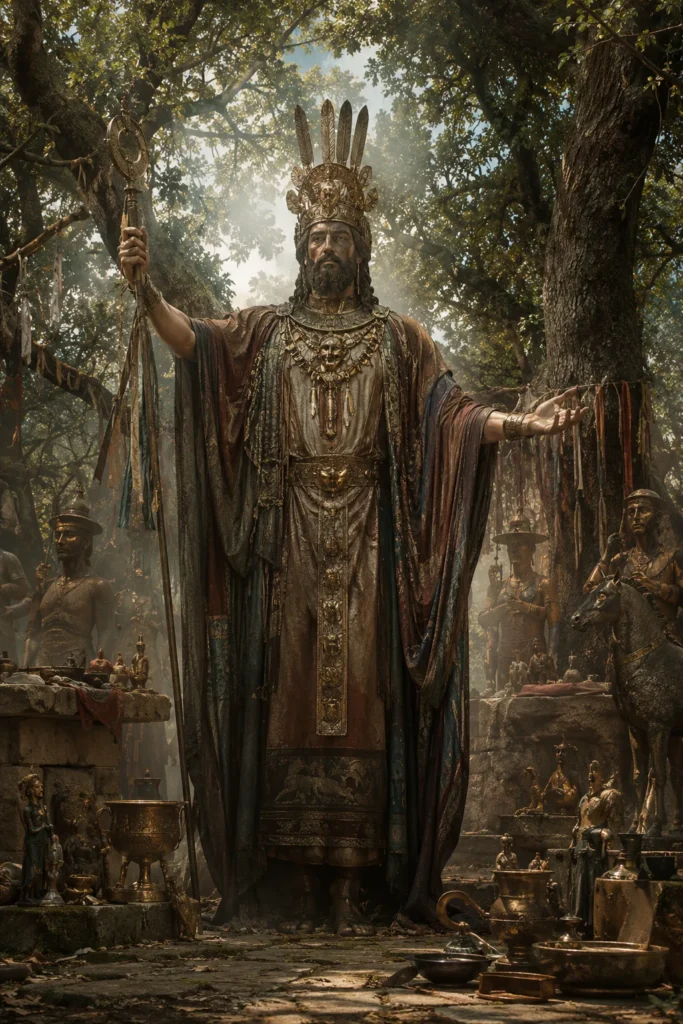
Profile: Voltumna
Voltumna: the most important aspects at a glance. The following fields summarise origin, function, appearance, veneration, symbols and parallels.
Voltumna, in Etruscan Veltha or Velthune, is the federal god of the Etruscan League of twelve cities. His cult was linked with the confederation of twelve cities (Dodecapolis), and the city of Volsinii guarded his federal sanctuary. The etymology of the name is uncertain.
As a politically determined federal god, Voltumna is protective god of the Etruscan League as a whole; his cult bears a state organisation. He was invoked at city foundings, the forming of alliances and political treaties. A connection with the changing of vegetation is discussed in scholarship.
The iconographic tradition is thin. On some Etruscan coins a male figure is depicted who is identified with Voltumna. He sometimes carries ears of grain, flowers or grapevines, which would support his vegetation function.
At the Fanum Voltumnae near Volsinii the confederation of the twelve cities assembled annually for sacrifices (bulls, sheep, pigs), prayers, processions and festival games. After the Roman conquest of Volsinii (264 BCE) the sanctuary continued in modified form.
Connected with Voltumna are ears of grain, flowers and grapevines on Etruscan coins as well as the sacrificial animals bull, sheep and pig. The Roman Vertumnus is attested by a statue in the Vicus Tuscus as a changing vegetation deity.
Voltumna lived on in the Roman Vertumnus; whether the two are identical is discussed. As federal gods, Zeus Hellanios, Jupiter Latiaris of the Latin League and Yahweh as the Israelite federal god are compared. The parallel to Jupiter Latiaris is regarded as especially revealing.
Classification within the Etruscan pantheon
Voltumna holds a special position within the Etruscan pantheon: he is not primarily a ‘cosmic’ high god like Tinia, but a politically and religiously defined federal god. His cult was tied to the institution of the league of twelve cities (Dodekapolis). The city of Volsinii was the guardian of his federal sanctuary.
Massimo Pallottino, Mauro Cristofani and Simonetta Stopponi shaped Voltumna scholarship in several works. Stopponi’s excavations at the Campo della Fiera near Orvieto made the probable localization of the Fanum Voltumnae possible.
The federal god Voltumna belongs to a religion that is so instructive for religious studies because it mediates between the Greek-Mediterranean and the Italic-Roman worlds of tradition.
Essential contributions to its study were made by Massimo Pallottino, Jacques Heurgon, Sybille Haynes, Mauro Cristofani and Giovanni Colonna, whose works sharpened the picture of an independent religious tradition.
Etruscan theology knew a clearly structured pantheon with graded ranks and distributed responsibilities, within which Voltumna held his own, politically and religiously determined position. Where older studies portrayed this system as enigmatic or alien, today one sees an independent variant of Mediterranean religion.
In the religious history of Italy, the Etruscans acted as mediators between Greek influences and the emerging Roman religion. The fact that, with Voltumna, an Etruscan deity lived on in the Roman Vertumnus is one example of this mediating role, which is of particular interest to religious studies.
The religious-ethnological research of recent decades regards Etruscan religion as a self-contained, religiously and phenomenologically independent system. The older tendency to read it as a mere derivative of Greek religion has given way to a markedly more differentiated view, from which the understanding of Voltumna also benefits.
Name and etymology
The Etruscan name Veltha, or Velthune, is rendered in Latin as Voltumna or Vertumnus. The etymology is uncertain; proposals range from ‘the growing one’ to ‘the changing one’. A connection to the seasonal change of vegetation is discussed in scholarship.
The Latin Vertumnus is attested in Rome as a god of change and vegetation; whether he is identical with Voltumna or an independent Roman deity is debated. The Roman sources are more productive here than the Etruscan ones.
Etruscan stands on its own linguistically; it is considered isolated or is hypothetically assigned to a Tyrsenian family, to which Lemnian and Raetic may also belong.
Work on deciphering the texts has been under way since the 19th century, and it is not complete, which also concerns the interpretation of names such as Veltha or Velthune.
The authoritative epigraphic collection of the Etruscan language corpus is Helmut Rix’s Editio Minor. Today it is supplemented by the Thesaurus Linguae Etruscae and the online database ETP, the Etruscan Texts Project, in which the material on Voltumna can also be accessed.
Already in antiquity the origin of the Etruscans was disputed: Herodotus derived them from Lydia, while Dionysius of Halicarnassus held them to be an indigenous Italic people. The question is relevant for religious history because it determines whether Etruscan religion shows connections to Anatolian cults.
Linguistics and epigraphy work closely together today. The digital edition of Etruscan texts, the Etruscan Texts Project (ETP), considerably facilitates comparative investigations, for instance into theonyms such as Veltha. Pioneering contributions to this have been made by Marie-Laurence Haack and Vincent Jolivet.
Description and iconography
The iconographic tradition of Voltumna is relatively thin. On some Etruscan coins a male figure is depicted who is identified with Voltumna. He sometimes bears vegetal symbols, ears of grain, flowers, grapevines, which would support the vegetation function.
In Rome, Vertumnus is attested by a famous statue in the Vicus Tuscus, which shows him as a changing vegetation deity. This statue is mentioned by Propertius and other Roman authors.
From the standpoint of religious phenomenology, Etruscan pictorial art is of great richness and at the same time the principal source of our knowledge.
Mirrors, vases, tomb paintings and bronzes carry the bulk of the material, while the tradition concerning Voltumna himself is comparatively thin. Larissa Bonfante stressed in her studies that this visual language is an independent tradition and not merely derivative.
A first-rate source on the religion and eschatology of the Etruscans is tomb painting, preserved above all in Tarquinia, Cerveteri and Vulci. Its images show banquets, mythological episodes, as well as dance and music, and project an afterlife that is conceived as a continuation of earthly life.
Etruscan iconography favors multi-figure compositions, narrative allusions and symbolically condensed pictorial statements. The interpretation of this visual language is the task of Etruscan religious iconography.
Characteristic of Etruscan pictorial art is a dense narrative layering: even a single mirror or vase can contain several mythological references at once. This condensation requires scholarship to carefully analyze the respective pictorial context.
Voltumna and the Etruscan league
The twelve principal Etruscan cities, Tarquinia, Caere, Vulci, Veji, Clusium, Volsinii, Cortona, Perugia, Arezzo, Volterra, Populonia and Roselle, formed a religious-political league (Dodekapolis) that met annually at the Fanum Voltumnae. This assembly served both religious and political purposes: sacrifices, federal decisions, common festival games.
Livy (4.23, 5.17) reports in detail on these federal meetings. For religious studies, Voltumna is thus an example of a ‘political god’ whose cult sustains a state organization.
A fully developed narrative literature, of the kind the Greek and Roman tradition knows, does not exist for Etruscan mythology. What we know, including about Voltumna, must be inferred from pictorial representations, inscriptions and the reports of Greek and Roman authors. This indirect source situation demands particular methodological caution.
The relationship between Etruscan and Greek mythology is multilayered. The Etruscans did adopt numerous Greek subjects, for instance concerning Achilles, Odysseus and Oedipus, but they often reinterpreted them and set their own emphases. How this process of appropriation proceeded is examined in detail in scholarship.
Characteristic of Etruscan theology is the council of the gods, the consensus deorum. Even the high god Tinia does not act alone, but takes counsel with the other gods, among whom, with Voltumna, the federal god of the league also counts. From the standpoint of religious phenomenology, this body represents a particular feature.
Etruscan mythology has not left behind a closed narrative tradition; it must be inferred from pictorial scenes, inscriptions and secondary sources, which requires careful interpretation. Precisely with a thinly attested figure such as Voltumna, bringing together the Etruscan caption, the Greek pictorial model and a contextual reading is an important method.
The Fanum Voltumnae
The Fanum Voltumnae is the most important Etruscan federal sanctuary. For a long time its exact localization was disputed. Since 2000, Simonetta Stopponi has excavated a significant temple complex at the Campo della Fiera near Orvieto, which today is identified with high probability as the Fanum Voltumnae.
The complex comprises several temples, altars, wells and assembly areas. The finds range from the 7th century BC into the Roman period. The sanctuary served continuously for roughly 1,000 years as a religious and political center.
The Disciplina Etrusca, the ordered divinatory system of the Etruscans, is divided into the inspection of entrails (haruspicina), the interpretation of lightning (fulguratura) and ritual knowledge. Passed on from the Etruscans to the Romans, it remained a living practice until the 4th century AD. We owe detailed accounts to Cicero and Seneca.
The Disciplina Etrusca was taught in priestly schools that existed specifically for this purpose. Among its important writings were the Libri Rituales, the Libri Haruspicini and the Libri Fulgurales. These texts are not preserved, but can in part be reconstructed from quotations by Roman authors such as Cicero, Festus and Macrobius.
The Etruscan cult was strongly tied to the respective city. Each of the important centers, that is Tarquinia, Caere, Vulci, Veji, Clusium, Volsinii, Cortona, Perugia, Arezzo, Volterra, Populonia and Roselle, maintained its own principal cults and religious peculiarities. Volsinii had a special role here, since it guarded the federal sanctuary of Voltumna.
As a closed religious-divinatory system, the Disciplina Etrusca is among the most highly developed divinatory practices of the ancient world. The Romans adopted it systematically, and it was continued into late antiquity. This continuity is remarkable in religious-historical terms.
Cult and rituals
The cult practice at the Fanum Voltumnae included sacrifices (bulls, sheep, pigs), prayers, processions and festival games. The annual assemblies were important religious and political events for the entire Etruscan world.
After the Roman conquest of Volsinii (264 BC), the Voltumna sanctuary was not abandoned; it continued in modified form and was in part integrated into the Roman cult. This continuity documents the religious significance of Voltumna even beyond the political downfall of Etruria.
Etruscan temples exhibit architectural peculiarities. Characteristic is the Tuscanus style, a distinct column order that Vitruvius describes in De Architectura. The ground plans emphasize the cella and a wide front hall and differ markedly in this from Greek models.
Many Etruscan temples were laid out monumentally. The Jupiter temple on the Roman Capitoline, for instance, was built by Etruscan architects and artists, above all by Vulca of Veji, and is regarded as an architectural testimony of Etruscan religiosity in early Rome.
Every year the league of the twelve Etruscan cities assembled at the Fanum Voltumnae near Volsinii, where religious and political affairs were negotiated at the same time. Voltumna was the federal deity of this league and possessed a significance that reached beyond the individual city cults.
Protective traditions and politics
Voltumna was the protective god of the Etruscan league as a whole. Whoever turned to the league turned to Voltumna. This political-religious fusion is interesting for religious studies: it shows a religion that organizes not only individual piety but also interstate relations.
In an apotropaic sense, Voltumna was invoked in city foundations, the formation of alliances and political treaties. This practice partly continued into Roman city-foundation rituals.
Among Etruscan protective customs is a series of averting signs: phallus amulets, Gorgoneion images, eye symbols, bullae and certain formulas.
Averting symbols were widespread in Etruscan culture, among them the eye of Tinia, phallus amulets and Gorgoneia. They adorned temples and tombs just as much as household shrines and personal property. In Roman as in Mediterranean folk belief, this practice lived on.
In the Etruscan context, protective action was closely linked to the Disciplina Etrusca. Before every significant undertaking, be it a city foundation, a military campaign or the building of a house, one obtained the will of the gods through divination, which applied in particular to the political decisions of the league around Voltumna.
Parallels in other cultures
Voltumna can be compared with other federal gods: Zeus Hellanios (panhellenic Zeus), Jupiter Latiaris (Latin Jupiter) or Yahweh in his function as the Israelite covenant god. The connection of political confederation and religious cult is a widespread phenomenon of ancient religious history.
In particular, the parallel to the later Jupiter Latiaris of the Latin League is instructive for religious history. Both federal cults met annually at a central place, both had political functions, both survived political changes.
Through the interpretatio Romana, Etruscan deities received Roman names: Tinia became Jupiter, Uni became Juno, Menrva became Minerva, and Voltumna lived on in the Roman Vertumnus. Such equations were usually not comprehensive, but emphasized only partial aspects. The research of the past fifty years works out which Etruscan peculiarities were thereby preserved.
Etruscan religion shows manifold points of contact with Anatolian, Phoenician and Near Eastern traditions. The Pyrgi Tablets in particular attest to the Phoenician exchange. This trans-Mediterranean interconnection has been an important field of research for some decades.
From a comparative-religion perspective, the Etruscan cult belongs to the wider Mediterranean religious family and stands in relation to Greece, Phoenicia, Egypt, Anatolia and Latium. This embedding forms a significant field of research.
Present-day research
Voltumna scholarship has experienced a massive upswing since the 2000s through the excavations at the Campo della Fiera (Simonetta Stopponi, University of Perugia). Annual excavation reports and several monographs document the finds.
Interdisciplinary studies on Etruscan statehood (Mauro Cristofani, Adriano Maggiani) also systematically include Voltumna. His cult is a key to understanding Etruscan federalism.
Etruscan religion is today the subject of internationally networked research. Among the important centers are the universities of Florence, Rome Sapienza, Pisa, Tübingen and Princeton. Each year several international conferences are devoted to individual aspects of the topic.
International projects on Etruscan religion today draw on digital methods: three-dimensional scans of temples and tombs, databases for inscriptions and pictorial sources, as well as GIS analyses of settlement structure. Such methods open up new insights, for instance in the localization of cult sites such as the Fanum Voltumnae.
Present-day Etruscan research is conveyed to a wider public through exhibitions, among others at the Vatican Museum, the Museo Nazionale Etrusco di Villa Giulia and the Boston Museum of Fine Arts, as well as through numerous publications.
Sources and state of research
The most important sources for Voltumna scholarship are the archaeological finds at the Campo della Fiera, the Etruscan inscriptions, the mentions in Livy, the Roman sources on Vertumnus, as well as the epigraphic finds from the Etruscan cities.
A deeper classification within Etruscan religious history as a whole shows how Voltumna is to be understood within the web of relations with Tinia, Uni, Menrva and the other Atua, with the specific feature that he is primarily defined in political-religious terms.
The sources on Etruscan religion are heterogeneous: epigraphic testimonies, collected in Helmut Rix’s Editio Minor, archaeological finds, pictorial sources and secondary literature. This diversity calls for an interdisciplinary approach, and recent research systematically combines philology, archaeology, religious studies and anthropology.
An appropriate source criticism presupposes knowledge of both the Etruscan original testimonies and the Greek-Roman secondary tradition. Precisely with Voltumna, whose Roman counterpart Vertumnus has left more productive traces than some Etruscan sources, this double view is indispensable.
Anyone who wants to classify Voltumna thoroughly in religious-historical terms must survey the epigraphic, archaeological and literary sources as well as the methods of modern religious studies. This multilayered engagement is regarded in scholarship as the standard.
The Fanum Voltumnae: federal sanctuary of the Etruscan cities
Voltumna, also called Vertumnus by Roman authors, is closely connected with a particular cult site, the Fanum Voltumnae.
The Roman historian Titus Livius reports several times that the representatives of the Etruscan cities assembled at this sanctuary in order to deliberate on common affairs, to decide on war and peace, and to hold religious festivals together with games.
The Fanum Voltumnae was thus at once the religious center and the political assembly place of the Etruscan league of cities.
The exact location of the sanctuary was long unknown and the subject of various hypotheses. Since the early 2000s, research has concentrated on the site of Campo della Fiera near Orvieto, the ancient Velzna or Volsinii.
There, excavations under the direction of Simonetta Stopponi have uncovered an extensive sanctuary district with temple foundations, altars, votive offerings and a long history of use. The identification with the Fanum Voltumnae is regarded by many scholars as probable, but, as with many Etruscan findings, it is not secured by an unambiguous inscription.
The findings from Campo della Fiera show that the site remained in use beyond the Etruscan period, in Roman and even still in late-antique times.
This fits the observation that Voltumna’s cult continued even after the Roman conquest of Volsinii and that the god went on being venerated in Roman form as Vertumnus. The federal sanctuary makes clear that Etruscan religion was not only a matter of individual cities, but also had a supra-regional, identity-forming function.
Voltumna, Vertumnus and the question of the god's nature
There is no agreement in scholarship about the nature of Voltumna, and this has to do with the peculiarity of the sources. The Roman scholar Varro describes Voltumna as the highest god of Etruria, deus Etruriae princeps.
Other testimonies suggest a god of vegetation or transformation, which is supported above all by the Roman figure of Vertumnus, who was connected with the change of the seasons and the ripening of the fruits. The poet Propertius has Vertumnus himself speak in a famous elegy and praise his capacity for transformation.
The problem lies in the fact that these statements come from a Roman perspective and were formulated centuries after the heyday of the Etruscan cult. Whether Voltumna was originally a vegetation god, a political federal god or a comprehensive deity with several aspects cannot be decided from the few Etruscan testimonies of their own.
The name itself is connected by some scholars with a root for turning or changing, which would fit the theme of transformation, yet this etymology too is not secured.
Voltumna is thus an example of a fundamental difficulty of Etruscology: a deity can be well attested by ancient authors and nonetheless remain blurred in its original nature, because the testimonies are late, foreign and guided by interest.
Serious accounts therefore mostly give several interpretations side by side, rather than settling on one. The only certainty is the prominent role of the god as a point of reference for the Etruscan league of cities.
Literature (selection)
- Simonetta Stopponi: Il Santuario di Voltumna al Campo della Fiera (several volumes)
- Mauro Cristofani: Gli Etruschi (1984)
- Massimo Pallottino: Die Etrusker (1942, German 1965)
- Larissa Bonfante: Etruscan Mythology (2006)
- Adriano Maggiani: contributions to Etruscan religion
- Livy: Ab Urbe Condita (4.23, 5.17)
Voltumna, also called Veltha or Vertumnus, was the divine patron of the twelve cities of the Etruscan league. His sanctuary, the Fanum Voltumnae near Volsinii, served, according to Livy, as the annual assembly place of the league’s representatives, where religious, political and legal questions were negotiated together.
As the divine point of reference for the league, Voltumna thus stood less in the domestic cult than in state representation and secured the ritual bracket between otherwise independent city-states.
The Etruscan myth names Voltumna as the highest federal god of the twelve cities; in his sanctuary, the Fanum Voltumnae near Volsinii, the representatives of the Etruscan league came together annually for deliberation and festival cult.
Related key terms: Voltumna Etruscans Fanum Voltumnae league Dodekapolis Volsinii Vertumnus Campo della Fiera.
iWell Guard and protective traditions
iWell Guard ties in with the cultural-historical tradition of portable protective objects, in the tradition of Etruscan and many other cultures worldwide. 41 layers, solid gold, platinum, silver, made in Germany. 30-day right of return.
Personal experiences may vary. Not a medical device. No promise of healing.