Tanit, Punic-Carthaginian chief goddess and "Pene Baal"
By Ralf Ittermann · last reviewed on
Tanit (Punic tnt) is the supreme female deity of Punic Carthage and its colonies. She appears regularly in association with Baal-Hammon and bears the title pene Baʿal (“Face of Baal”). Her “Hand Symbol” stelae from the Tophet are among the most characteristic visual signs of Punic religion.
Tanit is the Punic-Carthaginian chief goddess and consort of Baal-Hammon.
Classification and Brief Profile
Tanit is a goddess with scarcely any attestation in the Phoenician homeland, yet she rose to become one of the most important deities in Carthage and the western Mediterranean Punic colonies.
Maria Eugenia Aubet demonstrated in The Phoenicians and the West (2001) that Tanit only became chief goddess in Carthage during the 5th century BCE. Within the Phoenician tradition she therefore represents a specifically western development.
Sabatino Moscati described the Carthage-specific religion with Tanit as its apex deity in detail in Il mondo dei Fenici (1966) and in numerous later studies. She appears regularly before Baal-Hammon on the Tophet stelae (infant burials with dedicatory inscriptions), which underscores her standing as the supreme protective goddess of the Punic family and state.
From a history-of-religions perspective, Tanit represents the type of the state goddess found in several Mediterranean cultures (cf. Hebat among the Hittites, Astarte in Phoenicia, Roma in Rome). Her relationship to Baal-Hammon as husband or companion is the most important theological bond. Together the two form the supreme divine pair of Carthage.
An interesting question in scholarship concerns the possible prehistory of Tanit in the Phoenician homeland. Isolated attestations from Sarepta and Sidon suggest that a predecessor goddess existed who developed into an independent chief goddess in Carthage. This “Tanitic” transformation is one of the most remarkable history-of-religions phenomena of the western Mediterranean.
Name and Etymology
The etymology of the name Tanit has not been definitively resolved. One plausible interpretation connects it to the West Semitic root tnn “to lament, to wail,” which would suit a mourning-goddess function.
Another interpretation views the name as a Berber loanword, which would fit the Libyan-Numidian component of Carthage. A third possibility is a connection with Ugaritic attestations of a goddess Tannit.
In inscriptions she appears as tnt pn bʿl “Tanit, Face of Baal.” This epithet emphasizes her theological function as an appearance or manifestation of Baal-Hammon. In Greek sources she is identified with Hera or with Artemis Caelestis; in the Roman period with Juno Caelestis, who later became an important African-Roman chief goddess.
The Greek and Roman reception as “Lady of Heaven” connects her with an astral aspect; the lunar symbol is regularly associated with her. The famous “moon and star” stelae from the Tophet of Carthage clearly show this astral connotation. Charles Krahmalkov assembled the most important epigraphic attestations in A Phoenician-Punic Grammar (2001).
An important theological consequence of the epithet “Face of Baal” is the view of Tanit as a hypostatic appearance of Baal-Hammon. In this interpretation Tanit is not simply an independent goddess but the personified revelatory aspect of Baal, a kind of divine face through which the highest god appears in the world.
Description and Iconography
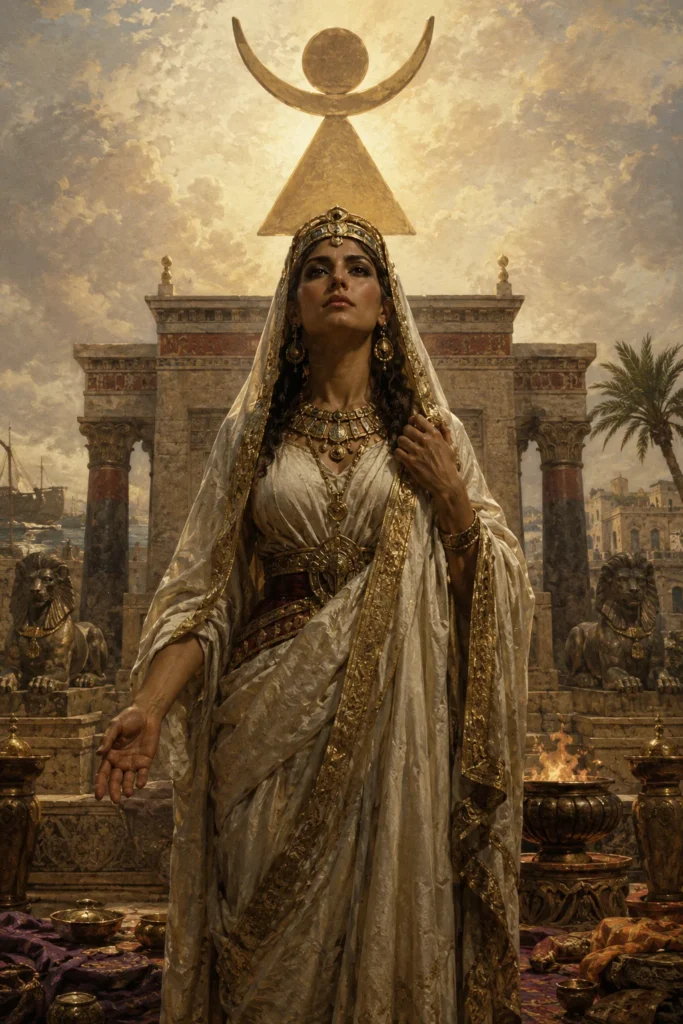
Tanit is iconographically famous for the “Tanit Symbol” or “Sign of Tanit” named after her: a stylized female figure with a triangle as the body, a horizontal bar as arms, and a circle as the head.
This sign appears on thousands of stelae from the Tophet sanctuary of Carthage and is one of the most recognizable symbols of Punic religion.
On the stelae she frequently appears in the company of additional symbols: the “Hand of Tanit” (an open hand as a protective sign), crescent and star, pomegranate, lotus flower. Sometimes the Tanit sign stands alone, sometimes in combination with the “caduceus” or with ship-prow symbols. This iconographic richness reflects the multifunctional character of the goddess.
Anthropomorphic representations are rarer; an important exception is a statuette from Thinissut (Tunisia) showing Tanit as an enthroned goddess with a polos crown and sphinx attendants.
In the Hellenistic-Roman phases she also appears increasingly in human form, especially after her identification with Juno Caelestis. The archaeological finds from the Tophet have been published in detail in several studies, including the work of Helene Benichou-Safar on Carthaginian religion.
Mythological Narratives
Actual mythological narratives about Tanit are largely absent. Unlike the material for Baal or Anat, no myth is preserved in which Tanit acts as a protagonist within a narrative sequence. She is primarily a cultic-ritual deity whose significance is understood through practice, not through myth.
A few fragmentary allusions to a Tanit myth in Carthage appear in late authors (Augustine, Tertullian); most of these accounts are, however, polemical and unreliable. Tertullian (Apologeticum 9) gives a graphic account of child sacrifices to Saturn (= Baal-Hammon) and his consort, an allusion to Tophet practice without any mythological background.
From a history-of-religions perspective this poverty of myth is typical of “city goddesses” of the late Bronze Age and Iron Age: they are central to cult but peripheral in mythology.
Arinna of the Hittite tradition shares this profile: supreme state goddess without her own mythological narrative. The theological function lies in constant presence, not in narrative action.
The scarcity of myth surrounding Tanit stands in interesting contrast to the rich symbolic world of the Tophet stelae; her theological significance is therefore not primarily narrative but anchored in symbol and cult. This shift from myth to symbol is noteworthy from a history-of-religions perspective.
Cult and Veneration
Tanit’s main cult site was the Tophet sanctuary of Carthage, an area that grew in multiple strata and contained thousands of urn burials of small children and young animals, each accompanied by inscriptions dedicated to Tanit and Baal-Hammon.
The precise significance of Tophet practice has been debated for generations: do the deposits represent regular child sacrifices (as classical sources such as Diodorus, Plutarch, and Tertullian claim) or burials of infants who died naturally (as more recent interpretations suggest)?
Current scholarship tends toward an intermediate position: both naturally deceased infants and sacrificed children were buried in the Tophet, in varying proportions depending on crises or particular religious obligations (neder, votive offerings).
Lawrence Stager, Joseph Greene, and Brian Schmidt analyzed bone finds in several studies; the discussion has not been concluded. From a religious-studies standpoint the Tophet is in any case one of the most remarkable sanctuaries of the Iron Age.
In addition to Carthage, Tophet sanctuaries are known at Motya (Sicily), Tharros (Sardinia), Sulcis (Sardinia), Hadrumetum (Tunisia), and several other Punic colonies. At each of these sites Tanit was venerated as the principal recipient of votive dedications. Sabatino Moscati documented the Punic sites systematically.
The interpretation of the Tophet deposits as burials rather than sacrifices is advocated especially by Jeffrey Schwartz and Frank Houghton; Lawrence Stager, by contrast, considers the sacrifice interpretation historically established. Both positions have faced each other in scholarship and continue to be debated.
Protective Practice and the Apotropaic
Tanit was the protective goddess of the family, of children, of pregnant women, and of the Punic polis as a whole.
The “Hand of Tanit” symbol appears apotropaically on house entrances, on amulets, and on animal enclosures; it was one of the most common protective signs in the Punic world. The open hand with outstretched fingers signals warding-off and divine protection.
Apotropaic Tanit statuettes were placed in homes; thousands of “Tanit plaques” in terracotta have been found at Carthaginian domestic sites. They served household protection, birth protection, and general piety. This private piety is well documented and contrasts with the state-ritual Tophet practice.
In Punic inscriptions Tanit appears as the recipient of neder vows in times of crisis: before births, before journeys, before battles, during illness. The frequency of her invocation shows the intense private piety of the Punic population.
The iWell Guard records Tanit as a historical-religious-studies figure without any current efficacy claims; the Tophet practice is today reconstructable only as a historical phenomenon in religious-studies discussion, not as something to replicate.
The neder inscriptions from the Tophet are an important primary source for Tanit’s devotional practice.
They follow a standard formula: “To the Lady Tanit, Face of Baal, and to the Lord Baal-Hammon, that which N.N. vowed, because he/she/it heard him/her/it.” This formula is transmitted in thousands of variants and belongs to the best-documented epigraphic corpora of the ancient world.
Parallels in Other Cultures
From a history-of-religions perspective Tanit is related to Astarte, to the Phoenician Baalat (“Lady”), to the Mesopotamian Ishtar, and to Atargatis of the later Syrian tradition.
In the Hellenistic-Roman period she was identified with Hera, Juno, Artemis Caelestis, and Demeter. The most significant syncretism is Juno Caelestis, an African-Roman chief goddess of the Roman imperial period who descends directly from Tanit.
Tanit shares with Hebat of the Hittite tradition the function of supreme female state goddess. With the Greek Artemis Ephesia she shares the astral “Lady of Heaven” profile. From a religious-studies perspective she is one of the most important figures of the western Mediterranean Iron Age.
In the Roman imperial period Tanit-Juno Caelestis remained present into the 4th century CE; her temple in Carthage was a significant religious center even after the fall of the Punic state.
Only Christian late antiquity brought her end; Augustine polemicizes extensively in De civitate Dei 2.4 against the Caelestis cults as the epitome of “pagan immorality.”
In the Numidian and Mauretanian traditions Tanit became a mediator between Punic and Libyan religion; she appears on Berber stelae with local epithets of her own. This “Berberization” of Tanit in the Hellenistic-Roman period is historically significant and is treated in detail in Marcel Le Glay’s studies Saturne africain (1966).
Modern Reception and Research
Tanit scholarship today stands at a high level. Sabatino Moscati, Maria Eugenia Aubet, Helene Benichou-Safar, Lawrence Stager, and Joseph Greene are among the most important authorities. Ongoing excavations in Carthage, at Motya, and at Tunisian sites regularly yield new material; Roald Docters’ work on Carthage topography has become important in recent years.
In popular reception Tanit is known above all through the Tophet controversy; the question of child sacrifices has strongly shaped her public perception. In modern Tunisia Tanit has experienced a modest renaissance as a cultural symbol; the “Sign of Tanit” appears occasionally in Tunisian symbolism and in North African art.
From a religious-studies perspective Tanit is today regarded as a central subject of study for Punic religion, for Tophet practice, and for western Mediterranean religious history. Current research focuses on the archaeological analysis of Tophet bones, on the iconographic history of the Sign of Tanit, and on the question of the Berber component.
The iWell Guard records Tanit as a historical pantheon member and not as a present-day recipient of protective invocation. A spiritual revival in a neo-pagan sense has not been observed.
Current studies on the age determination of burnt bones and teeth from the Tophet, conducted under Patricia Smith and Gal Avishai, indicate that the Tophet burials were predominantly newborns and infants in the first year of life, which is compatible both with infant mortality and with ritual sacrificial practice.
Literature and Sources
The following selection brings together the most important standard works on Tanit scholarship. It includes archaeological reports on the Tophet, history-of-religions syntheses, and inscription editions. Moscati, Aubet, and Benichou-Safar form the classical canon; Stager and Greene represent the newer bioarchaeological studies. Brian Doak’s work on Phoenician aniconism provides the iconological perspective.
The Tophet of Carthage and the Debate over Child Sacrifice
No topic in Phoenician-Punic religious history is as contested as the Tophet of Carthage, a precinct in the south of the city where urns containing cremated bones of infants and young animals were deposited over centuries.
Above the urns there often stood stelae with dedicatory inscriptions, many of them addressed to Tanit and Baal-Hammon. The site was excavated from 1921 onward and named Tophet after a biblical place designation.
Ancient authors such as Diodorus Siculus and Plutarch report Carthaginian child sacrifices to Cronus, by which they meant Baal-Hammon. For a long time this was taken as evidence of a cruel Punic practice.
Since the 1980s, however, scholars such as Sabatino Moscati and later a group around Jeffrey Schwartz have called this interpretation into question. They pointed to the high rate of infant mortality in antiquity and proposed seeing the Tophet as a cemetery for children who had already died.
The opposing position, represented among others by Paolo Xella and studies in the journal Antiquity from 2011 and 2013, maintains the sacrifice interpretation. It relies on the dedicatory inscriptions, which explicitly speak of a vow, on the absence of regular adult burials, and on the bone ages, which show a concentration.
An intermediate view holds that the Tophet received both votive sacrifices and burials of children who died early. The debate has not been settled. For Tanit this means that her main cult site is simultaneously the darkest and the most hotly debated finding in her entire tradition.
The Sign of Tanit
On countless Punic stelae, especially from the Tophet of Carthage, there appears a simple symbol that scholars call the Sign of Tanit.
It consists of a triangle with a horizontal bar resting on top of it, and above the bar a circle or disk. The ends of the bar are often curved upward, so that the whole resembles a stylized human figure with outstretched arms.
There is no consensus on the origin and precise meaning of the sign. Some see it as a schematic representation of the goddess herself; others see it as a symbol derived from the Egyptian ankh life sign; still others see a combination of altar, officiant, and sun disk.
The traditional name “Sign of Tanit” is problematic to the extent that the symbol also appears on stelae addressed exclusively to Baal-Hammon, and is therefore not bound exclusively to the goddess.
The sign is widespread above all in the western Mediterranean: in Carthage, on Sardinia, Sicily, and in North Africa, and there especially from the 5th century BCE onward. In the Phoenician homeland it is considerably rarer. This speaks in favor of its being a specifically Punic, that is to say western Phoenician, development.
It frequently stands alongside further signs such as the upward-opening crescent, the disk, or the raised hand. The combinations of symbols are read in scholarship as a religious visual language, whose precise grammar has not yet been fully decoded.
The Sign of Tanit thus remains one of the best-known and at the same time most enigmatic symbols of the Punic world.
Tanit pene Baal and the Relationship to Baal-Hammon
In the Punic dedicatory inscriptions Tanit appears almost always in close association with Baal-Hammon, and usually in the sequence in which the goddess is named first and the god second.
A frequent epithet reads tnt pn bʿl, rendered Tanit pene Baal, translated as “Tanit, Face of Baal.” The precise meaning of this phrase is disputed.
One interpretation understands the epithet spatially or cultically: Tanit is the one who stands before the face of Baal, thus as an intermediary or as the side turned toward the god.
Another reading sees in it a theological statement according to which Tanit is the visible, accessible appearance of the otherwise remote Baal-Hammon. Others draw a comparison with the biblical concept of the face of God.
It is noteworthy that in the inscriptions the goddess frequently precedes the male god, which is unusual in the Ancient Near East and assigns Tanit a prominent position in Punic cult.
In the Phoenician homeland, by contrast, Tanit is scarcely attested; an early attestation comes from Sarepta, but otherwise she is predominantly a goddess of the West.
Some scholars, including Edward Lipinski, connect Tanit with the sky goddess Astarte or regard her as a western manifestation of the same figure. The available sources do not permit a definitive judgment here.
What is certain is only that the pair Tanit and Baal-Hammon stood at the center of Carthaginian state religion and was jointly invoked in thousands of inscriptions.
Tanit after the Fall of Carthage
The destruction of Carthage by Rome in 146 BCE ended Punic statehood but not the cult of Tanit. In the Roman province of Africa the goddess lived on under a new name.
She was equated with the Roman sky goddess and venerated as Juno Caelestis or simply Caelestis. Septimius Severus, himself of North African origin, and his dynasty promoted this cult, which in the 2nd and 3rd centuries CE found followers throughout the province and beyond.
The continuity is not merely a matter of naming. In Carthage itself a large sanctuary of Caelestis arose on the site of the old Punic cult area. Inscriptions and dedications show that veneration continued unbroken over centuries, even as the religious language shifted from Punic to Latin.
Only Christianity eventually displaced the cult definitively. Church fathers from North Africa, above all Augustine of Hippo, polemicized against Caelestis as a pagan sky goddess. In the early 5th century her temple in Carthage was closed.
The history-of-religions significance of this long afterlife lies in showing how tenacious a chief deity can be, even when the political entity that had sustained her cult had long since fallen.
Tanit did not disappear with Carthage; she transformed her form and survived under a Roman name for another half millennium before vanishing from the religious life of North Africa.
Literature (Selection)
- Sabatino Moscati: Il mondo dei Fenici (Milano 1966)
- Maria Eugenia Aubet: The Phoenicians and the West (Cambridge 2001)
- Helene Benichou-Safar: Le tophet de Salammbô à Carthage (Rome 2004)
- Lawrence Stager / Joseph Greene: in Studies in the Archaeology of Israel and Neighboring Lands (Atlanta 2000)
- Charles Krahmalkov: A Phoenician-Punic Grammar (Leiden 2001)
- Brian Doak: Phoenician Aniconism in its Mediterranean and Ancient Near Eastern Contexts (Atlanta 2015)
Tanit is the Punic-Carthaginian chief goddess and companion of Baal-Hammon, whose sign consisting of a triangle, crossbar, and sun disk is attested on numerous stelae from the Tophet of Carthage.
Related key terms: Tanit Carthage Phoenician Tophet Baal-Hammon Juno Caelestis pene Baal.
iWell Guard and Protective Traditions
iWell Guard draws on the cultural-historical tradition of wearable protective objects, in the tradition of Phoenician and many other cultures worldwide. 41 layers, real gold, platinum, silver, made in Germany. 30-day return policy.
Personal experiences may vary. Not a medical product. No healing claims.