iWell Guard

Astarte, Phoenician Goddess of Love, War, and Kingship

Astarte (Phoenician ʿštrt) is the most important female deity of the Phoenician pantheon and appears in the city-states of Sidon, Tyre, Byblos, Kition, and throughout the Phoenician Mediterranean world. She is the goddess of love, war, kingship, and fertility.

GoddessPhoenicianHigh Deity

Table of Contents

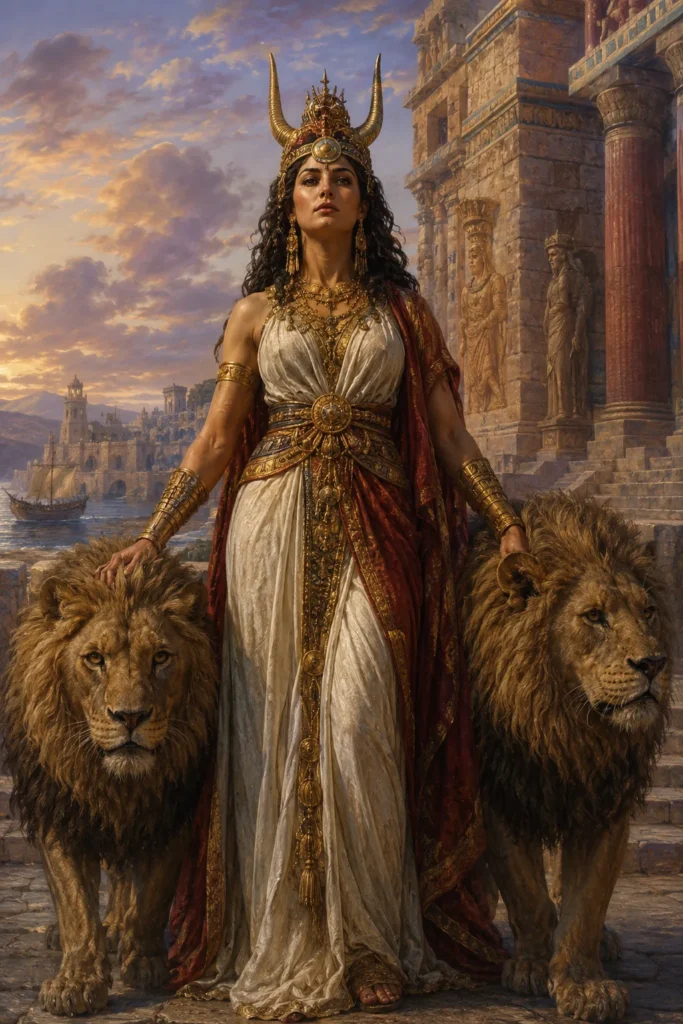
Astarte Phoenix - Gods from the Phoenician tradition, historical illustration

Classification and Brief Profile

Astarte (Akkadian Ishtar, Ugaritic ʿAṯtartu) is the Phoenician form of one of the oldest female deities of the ancient Near East. Sabatino Moscati demonstrated in The Phoenicians (1966) that Astarte held a central position in nearly every Phoenician city-state, frequently as the consort of the local chief god.

In Sidon she is the consort of Eshmun; in Tyre she appears alongside Melqart; in Byblos alongside Baalat. Within the Phoenician tradition she is by far the most important goddess.

Corinne Bonnet presented the most comprehensive monograph on this deity in Astarté (1996).

She shows that Astarte had a very broad functional profile: goddess of love and sexuality, goddess of war, protector of royalty, patron of seafarers, healing goddess, and in certain contexts a chthonic-underworld function as well. This multifunctionality is characteristic of ancient Near Eastern goddesses of the ʿAṯtart/Ishtar family.

From the perspective of the history of religions, Astarte belongs to the West Semitic goddess type that developed from the Old Syrian-Amorite Aṯtart tradition. During the first millennium BCE she was identified with the Greek Aphrodite; the Cypriot Aphrodite tradition derives directly from Phoenician Astarte, as Herodotus already noted.

An important city-specific form is the “Astarte of Lebanon,” mentioned in several inscriptions; she was probably identical with the Astarte of Beirut. An “Astarte of the Sea” is also attested in Tyre. This variety of hypostases is typical of Phoenician religion and makes Astarte the most extensively differentiated goddess of the pantheon.

Astarte’s position in the Phoenician pantheon is comparable to that of the Hittite Sun Goddess of Arinna or to Hebat as the supreme female state goddess.

Name and Etymology

The name ʿštrt (Astarte) is West Semitic and belongs to the root ʿštr, which also underlies ʿAṯtartu (Ugarit) and Ishtar (Mesopotamia). The etymology has not been definitively established; one plausible interpretation connects the root with the word for “star” and understands Astarte as “the Star Goddess,” likely with reference to the morning star (Venus).

In Phoenician inscriptions she appears as ʿštrt, and likewise in Punic texts. An important Hellenistic form is Ashtart with Aramaic vowel shift.

In Akkadian she is identified with Ishtar; in the Hellenistic world with Aphrodite or Hera (depending on the functional emphasis); in Egypt she appears from the New Kingdom onward as an independently imported deity under the name Astarte, retaining her West Semitic character there as well.

The Greek Aphrodite Urania corresponds directly to the Phoenician Astarte; Herodotus traces her veneration from Phoenicia via Cyprus to Greece. This line of transmission makes Astarte one of the most historically influential goddesses in the Mediterranean world.

In certain texts she is also designated “Heaven Lady” or “Queen of Heaven,” a title that also appears in the biblical book of Jeremiah (Jer 7:18; 44:17, 19) where it is commented on critically.

This “Queen of Heaven” tradition has been examined in the history of religions by Saby Cave and represents an important link between Canaanite and biblical religious history.

Description and Iconography

Astarte appears in Phoenician iconography in several image types: as a nude standing goddess (the posture of the “Astarte plaque”), as a throned queen with a polos crown, as a war goddess with spear and shield, as a rider on a lion, or as a celestial queen within a frame of stars. This visual variety reflects her multifunctionality.

Her sacred animal is the lion or lioness; in Sidon and Carthage she frequently appears enthroned or riding on a lion.

The dove is also associated with her, especially in Cypriot and broader Mediterranean contexts; the doves of Aphrodite are a direct legacy of Phoenician Astarte. A further animal association is the serpent, representing her chthonic dimension.

In the western Mediterranean colonies, especially in Tartessos (Spain), Astarte was venerated with particular intensity; the famous bronze figure “Astarte of El Carambolo” from the seventh century BCE shows her as a throned goddess with a Phoenician dedicatory inscription.

Astarte figurines have also been found in Seville, Cadiz, and other sites, documenting the intense presence of her cult.

In Kition (Cyprus) a large Astarte temple was excavated, one of the largest sanctuaries of the Iron Age Mediterranean world. Excavations conducted by Vassos Karageorghis and more recently by Maria Iacovou have substantially broadened our understanding of Phoenician cult practice on Cyprus.

Mythological Narratives

In the Ugaritic texts (KTU 1.92 and others) Astarte appears as a hunting goddess and companion of Baal; in the Baal Cycle, however, she plays a lesser role than her sister Anat.

In Phoenician mythological fragments, above all in Philo of Byblos (as cited by Eusebius), she appears as a queen who travels to Tyre on a bull and there assumes the royal throne.

Philo reports that Astarte “found a bull’s head” and placed it on her own head, thereby confirming her divinity. This narrative recalls the Egyptian Hathor tradition and the Mesopotamian Inanna-Anu story. Albert Baumgarten edited this material critically in The Phoenician History of Philo of Byblos (1981).

In Hellenistic texts Astarte is connected with the Europa narrative: Europa, daughter of King Agenor of Tyre, was abducted to Crete by Zeus in the form of a bull.

This connection is striking from a history-of-religions perspective: Astarte is both the mother of Europa and her divine background. The Europa mythology is thus a Helleno-Phoenician synthesis.

From the Carthaginian period, a connection between Astarte and the heroic figure of Dido is attested; Queen Dido, founder of Carthage, is interpreted in some Roman sources as a “priestly incarnation” of Astarte. This identification is illuminating from a history-of-religions standpoint.

Cult and Veneration

Astarte’s most important cult centers were Sidon (temple of Astarte, built by Eshmunazar II), Tyre, Byblos (with Baalat), Kition (Cyprus, where a large Astarte temple dominated the island), Carthage, and the Mediterranean colonies. Maria Eugenia Aubet documented the Mediterranean spread in The Phoenicians and the West (2001).

The cult included burnt offerings, libations, and the so-called “sacred dance festival” mentioned in several Phoenician sources.

The qedeshim and qedeshot, consecrated men and women, played a particular role whose precise function remains debated in scholarship; Annie Caubet, Corinne Bonnet, and Stephanie Budin have argued against the older interpretation as “temple prostitution,” though the question has not been conclusively resolved.

In the Hellenistic period Astarte was identified with Aphrodite; the famous Aphrodite sanctuary at Paphos on Cyprus is, from a history-of-religions perspective, the direct continuation of Phoenician Astarte veneration. The Phoenician Astarte tradition was also carried forward under the Greek name at Corinth, at Eryx (Sicily), and at numerous other Mediterranean sites.

In Carthage, Astarte was gradually displaced by Tanit without disappearing entirely; in the Tophet inscriptions both goddesses occasionally appear side by side. This rivalry between two female high goddesses is one of the most distinctive features of Punic religion.

Protective Practice and the Apotropaic

Astarte was the protective goddess of royal families, pregnant women, seafarers, and warriors. In Sidon she appears on royal seals as the patron of the royal house; the famous inscription of King Eshmunazar II (fifth century BCE) names her alongside Eshmun as the supreme protective goddess.

Apotropaic Astarte figurines were placed in houses; the so-called “Astarte plaques,” small terracotta reliefs of a nude woman, are known from thousands of examples at Phoenician sites.

They probably served purposes of protection, invocations of fertility, and household guardianship. The function of these plaques is debated in scholarship; their frequency is in any case evidence for the intensity of domestic Astarte veneration.

In Phoenician travel rituals, Astarte was invoked as patron of seafaring; captains and merchants brought her votive offerings before and after voyages.

This “piety of travel” is of interest to the history of religions because it directly frames the international mobility of the Phoenician world in religious terms. The iWell Guard records Astarte as a figure of historical and religious-studies significance, without any current claims of healing or efficacy.

Phoenician scarab seals of the seventh and sixth centuries BCE frequently display Astarte motifs: the nude standing goddess, Astarte on a lion, Astarte with a lotus flower. These small-format seals were worn as personal protective amulets and were very widely distributed in the Phoenician world.

Parallels in Other Cultures

Astarte belongs to the large West Semitic-Mesopotamian goddess family ʿAṯtart/Ishtar. She is closely related to Ugaritic ʿAṯtartu, Mesopotamian Ishtar, Middle Aramaic Atargatis (with its own line of development), Hurrian Shaushka, and Hittite Ishtar of Shamuha. In Akkadian, the multifunctionality of Ishtar of Uruk is particularly well documented.

Astarte is equivalent in the history of religions to the Greek Aphrodite; Cypriot Aphrodite is the direct successor of Phoenician Astarte. Greek Hera, Athena, and in certain aspects Artemis also carry Astarte heritage. In Carthage she increasingly merges with Tanit, who develops her own distinct function.

In the Hebrew material Astarte appears as Ashtoreth, loaded with polemical negative connotation (1 Kings 11:5; 2 Kings 23:13). This polemic is directed against Canaanite religion in its Phoenician form.

From a religious-studies perspective, Astarte represents for ancient Israel a competing deity from the same Canaanite tradition; the biblical anti-Ashtoreth stance is the theological response to a real religious proximity. Hittite parallels are found in Shaushka of Shamuha.

The identification Astarte equals Aphrodite is not arbitrary in the history of religions; Pausanias and other ancient authors attest the derivation of Greek Aphrodite from Phoenician models. The studies by Walter Burkert in Die orientalisierende Epoche and by Vinciane Pirenne-Delforge are the standard references on this question.

Modern Reception and Research

Astarte research today is at a high level. Corinne Bonnet’s monograph Astarté (1996) is the standard reference; Stephanie Budin’s The Origin of Aphrodite (2003) treats the Aphrodite connection critically.

Sabatino Moscati and Maria Eugenia Aubet are authorities on the Mediterranean spread. The edition of Phoenician inscriptions by Charles Krahmalkov and Wolfgang Rollig provides the primary texts.

In popular reception, Astarte is known above all through her identification with Aphrodite and through the biblical polemic.

A spiritual revival in the neo-pagan sense, especially in feminist and neopagan circles since the 1980s, has received Astarte as a “mother goddess”; this modern reception is problematic from a history-of-religions perspective, as it simplifies the historical profile considerably.

In religious studies Astarte is now regarded as one of the most important objects of study in West Semitic religion. Current research focuses on the differentiation of local Astarte hypostases (Astarte of Sidon, Tyre, Byblos, Kition), on the connection with the Aphrodite tradition, and on the question of the qedeshot in the Astarte cult.

The iWell Guard records Astarte as a central member of the pantheon and not as a present-day recipient of protective invocations.

Recent archaeological finds from Phoenician sites in Spain (Seville, Cadiz) and Morocco (Lixus) substantially broaden our picture of her western veneration. Research by Maria Belen Deamos and Manuela Marin has published important new evidence in recent years.

Literature and Sources

The following selection brings together the most important standard works in Astarte research. It includes monographs, inscription editions, and history-of-religions syntheses.

Corinne Bonnet’s Astarté is the first point of entry; Budin’s Aphrodite study covers the Greek line; Aubet covers the Mediterranean spread. Krahmalkov’s grammar of Phoenician-Punic provides the linguistic-historical material; Moscati’s classic synthesis supplies the cultural-historical framework.

Astarte in the Eshmunazar Sarcophagus and the Royal Inscriptions of Sidon

One of the most important epigraphic sources for Astarte is the inscription on the sarcophagus of King Eshmunazar II of Sidon, dated to the early fifth century BCE.

The sarcophagus itself is of Egyptian origin and was discovered in 1855; it is today housed in the Louvre. The Phoenician inscription is among the longest surviving texts in this language.

In it, the royal house reports having built a temple for Astarte. Named is the sanctuary of Astarte Shem Baal, Astarte, Name of Baal, a phrase that stands close to the Tanit pene Baal of Punic inscriptions and expresses a theological connection between goddess and god.

The inscription also names the god Eshmun, thereby revealing the religious program of the Sidonian royal dynasty.

A second central source is the inscription of King Bodashtart, also from Sidon, which likewise speaks of building activity for Astarte and Eshmun. From these texts it emerges that Astarte was the chief goddess of Sidon and that the city cult was closely linked to the legitimation of the royal house.

The Phoenician royal inscriptions are so valuable precisely because, unlike the mythological texts from Ugarit, they come directly from the Phoenician heartland and from actual cult practice.

They show Astarte not as a narrative figure but as the recipient of temples, dedications, and royal veneration. Editions of these texts can be found in the standard collections of Phoenician inscriptions, such as those of Herbert Donner and Wolfgang Rollig.

Astarte, Aphrodite, and the Greek Translation of the Goddess

The Greeks, who were in contact with the Phoenicians throughout the Mediterranean world, equated Astarte with their own goddess of love and beauty, Aphrodite. This equation is more than a simple translation.

Herodotus reports a sanctuary of the celestial Aphrodite at Ascalon and calls it the oldest of all sanctuaries of that goddess, from which even the one on Cyprus descended. He thereby explicitly locates the origin of Aphrodite in the Syrian-Phoenician sphere.

Cyprus plays a key role in this story. The island was settled early by Phoenicians, especially the city of Kition, and the cult of the Cypriot goddess whom the Greeks venerated as Aphrodite bears clear traces of Astarte.

The sanctuary at Paphos on Cyprus venerated its divine image in the form of a conical stone, a practice that corresponds more to Near Eastern than to Greek cultic understanding.

Scholarship debates how far Aphrodite is an originally Greek deity at all, or whether she emerged substantially from the adoption of the Phoenician Astarte. Walter Burkert, in his work on Oriental influence on Greek religion, strongly emphasized this connection. Other scholars see a mixture of an Indo-European dawn goddess and Near Eastern elements.

What is certain is that Astarte and Aphrodite were treated for centuries as two names for a goddess felt to be related. For Astarte, this means that her history of influence extends far beyond the Phoenician cities and continues in Greek and later Roman religion.

Astarte and Ashtoreth in the Hebrew Bible

Astarte appears in the Hebrew Bible under the form Ashtoreth, plural Ashtarot.

The vocalization of this name is regarded by scholars as a deliberate distortion: the Masoretic scholars are thought to have replaced the original vowels with those of the Hebrew word for shame, a procedure also suspected in the case of other foreign deities.

The biblical texts name Ashtoreth in several passages. In the First Book of Kings she is described as the goddess of the Sidonians, whose cult King Solomon had permitted.

She frequently stands in the plural alongside the Baalim, the Baal figures, as the embodiment of the foreign cults against which the biblical authors polemicize. The Book of Judges and the books of Samuel use the formulation that the people had served the Baals and the Ashtarots.

These attestations are important from a history-of-religions perspective for two reasons. First, they confirm from an external standpoint that Astarte was indeed the chief goddess of Sidon, which the Phoenician royal inscriptions attest from within.

Second, they show that the Astarte cult was also widespread among the population of the Israelite and Judean sphere; otherwise the prophetic polemic would have had no target.

The Bible is here a hostile but precisely for that reason informative source. It does not transmit the theology of Astarte’s worshippers, but does provide indirect evidence that their cult was vigorous enough to be perceived as religious competition over centuries.

The question of how Ashtoreth relates to the Asherah also mentioned in the Bible continues to be debated in scholarship.

Literature (Selected)

  • Corinne Bonnet: Astarté (Rome 1996)
  • Stephanie Budin: The Origin of Aphrodite (Bethesda 2003)
  • Sabatino Moscati: Die Phöniker (Stuttgart 1966)
  • Maria Eugenia Aubet: The Phoenicians and the West (Cambridge 2001)
  • Stephanie Budin: The Myth of Sacred Prostitution in Antiquity (Cambridge 2008)
  • Charles Krahmalkov: A Phoenician-Punic Grammar (Leiden 2001)

In Phoenician myth, Astarte unites love, war, and kingship; her cult extends from Sidon and Tyre to Carthage and later shaped Hellenistic identifications with Aphrodite and Hera.

Related key terms: Astarte Phoenician goddess love war Ishtar Aphrodite Sidon Tyre.

iWell Guard and Protective Traditions

iWell Guard draws on the cultural-historical tradition of wearable protective objects, in the tradition of Phoenician and many other cultures worldwide. 41 levels, real gold, platinum, silver, crafted in Germany. 30-day return policy.

Individual experiences may vary. Not a medical device. No healing claims.

Classification & Protection

IILEVEL
The Protection Compass assigns this being to influence level II, Noticeable influence.

Against its influence, cross-cultural tradition names these protective means:

Compare in the Protection Compass →

Recommended protective means

iWell Guard

The simplest protective means in this collection: 41 layers of fine gold 999, platinum, silver and silicon, manufactured in Ruhla, Thuringia. It requires no activation, is bound to no person, and is effective within a radius of around 50 meters, even without being worn.

All protective means at a glance →