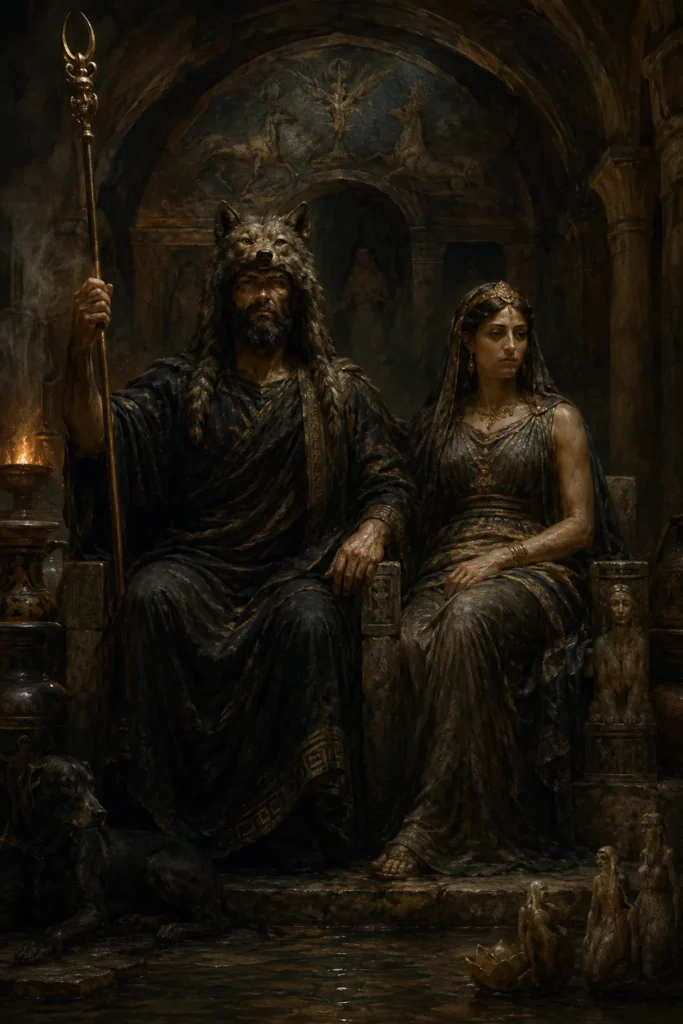
Uni: Etruscan Supreme Goddess, Counterpart to Juno and Hera
By Ralf Ittermann · last reviewed on
In Etruscan religion, Uni is the highest goddess, consort of Tinia and often grouped in research with Tinia and Menrva into a triad, though it is open whether the Etruscans understood this group of three as a fixed unit. She functionally corresponds to the Roman Iuno and the Greek Hera. This account describes her place in religious studies, her cult sites, and her manifold functions within the Etruscan pantheon.
Profile: Uni
Uni: the most important aspects at a glance. The following fields summarise origin, function, appearance, veneration, symbols and parallels.
Uni is among the highest gods of Etruscan religion and is the consort of Tinia. Scholarship often groups her with Tinia and Menrva into a triad; whether the Etruscans understood this group of three as a fixed unit is open. Epithets are Uni Aluseti, Uni Cupra and Uni Mater.
As consort of Tinia, Uni is protective goddess of marriage, birth and family. She was also invoked for the protection of the city. In contrast to the Greek Hera, the Etruscan tradition rather emphasises her protective and blessing side.
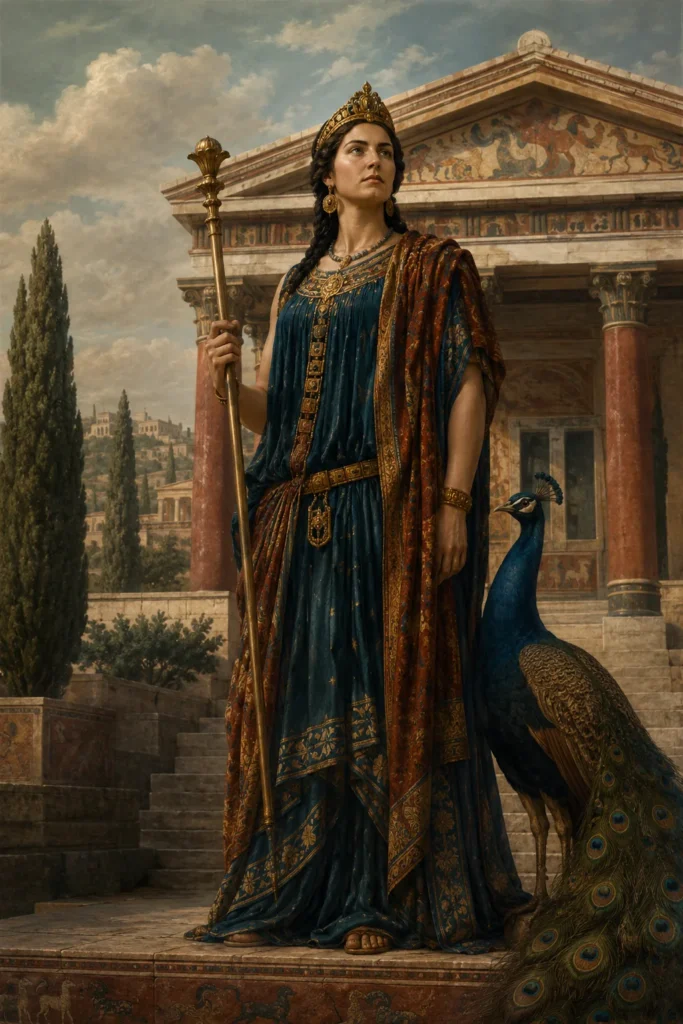
Uni is depicted as a clothed, majestic woman, often with diadem, sceptre and patera (offering bowl), sometimes with a veil. On Etruscan mirrors she appears in mythological scenes, often with the inscription “Uni”.
Uni was venerated in numerous city temples; important cult sites were Pyrgi (port of Caere), Veii, Tarquinia and Volsinii. The rituals comprised sacrifices, especially cow sacrifices, prayers and processions. Women played an important role in them.
Uni’s attributes include diadem, sceptre, patera (offering bowl) and sometimes a veil. In protective custom, bullae as amulets for children and figures of Uni in household shrines are added.
Uni corresponds functionally to the Greek Hera and the Roman Juno; the equation with Juno rests on the interpretatio Romana. On the tablets of Pyrgi she is equated with the Phoenician Astarte. Also named are Inanna/Ishtar (Mesopotamia), Isis (Egypt) and Frigg (Germanic).
Placement within the Etruscan Pantheon
Uni belongs to the highest gods of Etruscan religion.
Together with Tinia and Menrva she is often grouped in research into a triad, which in Rome became the Capitoline Triad, the state-sustaining group of gods, when the Etruscans built the Roman Capitolium in the 6th century BC. Uni is not only the consort of Tinia but a goddess in her own right with comprehensive functions.
Larissa Bonfante and Judith Swaddling (Etruscan Myths, 2006) and Jean-Rene Jannot (Religion in Ancient Etruria, 2005) have treated Uni systematically in their standard works. The research of the last 30 years has reassessed her position, beyond a mere identification with the Roman Iuno.
The supreme goddess Uni belongs to a religion that is so appealing to religious studies because it mediates between the Greek-Mediterranean and the Italic-Roman worlds of transmission.
Fundamental contributions to its study come from Massimo Pallottino, Jacques Heurgon, Sybille Haynes, Mauro Cristofani, and Giovanni Colonna. Their investigations have made clear that Etruscan religion forms an independent tradition.
The Etruscan world of gods was by no means disordered: its theology knew a graded pantheon with fixed ranks and clearly distributed tasks, and within it Uni held a prominent position as supreme goddess. Where older works portrayed this system as mysterious or alien in nature, today one recognizes an independent variety of Mediterranean religion.
Within Italic religious history, the Etruscans acted as mediators between Greek impulses and the emerging Roman religion. The fact that Uni, for example, was equated with Iuno in the interpretatio Romana illustrates this mediating role, which deserves special interest in religious studies.
Name and Etymology
The name Uni is attested on numerous Etruscan inscriptions. Like many Etruscan theonyms, its etymology is disputed. Proposals range from ‘the superior one’ to ‘the one’. Helmut Rix’s Editio Minor collects the attestations.
Epithets of Uni are Uni Aluseti, Uni Cupra (in Picenum), and Uni Mater. The Cupra connection is interesting because it points to a pre-Roman Italic goddess type. Goddesses under similar names were also venerated in Latium and Umbria, which documents the spread of the Uni type.
Linguistically, Etruscan occupies a special position: it is regarded as isolated or is assigned to a hypothetical Tyrsenian family, to which Lemnian and Raetic may also belong. Research has worked on deciphering the texts since the 19th century, without completing the task, which is why the interpretation of names such as Uni also remains open.
The authoritative epigraphic collection of the Etruscan language corpus is Helmut Rix’s Editio Minor; in it the attestations for the name Uni are also brought together. Since then, the Thesaurus Linguae Etruscae and the online database ETP, the Etruscan Texts Project, have been added.
Already in antiquity, opinions about the origin of the Etruscans diverged: Herodotus had them immigrate from Lydia, Dionysius of Halicarnassus considered them autochthonous Italics. This is significant for religious history because it determines whether Etruscan religion, and thus goddesses such as Uni, have connections to Anatolian cults.
Description and Iconography
In Etruscan art, Uni is depicted as a clothed, majestic woman, often with a diadem, scepter, and patera (sacrificial bowl). She sometimes wears a veil. On Etruscan mirrors she frequently appears in mythological scenes, often with the inscription ‘Uni’.
An important depiction is found on the famous Tablets of Pyrgi (5th century BC), where Uni is equated with the Phoenician goddess Astarte in a bilingual inscription (Etruscan and Phoenician). This equation is a finding remarkable for religious history.
From the perspective of religious phenomenology, Etruscan pictorial art is of great richness, and at the same time it is the most important source of knowledge, also for the depictions of Uni.
Mirrors, vases, tomb paintings, and bronzes carry the bulk of our knowledge. In her studies, Larissa Bonfante has emphasized that this visual language is an independent tradition and not merely a derivation of Greek models.
For the religion and the notions of the afterlife of the Etruscans, tomb painting ranks among the foremost sources; it is preserved above all in Tarquinia, Cerveteri, and Vulci. Depicted are banquets, mythological episodes, as well as dance and music, and the afterlife thereby appears as a continuation of life in this world.
Etruscan iconography favors multi-figured compositions, narrative allusions, and symbolically condensed pictorial statements; Uni too is often encountered in such scenes. The investigation of this visual language is the subject of Etruscan religious iconography.
Uni and the Tablets of Pyrgi
The Tablets of Pyrgi (discovered in 1964) are one of the most important sources on Etruscan religion.
They were found in a temple in the harbor of Pyrgi (today Santa Severa) and date from the early 5th century BC. The inscriptions, in the Etruscan and Phoenician languages, document a donation by the Etruscan king Thefarie Velianas to Uni-Astarte.
For religious studies this finding is highly interesting: the Etruscans identified their supreme goddess with the Phoenician Astarte (Ashtaroth). This interpretatio etrusca documents intensive trade contacts and religious exchange in the Mediterranean region. Larissa Bonfante has discussed the tablets in detail in several works.
An elaborated mythical narrative literature, such as the Greek and Roman tradition knows, does not exist for the Etruscans. Myths surrounding Uni must be reconstructed from pictorial depictions, inscriptions, and the reports of Greek and Roman authors. This indirect source situation calls for methodological restraint.
Between Etruscan and Greek mythology there exists a multilayered relationship. The Etruscans took over numerous Greek materials, among them the stories around Achilles, Odysseus, and Oedipus, but often interpreted them in their own way and set different accents. This creative appropriation is treated intensively in research.
Characteristic of Etruscan theology is the notion of a council of gods, the consensus deorum. Even the supreme god Tinia, with whom Uni is often grouped in research into a triad, does not act for himself alone but confers with the other gods. From the perspective of religious phenomenology, this body is an Etruscan peculiarity.
Uni as Goddess of Marriage and Mother
Uni is the consort of Tinia, just as Hera is the consort of Zeus and Iuno is the consort of Iupiter. In this function she is the protective goddess of marriage, of birth, and of the family.
She differs from the Greek Hera through a more strongly positive emphasis: the Greek tradition knows Hera’s jealous and sometimes cruel side; the Etruscan tradition rather emphasizes the protecting and blessing side.
This difference is illuminating for religious history. It shows that Etruscan theology was independent and not simply a copy of the Greek. Nancy Thomson de Grummond (Etruscan Myth, Sacred History, and Legend, 2006) has worked out this independence in detail.
The ordered divinatory system of the Etruscans, the Disciplina Etrusca, is divided into three areas: the inspection of entrails (haruspicina), the interpretation of lightning (fulguratio), and the observation of birds (auspicia). The Romans took over this system, which remained alive until the 4th century AD. Detailed descriptions are available from Cicero and Seneca.
The Disciplina Etrusca was taught at priestly schools established specifically for that purpose. Its knowledge was laid down in books, above all in the Libri Rituales, the Libri Haruspicini, and the Libri Fulgurales. These texts are lost, yet they can be partly recovered from quotations of Roman authors such as Cicero, Festus, and Macrobius.
The Etruscan cult was strongly tied to the respective city. Each of the significant centers, that is Tarquinia, Caere, Vulci, Veji, Clusium, Volsinii, Cortona, Perugia, Arezzo, Volterra, Populonia, and Roselle, had its own principal cults and religious peculiarities, and accordingly Uni too was venerated differently in different places.
Cult and Rituals
Uni was venerated in numerous Etruscan city temples. Important cult sites were Pyrgi (harbor of Caere), Veji, Tarquinia, and Volsinii. The temple of Pyrgi was an important sanctuary, which was also visited by Phoenician traders, hence the bilingual tablets.
Rituals comprised offerings (especially cattle offerings), prayers, and processions. Women played an important role in Uni rituals. Unlike in many other ancient cultures, the position of women in Etruscan society was strikingly strong.
Etruscan women appear at banquets alongside their men and are named in inscriptions with their own names, a practice that disconcerted Greek and Roman observers. Larissa Bonfante’s Etruscan Dress (1975) documents these conditions on the basis of the pictorial record.
Etruscan temples, in which Uni too had a cult, exhibit architectural peculiarities. Characteristic is the Tuscanus style, a distinct order of columns that Vitruvius describes in De Architectura. The ground plans emphasize the cella and a broad front hall and thereby set themselves clearly apart from Greek models.
Etruscan temples were frequently laid out monumentally. The Iupiter temple on the Roman Capitolium, for instance, was built by Etruscan architects and artists, namely by Vulca of Veji.
Since this temple housed the Capitoline Triad, in which, with Iuno, the Roman counterpart of Uni has its place, it is regarded as an architectural testimony of Etruscan religiosity in early Rome.
Every year the League of Twelve Cities of the Etruscans gathered at the Fanum Voltumnae near Volsinii to deliberate on religious as well as political questions. The federal deity of this confederation was Voltumna, whose religious significance reached beyond that of the individual city cults.
Protective Traditions and the Apotropaic
In protective contexts, Uni was invoked primarily in relation to marriage, birth, family, and the protection of the city. The Roman tradition knows many of these functions under Iuno, for instance Iuno Lucina (Iuno of the light) as goddess of birth or Iuno Sospita as protectress of the city. The equation of Uni and Iuno rests on the interpretatio Romana.
Apotropaic practices in the Uni sphere include the wearing of certain amulets (bullae for children), the placing of Uni figures in household shrines, and the speaking of certain formulae before weddings and births. The Etruscan bullae tradition is the direct source of the later Roman practice.
In Etruscan protective customs many averting signs are found: phallus amulets, Gorgoneion images, eye symbols, bullae, and certain protective formulae.
Averting symbols were a firm part of the Etruscan world of life, among them the eye of Tinia, phallus amulets, and Gorgoneia. They adorned temples and tombs as well as household shrines and personal possessions. In Roman as well as in Mediterranean popular belief, this practice lived on.
Among the Etruscans, protective acts were closely interlocked with the Disciplina Etrusca. Before every important undertaking, whether the founding of a city, a military campaign, or the building of a house, the will of the gods, in which the supreme goddess Uni too had a share, was consulted through divination.
Parallels in Other Cultures
Uni functionally corresponds to the Greek Hera and the Roman Iuno. The connection is typological and historical at once: the equation rests on the interpretatio Romana, since Iuno is an ancient Latin goddess with her own etymology. The Pyrgi tablets additionally document the equation with the Phoenician Astarte.
In comparative religious terms, Uni can be connected with other supreme goddesses of Indo-European and Mediterranean traditions: with Inanna/Ishtar (Mesopotamia), with Isis (Egypt), with Frigg (Germanic). The idea of the highest female deity as goddess of marriage and protectress of the city is widespread in the ancient Mediterranean.
Through the interpretatio Romana, Etruscan deities were assigned Roman names: Tinia appears as Iupiter, Uni as Iuno, Menrva as Minerva. Such equations were as a rule not comprehensive but emphasized only partial aspects. The research of the last fifty years works out which Etruscan peculiarities of Uni were thereby preserved.
Manifold points of contact with Anatolian, Phoenician, and Near Eastern traditions shape Etruscan religion. Precisely the Pyrgi tablets, which equate Uni with the Phoenician Astarte, attest the Phoenician exchange. This cross-Mediterranean networking has for some decades been an important field of research.
In a comparative religious approach, the Etruscan cult belongs to the wider Mediterranean family of religions and stands in connection with Greece, Phoenicia, Egypt, Anatolia, and Latium. The fact that Uni is linked with Astarte on the Pyrgi tablets fits into this networking, which forms a significant field of research.
Present-Day Research
Research on Uni has gained considerably in depth over the last 50 years through the discovery of new inscriptions (Pyrgi 1964, further finds in Tarquinia and Volsinii). Important researchers are Larissa Bonfante, Nancy Thomson de Grummond, Marie-Laurence Haack, and Anna Marina Moretti Sgubini.
Research intensively discusses the question of the ‘independent nature’ of Uni beyond the interpretatio Romana. Where are the differences from the Roman Iuno? How far do the Phoenician and Greek influences reach? These questions are the subject of current research.
Etruscan religion, and with it figures such as Uni, are today researched internationally. Among the authoritative locations are the universities of Florence, Rome Sapienza, Pisa, Tuebingen, and Princeton. Each year several international conferences address particular questions of the field.
International research projects on Etruscan religion today rely on digital methods: three-dimensional scans of temples and tombs, databases for inscriptions and pictorial sources, as well as GIS-supported analyses of settlement structure. These methods bring new insights, also on the veneration of Uni.
Current Etruscan research is conveyed to the broader public through exhibitions, among others at the Vatican Museum, the Museo Nazionale Etrusco di Villa Giulia, and the Boston Museum of Fine Arts, as well as through numerous publications.
Sources and State of Research
The most important sources for Uni research are the Tablets of Pyrgi, the Etruscan inscriptions (Helmut Rix’s Editio Minor), the Etruscan mirrors with inscriptions, the archaeological findings from the great temples (Pyrgi, Veji, Tarquinia, Volsinii), as well as the Greek-Roman secondary sources.
A deepened placement within Etruscan religious history as a whole shows how Uni is to be understood not in isolation but within the network of relationships with Tinia, Menrva, and the other Atua. This networking is essential for religious studies.
The sources on Etruscan religion are heterogeneous: epigraphic testimonies, collected in Helmut Rix’s Editio Minor, archaeological finds, pictorial sources, and secondary literature. Anyone who wants to grasp Uni adequately must evaluate this variety across disciplines, and recent research systematically combines philology, archaeology, religious studies, and anthropology.
Appropriate source criticism requires that one know the Etruscan original testimonies and the Greek-Roman secondary transmission equally well. This twofold approach is demanding but indispensable for a sound religious-historical reconstruction of Uni.
Anyone who wants to place Uni thoroughly in religious-historical terms must survey the epigraphic, archaeological, and literary sources as well as the methods of modern religious studies. This multilayered engagement is regarded as standard in research.
Uni on the Bronze Liver of Piacenza and in the Discipline of Liver Inspection
One of the most important sources for the Etruscan world of gods is the so-called Liver of Piacenza, a bronze model of a sheep’s liver that was found in 1877 near Piacenza and is dated to the 2nd or 1st century before our era.
Its surface is divided into numerous fields into which Etruscan divine names are engraved. The object presumably served as a teaching or reference piece for the haruspices, the Etruscan specialists of entrail inspection.
Uni appears on this model under her Etruscan name and thereby holds a fixed place in the system of liver inspection.
The arrangement of the divine names on the liver is interpreted in such a way that the outer rim is divided into sixteen fields, which correspond to a division of the sky into sixteen regions.
To each region of the sky one or more deities were assigned. From the location of anomalies on the examined animal liver, such as growths or discolorations, the haruspex inferred the will of the respective responsible deity.
The fact that Uni is recorded on the liver shows that she was an object of myth and temple cult and was, beyond that, integrated into the highly formalized Etruscan doctrine of divination.
This disciplina etrusca was highly esteemed by the Romans and partly adopted; ancient authors report that Etruscan haruspices were still called in during the Roman imperial period.
The bronze liver is thus a central testimony to how closely the world of gods, ritual technique, and writing culture were connected among the Etruscans. However, much about the exact functioning of liver inspection remains unclear, since no complete Etruscan teaching text has come down to us.
The Gold Tablets of Pyrgi: Uni, Astarte, and the Contact with the Phoenician World
Among the most significant inscription finds of Etruscan religion are the gold tablets of Pyrgi, discovered in 1964 in the sanctuary of the harbor town of Pyrgi, which belonged to the territory of the Etruscan city of Caere.
They are three thin gold sheets from the late 6th or early 5th century before our era, two of them in the Etruscan, one in the Phoenician language.
For the research on Uni these tablets are of outstanding significance, because the Etruscan and the Phoenician text are close to one another in content and thereby form a bilingual bridge. The Phoenician text speaks of the goddess Astarte, the Etruscan of the sanctuary of Uni.
From this it is inferred that in this context the Etruscans equated Uni and the Phoenician-West Semitic Astarte, or at least related them to one another.
The donor, a ruler of Caere named Thefarie Velianas, thereby had documented a sanctuary that was apparently dedicated to the cult of a goddess who could be understood in both religious worlds.
The Pyrgi tablets are thus a stroke of linguistic luck that contributes to the deciphering of Etruscan; they are at the same time a testimony to the intensive interweaving of Etruria with the Mediterranean region. They show Uni as a deity who played a role in the trade and cultural contacts with Phoenicians and Carthaginians.
At the same time the find urges caution: an equation of Uni with Astarte at a harbor sanctuary does not mean that Uni was understood everywhere and always as Astarte. Religious equations were situation-dependent and say more about the respective context than about a fixed nature of the goddess.
Uni, Tinia, and Menrva: the Etruscan Group of Gods and Its Roman Interpretation
In the sources Uni frequently appears in connection with Tinia, the highest Etruscan sky god, and with Menrva.
These three deities have repeatedly been brought into connection by research with the Roman Capitoline Triad Jupiter, Juno, and Minerva. Indeed, Uni corresponds in many functions to the Roman Juno, and the later interpretatio equated the two.
With this equation, however, methodological caution is advisable. The notion of a firmly established group of three as principal deities is well attested in the Roman context, for instance by the temple on the Capitol.
For Etruscan religion, the question of whether Tinia, Uni, and Menrva actually formed a comparable, clearly institutionalized triad is less unambiguous to answer.
The bronze liver of Piacenza records numerous deities, without a group of three being particularly highlighted. It is possible that the notion of an Etruscan triad is partly an inference from the Roman model.
What is securely attested, by contrast, is that Uni was a deity of the first rank, who possessed sanctuaries in several significant Etruscan cities and was connected with rule, the protection of the community, and possibly with kingship.
Mirror depictions, the most important pictorial source for Etruscan mythology, show Uni in various scenes, for instance in a famous depiction in which she suckles the adult Hercle, the Etruscan counterpart to Heracles, and thereby as it were adopts him or raises him to immortality.
Such images attest that Uni was venerated as more than an abstract city goddess: she was placed in a living narrative context influenced by Greek mythology yet independently Etruscan.
Literature (Selection)
- Larissa Bonfante and Judith Swaddling: Etruscan Myths (2006)
- Larissa Bonfante: Etruscan Dress (1975)
- Jean-Rene Jannot: Religion in Ancient Etruria (2005)
- Massimo Pallottino: Die Etrusker (1942, German 1965)
Further standard works in the literature index.
Uni is the Etruscan supreme goddess and is treated in religious-historical research as the direct counterpart to the Roman Juno and the Greek Hera.
The famous bilingual gold tablets of Pyrgi from the late sixth century before our era equate Uni with the Phoenician Astarte and thereby also attest how naturally Etruscan theology understood its figures as counterparts to neighboring pantheons.
A triad cult is considered for the citadel of Veji, in which Uni forms the high center of the city together with Tinia and Menrva.
Related key terms: Uni Etruscans supreme goddess Pyrgi Astarte Iuno Hera Tinia.
iWell Guard and Protective Traditions
iWell Guard ties in with the cultural-historical tradition of portable protective objects, in the tradition of Etruscan and many other cultures worldwide. 41 layers, solid gold, platinum, silver, made in Germany. 30-day right of return.
Personal experiences may vary. Not a medical device. No healing promise.