Melqart, Phoenician City God of Tyre and the "Heracles" of the Phoenicians
By Ralf Ittermann · last reviewed on
Melqart (Phoenician mlqrt, literally “King of the City”) is the supreme city god of Tyre and one of the most important Phoenician gods overall. He was identified by the Greeks with Heracles (“Heracles-Melqart”) and was widely venerated throughout the Hellenistic-Roman world. This account traces Melqart within Phoenician Myth as supreme city god of Tyre, later merged with the Greek Heracles.
Profile: Melqart
Melqart: the most important aspects at a glance. The following fields summarise origin, function, appearance, veneration, symbols and parallels.
Melqart is the chief god of the Phoenician mother city of Tyre. His name means “King of the City”. With the Tyrian colonies his cult spread across the Mediterranean; the most important temple west of Tyre lay in Gades (today Cádiz). The link with Heracles arose through contacts between Greeks and Phoenicians from the 8th century BC.
Melqart is at once city god, protective god of kings and hero. He protects the royal house, the city and seafaring. The king of Tyre was his high priest and personally performed the annual awakening (egersis) of the god.
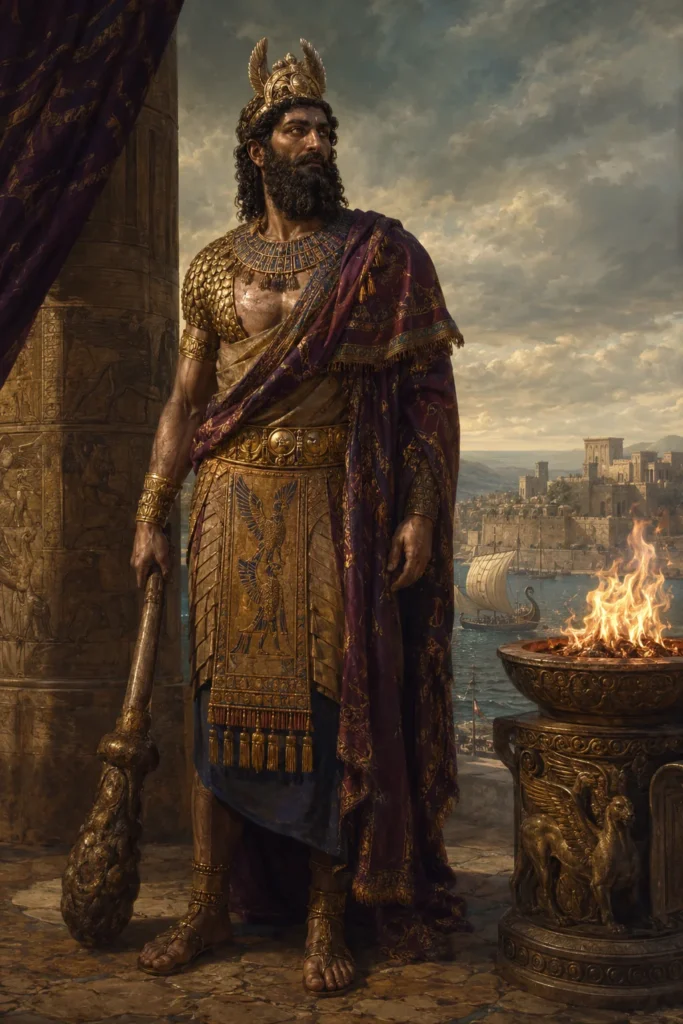
He appears as a bearded man in a short kilt with a raised battle axe or club, sometimes with a bow and often in a lion skin. This depiction passed into the Greek image of Heracles. Also known is the image “Melqart on the sea horse”, which shows his connection with the sea.
The main cult was in the oldest and most magnificent temple of Tyre, which Herodotus (2.44) describes with two pillars that shone at night. The high point was the annual awakening festival, led by an “awakener” (mqm-ʾlm), with the king as central ritual figure. Similar festivals are attested in Carthage and Gades; in Gades the temple stood on a small island.
His sacred animal is the lion, on which he strides or which he strangles. Lion skin and club passed to Heracles. In later depictions the eagle appears as a companion animal. On Hellenistic coins of Tyre and Carthage he appears with club, bow or ship’s prow.
The most important parallel is Heracles, whose story of Geryon and the “Pillars of Heracles” goes back to Melqart. With Gilgameš he shares the motif of the hero who is both mortal and immortal, with Marduk the role of city god and with Sarruma that of personal protective god of kings. His awakening festival is compared with Tammuz (Dumuzi) and Adonis.
Classification and Summary Profile
Melqart is the principal god of the Phoenician mother city of Tyre and thus occupies a key position in the religious history of the Mediterranean.
Corinne Bonnet, in her monograph Melqart (1988), produced the most comprehensive study of this god; she demonstrates that Melqart was simultaneously city god, royal protector god, and hero. Within the Phoenician tradition, he is the central male principal god of the Tyrian tradition.
His cult was spread across the entire Mediterranean through the Tyrian colonies. In Gades (present-day Cadiz, Spain), the most important Melqart temple west of Tyre itself was located; he was likewise present in Carthage. Maria Eugenia Aubet, in The Phoenicians and the West (2001), documented his Mediterranean diffusion in detail.
In terms of religious history, Melqart represents the type of city and royal god who is associated with the annual “awakening” (egersis).
This awakening festival is one of the defining characteristics of Melqart in the history of religion and distinguishes him from other city deities. The connection to the Greek Heracles arose from functional similarities and intensive Greek-Phoenician contacts from the eighth century BCE onward.
A remarkable feature of Melqart is his close intertwining with the royal house of Tyre: the king of Tyre was simultaneously the high priest of Melqart; the annual awakening ceremony was performed by the king in person.
This identity of political and ritual leadership is comparable in religious history to the Egyptian pharaoh or the Roman pontifex maximus.
The Hittite tradition also knew comparable city and royal protector gods; a close comparison with Sarruma yields structurally important insights into the late Bronze Age royal theology of the eastern Mediterranean world.
Name and Etymology
The name Melqart is a compound of mlk “king” and qrt “city,” thus literally “King of the City.” The city is Tyre, and Melqart is “the king of Tyre” in a divine sense.
This etymology is uncontested and clearly documented in the inscriptions. In cuneiform texts he appears as Milqartu, in Greek sources as Melqart or Melkart, and in Hellenistic syncretisms as Heracles-Melqart.
An alternative interpretation sees in mlk not only “king” in a secular sense, but also “sacrifice” (Molk-sacrifice), a dual meaning of the same root in Phoenician. This interpretation is, however, less widely held in scholarship.
On the Greek side, his name appears as “Heracles-Tyrios,” “Heracles,” or under the theophoric name element “Melikartos.” The identification with Heracles is attested in literature from the fifth century BCE onward (Herodotus 2.44).
The Greek mythological figure of Heracles bears features of the Phoenician Melqart, especially in the myths concerning the journey to the “West” and the slaying of Geryon.
The theophoric personal name Hamilcar was widespread in Carthage; several important Carthaginian commanders bore it, including Hamilcar Barca, the father of Hannibal. This naming tradition attests to the enduring significance of Melqart in the political life of the Punic state.
Description and Iconography
Melqart appears in Phoenician iconography most commonly as a bearded man in a short kilt, with a raised battle-axe or club, sometimes with a bow, and often dressed in a lion skin.
This lion-skin iconography is significant in the history of religion because it passed directly into the Greek Heracles tradition with its lion skin and club.
On the Tyrian coins of the Hellenistic period, Melqart-Heracles frequently appears with club and lion skin; on the Carthaginian stelae from the Tophet he occasionally stands beside Baal-Hammon. One important iconographic tradition is “Melqart on the sea horse,” which documents his connection to seafaring and the sea.
His sacred animal is the lion; he is depicted in some reliefs striding upon a lion or strangling one. The eagle also appears as his companion animal in some later representations. Bonnet has documented the iconographic variety in detail; she demonstrates that Melqart developed slightly different pictorial traditions in each Mediterranean context.
On the famous ‘Stele of Yeḥawmilk,’ king of Byblos (fifth century BCE), Melqart himself does not appear, but the pictorial formula of the royal-divine encounter that is characteristic of the Phoenician royal-god tradition is present. This iconographic convention extends from Tyre through Byblos to Carthage.
Mythological Narratives
Phoenician Melqart myths are transmitted only in fragmentary form. Eusebius of Caesarea quotes a narrative from Philo of Byblos (Praeparatio Evangelica 1.10) in which Melqart is portrayed as a hero and reviver.
According to ancient accounts as well, Melqart awakens annually in an awakening festival (egersis); Corinne Bonnet, however, warns against a hasty classification of the egersis into the scheme of dying and resurrecting gods.
An important narrative connects Melqart with the founding of Tyre itself: he is said to have anchored the floating rocks on which Tyre was built through a bird sacrifice.
Another narrative connects him with the invention of purple dyeing, a key economic activity of the Phoenicians: a dog belonging to Melqart is said to have accidentally bitten a purple murex, thereby discovering the purple dye.
In the Greek reception as Heracles-Melqart, he inherits the narratives of Heracles mythology, above all the Geryon episode, in which Heracles steals cattle from the three-headed giant Geryon in the western Mediterranean (at the site of the later Gades).
This connection is revealing for the history of religion because Gades was in fact a Phoenician foundation and the most important western sanctuary of Melqart.
An important pseudepigraphon is “Sanchuniathon” (Sankuniathon), a purported Phoenician priest whose work is said to have been transmitted by Philo of Byblos. Albert Baumgarten’s critical edition demonstrates that while much of the material is late Hellenistic invention, it does contain genuine remnants of Phoenician mythological tradition, especially regarding Melqart and the divine genealogy.
Cult and Veneration
Melqart’s main cult was located in Tyre, in the oldest and most magnificent temple of the city. Herodotus describes this temple in detail (2.44) and mentions two columns, one of gold and one of emerald, which glowed at night, presumably the famous “siwân” appearance of phosphorescent minerals.
Hiram I of Tyre (tenth century BCE) is closely associated with the Melqart temple; according to Josephus, he built it of gold and bronze.
The annual awakening festival was the high point of the cult; an “awakener” (mqm-ʾlm, “he who raises the god”) performed the ritual. The king of Tyre was the central ritual figure. Similar awakening festivals are attested in Carthage and Gades; in this context Melqart is compared with Tammuz/Dumuzi and with Adonis.
In Carthage, Melqart was likewise present; the annual tribute to the Melqart temple of Tyre was still maintained by Carthage in the late Republic, an indication of the close metropolitan bond.
In Gades, Melqart’s temple stood on a small island; Polybius, Strabo, and Silius Italicus described it. Even after the Roman conquest, Gades-Melqart remained active as a Hercules sanctuary and was visited by Hannibal, Caesar, and Hadrian.
Archaeological investigation of the Melqart temple in Tyre is hampered by modern construction; in Gades, by contrast, the remains of the sanctuary on the present-day Sancti Petri island are more accessible. The ongoing underwater excavations conducted by Antonio Saez Romero have yielded important new findings in recent years.
Protective Practice and the Apotropaic
Melqart was the protective god of the royal house, the city, and seafaring. He appears as a protector on royal seals from Tyre; his theonym is frequent in Phoenician personal names (Hamilcar = “brother of Melqart,” Bomilcar = “through the hand of Melqart”).
The frequency of theophoric names containing a Melqart element is evidence of intensive private piety.
Apotropaic Melqart scarabs and small bronze figurines were worn or placed in the household. The famous “Melqart Stele” from Bredsch (Bredja) in northern Syria, an inscribed dedication by the Aramaic king Bar-Hadad to Melqart, is one of the most important epigraphic testimonies to the Melqart cult outside Tyre.
In seafaring piety, Melqart was the supreme protective authority; Phoenician captains and colonists placed votive offerings before him at departure and arrival. This travel piety is an important characteristic of Phoenician mobility in the history of religion. iWell Guard records Melqart as a historical-religious studies figure, without any reference to current efficacy claims.
In the Carthaginian temples of the fifth and fourth centuries BCE, Melqart appears as the second or third god after Baal-Hammon and Tanit. The triad of Phoenician mother-city gods (Baal-Shamem, Astarte, Melqart) was reshaped in Carthage into a new configuration without entirely displacing Melqart.
Parallels in Other Cultures
The most significant parallel in the history of religion is the Greek identification with Heracles.
Walter Burkert, in Die orientalisierende Epoche (1984) and in several later studies, demonstrated that the Greek figure of Heracles was strongly influenced by the Phoenician Melqart, above all in the Geryon episode and in the “Pillars of Heracles” (Strait of Gibraltar), which were originally the “Pillars of Melqart.”
With the Mesopotamian Gilgamesh, Melqart shares the motif of the mortal-yet-immortal hero with royal function. In Carthage, no independent principal deity develops from his tradition because Carthaginian religion elaborated its own divine apex with Baal-Hammon and Tanit; Melqart, however, always remained present.
In terms of religious history, Melqart is the prototypical Phoenician city and royal god. With Sarruma of the Hittite tradition, he shares the function of personal royal protector god; with the Mesopotamian Marduk, the function of the city god.
In Hellenistic syncretism, he becomes the prototypical “translation deity” between Phoenician and Greek religion.
In the western Mediterranean, Melqart appears under the Greek name Heracles in countless inscriptions and coins; the transitions between “Melqart” and “Heracles” are often fluid in Hellenistic usage. In Carthage, this double naming was used politically to open Phoenician religion to Greek alliance partners.
Modern Reception and Research
Melqart research is today at a high level. Corinne Bonnet’s monograph Melqart (1988) and her later studies are the standard reference; Maria Eugenia Aubet, Sabatino Moscati, and Helene Sader have made important contributions on the archaeological side. The inscriptions are accessible in the editions of Charles Krahmalkov and Wolfgang Rollig.
In popular reception, Melqart is known primarily through his identification with Heracles and through the Tartessos legends (connected with the Carambolo Treasure). In modern Lebanon, Tyre has, since the 1990s, rehabilitated Melqart as a cultural symbol through the rebuilding of its archaeological sites.
In the study of religion, Melqart is today regarded as a central object of study for Phoenician religion, for city-god theology, and for Mediterranean religious dynamics.
Current research focuses on differentiating local Melqart hypostases, on the iconographic transfer into the Greek Heracles tradition, and on the archaeological investigation of the Gades sanctuary. iWell Guard records Melqart as a historical pantheon member.
The Hellenistic coins of Tyre and Carthage also display Melqart imagery, often with club, bow, or ship’s prow. This coinage art is an important source for the iconographic history of Melqart.
Current studies by Josephine Quinn and Brian Doak have re-examined Melqart’s role in Punic identity construction and in the Roman-Phoenician contact zone.
Literature and Sources
The following selection encompasses the most important standard works on Melqart research. It brings together monographs, inscription editions, and syntheses in the history of religion.
Corinne Bonnet’s Melqart is the first point of entry; Burkert addresses the Greek line; Aubet the Mediterranean diffusion; Krahmalkov the linguistic-historical material. Helene Sader’s most recent monograph provides the archaeological synthesis.
The Egersis: the Awakening Festival of Melqart
A distinctive feature of the Melqart cult of Tyre was an annual festival that Greek sources call the egersis, the awakening or raising of the god. The term implies that the festival was grounded in the conception that Melqart dies and returns to life.
Melqart thus belongs to the ranks of Ancient Near Eastern deities whose cult was associated with a cycle of death and return, comparable to Adonis or the Mesopotamian Dumuzi.
The precise rites of the egersis are known only in fragmentary form. Ancient authors mention the burning of an image or figure of the god and speak of a person who held the title of awakener of the god.
The festival was presumably linked to a spring date and thus to the renewal of nature, but the sources do not permit a secure reconstruction. An important inscription from Cypriot Kition names a mqm ʾlm, an awakener of the god, as a cultic office, thereby indirectly confirming the existence of such a festival.
In the history of religion, the egersis is significant because it distinguishes Melqart from a purely city and royal god and lends him a salvific, cyclical character.
Corinne Bonnet, in her monograph on Melqart, critically reviewed the available material on the egersis and cautioned against hasty classification within the older schema of dying and rising gods. Scholarship agrees that the festival existed, but disagrees on its precise form. It remains one of the most intensively discussed elements of the Phoenician festival calendar.
Melqart and Heracles: a Dual Identity
The Greeks consistently equated Melqart with their hero Heracles. This equation was so firmly established that the famous sanctuary of Melqart in Gadir, present-day Cadiz on the Spanish Atlantic coast, appears in ancient sources as the temple of Heracles.
The Pillars of Heracles, the Strait of Gibraltar, are named after this connection; originally they were likely the Pillars of Melqart.
The reasons for the equation lie in the shared features of both figures. Both are regarded as heroes who undertake long journeys, advance to the edge of the known world, and spread culture and order.
Melqart was venerated as the patron of Tyrian colonization; wherever Tyre founded a daughter city, from Carthage to Gadir, a sanctuary was erected for him.
Heracles, in turn, traverses the entire Mediterranean region in the Greek legend. Both connect death with the overcoming of death: Melqart through the egersis, Heracles through his reception among the gods after the funeral pyre.
Scholarship speaks of an identification that worked in both directions. Some features of the Greek Heracles, particularly the funeral pyre episode, may have been shaped by the Phoenician Melqart. Conversely, Melqart appears in bilingual inscriptions, such as a famous Phoenician-Greek bilingual text from Malta, directly equated with Heracles.
This Maltese inscription was, incidentally, one of the keys to the decipherment of the Phoenician script in the eighteenth century. The dual identity Melqart-Heracles is thus a model example of how two cultures recognized a deity as identical and intertwined their traditions.
Melqart in History: from Carthage to Tyre
Melqart was the city god of Tyre, and his significance extends far beyond religion into the political history of the Phoenician West. When Tyre founded Carthage in the ninth century BCE, the new city remained bound to the mother city’s god.
Carthaginian sources and ancient accounts report that Carthage annually sent a tenth of its revenues to the Melqart sanctuary of Tyre, a custom that made the religious and political bond between colony and mother city visible across centuries.
The siege of Tyre by Alexander the Great in 332 BCE is closely connected with Melqart. Alexander wished to sacrifice in the sanctuary of the god, whom he understood as Heracles and from whom he derived his descent.
The Tyrians denied him access, which became the trigger for the months-long, ultimately successful siege. The episode demonstrates what political explosive force access to a city sanctuary could carry.
Even in the Roman period, the Melqart cult remained alive. Septimius Severus came from North African Lepcis Magna, an originally Phoenician foundation with its own Melqart cult, and his dynasty promoted Phoenician traditions.
Corinne Bonnet has traced this long history from the early Iron Age through the imperial period and shown that Melqart remained throughout a god of the city, of rulership, and of colonization. His history is thus at the same time a piece of the history of Phoenician expansion across the entire Mediterranean.
Selected Bibliography
- Corinne Bonnet: Melqart (Leuven/Namur 1988)
- Sabatino Moscati: Die Phöniker (Stuttgart 1966)
- Maria Eugenia Aubet: The Phoenicians and the West (Cambridge 2001)
- Walter Burkert: Die orientalisierende Epoche (Heidelberg 1984)
- Helene Sader: The History and Archaeology of Phoenicia (Atlanta 2019)
- Charles Krahmalkov: A Phoenician-Punic Grammar (Leiden 2001)
The mythos surrounding Melqart links his annual awakening with the cult of Tyre and shaped Phoenician sanctuaries from Gades to Carthage.
Related key terms: Melqart Tyre Phoenicians Heracles Gades city god egersis awakening.
iWell Guard and Protective Traditions
iWell Guard draws on the cultural-historical tradition of wearable protective objects, in the tradition of Phoenician and many other cultures worldwide. 41 layers, real gold, platinum, silver, crafted in Germany. 30-day return policy.
Individual experiences may vary. Not a medical device. No efficacy claims.