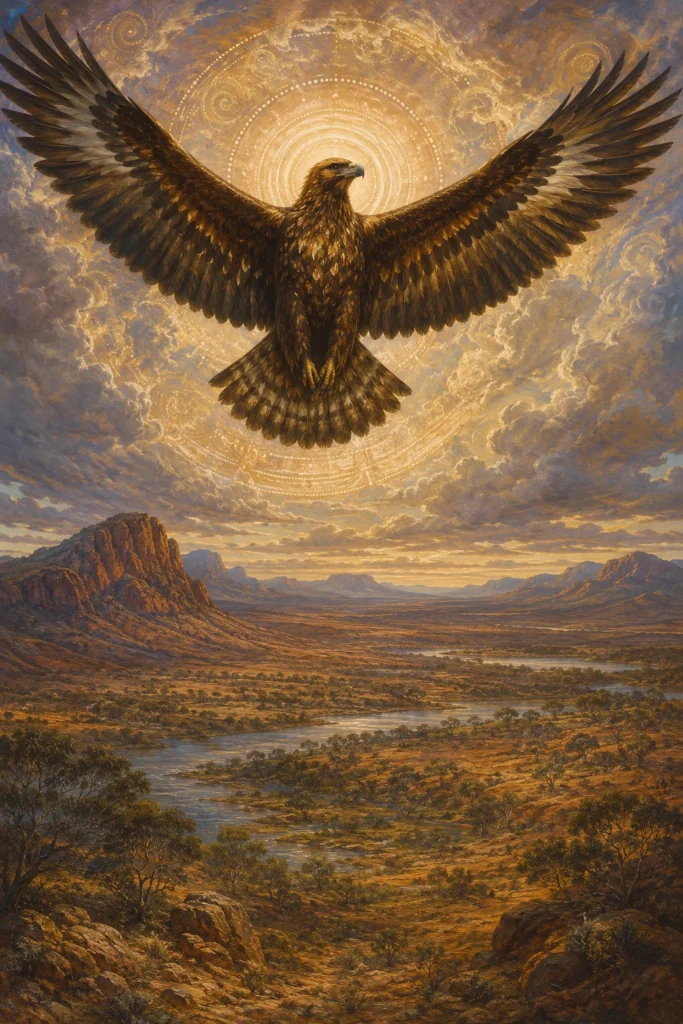
Bunjil is the eagle creator of the Kulin tribal confederation in Victoria, southern Australia. He appears in the form of the wedge-tailed eagle (Aquila audax) and is regarded as the “All-Father” of a group of related Aboriginal languages, including Wurundjeri, Boon Wurrung, Taungurong and Wathaurong.
Bunjil is the most important religious figure of the Kulin tribal confederation in Victoria. The Kulin comprise several related language groups: Wurundjeri (in the Yarra Valley), Boon Wurrung (on Port Phillip Bay), Taungurong (in the Goulburn Valley), Wathaurong (in the Geelong region) and Djadja Wurrung, all of whom share Bunjil as a high deity.
Bunjil is identified with the wedge-tailed eagle, the largest bird of prey in Australia. In this animal identification he differs from Baiame, who is conceived in more anthropomorphic terms. In terms of the phenomenology of religion, he nevertheless belongs to the “All-Father” type that Alfred Howitt described systematically in 1884.
Within the Aboriginal tradition, Bunjil is especially interesting because of his connection with a dual system: the Kulin are divided into two moieties (“halves”), Bunjil-Eaglehawk and Waa-Crow. This dualistic structure organizes the entire marriage and social order.
The name Bunjil (also Bundjil, Punjel) is established as a proper name in Wurundjeri and the other Kulin languages. The etymology probably connects the word with the root bunj-, “older man, wise lord”, attested in many languages of south-eastern Australia.
Robert Brough Smyth, in The Aborigines of Victoria (1878), used the spelling Pun-jel. This spelling did not become established; today Bunjil is standard.
The connection with the eagle (wedge-tailed eagle, locally willarwill or maliyan) is not only nominal but also iconographic. In the rock art of the Bunjil cave near Stawell (Wurundjeri Country), a large eagle-human figure is preserved that is identified as Bunjil.
Bunjil is described as a great, wise man with two wives and two sons, who can at the same time take on the form of a powerful eagle. In this dual nature he differs from the purely anthropomorphic high deities of other Aboriginal groups.
The most famous depiction of Bunjil is the rock painting in the Bunjil cave (Bunjil Shelter) near Stawell in western Victoria.
It shows a figure about 1.2 metres tall with outstretched arms, a feather-like ornament and two accompanying dog-like beings (presumably his two sons in animal form). This site has been under Aboriginal protection since the 1980s.
In contemporary Aboriginal art of Victoria, Bunjil is frequently represented through eagle symbols. Various Wurundjeri artists have created modern depictions of Bunjil; a well-known sculpture by the sculptor Bruce Armstrong stands today in Melbourne (Docklands).
The central Bunjil narrative describes the creation of the Kulin world: Bunjil and his brother Waa-Crow descended to the earth in the Dreaming. Bunjil shaped the landscape and the animals; from two pieces of wood he created the first two men; from clay from the riverbed, the first two women.
He then gave the people the tribal laws and ascended back into the sky, where he is visible today as the constellation Altair (in the Kulin tradition).
A second narrative describes a dispute between Bunjil and Waa-Crow over the question of who should distribute people into which moiety. This narrative legitimizes the dual moiety structure of Kulin society, which prescribes marriages between the Bunjil and Waa halves.
A. W. Howitt documented several Bunjil narratives from various Kulin language groups in The Native Tribes of South-East Australia (1904). This collection remains a central primary source, even though its outside perspective is reflected upon critically today.
The Bunjil cult was, in the historical Kulin region, closely connected with the initiation of young men. Howitt describes several initiation sequences in which Bunjil songs were learned, Bunjil bullroarers were shown, and the cosmological order was transmitted. The initiation was graduated and lasted several years.
With the European settlement of Victoria from 1834 onward, Kulin religion was severely damaged. By 1880, traditional Bunjil practice had been largely interrupted. The Wurundjeri community of Coranderrk (founded in 1863) preserved some elements in moderate form; Diane Barwick’s Rebellion at Coranderrk (1998) documents this history.
Since the 1980s, the Bunjil tradition has been experiencing a renaissance. The Wurundjeri Council of Elders uses Bunjil as a central figure of cultural identification; at official “Welcome to Country” ceremonies, Bunjil is regularly invoked.
Described in terms of religious studies: apotropaic practices in the Bunjil complex aimed less at warding off harm than at upholding the tribal order given by Bunjil. Forbidden were: marriage within the same moiety; killing the wedge-tailed eagle (Bunjil himself); desecration of sacred sites such as the Bunjil cave; betrayal of the men’s secrets.
Breaking these rules was regarded, within the tradition, as the trigger of illness and social misfortune. The taboo on killing eagles was especially strict; a dead eagle had to be buried like a member of the tribe.
In contemporary Wurundjeri practice, the protection of the wedge-tailed eagle has become a surviving ecological norm. Several Wurundjeri initiatives are working on the reintroduction of the eagle in the Yarra Valley region.
Structurally comparable to Bunjil are: Baiame among the Wiradjuri/Kamilaroi (anthropomorphic), Daramulun in some NSW groups, Mungan-Ngana among the Kurnai (all of the “All-Father” type according to Howitt 1884). In the North American Plains there is the eagle creator tradition of the Sioux (Wakinyan), in Siberia the eagle creation animal of several shamanistic traditions.
In terms of the phenomenology of religion, Bunjil is an interesting mixed type: half anthropomorphic, half totemic. This dual nature distinguishes him from purely anthropomorphic high deities and makes him a rewarding case study for classification in religious studies.
Tony Swain, in A Place for Strangers (1993), presented Bunjil as an example of a specifically south-eastern Australian form of religion that cannot be forced into European categories of gods.
The most important early works are Robert Brough Smyth: The Aborigines of Victoria (1878) and A. W. Howitt: The Native Tribes of South-East Australia (1904). Both works are shaped by colonial perspectives but remain indispensable primary sources.
Diane Barwick’s Rebellion at Coranderrk (1998, posthumous) is the most important historical study of the Wurundjeri community in the 19th century; it shows how traditional religiosity survived and was transformed during the reserve period.
In contemporary Aboriginal scholarship, Indigenous Wurundjeri and Kulin voices play an increasingly important role. Bruce Pascoe, Marcia Langton and others have brought Bunjil into the current discussion about Aboriginal identity and land rights.
Several research debates circle around Bunjil. First: what is his relationship to Baiame and Daramulun? Howitt saw them as regional variants of a common “All-Father” type; more recent research (Swain) tends to read them as independent regional figures.
Second: what role does the moiety system (Bunjil/Waa) play in present-day Wurundjeri identity? With the interruption of the traditional marriage order in the 19th century, the moiety structure lost its original social function; today it survives as a figure of cultural identification.
Third: how is the Bunjil tradition changing through the contemporary Aboriginal renaissance? Ian D. Clark presented a systematic survey in Aboriginal Languages and Clans of Victoria (1990); more recent voices from the Wurundjeri community itself complement the picture.
The moiety system of the Kulin deserves closer examination. Kulin society was divided into two “halves” (moieties): Bunjil-Eaglehawk and Waa-Crow. Each person belonged to one of the two halves, and marriages were permitted only across the moiety boundary. This dual structure regulated kinship; it also governed ritual functions, land rights and cosmological assignments.
Howitt described this system systematically in The Native Tribes of South-East Australia (1904); his records are an important source in the anthropology of religion for the study of dualistic social orders.
In terms of the phenomenology of religion, the moiety system is one of the best examples of the close connection between mythology (the Bunjil/Waa sibling dispute) and social order. Here religion is not a separate domain but an integral part of social life.
Since the 1980s, the Wurundjeri community in Melbourne has been experiencing a cultural renaissance. Bunjil has become the central figure of identification in this process. The Wurundjeri Council of Elders uses him in official statements; the Bunjil cave near Stawell has become a place of pilgrimage.
At the annual “Welcome to Country” ceremonies in Melbourne, Bunjil is regularly invoked; the city itself has had, since 2002, a large Bunjil sculpture (by Bruce Armstrong) in the Docklands area, which functions as a symbolic point of welcome for visitors.
In terms of the sociology of religion, this renaissance is an example of contemporary Aboriginal identity politics: religious traditions become the basis of modern cultural representation and political argument.
Several methodological problems arise in research on Bunjil. First: the most important primary sources (Brough Smyth, Howitt) date from the 19th century and are shaped by colonial perspectives. Contemporary research works critically with them.
Second: much Bunjil knowledge was damaged by the dissolution of Coranderrk in 1924 and the subsequent reserve policy. What we know today is therefore inevitably only a fragment of the traditional depth.
Third: contemporary Wurundjeri self-representation is a source level in its own right. Bruce Pascoe (Dark Emu, 2014) and other Indigenous researchers bring new perspectives.
Anyone wishing to study the Bunjil complex in its breadth will find, on the overview page Aboriginal tradition, the most important cross-references to related figures such as Baiame and Yhi.
The Coranderrk legacy deserves a particular historical examination. Coranderrk was an Aboriginal reserve in Victoria (1863 to 1924) that became the most important Wurundjeri community of the 19th century. It was a model of relatively autonomous Aboriginal self-administration.
Diane Barwick’s Rebellion at Coranderrk (1998, posthumous) is the most important historical study of this reserve. It shows how the Wurundjeri, under Coranderrk conditions, allowed their traditional religion to survive in modified form; Bunjil remained a central point of reference.
The closure of Coranderrk in 1924 was a traumatic rupture in Wurundjeri history. Only since the 1980s has the Wurundjeri community again openly asserted its cultural continuity; the Bunjil tradition plays a central role in this.
The city of Melbourne is built on Wurundjeri Country. This fact has been increasingly recognized in urban identity politics since the 1990s; Bunjil has here become the symbolic embodiment of the Indigenous heritage.
Bruce Armstrong’s Bunjil sculpture (2002) in the Melbourne Docklands is a striking example: an eagle sculpture 25 metres high that functions as a symbolic “Welcome to Country” for visitors. It is Australia’s largest Aboriginal-related sculpture.
In terms of the sociology of religion, this sculpture is a textbook example of contemporary Aboriginal representation in urban space. It makes a religious tradition visible to a broad, largely non-Aboriginal public.
In the Kulin tradition, Bunjil is identified with the star Altair (the Eagle in the Western system). This astronomical anchoring is not coincidental: Altair is in fact the brightest star in the Western constellation “Eagle” (Aquila), which fits the iconographic identification of Bunjil as a wedge-tailed eagle.
The Aboriginal astronomy of the Kulin groups encompasses a rich tradition of star narratives. John Morieson, in The Night Sky of the Boorong (1996), reconstructed the astronomical tradition of a Wergaia group; it reveals an extraordinary depth of observation.
In terms of the phenomenology of religion, this astronomical anchoring is important: Bunjil is a mythical being and at the same time a cosmological constant. He “moves” with the course of the year, which structured Aboriginal calendar practice. This interweaving of religion and astronomy is one of the richest legacies of Aboriginal knowledge.
Bruce Armstrong’s 25-metre Bunjil sculpture (2002) in the Melbourne Docklands is one of the largest Aboriginal-related sculptures in Australia. It symbolizes contemporary Wurundjeri identity and functions as a “Welcome to Country” for visitors to the city.
In terms of the anthropology of religion, the sculpture is interesting because it translates a traditionally ritual figure into urban space. Here Bunjil serves as the figure of identification of a small Indigenous community and, beyond that, as the public symbol of a city with almost five million inhabitants.
This dual function (Indigenous religion and urban representation) is a textbook example in the sociology of religion. It raises questions: how far may an Indigenous figure be translated into public spaces? Who decides this? These questions are vigorously negotiated in contemporary Aboriginal discussion.
The role of Bunjil in the contemporary Aboriginal health discussion deserves a contemporary-history examination. The health situation of the Aboriginal population of Victoria is significantly worse than that of the non-Aboriginal population; the “Closing the Gap” initiative aims to close this gap.
In this discussion, Bunjil is increasingly drawn upon as a point of reference for “culturally informed” health services. Aboriginal health organizations such as VAHS (Victorian Aboriginal Health Service) integrate traditional spirituality into modern medical practice.
In terms of the sociology of religion, this integration is an interesting case study. Religion is not seen as an alternative to medicine but as a complement; Bunjil is not a “competitor” of conventional medicine but part of a holistic conception of health.
A concluding remark is due regarding Bunjil in contemporary Aboriginal discourse. The Wurundjeri Council of Elders and other Kulin organizations use Bunjil as a central point of reference for cultural self-affirmation.
Stan Grant, an important Aboriginal journalist and author, has elaborated the significance of Bunjil for contemporary Indigenous identity in several works. This discursive practice makes Bunjil one of the most vivid Aboriginal high figures of the present.
Bunjil is not a pan-Australian figure but belongs specifically to the language groups of the so-called Kulin nation in central and southern Victoria. These include, among others, the Wurundjeri, Boonwurrung, Taungurung, Wathaurong and Dja Dja Wurrung.
In these related languages, the word bunjil denotes the wedge-tailed eagle, and the mythological figure bears this name as an eagle ancestor. A transfer of the Bunjil tradition to Aboriginal cultures of other parts of the country, such as Arnhem Land or the Western Desert, is not factually tenable.
Within Kulin society, Bunjil is associated with one of the two moiety halves, the social bipartition that orders marriage rules and kinship. One half stands under Bunjil, the eagle, the other under Waa, the crow ancestor.
This pairing is not to be read as an opposition of good and evil but as a complementary order that prescribes marriages between the halves.
Early observers such as the linguist and settler William Thomas and the ethnographer Alfred William Howitt documented these structures in the 19th century, although already in a phase of massive colonial destruction of Kulin society.
The source situation must therefore be treated with caution. Much of what has been handed down about Bunjil comes from records by settlers, missionaries and officials who mastered the languages only in part and often questioned their informants under conditions of displacement and mission.
Present-day Wurundjeri and other Kulin communities emphasize that Bunjil is a living part of their identity and must not be reduced to historical ethnography. Statements about Bunjil should therefore always name the respective language group and identify colonial mediation as such.

The best-known place connected with Bunjil is a rock overhang in the Black Range near Stawell in western Victoria, known today as Bunjil’s Shelter or Bunjil’s Cave.
Under the overhang is a rock painting showing a human figure with outstretched arms, flanked by two smaller animal figures, usually interpreted as dingoes. It is the only known pictorial depiction of Bunjil in rock art within the region.
The dating of the painting is uncertain. It was executed with red and white pigments, and repeated repaintings or refreshings cannot be ruled out. No reliable absolute age determination exists, which is frequently the case with ochre paintings of this kind.
The attribution of the figure to Bunjil rests on the local tradition of the Aboriginal communities of the region and not on an inscription or an unambiguous iconographic feature.
In the 20th century, the site was at times severely damaged by vandalism, whereupon protective measures were taken in the 1950s and later in the 1990s, including a grille and a modified path layout. Today the site is managed in cooperation with the traditional owners.
Bunjil’s Shelter exemplifies how a single find complex is at once an archaeological monument, a living cult site and an object of protection policy.
For research on Bunjil the site remains central, because it links the oral tradition with a material testimony, even if its age and original meaning can be reconstructed only to a limited extent. Related conceptions of order are also found with Baiame further north.
Bunjil, the wedge-tailed eagle, is regarded in the traditions of the Kulin tribes in present-day Victoria as creator and establisher of order.
These tribes include, among others, the Wurundjeri, Boonwurrung, Taungurung, Wathaurong and Dja Dja Wurrung, each of whom maintain their own variants of the Bunjil narratives. The tribes connect the eagle with landscape features, social rules and initiation knowledge.
Among the Kulin tribes of Victoria, Bunjil appears as the wedge-tailed eagle and creator; the sources of Howitt, Smyth and Massola transmit his myth of the ascent into the sky and the founding of the clan order.
Related key terms: Bunjil Kulin Wurundjeri Wedge-Tailed Eagle Waa Crow All-Father.
iWell Guard ties in with the cultural-historical tradition of portable protective objects, in the tradition of Aboriginal cultures and many others around the world. 41 layers, solid gold, platinum, silver, made in Germany. 30-day return policy.
Personal experiences may vary. Not a medical device. No healing promise.
Against its influence, cross-cultural tradition names these protective means:
Compare in the Protection Compass →Recommended protective means
The simplest protective means in this collection: 41 layers of fine gold 999, platinum, silver and silicon, manufactured in Ruhla, Thuringia. It requires no activation, is bound to no person, and is effective within a radius of around 50 meters, even without being worn.
Related Beings

Holla, also known as Frau Holle: Germanic mother goddess of weather, fertility and the otherworld...

Heimdall is the Germanic guardian of the rainbow bridge Bifröst who blows the Gjallarhorn at the ...

Tatewari, Grandfather Fire and eldest god of the Huichol. Origin, his role as the first shaman an...

Vanadevata, the forest and tree deities of India. Origin, the sacred groves, the tree cult and cl...

Freyr is the Germanic-Norse god of fertility, peace and the sun. Brother of Freyja, son of Njord,...

Yama-no-Kami, the mountain Kami of Shinto and folk belief. Origin, the alternation with Ta-no-kam...