The cult of Baal-Hadad encompasses temples in the Levant and Mesopotamia.
Baal-Hadad is the supreme weather god of the Phoenician pantheon and stands in the tradition of the Northwest Semitic storm god Hadad, attested since early Syrian times (third millennium BCE) in Aleppo, Mari, Ebla and Ugarit.
In The World of the Phoenicians (1965, German 1966), Sabatino Moscati showed that Baal-Hadad forms the center of Phoenician high religion. Within the Phoenician tradition he is by far the most important male deity.
The name Baal is a Semitic appellative meaning ‘lord’ or ‘owner’; it is prefixed to many local hypostases (Baal-Šamem, Baal-Hammon, Baal-Saphon, Baal-Sidon). Baal-Hadad designates the principal form bearing the personal name Hadad, which signifies thunder.
In Les enfants de Cadmos (2015), Corinne Bonnet presented the Phoenician pantheon configuration comprehensively; Mark Smith set out the history-of-religions context in The Origins of Biblical Monotheism (2001).
In religious-studies terms, Baal-Hadad is the key Northwest Semitic god for the weather-god type of the Late Bronze and Iron Age.
His myth in the Baal Cycle of Ugarit (fourteenth century BCE) is the most important mythological composition of the West Semitic world. In the Iron Age his veneration continues in the Phoenician city-states of Tyre, Sidon, Byblos and Arwad and in their Mediterranean colonies.
Baal-Hadad’s centrality can also be seen in the fact that his hypostases are the most important deity in nearly every Phoenician city-state.
In Tyre Melqart dominates, in Sidon Eshmun and Astarte, in Byblos Baal-Šamem; all three are, in the broadest sense, hypostases or sons of Baal. This ‘Baalization’ of the Phoenician pantheon is one of the characteristic history-of-religions structures of the Iron Age.
The double name Baal-Hadad consists of the appellative baʿal ‘lord, owner’ and the personal name Haddu or Hadad. The root hdd means ‘to thunder’ and belongs to the West Semitic vocabulary for meteorological phenomena. In Die Wettergottgestalten Mesopotamiens und Nordsyriens (2001), Daniel Schwemer discussed the etymological foundations at length.
In Ugaritic texts he appears as bʿl (Baal) or bʿl hd (Baal-Haddu); in Phoenician inscriptions of the Iron Age the plain Baal name with a local specification predominates. In Akkadian god-list material he is identified as Adad; in Hittite with DU/Iškur, which facilitated the identification with Teshub.
An interesting special form is Baal-Saphon, ‘lord of Mount Saphon’ (Mons Casius), the mountain consecrated to him north of Ugarit. Saphon is his dwelling place and functionally corresponds to the Hurrian Hazzi or the Greek Olympus. The identification Baal-Hadad = Baal-Saphon is made explicitly in the Ugaritic texts.
In the Hieroglyphic Luwian inscriptions of the North Syrian city-states, Baal appears as ‘Tarhunza of the Vineyard’ or ‘Tarhunza of the Mountain’; the identification with the Anatolian weather god is evidence of the close history-of-religions interweaving of the Late Bronze Age Levant.
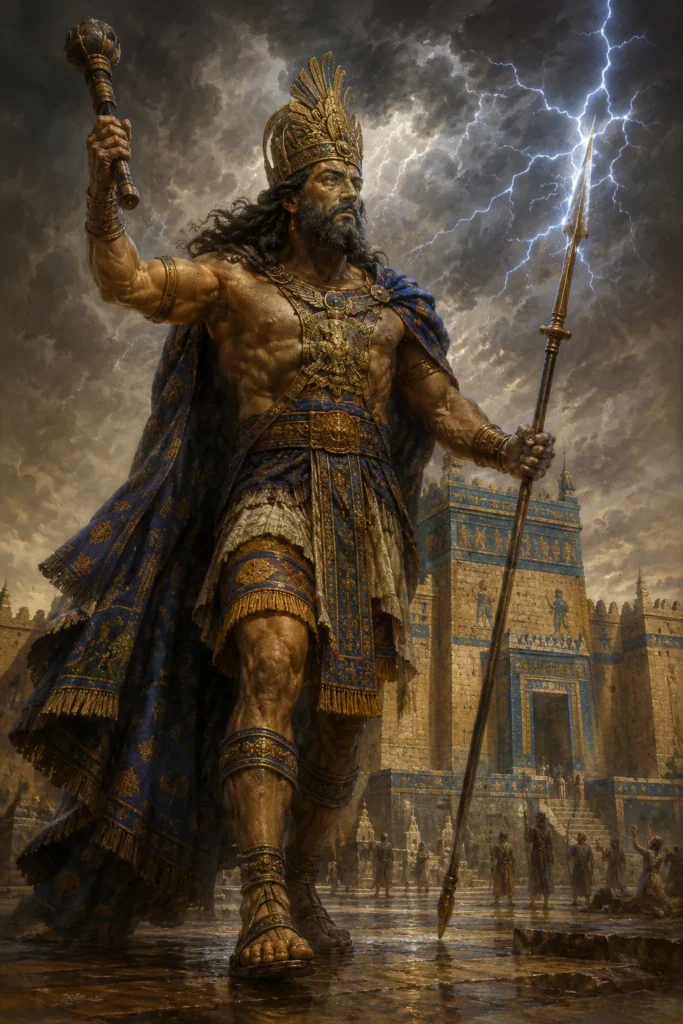
In iconography Baal-Hadad appears as a powerful, bearded man in a short kilt, with a raised battle-axe or a bundle of lightning bolts in one hand and a lance or an ear-of-grain scepter in the other.
The best-known depiction is the stele from Ras Shamra (Ugarit, thirteenth century BCE), which shows Baal in the classical striding-pose scheme with a raised mace; the stele is today in the Louvre.
His sacred animal is the bull; in many reliefs he stands or strides upon a bull or beside a bull. The bull iconography links him to Hadad and to early Syrian bull-storm-god traditions. In Phoenician contexts the eagle also occasionally appears as his attendant animal, possibly under Mesopotamian influence.
On Phoenician coins and stelae of the Iron Age his iconography is somewhat more variable; he appears enthroned, striding or as a cosmic ruler against a starry background. In the western Mediterranean colonies (Carthage, Sicily) his pictorial tradition merges with Baal-Hammon, who develops into an independent theological figure.
On the Carthaginian stelae from the Tophet sanctuary, Baal-Hammon frequently appears as an enthroned bearded god with the symbol of the ‘sign of Tanit’ above him, a pictorial formula of late Punic piety.
The most important mythological source is the Ugaritic Baal Cycle (KTU 1.1, 1.6), a composition of six tablets from the fourteenth century BCE, edited by Mark Smith in The Ugaritic Baal Cycle (vol.
I 1994, vol. II with Wayne Pitard 2009). The cycle contains three main conflicts: Baal against Yam (the sea), Baal as temple-builder, and Baal against Mot (death).
In the first conflict Yam demands kingship and receives the assent of El; Baal fights with two magical weapons fashioned by the craftsman god Kothar-wa-Khasis and defeats Yam.
In the second conflict Baal builds a palace on Saphon with the permission of the father god El and through the mediation of Athirat. In the third conflict Mot takes Baal into the underworld; Anat, Baal’s sister and companion, thereupon kills Mot and frees Baal, who is resurrected.
This sequence of ‘victory over chaos, temple, death and resurrection’ is one of the most influential mythological schemes of ancient Near Eastern religion.
Baal’s awakening in spring was understood as a seasonal sign: when Baal lives, it rains; when he dies, drought prevails. In history-of-religions terms, the myth belongs in a series with Tarhunna-Illuyanka, Marduk-Tiamat, Teshub-Ullikummi and the Greek Zeus-Typhon combat.
An important secondary tradition is the Hurrian-Hittite myth of the ‘Song of the Sea’ (CTH 346), in which Teshub fights against the sea.
The parallels to the Baal-Yam combat are so close that a direct literary connection is likely. In From Hittite to Homer (2016), Mary Bachvarova traced in detail the paths along which these sea-combat narratives traveled.

Baal-Hadad’s principal cult centers were Ugarit (temple on the tell mound), Tyre (temple of Baal-Saphon), Sidon, Byblos (with Baal-Šamem) and the inland city of Aleppo. In Tyre the Baal-Šamem temple was linked to kingship; according to Josephus, Hiram I of Tyre built a splendid Baal temple in the tenth century BCE.
In The World of the Phoenicians, Sabatino Moscati described Phoenician temple architecture and ritual. The temples were elongated spaces with a forecourt, a main hall and a holy of holies (adyton), in which the cult image stood.
Offerings included burnt offerings, incense offerings and libations; an important festival ritual was the annual ‘awakening’ of Baal in spring.
In the Iron Age the Baal cult spread with the Phoenician colonies across the entire Mediterranean: Cyprus (Kition, Salamis), Sicily (Motya, Lilybaeum), Sardinia (Tharros, Sulcis), Tunisia (Carthage, Utica), Spain (Gades, Tartessos). In Melqart (1988) and in several later works, Corinne Bonnet documented the Mediterranean diffusion in detail.
In Carthage the Baal cult developed into an independent history-of-religions tradition with Baal-Hammon and Tanit as the supreme divine family. In The Phoenicians and the West (2001), Maria Eugenia Aubet set out the transformation of the eastern Baal cult into the Punic pantheon.
Baal-Hadad was the protective god of the king, the city and fertility. In the Phoenician inscriptions he is invoked as the guarantor of oaths; treaty texts between Phoenician kings and foreign rulers begin with his invocation. On royal seals his image or his name appears as a protective formula.
Apotropaic practices frequently used the bull as a symbol; bull-horn forms appear as amulets and on altars. In Phoenician houses bronze statuettes of Baal were set up, mostly with a raised battle-axe. This ‘striding Baal’ statuette practice is well attested archaeologically and is the subject of several studies, for example by Hélène Sader.
From a religious-studies perspective, Baal-Hadad’s protective function is bound up with imperial order and fertility. He does not primarily guarantee individual healing, but the return of the rainy season, the stability of kingship and victory in battle. The iWell Guard regards him as a historical history-of-religions figure without any present-day healing-related claims.
In Phoenician oath formulas of the first millennium BCE, Baal regularly appears as the first guarantor of the oath; the Esarhaddon adê treaties between the Assyrian great king and Phoenician vassal rulers (seventh century BCE) are an important witness to this.
Baal-Hadad is closely related to the Hurrian Teshub, the Hittite Tarhunna, the Mesopotamian Adad/Iškur and the Urartian Teišeba. His dragon-combat motif has close parallels to Indra’s victory over Vritra, to Marduk’s victory over Tiamat and to Zeus’ combat against Typhon. In his monograph, Daniel Schwemer treated all of these parallels in detail.
In the Hebrew material Baal appears as the great adversary of Yahweh; the polemical texts of the Old Testament (especially 1 Kings 18, Hosea, Jeremiah) portray him negatively.
In history-of-religions terms Baal-Hadad was not a foreign god to the ancient Hebrews but a competing god from the same Canaanite tradition; the biblical anti-Baalism is the theological reaction to a real religious proximity. Mark Smith treated this at length in The Early History of God (1990).
Baal-Hadad was identified with the Greek Zeus in the Hellenistic period; Baal-Šamem corresponds to Zeus Hypsistos, Baal-Saphon to Zeus Kasios. In Carthage the independent figure Baal-Hammon develops out of the Baal tradition, with a different functional definition.
In the late Carthaginian tradition Baal-Hammon was identified with the Roman Saturn; this Saturnization of the Phoenician Baal cult in the North African region was investigated in detail by Marcel Le Glay in Saturne africain (1966) and is a classic example of history-of-religions syncretism.
Research on Baal is highly developed today. The standard edition of the Baal Cycle by Mark Smith and Wayne Pitard is a reference work; Daniel Schwemer’s monograph on weather-god figures is the most comprehensive synthesis.
In several works Corinne Bonnet has presented the history of Phoenician religion comprehensively. Sabatino Moscati and Maria Eugenia Aubet are authorities on the Mediterranean diffusion of Phoenician religion.
In popular reception Baal is known above all through biblical polemic; in modern usage the word ‘Baal’ often carries pejorative connotations. More scholarly and differentiated accounts are found in the standard works named above as well as in numerous collective volumes on Phoenician archaeology.
Current research focuses on the differentiation of the Baal hypostases (Baal-Šamem, Baal-Saphon, Baal-Hammon, Baal-Sidon and so on), on the Mediterranean spread of the cult, and on the question of how the Baal Cycle was ritually actualized.
The iWell Guard records Baal-Hadad as a central historical pantheon member and not as a present-day recipient of protective appeals. Healing claims or modern spiritual effects are not part of this account.
An intriguing new direction of research concerns the iconographic persistence of Baal in the Hellenistic and Roman Near East. Klaus Stähler and Andreas Kropp have examined the transitions between Phoenician, Hellenistic and Roman pictorial traditions in several publications.
The following selection comprises the most important standard works on Baal-Hadad research. It brings together text editions, history-of-religions syntheses and archaeological publications. Mark Smith’s Baal Cycle edition is the foundation of the primary sources; Schwemer, Bonnet and Moscati provide the history-of-religions contextualization.
Those who wish to examine the material in depth will find excellent bibliographies on the Mediterranean spread of the cult in Aubet and Bonnet.
The central episode of the Ugaritic Baal Cycle is the confrontation between Baal and Yam, the deified sea. On the tablet listed in the KTU numbering as 1.2, Yam demands before the assembly of the gods that Baal be handed over.
The old king of the gods, El, seeking peace, at first consents and calls Baal a prisoner of Yam. But Baal refuses.
The decisive role falls to the divine craftsman Kothar-wa-Hasis. He forges two miraculous weapons by the names of Yagrush and Ayyamur, whose designations are interpreted as Driver and Chaser.
With the first Baal strikes Yam on the shoulder, with the second between the eyes. Yam falls to the ground, and Baal is proclaimed ruler. Astarte restrains him from dismembering the defeated foe.
In religious-studies terms this narrative belongs to the widespread type of the combat with chaos, in which a young weather god subdues a water power embodying chaos and thereby secures the order of the world.
Comparable accounts are found in the Babylonian Enuma Elish with Marduk and Tiamat as well as in the Hittite Illuyanka myth.
As early as 1895, Hermann Gunkel pointed to such parallels in the ancient Near East, long before the Ugaritic tablets were known.
Today the biblical allusions to Yahweh’s victory over the sea, over Rahab and the Leviathan, are read against the background of precisely this Northwest Semitic tradition. The Baal-Yam myth is thus a key text for understanding ancient Near Eastern royal ideology.
The second great narrative arc of the Baal Cycle leads the weather god into death. Mot, the god of drought, death and the underworld, invites Baal into his realm.
Baal accepts the invitation, and the tablets report that he descends into Mot’s jaws like a morsel into the gullet. The news of his death reaches El, who steps down from the throne, dons mourning garments, gashes his skin and laments for Baal.
There follows the search by his sister Anat, who recovers Baal’s body and buries it with the help of the sun goddess Shapash. For a time a substitute ruler reigns, but the earth withers.
Finally Baal appears alive to El in a dream, and the fields once again drip with honey. In a final confrontation Baal and Mot fight like wild beasts, until Shapash mediates and Mot yields.
Older scholarship read this sequence as a pure seasonal myth, as a reflection of the summer withering and the autumn rainy season on the Syrian coast. More recent work, for example by Mark Smith and Wayne Pitard in their commentary, considers this interpretation too narrow.
The Ugaritic calendar, they argue, knows no annual death of Baal as a fixed ritual date, and the text itself speaks rather of a seven-year rhythm.
The episode links the legitimation of rule, fertility and the experience of drought without committing itself to a single interpretive scheme. It remains one of the most discussed texts in the history of ancient Near Eastern religion.
The god whom the Ugaritians called Baal bore the actual name Hadad or Haddu. This name is far older and more widespread than the Ugaritic tablets.
In the archives of Mari on the middle Euphrates, which date to the eighteenth century before our era, the weather god of Aleppo, called Adad, appears as a major political force.
A famous letter has a prophet speak in the name of the god to King Zimri-Lim and reminds him that Adad set him on the throne of his father and expects services in return.
In the Amarna letters of the fourteenth century, the diplomatic correspondence of Egyptian pharaohs with the princes of Syria and Palestine, the god appears in personal names and in similes.
Local rulers describe the dread of the pharaoh with images borrowed from the thunder of Hadad. These attestations show that Hadad was a central imperial deity long before the Phoenician era, closely bound up with kingship and military power.
For Phoenician religion this means that the Baal of the Phoenician cities is the late heir of a centuries-old weather-god tradition. In Tyre Melqart emerged as the city god, while elsewhere the title Baal remained bound to Hadad.
The Assyrian designation Adad and the Aramaic form Hadad likewise attest that the same deity was venerated across linguistic and imperial boundaries. The sources from Mari and Amarna are indispensable for placing the Phoenician evidence in historical context.
Among the finds from Ras Shamra one limestone stele stands out, known in scholarship as Baal au foudre, the Baal with the thunderbolt. It was found near the great Baal temple on the acropolis of Ugarit and is today in the Louvre.
The stele shows the god in a striding pose, with his raised right arm wielding a mace, while the left hand holds a spear whose point is directed downward into the ground and whose upper end branches into plant forms.
This detail is telling. The spear, which is at once lightning and sprouting plant, gathers the two spheres of action of the weather god: the destructive violence of the storm and the life-giving power of the rain.
Beneath the god’s feet wavy lines suggest the mountains or the sea. A small human figure at the edge is usually interpreted as the king of Ugarit, who places himself under Baal’s protection.
The horned cap that the god wears is an ancient Near Eastern sign of divine rank. The whole composition follows a pictorial type that was widespread from the Anatolian region to Egypt, there for instance in depictions of the weather god associated with Seth.
In her monograph on Ugarit, Marguerite Yon described the stele in detail and pointed to its significance as a connection of temple, kingship and divine image. For the iconography of the Phoenician Baal it is the most important surviving witness, even though strictly speaking it comes from Ugarit and not from a Phoenician city.
As the Phoenician high god, Baal-Hadad governs the weather, that is, storm, rain and vegetation; in the Ugaritic texts he triumphs over Yam and Mot and secures the cosmic order of the Phoenician pantheon.
Related key terms: Baal-Hadad Phoenician weather god Baal Cycle Saphon Ugarit Aleppo Yam Mot.
iWell Guard draws on the cultural-historical tradition of wearable protective objects, in the tradition of Phoenician culture and many other cultures worldwide. 41 layers, solid gold, platinum, silver, made in Germany. 30-day right of return.
Personal experiences may vary. Not a medical device. No promise of healing.
Against its influence, cross-cultural tradition names these protective means:
Compare in the Protection Compass →Recommended protective means
The simplest protective means in this collection: 41 layers of fine gold 999, platinum, silver and silicon, manufactured in Ruhla, Thuringia. It requires no activation, is bound to no person, and is effective within a radius of around 50 meters, even without being worn.
Related Beings

Pele is the Hawaiian goddess of volcanoes and fire. Academic classification covering myth, cult, ...

King Gesar of Ling is the hero of the longest epic in the world: Tibet, Mongolia, Bhutan. Incarna...

The written tradition concerning Israfil reaches back several centuries into the past, very proba...

Avalokiteshvara, Bodhisattva of compassion. Guanyin and Kannon forms, Om Mani Padme Hum

Kaikias, the cold, hail-bringing north-east wind of the Greeks. Origin, the Tower of the Winds an...

Amaterasu, sun queen of Japan. Imperial legitimation, the sacred Ise shrine, and the central kami...