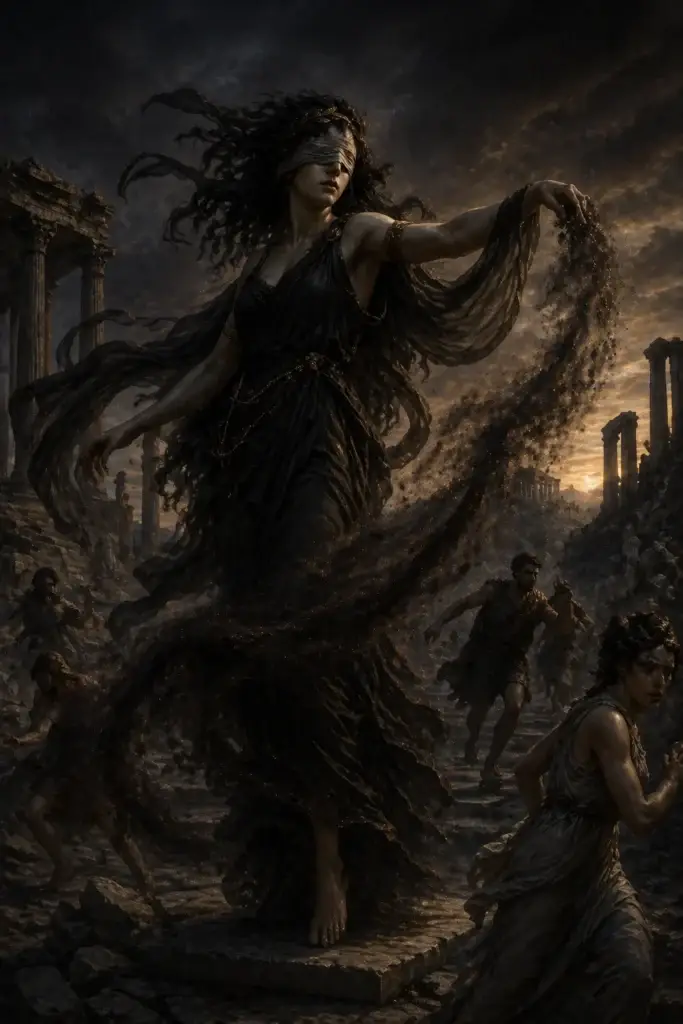
Enlil is regarded in the Mesopotamian pantheon as lord of the pantheon, who administers the tablets of destiny and rules over gods and humans alike.
Enlil counts among the most important deities of ancient Mesopotamia. In the religious conception of the Sumerians and later of the Akkadians, Babylonians and Assyrians, he formed, together with the sky god An and the god of water and wisdom Enki, the supreme divine triad.
While An remained a rather abstract, distant authority, Enlil was the god who actually carried out and enforced the decisions of the divine council. For this reason the texts frequently called him the lord of the lands and the one in whose hand the destinies lay.
The significance of Enlil for the history of religion can hardly be overstated. From the third millennium before our era well into the second millennium, his temple in Nippur was the ideal center of the Mesopotamian world.
Rulers of various city-states and dynasties sought the recognition of Enlil in order to legitimize their power. Only with the rise of Babylon and the growing precedence of the city god Marduk did Enlil gradually lose weight, without ever disappearing entirely.
Enlil is not an unambiguously benevolent figure. The sources show him as an ambivalent power that creates order and grants prosperity, but likewise imposes catastrophes when humanity disturbs the cosmic balance. This double-facedness corresponds to the nature of the storm itself, which brings rain for the fields and at the same time can cause devastation.
The name Enlil is of Sumerian origin. The traditional interpretation understands it as a combination of the elements en, meaning lord, and líl, a word that is associated with wind, air or atmospheric breath.
In this reading the translation lord wind or lord of the air results, which corresponds well with Enlil’s character as god of the moving airspace between heaven and earth.
Scholarship has pointed out that the Sumerian líl is a multilayered term. It denotes not only the moving air but can also mean a ghostly, uncanny sphere.
Some Assyriologists see in this an indication that Enlil originally also carried numinous, elusive aspects. In any case the name stands for a power that works invisibly and yet is perceptible everywhere.
In Akkadian texts the god appears under the same name, occasionally also in the form Ellil. In addition he bore numerous epithets and titles, such as Nunamnir, as well as designations like Great Mountain or Father of the Gods.
The reference to the mountain is significant, for his temple in Nippur was called Ekur, which means mountain home or mountain temple.
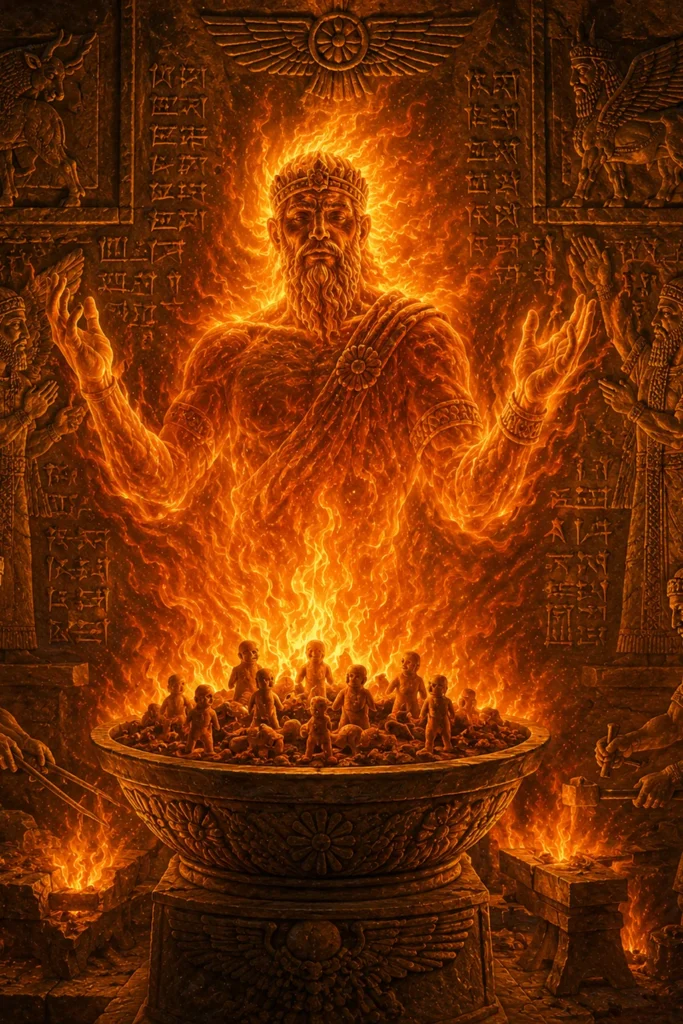
Unlike with some other Mesopotamian deities, the pictorial representation of Enlil is not marked by an unambiguous, recurring attribute. In glyptic art, that is on cylinder seals, and in relief art, deities frequently appear in human form, enthroned, with the horned crown as a sign of divine dignity.
The horned crown is the general mark of divine rank and is also attributed to Enlil, yet a specific symbol reserved for him alone cannot be determined with the same certainty as, for example, the spade of Marduk or the crescent of the moon god.
In the texts Enlil is portrayed as a majestic, enthroned figure before whom even the other gods feel reverence. Hymns describe his gaze as so mighty that no god can challenge him with impunity. His word is regarded as irrevocable. This verbal iconography is often more revealing for understanding Enlil than the surviving pictorial art.
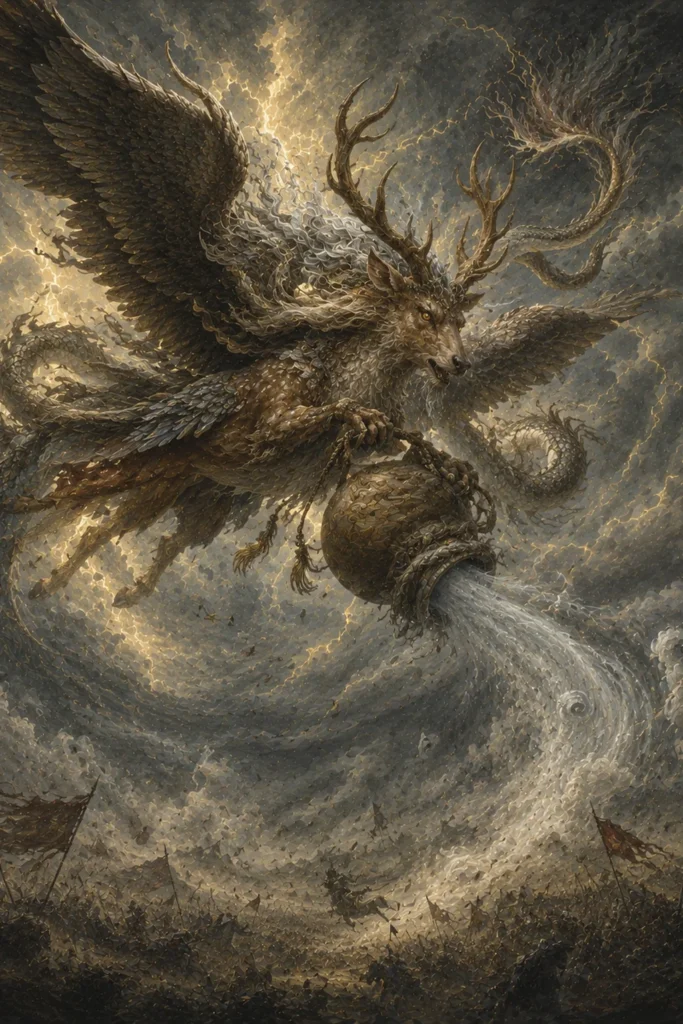
Associated with Enlil is the image of the storm and the tempest. Literary texts compare his voice with thunder and his wrath with the storm flood. His symbolic animal is in some traditions linked with the realm of the earth and the mountains.
The notion that Enlil resides on a mountain temple shapes the entire symbolism around his person and makes the temple Ekur itself a central pictorial bearer of his worship.
Enlil appears in numerous Sumerian and Akkadian myths as an acting main figure. In creation myths it is ascribed to him that he separated heaven and earth and thereby created the space in which life became possible.
Some texts present him as the one who invented the hoe and thus made agriculture and civilization possible for humanity.
A well-known narrative describes the union of Enlil with the grain goddess Ninlil. In this story the young Enlil encounters the goddess by the water, and their union leads to the birth of several deities, among them the moon god.
Because of his transgression Enlil is banished by the divine assembly into the underworld. Ninlil follows him, and through a series of further encounters deities of the underworld come into being. The narrative connects in a peculiar way guilt, punishment and the origin of important divine beings.
Particularly influential is Enlil’s role in the flood myths. In the narrative of Atrahasis and in related traditions it is Enlil who perceives the growing humanity as a disturbance. At first he sends plagues and droughts, and finally he decides on the great flood in order to destroy humanity.
The wise god Enki thwarts this plan by warning a human being, who builds a boat and survives. This mythical constellation, in which Enlil appears as the wrathful and Enki as the saving power, lastingly shapes the Mesopotamian image of the two gods.
In the narrative of the bird Anzu, Enlil likewise plays a central role. The bird Anzu steals the so-called tablets of destiny, an object that embodies power over the cosmic decisions.
Only after a battle are the tablets regained. The episode underlines that dominion over the destinies is closely linked with Enlil and that their loss threatens the order of the world itself.
The center of Enlil’s worship was the city of Nippur in southern Mesopotamia. Nippur was not an important political seat of power but rather a city defined above all in religious terms. It was precisely this relative political neutrality that made it the shared sanctuary of competing city-states.
The temple Ekur was regarded as the place where kingship was bestowed and confirmed. To the sanctuary belonged the ziggurat, which appears in the sources under the name Eduranki, a name that alludes to the connection of heaven and earth and marked Nippur as the axis point of the world.
Rulers of the Sumerian city-states, of the dynasty of Akkad as well as of the third dynasty of Ur, had buildings erected in Nippur, donated votive gifts and emphasized in their inscriptions the favor of Enlil.
The early dynastic ruler Ur-Nanshe of Lagash and later Eannatum already referred to Enlil, as did Sargon of Akkad and his grandson Naram-Sin.
Under the third dynasty of Ur, Ur-Nammu and Shulgi had the Ekur renewed on a large scale. Whoever was recognized by Enlil as a legitimate ruler could assert a comprehensive claim to dominion. This ideological function of the Enlil cult was stable over centuries.
The cult included regular offerings, hymns and festival rituals. The temple calendar of Nippur knew fixed festivals, among them celebrations connected with sowing and harvest as well as the New Year festival.
An extensive priesthood served the sanctuary, administered its lands and carried out the daily cult, which comprised the feeding of the divine image, rites of purification and the recitation of hymns.
The economic importance of the Ekur was considerable, since the temple commanded fields, herds and labor. Temple archives from Nippur belong to the most important sources for the social and economic history of the region.
At Enlil’s side stood his consort Ninlil, who possessed her own sanctuary in Nippur. Further deities were also connected with the Ekur and its environment, among them Enlil’s servant and vizier Nuska, so that the temple complex bundled an entire network of cultic relationships.
A group of literary texts, the so-called temple hymns, and laments over the destruction of Nippur show how strongly the city was felt as a religious emblem, whose devastation was regarded as a cosmic catastrophe.

In the everyday religious life of Mesopotamia, people turned to Enlil above all in prayers and hymns that acknowledged his power and entreated his favor. Since Enlil was regarded as the one who imposed destinies, it was decisive to preserve his goodwill and not to provoke his wrath.
Penitential prayers and laments, in which people interpreted their misfortune as the consequence of divine wrath, were in part also directed to him or to the deities assigned to him.
The Mesopotamian world of ideas knew a dense system of incantations and apotropaic rituals with which people sought to protect themselves against illness, misfortune and demonic powers. Enlil himself, however, was not a protective deity in the narrower sense, to whom one turned for the immediate warding off of demons.
This function was fulfilled rather by exorcist priests as well as certain deities and protective hybrid creatures. Against the feared demoness Lamashtu, for example, people invoked the help of the demon Pazuzu, not that of Enlil.
Nevertheless Enlil touched the realm of protection on a higher level. Since he was regarded as the guarantor of cosmic and political order, his goodwill secured the stability in which human life could thrive at all.
A king confirmed by Enlil understood his rule as a protective wall against chaos and enemies. In this wider sense Enlil was an ordering and thus indirectly protective power.
The type of the storm and weather god at the head or in the center of a pantheon is found in numerous ancient Near Eastern and Mediterranean cultures.
In the Hurrian and Hittite world the weather god Teshub holds a comparably central position. In Syria and the Levant the weather god Hadad or Baal is a defining figure who embodies rain and fertility, but also destructive storms.
Within Mesopotamia itself there is a remarkable shift. With the political rise of Babylon, the city god Marduk took over many functions that had previously belonged to Enlil.
In the Babylonian creation epic Enuma Elish, Marduk is raised to king of the gods and equipped with titles that recall Enlil’s old dignity. Some texts even speak of an Enlil of the gods as an honorary title for Marduk. In Assyria, in turn, the imperial god Ashur took over corresponding roles.
A direct comparison with the Greek Zeus or the Roman Jupiter is possible only with caution. They do share the motif of the highest god with reference to sky and weather, yet the religious systems in which they stand differ fundamentally. Such parallels are to be understood rather as typological similarities, not as historical dependence.
Enlil is an intensively researched figure in modern Assyriology. The excavations in Nippur, carried out with interruptions since the late nineteenth century by American expeditions and later in cooperation with Iraqi authorities, have yielded an extraordinarily rich tradition.
Thousands of cuneiform tablets, among them literary texts, hymns and administrative records, allow a detailed insight into the Enlil cult and its history. A considerable part of the known Sumerian school literature comes from Nippur, since the city was a center of scribal training.
Scholarship is particularly interested in the question of how religious authority and political power related to one another in ancient Mesopotamia. The case of Enlil is a key example of this, because here a religiously defined city conveyed the legitimation of changing rulers over centuries.
Likewise the gradual transfer of the highest divine dignity from Enlil to Marduk is examined as an example of theological change in the wake of political upheavals.
It is also discussed how far Enlil remained an independent person and how far he became a kind of title and functional designation that could be transferred to other gods.
A further emphasis lies on the ambivalence of Enlil. The texts show him not as a thoroughly benevolent god but as a power that disposes of blessing and ruin in equal measure.
From the perspective of religious studies, precisely this tension is revealing, because it shows that Mesopotamian theology did not keep evil away from the highest deity but included it in its nature.
In the broader public, Enlil has become known above all through the flood myths, since these were much discussed in connection with the biblical flood tradition. Here caution is called for, because popular presentations often considerably simplify the complex source situation.
A serious engagement with Enlil rests on the edited cuneiform texts and the specialist literature of religious studies, which places his role in its historical and cultural context.
Enlil is regarded as the central Mesopotamian chief god, who from Nippur commanded wind, storm and kingship and appears in Sumerian as well as Akkadian hymns as head of the great divine assembly.
Related key terms: Enlil Nippur Ekur Sumer Akkad storm god divine council tablets of destiny Ninlil.
iWell Guard ties in with the cultural-historical tradition of portable protective objects, in the tradition of Mesopotamia and many other cultures worldwide. 41 layers, solid gold, platinum, silver, made in Germany. 30-day right of return.
Personal experiences may vary. Not a medical device. No promise of healing.
Against its influence, cross-cultural tradition names these protective means:
Compare in the Protection Compass →Recommended protective means
The simplest protective means in this collection: 41 layers of fine gold 999, platinum, silver and silicon, manufactured in Ruhla, Thuringia. It requires no activation, is bound to no person, and is effective within a radius of around 50 meters, even without being worn.
Related Beings

Ha, the ancient Egyptian god of the western desert. Origin, iconography and classification in rel...

Gula is the Babylonian goddess of the healing arts, medicine, and revival. Her animal is the dog:...

Inti, the sun god of the Inca, is considered the father of the ruling dynasty and the central fig...

Elixir of immortality, lunar solitude and the Jade Rabbit: the myth and the Moon Festival in Chin...

Nephthys, Egyptian patroness of the dead and goddess of mourning. Mummification, afterlife, Book ...

Falcon god, Eye of Horus, symbol of rule and healing. Mythology, the temple at Edfu, and signific...