Yer-Sub, Old Turkic Earth and Water Power of the Sacred Ground
By Ralf Ittermann · last reviewed on
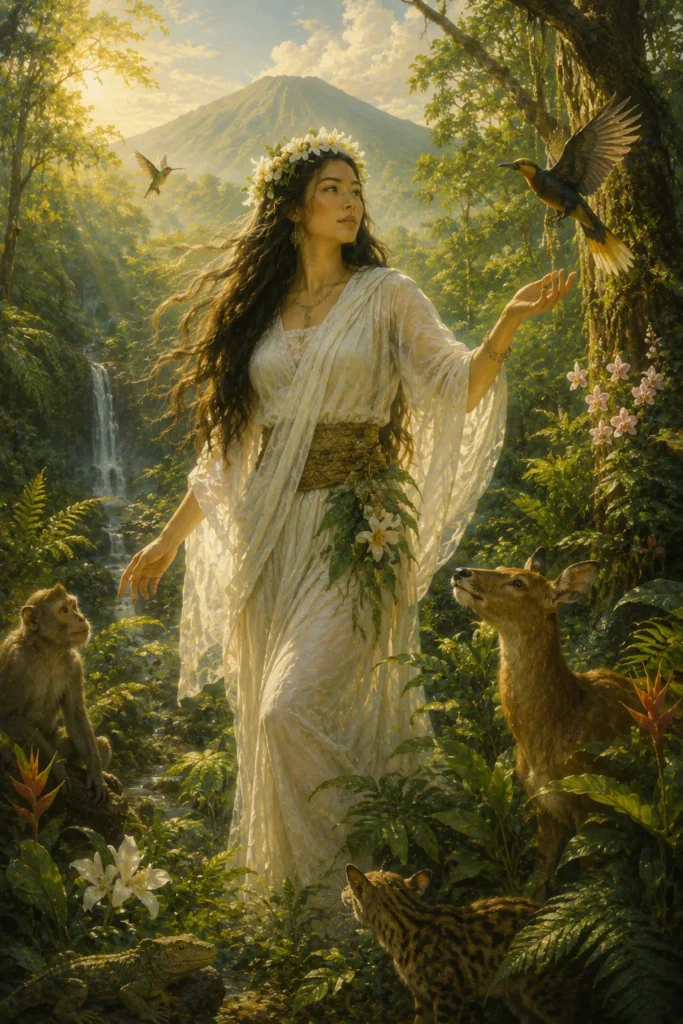
Yer-Sub (Old Turkic Yer-Sub, “Earth-Water”) is the combined numinous power of the sacred ground and sacred waters in the Old Turkic and Siberian-Tengrist religious system. It completes Tengri above and Umai between, forming a cosmological triad.
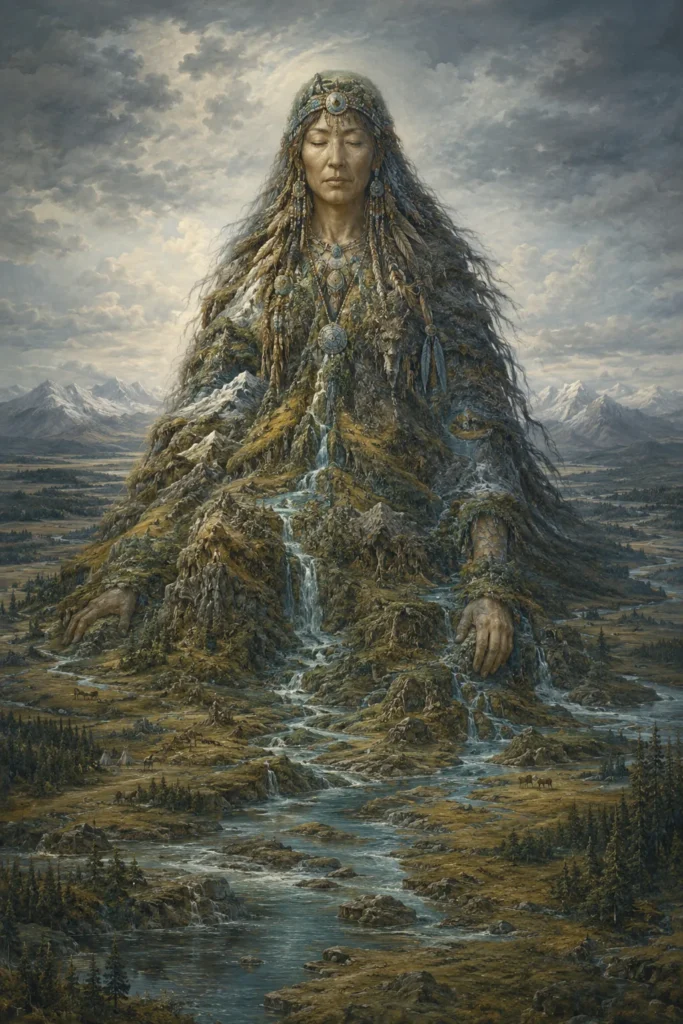
Yer-Sub, the Earth-Water Power, embodies in the Old Turkic tradition the sacred ground and the flowing element simultaneously.
Profile: Yer-Sub
Yer-Sub: the most important aspects at a glance. The following fields summarise origin, effect, appearance, function, protection and parallels.
Yer-Sub is the combined power of the sacred soil and the sacred waters in the Old Turkic religious system and in the Tengrism of Siberia. The name combines yer (earth) and sub (water). The Orkhon inscriptions of the 8th century name it in a triple formula together with Tengri and Umai.
Yer-Sub is bound to place and gathers at mountain passes, springs, river mouths and rocks. The breaking of taboos was regarded as an injury to Yer-Sub and could be answered with failure in hunting or with illness. Whoever betrays the khan also injures Yer-Sub and falls out of the order.
Yer-Sub has no iconography of its own and remains invisible as a whole; matter itself is its body. The place-bound specialised spirits are given visual form through stone heaps (obo), inscribed wooden posts (serge), cloth bands on larches (kyira) and small wooden figures at the edge of springs.
Yer-Sub is a collective, place-bound power and completes Tengri and Umai into a cosmological triad. At the level of the state it was part of the khan’s oaths. Later specialised figures such as mountain lords, spring spirits and river spirits take over the functions that were originally attributed collectively to Yer-Sub.
Above all the purity of the place is protected: spitting into a spring, breaking sacred trees and relieving oneself on an obo were forbidden. Small stones from the sacred mountain, protective formulas on spring posts and tufts of horsehair on thresholds served as protective means. At the Ovoo a stone heap is piled up and circled three times clockwise.
Structurally comparable are the Roman genii loci, the Germanic land spirits, the inhabitants of the Celtic sídh, the Japanese jinushigami and the Andean apus and huacas. Especially close is the proximity to the Chinese tudi gong and the Tibetan sa-bdag (“earth lords”).
Classification and Brief Profile
Unlike the personal gods Tengri, Umai, or Ulgen, Yer-Sub is not an individual but a collective, place-bound power.
In the Orkhon inscriptions of the 8th century (Kul-Tigin, Bilge Khagan, Tonyukuk), Yer-Sub appears regularly in a triple formula: “Tengri (Heaven), Umai (Mother), and Yer-Sub (Earth-Water) have given us victory.” This formula is one of the most important attestations of the cosmological structure of Old Turkic Tengrism.
Within the Siberian-Tengrist tradition, later specialized figures, mountain lords, spring spirits, river spirits, take on the concrete functions that were originally attributed collectively to Yer-Sub. In later religious history, Yer-Sub thus condenses into a variety of named individual spirits without disappearing as a concept.
In terms of the phenomenology of religion, Yer-Sub is a textbook example of “local numinosity”: unlike universal high deities, this power is space-bound and gathers at concrete places, mountain passes, springs, river mouths, and rocks. It stands in a line with the Roman genii loci and the Japanese jinushigami.
Name and Etymology
The name is a classic Old Turkic dvandva compound: yer (“earth, land, place”) and sub (“water, spring, river”). Comparable formations are attested in many Indo-European and Altaic languages; they express that earth and water are conceived here not as two separate things, but as a pair of life foundations that belong together.
In the Mongolian world, the concept corresponds in part to gazar usu (“land-water”) and Etugen Eke (“Mother Earth”). In Siberia itself, the Buryats know the Lus (spring spirits) and the Yakuts know Aan Alakhchyn, earth servant of Aar Toyon.
Talat Tekin (1968) determined the grammatical status of yer sub as a compound (a view that is largely accepted but not undisputed): it is not two gods named in succession, but a single power with a two-part name. This linguistic observation has consequences for religious studies, since it implies an integrated conception of land-water power.
Description and Iconography
Yer-Sub has no iconography of its own. Where the place-bound specialized spirits are given visual form, this happens through stone cairns (obo), inscribed wooden posts (serge), cloth strips tied to larch trees (kyira), and small wooden figures at the edge of springs.
Yer-Sub as a whole remains invisible; matter itself is its body.
Yer-Sub shares this absence of imagery with the distant Tengri, in contrast to the personally anthropomorphic Ulgen, Umai, or Erlik Khan. In terms of the phenomenology of religion, this marks a difference between collectively numinous and individually personalized powers within a pantheon.
In modern Mongolian practice, Yer-Sub is partly embodied through the ovoo stone cairns; at larger festivals, long blue khadag scarves are stretched around the ovoos, whose blue color consciously refers to Mongke Koke Tengri, while the stones themselves represent Yer-Sub.
Mythological Narratives
The Gokturk inscriptions contain no narratives about Yer-Sub, only invocations. Narratives about individual mountain and river lords, which together fill out the Yer-Sub spectrum, first appear in the ethnographic records of the 19th century (Radloff, Anokhin, Verbickij).
Among the Buryats, for example, Lake Baikal is addressed as “Father” and the surrounding mountains as “Brothers,” a family schema that resolves the Yer-Sub power into kinship metaphors.
A specific Altaic narrative recounts how the mountains arose when Yer-Sub rebelled against an attempt by Erlik to take the earth for his own use: mountains are frozen waves of a cosmic confrontation. This narrative stands midway between creation myths and etiological myths.
In the Yakut Olonkho epics, the earth goddess Aan Alakhchyn Khotun embodies one aspect of the Yer-Sub function. She dwells in the sacred tree at the center of the world and gives all living beings a share of her water of life, a motif that elaborates the integral land-water concept in epic form.
Cult and Veneration
The most important form of cult is the Ovoo ritual: on a mountain pass or at a prominent spring, a stone cairn is piled up, decorated with cloth strips, and honored by circling it three times clockwise. Travelers add a stone; herders pour a little milk or kumiss onto the ground.
At the state level, Yer-Sub was part of the Khan’s oaths: whoever deceives the Khan “injures Yer-Sub” and falls outside the order. This political function is even implicitly transmitted in the Byzantine account of Theophylact Simocatta (early 7th century), when he reports on Turkic oath practices.
In modern Mongolia, the Ovoo ritual has experienced a remarkable renaissance; since 1990, thousands of new ovoos have been established or restored. Caroline Humphrey has documented this renaissance in detail in Karl Marx Collective.
Protective Practice and the Apotropaic
Described in religious-studies terms: protective practices in the Yer-Sub complex aim less at warding off harm than at preserving the purity of the place. Prohibited acts included spitting into a spring, breaking sacred trees, and relieving oneself on an obo.
The violation of these taboos was considered an “injury to Yer-Sub” and could, within the tradition, be answered by failure in the hunt or illness.
Apotropaia in the strict sense included carrying small stones from the sacred mountain, engraving protective formulas on spring posts, and attaching tufts of horsehair to thresholds. These practices remain alive today in Mongolia and Tuva.
An interesting detail from the Yakut tradition: before leaving a sacred place, one formally “asks” it for permission, often with the words “Bahyy bolokhtuun” (“be gracious, let me go free”). This courtesy toward the landscape is, in terms of the phenomenology of religion, a classic example of animistic etiquette.
Parallels in Other Cultures
Structurally comparable to the Roman genius loci; the Germanic land wights; the Celtic sidh inhabitants; in Japan the jinushigami of the Shinto tradition; in Latin America the Andean apus and huacas. In all cases, these are place-bound, collective powers honored through purity taboos rather than through personal myths.
The typological proximity to the Chinese tudi gong system of local earth gods and the Tibetan sa-bdag (“earth lords”) is particularly close. This reveals cultural bridges within Inner Asia, without any direct historical derivation being established.
In terms of the phenomenology of religion, Yer-Sub marks what Mircea Eliade in Le sacre et le profane (1957) called the “hierophany of place”: certain locations become a sacred center through their ritual marking, without any personal god needing to dwell there.
Current Reception and Research
In contemporary Mongolian and Tuvan contexts, Yer-Sub (as gazar usu or cher-sug) has become a central element of environmental ethics. Several ecologically oriented NGOs cite the traditional ovoo complex as a basis for their arguments.
Key academic references: Caroline Humphrey (Karl Marx Collective, 1983; Inside and outside the Mongolian tent, essay of the 1970s), Roberte Hamayon, Sergei Neklyudov.
A separate strand of research connects the Yer-Sub practice with current conflicts over mining and water rights in Mongolia: indigenous groups invoke the religious inviolability of Yer-Sub sites to oppose large-scale projects. This political dimension has implications for religious studies that Caroline Humphrey discusses at length.
In Tuva, a Dungur association of shamanic practitioners has formed since 1990 that publicly codifies Yer-Sub rituals. From a religious-studies perspective, this codification is an interesting case of the “inventarization” of an originally diffuse practice through modern organizational structures.
Research Debates and Open Questions
A central debate concerns the question of whether Yer-Sub is a single term or a collective term. Talat Tekin and Sergei Neklyudov argued for an integrated reading; more recent research (including B. Kellner-Heinkele) tends toward assuming regionally differentiated personalizations.
A second open question concerns the relationship between Yer-Sub and the Buddhist local spirit concept in Mongolia: how much of the current ovoo practice is pre-Buddhist, and how much has been reformulated in Buddhist terms? Walther Heissig proposed a stratigraphy here that is being critically examined in more recent research.
Finally, and this is the most practically pressing question, how does the currently living Yer-Sub complex relate to ecological movements without being instrumentalized by them? The Inner Mongolian civic initiative Onggi River Movement takes up this question itself and provides a research field for the religious ethnology of the 2020s.
Yer-Sub in the Modern Environmental Debate
One of the most surprising turns in recent Tengrism research is the rediscovery of Yer-Sub as a reference point for contemporary environmental movements.
The Mongolian civic initiative Onggi River Movement (founded 2001) protests against gold mines that destroy sacred springs and river courses, explicitly invoking the traditional Yer-Sub veneration. Caroline Humphrey has documented this movement in several essays.
From a religious-studies perspective, this turn is ambivalent. On one hand, it demonstrates the continuing vitality of a supposedly “archaic” religious concept; on the other, it carries the risk that religious content is selectively mobilized as an instrument for political ends. Both aspects should be considered in a differentiated analysis.
In Tuva and the Sakha Republic, similar movements are visible; they create a new interface between religious ethnology and political ecology. Scholars in the phenomenology of religion such as Bron Taylor (Dark Green Religion, 2010) have analyzed this constellation as “green religion” and cited Yer-Sub as one example.
Sources and Reference to the Culture Hub
Those wishing to study the Yer-Sub complex in its full breadth will find the most important cross-references to related figures on the overview page Siberian-Tengrist Tradition, including Tengri, Umai (in the Tonyukuk triple formula), and the place-bound spirit worlds.
Talat Tekin’s A Grammar of Orkhon Turkic (1968) remains the most important philological foundation for the Old Turkic layer. Caroline Humphrey’s essay Inside and outside the Mongolian tent (1970s) and Marx Went Away, But Karl Stayed Behind (1998) provide contemporary ethnographic depth.
The encyclopedia Mify narodov mira, edited by S. A. Tokarev (Moscow 1980–1982), is a Russian reference work on mythology and should appear in any serious bibliography.
Phenomenology of Religion: The Binding to Place
Yer-Sub illustrates, in terms of the phenomenology of religion, the category of “place-bound numinosity” that Mircea Eliade elaborated in Le sacre et le profane (1957) as the “hierophany of place.” In contrast to universal high deities, this form of numinosity is space-bound and concrete.
The ritual marking of a place (through stone cairns, cloth strips, wooden posts) is a classic example of what van Gennep called the “sacralization of landscape.” Yer-Sub here is not a person dwelling in a place, but the power that itself becomes place, a distinction that is important in the phenomenology of religion.
In comparison with the Japanese kami concept and the Roman genius loci, it becomes clear that place-bound numinosity is a globally widespread concept, yet one that is formulated specifically in each tradition. Yer-Sub is a particularly compact and well-documented variant.
Methodological Reflection
Several methodological problems arise in Yer-Sub research. First: the word itself is a compound whose exact grammatical treatment in Old Turkic is disputed. Talat Tekin’s definition of it as “a single power with a two-part name” is broadly accepted, but not without challenge.
Second: the identification of the Tonyukuk inscription Yer-Sub with the ethnographically attested mountain and spring spirit world of the 19th and 20th centuries is a hypothesis; scholarship has become cautious here.
Third: the contemporary mobilization of Yer-Sub for ecological movements is methodologically demanding for religious studies. Caroline Humphrey and Bron Taylor have made important contributions here without closing the discussion.
Yer-Sub and the Mongolian Naadam
The relationship between Yer-Sub and the Mongolian summer festival Naadam deserves closer attention. The Naadam, celebrated annually in July, has its origins in the invocations of the mountain and spring deities and is thus historically connected to the Yer-Sub complex.
The three classical “manly games” of the Naadam, horse racing, archery, and wrestling, were originally ritual demonstrations of tribal strength before the mountain patron and before Yer-Sub. Christopher Atwood described this ritual anchoring in detail in his Encyclopedia (2004).
In Mongolia today, the Naadam is a major national festival that is simultaneously charged with both state-secular and religious-traditional significance. The ovoo rituals at the start of the festival continue to make the Yer-Sub layer visible.
Yer-Sub and the Archaeological Evidence
The archaeological evidence for Yer-Sub is limited but instructive. In the south Siberian steppe highlands (Tuva, Altai), kurgan mounds and standing stone posts from the Scythian and Hunnic periods are preserved, which are read as ritual markings of “sacred places.” Whether these markings are identical to the later Yer-Sub concept is not conclusively established.
A particularly important archaeological material consists of the balbal stone posts of the Gokturk period, set up in rows at royal graves. Sergei Klyashtorny discussed the religious content of these posts in Drevnetjurkskie pis’mennye pamjatniki (1964).
A mediating thesis connects the archaeological stone posts with the ethnographically attested serge posts of the Sakha: both could be a reflex of a continuous Yer-Sub marking of places, with long continuities and transformations over two millennia.
Yer-Sub as a Dual Concept: Earth and Water in Tengrism
The name Yer-Sub, literally “earth-water” in Turkic languages, does not designate a single clearly delineated deity, but a collective entity: the totality of the middle world with its mountains, rivers, springs, and forests, conceived as an animated, veneration-worthy power.
The Old Turkic inscriptions of the Orkhon Valley from the 8th century, the oldest continuous texts in a Turkic language, already name yer sub alongside the sky god Tengri as a force that watches over the fate of the people.
This early attestation is important because it shows that this is an ancient, textually secured concept and not a later construction of ethnography. In the Orkhon inscriptions, yer sub appears in the same breath as Tengri, as powers that intervene when the people are in distress.
The precise theological position, however, remains open: whether Yer-Sub was conceived as a unity, as a multitude of local spirits, or as both simultaneously cannot be determined unambiguously from the brief inscription texts.
In the later, ethnographically documented traditions of the south Siberian Turkic peoples, such as the Altaians and Khakas, Yer-Sub frequently appears in the plural as a multitude of lords of specific mountains, rivers, and passes, to whom travelers offered small gifts.
This reveals the same oscillation between unity and plurality found in many Tengrist concepts. Research on the Altaic religion interprets this as an expression of a religiosity that does not strictly separate the local from the overarching. Related concepts are discussed in the entry on Buga.
Bibliography (Selected)
- Talat Tekin: A Grammar of Orkhon Turkic (1968)
- Caroline Humphrey: Inside and outside the Mongolian tent (essay, 1970s)
- Jean-Paul Roux: La religion des Turcs et des Mongols (1984)
- Wilhelm Radloff: Aus Sibirien (1884)
- Roberte Hamayon: La chasse a l’ame (1990)
- S. A. Tokarev (ed.): Mify narodov mira (Moscow 1980–1982)
- V. Diószegi and M. Hoppál (eds.): Shamanism in Siberia (Budapest 1978)
The Old Turkic myth of the Orkhon inscriptions of the eighth century names Yer-Sub as the sacred dual power of earth and water, which alongside the sky god Tengri guaranteed the welfare of ruler and people.
Related key terms: Yer-Sub Orkhon Bilge Khagan obo ovoo gazar usu Etugen Eke.
iWell Guard and Protective Traditions
iWell Guard draws on the cultural-historical tradition of portable protective objects, in the tradition of Siberia / Tengrism and many other cultures worldwide. 41 levels, real gold, platinum, silver, crafted in Germany. 30-day return policy.
Individual experiences may vary. Not a medical device. No healing claims.