Simbi, Loa of Springs and Magic in Vodou
By Ralf Ittermann · last reviewed on
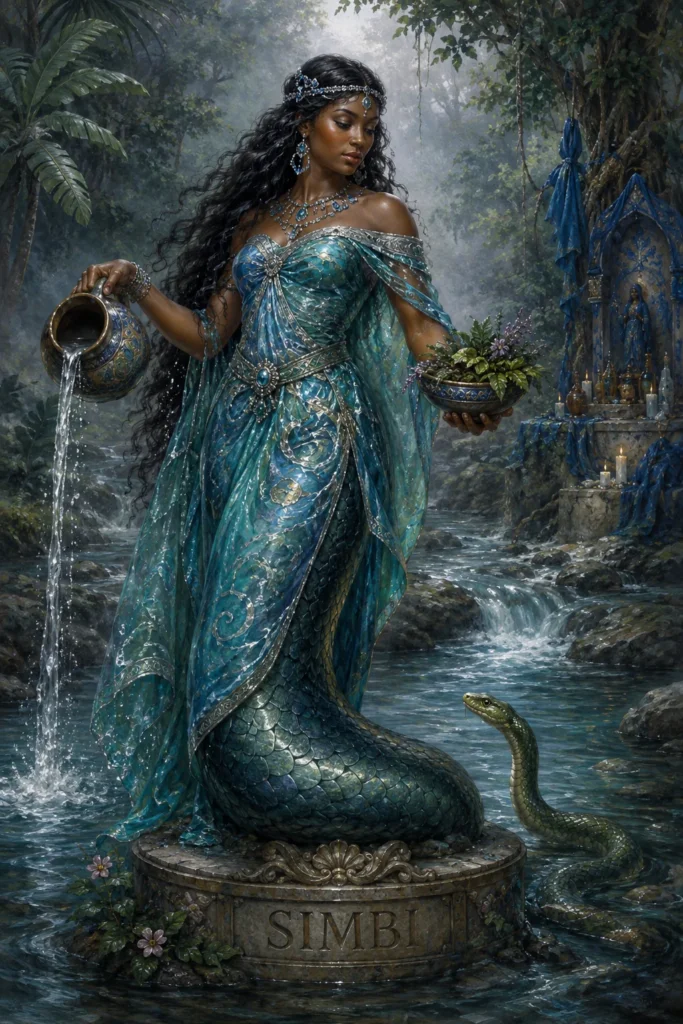
The Simbi are water spirits and serpent loa of Vodou who act at springs, rivers and swamps and guard the knowledge of magic. Simbi (also Sim’bi, Simbi Dlo, Simbi Andezo) denotes, in Haitian Vodou, a family of serpent and water spirits connected with freshwater, rivers, lakes and springs.
It belongs to the Petwo family, the younger and more hot-blooded current of Vodou, and is clearly distinct from the Rada loa Damballa, even though he too has a serpent form. The Simbi are venerated as healers, magicians and guardians of the hidden water mysteries.
Profile: Simbi
Simbi: the most important aspects at a glance. The following fields summarise origin, function, appearance, veneration, symbols and parallels.
The Simbi belong to the Petwo family, the younger current of the Haitian tradition. Their roots lie in the beliefs of the Bakongo in what is now the Democratic Republic of the Congo and in Angola, where the Bisimbi are regarded as water spirits. With the slave deportation from the Kongo in the 17th and 18th centuries, the tradition reached the Caribbean.
The Simbi guard the knowledge of magic and act as healers, magicians and keepers of hidden water mysteries. Bokors call on them for difficult healings, and in folk medicine healing recipes are prepared at rivers while invoking them. Simbi Yandezo is connected with the healing of women and with accompanying childbirth.
The snake of the Simbi is regarded as agile, dangerous and charged with magical power. In the vèvè they are often drawn in water, in spirals or with crescent moon and stars. When they mount a believer, cool, smooth movements and water symbolism appear.
Invocation takes place at concrete water sites such as springs and rivers. Offerings are fresh water, milk, white rice and fish. The most important pilgrimage site is the waterfall Sodo (Saut-d’Eau), where the feast of the Virgin of Mount Carmel takes place in mid-July and the Simbi are invoked at the same time.
Central symbols are the snake, water and the crescent moon. The colors are green and blue, in some traditions also black. Children under the protection of a Simbi often wear talismans or small pieces of jewelry that mark their connection to the protective spirit.
Like Damballa, the loa of the Rada, the Simbi is a serpent figure, but acts as more agile and more dangerous. The Bisimbi of the Bakongo correspond to it in Africa; this tradition was also preserved in Cuba (Reglas de Congo) and in some lineages of Candomblé. Simbi Andezo is identified with Saint Andrew.
Roots in the Kongo Cult
Unlike most Haitian loa, the roots of the Simbi lie not in the Yoruba or Fon sphere, but in the Bakongo belief of present-day Democratic Republic of the Congo and Angola.
In the Bakongo tradition the «Bisimbi» (singular: simbi) denote a class of water spirits who live in rivers, lakes and underground watercourses. They are regarded as guardians of special powers and are invoked by «nganga», traditional healers and priests, in healing rituals.
Robert Farris Thompson, in «Flash of the Spirit» (1983), systematically examined the Bakongo origin of Simbi veneration and showed that, with the deportation of enslaved people from the Congo basin in the 17th and 18th centuries, this tradition too reached the Caribbean.
In Haiti it blended with other African and with Creole traditions, but kept its characteristic connection to freshwater and to the magical healing arts.
Function and Manifestations
The Simbi are venerated in several manifestations. Simbi Dlo («Simbi of the water») is the main manifestation and is invoked at rivers and springs. Simbi Andezo («Simbi of the two waters») marks the place where freshwater and saltwater flow together and is regarded as a mediator between different worlds.
Simbi Makaya is the magical-medicinal form invoked by «bokors» (magical specialists) to practice their art. Simbi Yandezo is a female form connected with the healing of women and with attendance at childbirth.
Alfred Métraux, in «Le vaudou haïtien», documented the diversity of Simbi manifestations and pointed to their often differentiated invocation in different ritual contexts.
Maya Deren, in «Divine Horsemen», described the Simbi as a «growth of the water», whose appearance is often accompanied by the sound of flowing water, by water symbolism and by cool, smooth movements when they ride a horse-believer.
Symbolism and Attributes
The central symbols of the Simbi are the serpent, water, the crescent moon and the colors green and blue, in some traditions also black.
Unlike Damballa, whose serpent form appears calm and fatherly, the Simbi serpent is agile, dangerous and charged with magical power. In the «vèvè», the ritual ground drawings, Simbi serpents often appear in water, in spirals or in connection with crescent and stars.
The preferred offerings are fresh freshwater, milk, white rice, fish and small water creatures. In some rites the offerings are placed into the river or into a spring.
The invocation often takes place at specific water sites where the Simbi are said by local tradition to dwell. This geographical placement distinguishes the Simbi from many other loa, who can be venerated independently of any particular place.
Simbi as Spirits of Magic and Healing
The Simbi have a special relationship with the magical healing arts. Bokors and magical specialists seek their help when they need difficult healings or special powers.
In Haitian folk medicine there are numerous healing recipes prepared with the invocation of the Simbi at rivers. This «medsin fey» (leaf medicine) and other traditional healing forms are widespread among the Haitian rural population and are passed down from generation to generation.
Karen McCarthy Brown, in «Mama Lola», documented the healing function of the Simbi in urban diaspora practice. The priestess she describes uses Simbi rites for chronic illnesses, for healing blockages and for cleansing negative energy. This healing function is strongly widespread in Haitian Vodou practice and is among the most frequently sought services.
Connection to Children and the Protection of Children
A special function of the Simbi consists in accompanying children. In some Haitian families, children regarded as spiritually especially sensitive are placed under the protection of a Simbi spirit.
These «Simbi children» often wear talismans or small ornaments that mark their connection to the protective spirit. In times of illness or threat they are washed at rivers or springs, in the expectation that the Simbi will bring them healing.
This connection between Simbi and childhood is also attested in the Kongo and is regarded as one of the most direct continuities between the African and the Caribbean form. The belief that certain spirits especially protect children is widespread in many religious traditions, but in Vodou it has a specific form connected with water symbolism.
Syncretic Identification
In the Catholic-Vodou syncretic system the various Simbi manifestations are identified with different Catholic saints. Simbi Dlo is often connected with the «Three Wise Men», because in Catholic iconography they are frequently associated with water and travel.
Simbi Andezo is identified with Saint Andrew, who is venerated as a fisherman and patron of seafarers. Simbi Makaya is connected with Saint Mark.
These identifications vary regionally and follow local iconographic conventions. Leslie Desmangles has shown in his studies that the Simbi identifications are less firmly established than those of the main figures Damballa or Ogou, which may be because the Simbi are less central in the general Vodou hierarchy and have therefore undergone less iconographic stabilization.
Simbi and the Petwo Family
The Simbi belong to the Petwo family of Vodou, which is regarded as a younger, Creole-shaped current. Unlike the Rada family, which has its roots directly in Fon and Yoruba traditions, the Petwo family arose in the Caribbean, possibly in the context of the experience of slavery and of the revolution.
The Petwo loa are regarded as more hot-blooded, aggressive and magically powerful than the Rada loa, which is also reflected in the music and in the rites.
Joan Dayan, in «Haiti, History, and the Gods», described the Petwo family as a specific answer of the enslaved population to the experience of slavery. The aggressiveness of the Petwo loa corresponds to the necessity of resisting a violent system.
The Simbi have a mediating role in this family: they are not as warlike as other Petwo loa, but clearly more powerful and more magical than the Rada family.
Research and the Present Day
Research on the Simbi is part of the broader study of Vodou and draws on the works of Maya Deren, Alfred Métraux, Karen McCarthy Brown, Leslie Desmangles, Joan Dayan and Robert Farris Thompson.
Specific studies on the Bakongo origin and on the continuity of the water-spirit tradition have been presented in the works of Wyatt MacGaffey and John Janzen.
They have shown that the Bakongo tradition of the Bisimbi has been preserved not only in Haiti, but also in other African American religions (in Cuba in the Reglas de Congo, in Brazil in some Candomblé lineages).
In the Haitian diaspora, Simbi veneration is continued in urban contexts under changed conditions. In Brooklyn and Miami, Vodou practitioners often use aquariums, fountains or public drinking fountains to invoke the Simbi spirits.
These adaptations show the flexibility of the tradition, which preserves its theological substance even under changed geographical conditions. The Simbi thus remain a living tradition that unites African roots, Caribbean history and a transnational present.
Bisimbi in the Bakongo Context
The Bakongo tradition knows several classes of «bakulu» (ancestors) and spirits, among which the Bisimbi form a category of their own.
Wyatt MacGaffey, in «Religion and Society in Central Africa: The BaKongo of Lower Zaire» (Chicago 1986) and in «Kongo Political Culture» (Bloomington 2000), showed that the Bisimbi are regarded as dwellers of the water and as first inhabitants of the land before the arrival of human ancestors.
They are not deceased ancestors, but spirit beings of an order of their own, connected with special places: springs, water holes, rapids and «makulu» sites, that is, certain rocks in the water. John Janzen, in «Lemba, 1650-1930: A Drum of Affliction in Africa and the New World» (New York 1982), documented the transatlantic transmission.
In the Kingdom of Kongo, above all in the Mbanza Kongo region and in the ports of Mpinda, Soyo and Loango, the Bisimbi were invoked in the rites of the Lemba brotherhood, a healing movement that between the 17th and the 19th centuries was widespread across the entire southern Kongo.
The Lemba brotherhood died out in Africa in the early 20th century, but its water-spirit traditions survived in the Caribbean.
Janzen interpreted the Haitian Simbi rites as a direct descendant of this Lemba tradition, a thesis that has been widely taken up in Vodou research and that confirms the Petwo family as a Kongolese substrate of Haitian Vodou.
Simbi Makaya and the Sanpwèl Brotherhoods
The Simbi Makaya manifestation has a special place in the «sanpwèl» brotherhoods (also «sanpoèl», «sans poil», roughly translated «the hairless»), the secret associations of the Haitian rural population that exercise rural functions of protection, justice and healing.
Wade Davis, in «Passage of Darkness: The Ethnobiology of the Haitian Zombie» (Chapel Hill 1988), the ethnographically grounded follow-up to «The Serpent and the Rainbow» (1985), described the sanpwèl brotherhoods.
They are not «black magic» circles of the Hollywood clichés, but local self-help organizations that, in a context of weak statehood, offer traditional dispute resolution and healing work.
Simbi Makaya is invoked in the sanpwèl initiations and is regarded as the patron of those «bokors» who act in the dual role of healer and of agent of popular legal justice. This dual role is theologically anchored in the Vodou tradition: healing and punishing are different sides of the same magical competence.
Karen Richman, in «Migration and Vodou» (Gainesville 2005), documented the social function of the sanpwèl in the rural communities of Haiti and in transnational migration practice. She shows that Simbi Makaya veneration also lives on in the migrant communities in Florida and in the Dominican Republic, though in strongly transformed forms.
Water Sites and Sacred Geography
The veneration of the Simbi is spatially bound to specific water sites.
The most important place of pilgrimage is «Sodo» (Saut-d’Eau) in the Mirebalais department, a waterfall where every year in mid-July the feast of the Virgin of Mount Carmel («Vierge du Mont-Carmel») takes place, with simultaneous invocation of the loa Erzulie Freda and of the Simbi water spirits.
Thousands of pilgrims travel from all over Haiti and from the diaspora, bathe in the waterfall and perform healing rites. Karen Richman and Elizabeth McAlister have described the Saut-d’Eau feast in detail. It illustrates the fusion of Catholic Marian devotion with the Vodou water-spirit tradition into an independent religious practice.
Besides Saut-d’Eau there are local Simbi sites at countless springs, stream crossings and water holes on the Haitian peninsula. These «pwen» («points») are identified by local houngans and mambos and integrated into the hounfor practice.
Donald Cosentino, in «Sacred Arts of Haitian Vodou» (Los Angeles 1995), presented an overview of the most important local water sites and their iconographic conventions. The sacred geography of Simbi veneration thus represents a map of Haitian water geography from a religious perspective, one that coincides only partly with the civil geography of the country.
Sources and Literature
Secondary literature: Alfred Métraux, «Le vaudou haïtien» (Paris 1958); Maya Deren, «Divine Horsemen» (New York 1953); Karen McCarthy Brown, «Mama Lola» (Berkeley 1991); Leslie G. Desmangles, «The Faces of the Gods» (Chapel Hill 1992); Joan Dayan, «Haiti, History, and the Gods» (Berkeley 1995); Donald Cosentino (ed.), «Sacred Arts of Haitian Vodou» (Los Angeles 1995); Karen Richman, «Migration and Vodou» (Gainesville 2005); Elizabeth McAlister, «Rara!» (Berkeley 2002); Patrick Bellegarde-Smith and Claudine Michel (eds.), «Haitian Vodou: Spirit, Myth, and Reality» (Bloomington 2006). On the Bakongo background: Robert Farris Thompson, «Flash of the Spirit» (New York 1983); Wyatt MacGaffey, «Religion and Society in Central Africa» (Chicago 1986) and «Kongo Political Culture» (Bloomington 2000); John M. Janzen, «Lemba, 1650-1930: A Drum of Affliction in Africa and the New World» (New York 1982); Anne Hilton, «The Kingdom of Kongo» (Oxford 1985). On sanpwèl and popular justice: Wade Davis, «Passage of Darkness: The Ethnobiology of the Haitian Zombie» (Chapel Hill 1988); Laënnec Hurbon, «Le barbare imaginaire» (Paris 1988).