Gede, the loa family of death in Vodou
By Ralf Ittermann · last reviewed on
Gede (also Ghede or Guédé) is, in Haitian Vodou, not a single loa but an entire family of spirits connected with death, sexuality, the joy of life and healing.
At the head of this family stand Baron Samedi, Baron La Croix and Baron Cimetière, who are regarded as lords of the cemetery, as well as Maman Brigitte, the mistress of the dead.
The Gede are the most popular and most ambivalent loa of Vodou, equally awe-inspiring and burlesque, and they are among the most strongly creolized spirits of the Haitian pantheon.
Profile: Gede
Gede: the most important aspects at a glance. The following fields summarise origin, function, appearance, veneration, symbols and parallels.
The Gede are a family of spirits that is strongly creolized. Their roots lie in the ancestor veneration of the Fon, in the Egungun tradition of the Yoruba and in the ancestor notions of the Bakulu among the groups of the Kongo. They cannot be clearly assigned to either the Rada or the Petwo and are regarded in most hounfors as a “nation” of their own.
The Gede stand at the boundary between the living and the dead and act as healers, mediators and keepers of destinies. They are responsible for sexuality, fertility and the protection of children. Baron Samedi brings the dying back to life, and the Gede are regarded as incorruptible judges in disputes.
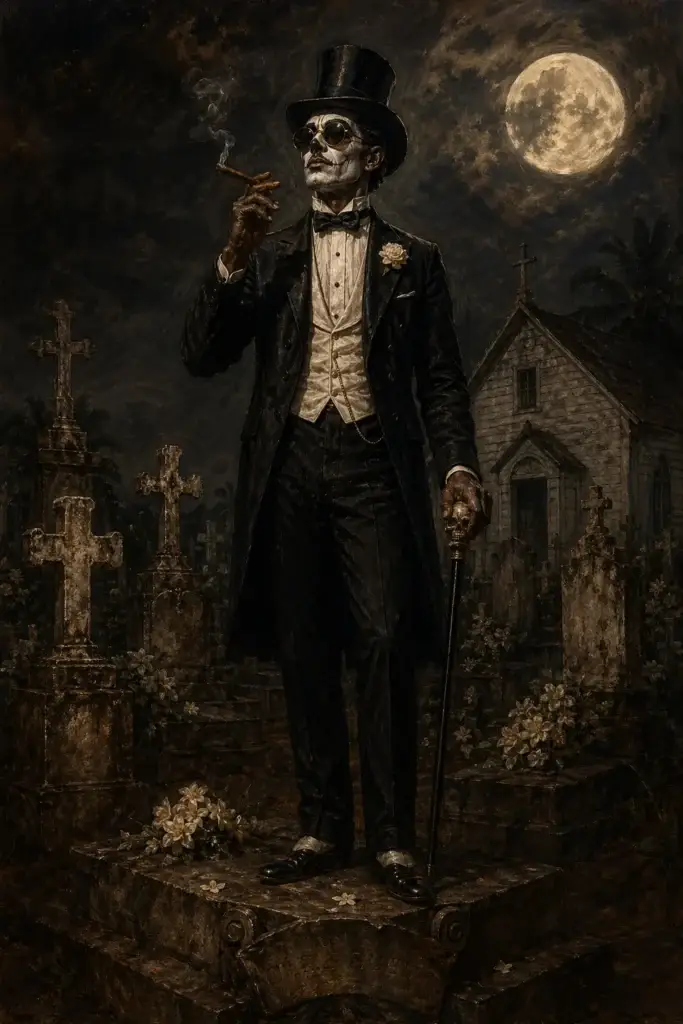
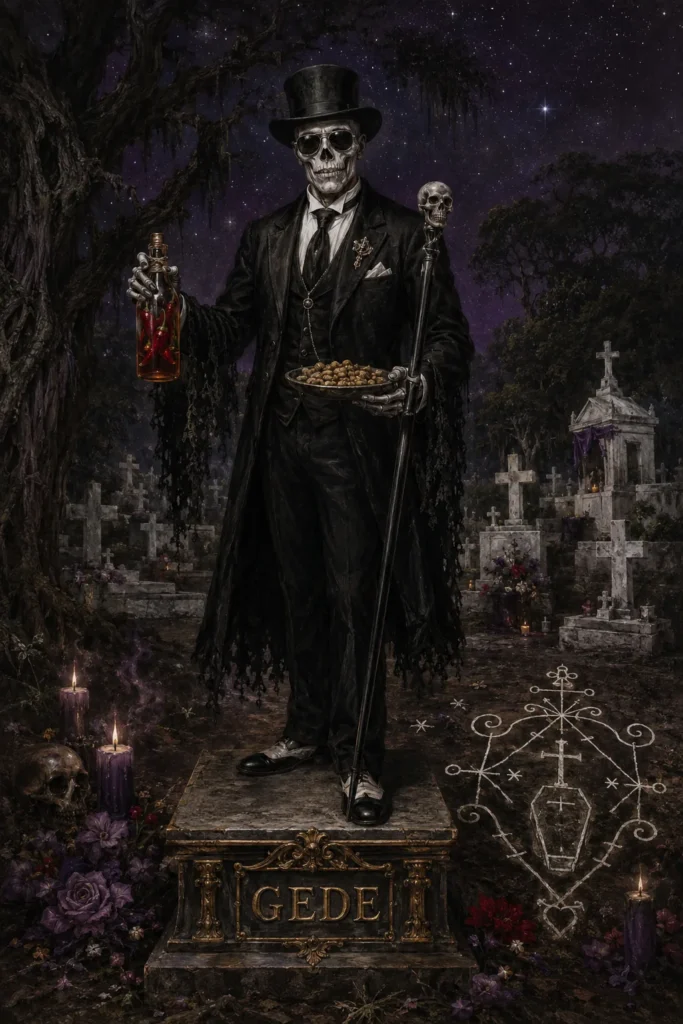
Baron Samedi wears a black tailcoat, a black top hat, black sunglasses, often with a missing lens, and a walking stick. Iconographically, Maman Brigitte appears as a red-haired woman. Black and purple are the main colors of the Gede.
The most important feast day is Fèt Gede on All Saints’ Day and All Souls’ Day (November 1 and 2). The communities gather in the cemeteries, above all in the main cemetery of Port-au-Prince, clean the graves, light candles, offer food and dance to drum music. The mood is at once solemn and exuberant.
The main symbols are the cross, the skull, the black sunglasses, the top hat, the tailcoat and the walking stick. The vèvè usually show a cross, a coffin or a skull with bones. Offerings are hot rum, tobacco, peanuts, coffee and spicy candies, together with kleren, a rum with 21 hot spices.
The ancestor veneration of the Fon and the Egungun of the Yoruba, masked dancers as embodiments of the ancestors, are regarded as forerunners. Some researchers, among them Leslie Desmangles, link Maman Brigitte with the Irish Saint Brigid. Baron Samedi is often identified with Saint Martin de Porres, Baron La Croix with Saint Gerard Majella.
Nature and Function
The Gede stand at the border between the worlds of the living and the dead. They know the beyond because they themselves dwell there, and they know this world because they regularly return to the living.
This dual position makes them healers, mediators and keepers of past and future fates. They are also the loa responsible for sexuality, fertility and the protection of children, which is explained by their position as guardians of the beginning and the end of life.
In “Divine Horsemen” (1953), Maya Deren described the paradoxical nature of the Gede: they are spirits of death, yet loud, dirty and life-affirming like no other spirits of the Haitian tradition.
When the Gede ride a believer like a horse, a drastic sexual and scatological language often manifests, combined with coarse humor and extraordinary healing power. According to Deren, this connection of cemetery and joy of life is a theological statement about the inseparability of death and life.
The Baron Family
At the head of the Gede family stand the “Baron” manifestations, each of which represents an aspect of dominion over the cemetery. Baron Samedi (“Saturday Baron”) is the best known; he wears a black tailcoat, a black top hat, black sunglasses (often with one lens missing) and a walking stick.
He is regarded as the guardian who escorts the deceased into the realm of the dead, and as the healer who can bring the dying back to life.
Baron La Croix (“Baron of the Cross”) is the aspect of resurrection and transition; he stands for the final threshold between life and death. Baron Cimetière (“Baron of the Cemetery”) is the guardian of the concrete burial site.
These three Baron manifestations are venerated together and share many attributes without merging into one another. In “Mama Lola”, Karen McCarthy Brown described the distinctions and connections in detail from the perspective of a practicing priestess.
Maman Brigitte
Maman Brigitte, the mistress of the dead and wife of Baron Samedi, is the most important female manifestation of the Gede family. She is connected with the cemetery, with the protection of women and with healing rituals.
Her iconographic form depicts her as a red-haired woman, which scholars of the Haitian tradition have interpreted as a possible indication of a Scottish-Celtic substrate connection, though this remains speculative.
Some researchers, among them Leslie Desmangles, see in the figure a connection to the Irish Saint Brigid, whose veneration may have reached the Caribbean through French Catholic missionaries.
Maman Brigitte is venerated especially by women who ask for the protection of their children, for healing of gynecological complaints, or for assistance in family crises. Her invocation takes place at the first grave of a woman in the respective cemetery, which is traditionally reserved for her.
This practice is widespread in Haiti and was analyzed by Joan Dayan in her works on the gender order of the Haitian tradition as an example of female religious power.
West African and Creole Roots
The roots of the Gede family lie in several West African traditions, but they are strongly creolized. Important precursors are the ancestor veneration of the Fon (Vodun) and the Egungun tradition of the Yoruba, in which masked dancers appear as embodiments of the ancestors.
The notion of the Gede as their own family of spirits, appearing collectively, presumably also derives from the Fon tradition.
Alfred Métraux pointed out that the specific form of the Gede in Haiti shows strong creole features that cannot be derived directly from African models.
The connection of cemetery, sexuality and burlesque is, in this concentration, attested only in the Haitian tradition and appears to be a response of the enslaved population to the experience of mass dying during slavery. Joan Dayan developed this thesis further and showed how the Gede accomplish a collective working-through of the history of slavery.
Symbols and Attributes
The main symbols of the Gede are the cross (often as a cemetery cross), the skull, the black sunglasses, the black top hat, the tailcoat and the walking stick. Black and violet are the main colors. The “vèvè”, the ritual ground drawings, usually show a cross, a coffin or a skull with bones.
The preferred offerings are hot rum (often laced with pepper), tobacco, peanuts, coffee and spicy candies. A special speciality is “kleren”, a high-proof Caribbean rum that is often infused with 21 different hot spices.
This mixture is traditionally drunk for the invocation of the Gede and is regarded as a hallmark of their ritual practice. The lighting and swallowing of small amounts of burning rum also belongs to their manifestations.
Feast Day and Cemetery Ritual
The most important feast day of the Gede is “Fèt Gede”, which coincides with the Catholic feasts of All Saints and All Souls (1 and 2 November).
On these days the communities of the Haitian tradition gather in the cemeteries, above all in the main cemetery of Port-au-Prince. They clean the graves, light candles, offer food and dance to drum music. The atmosphere is at once solemn and exuberant, with carnival elements and obscene songs.
In “Rara!” (2002), Elizabeth McAlister documented Fèt Gede in detail and showed how it fulfills an important function in Haitian memory culture.
It is not only a religious festival but also a collective gesture of remembrance for the deceased, above all for the victims of slavery and political violence. In the 1980s and 1990s the festival became increasingly politically charged and was connected with the democracy movement.
Healing Function
Despite their connection to death, the Gede are the most significant healers of the Haitian pantheon. When a person stands on the threshold of death, Baron Samedi is invoked to bring them back to life.
This healing function arises from his position as lord of the cemetery: only he can decide whether a dying person is let in or sent back. In numerous stories from the Haitian tradition, a dying person returns to life through the intervention of Baron Samedi.
In “Mama Lola”, Karen McCarthy Brown documented several cases in which followers invoked Baron Samedi for the rescue of seriously ill family members.
This healing function is also relevant in the context of judgment and conflict resolution: the Gede are regarded as incorruptible judges who speak the final word in complicated disputes. This juridical dimension connects them with the West African tradition of ancestral jurisdiction.
Syncretistic Identification
In this syncretistic system rooted in Catholicism and the Haitian tradition, the various Baron manifestations are identified with different Catholic saints. Baron Samedi is often associated with Saint Martin de Porres or with a Black Madonna depiction; Baron La Croix with Saint Gerard Majella; Baron Cimetière with Saint Expeditus.
Maman Brigitte is identified with Saint Mary Magdalene or with Saint Brigid. These associations vary regionally and follow local iconographic conventions.
Leslie Desmangles pointed out that these syncretistic associations are not to be understood as confusion but as deliberate acts of translation. Practitioners of the Haitian tradition know very well that Baron Samedi is not identical with Saint Gerard; they use the Catholic images as visual anchors without adopting their theological content.
This “double religiosity” is a specific form of Caribbean religiosity that can be found in comparable form in Cuba, in Brazil and in the southern United States.
Research and Cultural Significance
The study of the Gede is part of the broader research on the Haitian tradition and draws on the classic works of Maya Deren, Alfred Métraux and Karen McCarthy Brown.
Joan Dayan, Elizabeth McAlister, Leslie Desmangles and Claudine Michel have presented more differentiated studies in recent decades that take into account the cultural, political and gender-specific dimension of Gede veneration. Today the Gede are regarded as the theologically most complex loa family of this tradition, precisely because they unite seemingly contradictory functions.
In popular culture the Baron Samedi figure is by far the best-known manifestation of this tradition. It appears in James Bond films (especially in “Live and Let Die”), in the Disney animation “The Princess and the Frog” and in numerous novels and songs.
These pop-cultural appropriations have strongly shaped the public image of Baron Samedi, often at the expense of the religious substance. The Haitian research of Patrick Bellegarde-Smith and Laennec Hurbon has repeatedly pointed to the necessity of distinguishing between exoticizing representation and religious tradition.
Placement Between Rada and Petwo
The Gede family holds a special position within the Haitian tradition because it cannot be assigned unambiguously to either the Rada or the Petwo family. In most hounfor they are treated as their own “nation” (“nasyon”), with their own drum rhythms (“banda” and “gede”), their own songs and their own dance forms.
In the liturgical course of a ritual night in this tradition, they usually appear at the end, after the Rada and Petwo rites, which underlines their function as beings of transition. They close the ceremony just as they close life itself.
In “Sacred Arts of Haitian Vodou” (Los Angeles 1995), Donald Cosentino presented a detailed analysis of Gede iconography.
In the monograph “The Faces of the Gods”, Leslie Desmangles describes how the Gede are composed of several African substrates: the family of the dead among the Fon, the Egungun ancestors of the Yoruba, and the Bakulu ancestor conceptions of the Kongo groups.
This mixture forms the basis of the distinctly Haitian Gede family and explains their theological complexity.
The Appropriation of Baron Samedi under the Duvaliers
A politically burdened episode in the history of the Gede is the appropriation of Baron Samedi by the Haitian dictator François “Papa Doc” Duvalier (president 1957 to 1971).
Duvalier publicly styled himself with the iconographic markers of the loa: black suit, black top hat, black sunglasses with a missing lens and a nasal way of speaking.
This self-presentation was meant to make him appear as the embodiment of the lord of the cemetery and thus as untouchable. It exploited the folk-religious fear of death and of the spirits of the deceased in order to stabilize the reign of terror.
In “Culture et dictature en Haïti” (Paris 1979) and in later studies, Laënnec Hurbon analyzed the religious-political mechanics of this appropriation.
It was not an authentic ritual expression of the Haitian tradition but a secular instrumentalization of religious symbolism. The religious community in Haiti reacted in a divided way: some houngans were integrated into the regime, others distanced themselves.
In “Haiti: The Breached Citadel” (Boulder 1990), Patrick Bellegarde-Smith showed how this episode still burdens the international perception of the Haitian tradition today and forces research into a difficult defensive position: the religious substance of the Gede must be consistently set apart from the political caricature under the Duvaliers.
Individual Gede Loa and Their Names
The Gede family is not a homogeneous group but an assembly with numerous individual members, each of whom represents a character and a social function.
Among the better-known Gede are Gede Nibo (guardian of the young deceased), Gede Doubye (with a medical function), Gede Plumaj (patron of the theatrical and the eloquent), Gede Linto (often depicted as a child loa), Gede Loraj (with a connection to thunder), Gede Souffrant (for those who died unjustly) and Gede Zarenyen (with a spider connotation).
The exact list varies from hounfor to hounfor and is handed down differently in the ethnographic literature.
In the anthology “Sacred Arts of Haitian Vodou”, Donald Cosentino presented an iconographic overview of more than twenty Gede manifestations. In “Mama Lola”, Karen McCarthy Brown described the priestess’s personal relationship to several individual Gede loa, among them a deceased brother who is newly venerated as a member of the Gede family.
This personalization of deceased family members is a typical element of Gede veneration: after a certain time (often a year and a day) the dead person enters the Gede family and there receives a name that continues their personality. This process follows the West African ancestral logic and substantially shapes Haitian mourning work.
Sources and Literature
Secondary literature: Alfred Métraux, “Le vaudou haïtien” (Paris 1958); Maya Deren, “Divine Horsemen” (New York 1953); Karen McCarthy Brown, “Mama Lola” (Berkeley 1991), especially the chapters on Maman Brigitte and the healing function of the Gede; Leslie G. Desmangles, “The Faces of the Gods” (Chapel Hill 1992); Joan Dayan, “Haiti, History, and the Gods” (Berkeley 1995); Donald Cosentino (ed.), “Sacred Arts of Haitian Vodou” (Los Angeles 1995), with the essays on Bawon Samdi and Gede iconography; Elizabeth McAlister, “Rara! Vodou, Power, and Performance” (Berkeley 2002), especially the chapter on Fèt Gede; Laënnec Hurbon, “Culture et dictature en Haïti” (Paris 1979) and “Le barbare imaginaire” (Paris 1988); Patrick Bellegarde-Smith and Claudine Michel, “Haitian Vodou: Spirit, Myth, and Reality” (Bloomington 2006); Patrick Bellegarde-Smith, “Haiti: The Breached Citadel” (Boulder 1990). On the West African models: Melville J. Herskovits, “Dahomey” (New York 1938); Suzanne Preston Blier, “African Vodun” (Chicago 1995); Robert Farris Thompson, “Flash of the Spirit: African and Afro-American Art and Philosophy” (New York 1983), with chapters on Kongo substrates of the Gede tradition.