iWell Guard

Baron Samedi, god of the Haitian tradition

Baron Samedi is a god of the Haitian tradition.

Lord of the Gede, ruler of the dead, harbinger of death. Baron Samedi is the leader of the Gede family, those Loa who hold dominion over death, the earth, and the afterlife.

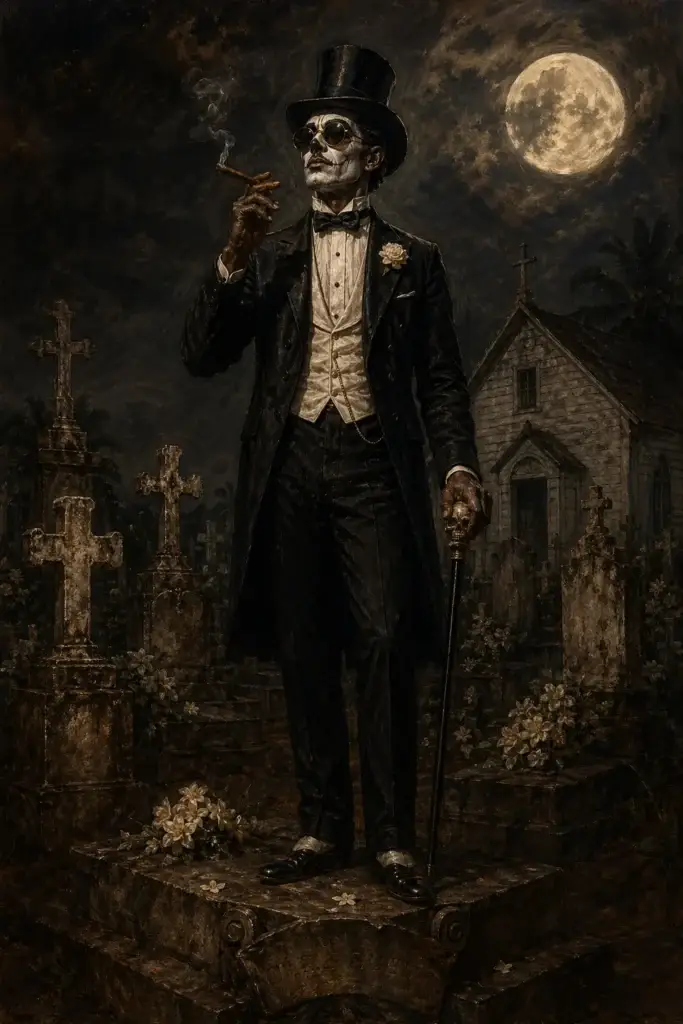
Dressed in a black tailcoat, top hat, and skull face painted white, he personifies the boundary between the living and the ancestors. In Vodou, Baron Samedi inspires not fear but respect and dark humor. He swallows flames, loves rum, and his laughter echoes from the cemeteries.

Table of Contents

Baron Samedi - gods from the Vodou tradition, historical illustration

Baron Samedi

Overview: Baron Samedi

Type: Vodou Loa of the Petro family, lord of the dead and cemeteries
Pantheon: Vodou (Haiti), Louisiana Vodou (USA), Vodou diaspora
Function: Escorting the dead to the afterlife, healing in extreme cases, sexuality
Main attributes: top hat, black-purple tailcoat, sunglasses (one lens missing), cigar, rum
Main cult sites: cemeteries in Haiti (especially Port-au-Prince), Hounfor temples
Popular standing: in Creole tradition, he ranks among the most beloved spirits

Classification

Period of the Sources

Baron Samedi (Creole: Bawon Samedi) developed from West African Vodun roots (Dahomey, Yoruba) in colonial Saint-Domingue (present-day Haiti) during the 17th and 18th centuries. He belongs to the Guédé family of death Loa, which are central to the November festival Fete Gede (an All Saints tradition).

In the 20th century he became internationally known through popular culture (James Bond film Live and Let Die, 1973), though that portrayal is heavily distorted.

Area of Spread

Main cult sites: all Haitian cemeteries (Baron Samedi takes the first grave as his seat), particularly the large ones in Port-au-Prince. Hounfor temples (traditional Vodou temples) have a dedicated area for him.

He is present in the Haitian diaspora in New Orleans, Miami, New York, and Montreal. The associated feast day Fete Gede (1st and 2nd November) is one of the largest Vodou folk festivals.

State of Sources

Key sources: Dewitt-Talent’s studies, Maya Deren’s Divine Horsemen (1953, a classic Vodou ethnography), Alfred Métraux’s Le Vaudou haïtien (1958), Karen McCarthy Brown’s Mama Lola. Important academic references: Desmangles, The Faces of the Gods; Ramsey, The Spirits and the Law. Cultural history: Hurbon, Voodoo: Search for the Spirit.

Name

Baron Samedi is consistently depicted in the image of a funeral director or wealthy dead man: black tailcoat, white waistcoat, top hat, often a cane or pipe. His face is made up like a skull, with white lime paint, black eye sockets, and a broad line across the nose.

A wide, somber grin completes the mask. His Loa symbol (Veve) consists of crosses and interlaced lines. Baron Samedi loves rum, wine, and cigarettes, genuine offerings at his festivals.

Character Traits

Baron Samedi opens the doors to the afterlife. He is not cruel but pragmatic: without him there is no connection to the ancestors, no ancestral blessings, no healing through ancestral knowledge. In rites he is invoked through possessions: the Houngan or Mambo falls into trance, and Baron Samedi “rides” the priest.

He then speaks in rough, earthy Vodou, cracks jokes about death, and gives practical advice, often accompanied by monetary negotiations. Cemetery offerings, rum gifts, and loud music belong to his festivals.

On the 1st and 2nd of November (All Saints / All Souls), the Fète Gede is held; hundreds of thousands of pilgrims visit Haiti’s cemeteries to dance with the Gede.

Appearance and Symbolism

Baron Samedi is depicted as a tall, dark man in a black suit or tailcoat with a top hat, often with white skull make-up painted on his face.

He carries a staff or a cigar. His movements are dancing and wild. His attributes are bones, crosses, and rum. He is portrayed as funny, obscene, and dangerous at the same time.

Profile: Baron Samedi

The most important aspects of Baron Samedi at a glance. The following fields summarize his origin, function, appearance, veneration, symbols, and parallels.

Tradition

Baron Samedi is the head of the Guédé Loa family and leader of the spirits of the dead. Husband of Maman Brigitte (patron Loa of cemeteries).

Brother or cousin of the further Baron Loas (Baron La Croix, Baron Cimetière, Baron Kriminel). Without his permission no soul can enter the afterlife; he must cast the first shovel into every grave. He also receives the dying at the threshold.

Addressees

Escort function for the dead into the afterlife. Healing deity in extremis: when no other Loa can help, one turns to Baron because he decides over death.

Patron of sexuality (in an obscene, life-affirming form; the Banda dances of the Fete Gede are sexually explicit). Protector of children; in some traditions he is petitioned for the healing of sick children.

Appearance

A gaunt, tall male figure with dark skin, in a formal black or purple tailcoat with top hat. Characteristic: sunglasses with one lens missing on one eye (one eye looks into this world, the other into the spirit world).

Often a cigar or long tobacco pipe at the corner of his mouth. Long dark bony fingers, skull face beneath the hat. During possession of his Hounsi (horse), the possessed dances in this attire.

Sphere of Influence

Sphere of Influence: Baron Samedi is invoked in every Vodou funeral; without him the dead cannot enter the afterlife. During Fete Gede (early November), thousands of Haitians bring food and rum to the cemeteries.

In acute illness one turns to him when other healings have failed. Personal invocation with rum, tobacco, peanuts, and corn juice. Consultation takes place through the Houngan (priest), who is possessed by him.

Forms of Protection

Top hat, black or purple tailcoat, sunglasses with one missing lens, cigar or tobacco pipe, rum (Clairin or Barbancourt), peanuts, skulls and bones, black rooster (sacrificial animal), black cross (symbol on cemeteries). Sacred plant: celandine, nasturtium. Sacred colors: black and purple.

Counterparts

West African roots: Eshu/Elegba (Yoruba, threshold deity), Legba (Vodun-Dahomey, gate-opener). Caribbean syncretisms: Ogou Feray (Loa family), Papa Legba (related Loa). Global death-guide parallels: Hermes Psychopompos (Greece), Anubis (Egypt, escort of the dead), Charon (ferryman), Yama (Hindu-Buddhism), Mictlantecuhtli (Aztec), Hecate (crossroads). In Western folk tradition: Death as a personified threshold guardian.

Everyday Protection

Veneration Rituals

Baron Samedi (Haitian Creole: Bawon Samdi, “Baron Saturday”) is the chief of the Guédé Loa family, the spirits of the dead in Haitian Vodou. His festivals are celebrated on the All Saints weekend (1st and 2nd November) in cemeteries (Fèt Gede), a Creole synthesis with the Catholic All Souls.

Devotees dress in black and purple, drink Clairin rum infused with chili peppers, smoke cigars, and dance the Banda. Central rituals take place in a Hounfor (Vodou temple) with Baron Samedi’s Vèvè diagram (cross, skull, coffin) (cf. Métraux, Voodoo in Haiti; Hurbon, Voodoo: Search for the Spirit).

Invocations

Houngan (Vodou priest) and Manbo (priestess) summon Baron Samedi with drum rhythms (Banda rhythm) and Creole chants. The invocation begins with “Bawon Samdi, Bawon Lacroix, Bawon Cimitière”; he is summoned under three aspects. The possession (chevauchement) by Baron Samedi is marked by his black suit, top hat, and sexually suggestive language.

Amulets and Protective Symbols

Vèvè diagrams (cross with coffin and skull) are drawn in cornmeal on the temple floor. The black sunglasses (often with only one lens) are Baron Samedi’s iconic attribute. Skull pendants made of bone or plastic.

Cemetery earth from an active Haitian cimetière as protection against illness and death. The Vèvè variant with a single point at the center serves as a personal protective tattoo.

Baron Samedi: Parallels in Other Cultures

In European traditions, Baron Samedi recalls the Grim Reaper, Charon (Greece), and Pluto/Hades. In Mexican cultures he bears resemblance to Santa Muerte or Catrina, mysterious and humorous figures that negotiate death.

In the folklore of other African diaspora cultures (Santería, Candomblé) analogous death-guides exist. Baron Samedi is nonetheless his own figure, not simply a variant of another god but a product of Haitian synthesis.

Baron Samedi and the Family of Gede Spirits

Baron Samedi can only be understood within the community of the Gede, the family of death and ancestral spirits in Haitian Vodou.

The Gede are the Lwa responsible for the realm of death, cemeteries, and the dead, yet at the same time, and this is crucial for understanding them, also for sexuality, procreation, and life force. In Vodou logic, death and fertility belong together because both concern the transition and renewal of life.

Within this family, Baron Samedi occupies a prominent position as its head. Alongside him stand further Barons, among them Baron La Croix, Baron Cimetière, and Baron Kriminel, who are understood partly as aspects and partly as distinct figures.

At his side stands his companion Maman Brigitte, the only female Lwa of comparable rank in this domain, regarded as mistress of the cemeteries and protector of graves.

Baron Samedi is considered the father or leader of the numerous Gede spirits, who appear as a loud, coarse, and irreverent crowd. This family structure is not merely genealogical but functional: Baron Samedi decides whether a deceased person is actually admitted to the realm of the dead.

Without his involvement, the belief holds, no grave permanently claims its occupant. He is thus the gatekeeper between the living and the dead, and the other Gede are his retinue. Related functions can be found in Papa Legba, who opens the gates to the spirit world in general.

Iconography and Ritual Attributes

Baron Samedi is one of the most distinctly defined Lwa in terms of iconography.

When he “rides” a believer during a ceremony, that is, when he takes possession of that person, he appears in a fixed guise: black tailcoat or suit, top hat, often dark glasses with one lens sometimes missing, which is interpreted as meaning he looks into the world of the living with one eye and into the world of the dead with the other.

The face is frequently painted or envisioned as white or as a skull.

His attributes connect the cemetery with enjoyment. He drinks sharp rum infused with twenty-one chili peppers, a mixture barely tolerable to others, and smokes cigars or cigarettes.

Associated with him are the grave cross, the spade, the coffin, and the colors black and purple. His central cult site is the Kwa Baron, the first cross in a Haitian cemetery, considered his seat, at which offerings are brought to him.

Characteristic is his behavior in the state of possession. Baron Samedi and the Gede are known for obscene language, sexually suggestive dances, and crude jokes.

This behavior is not a lapse but part of the meaning: by presenting themselves as emphatically vital, joyful, and shameless, the spirits of death mock death and assert the power of life against it. Research has described this laughter in the face of death as a central religious element of the Gede cult.

The seemingly irreverent staging is precisely an expression of a serious engagement with mortality.

African Roots and Creole Reformulation

The origins of Baron Samedi lead into the complex history of Haitian Vodou, which developed from West African religions under the conditions of slavery in the French colony of Saint-Domingue.

Research sees in the Gede spirits connections above all to ideas from the Fon and Yoruba regions of present-day Benin and Nigeria, where death, ancestors, and the earth had their own cults.

A direct, unambiguous identification of Baron Samedi with a single African deity cannot, however, be established; he is better understood as a Creole new formation.

Several layers have gone into this new formation. From Catholicism, to which the enslaved were forcibly introduced, come elements such as the cemetery cross and the connection to All Souls’ Day.

The name itself is French-Creole: Baron as a title, Samedi as “Saturday.” Research discusses several interpretations of the day name without any one being securely attested; a reference to the Sabbath or to the day of funerary memorial rites is often considered.

It is important not to misread this synthesis as mere mixing. The enslaved Africans and their descendants, under the pressure of colonial society, shaped from African, European, and partly indigenous Caribbean elements an independent, coherent religion. Baron Samedi is a product of this creative appropriation.

He bears a European aristocratic title and a Christian weekday in his name, is connected to the Catholic cemetery, and yet stands entirely within the African-influenced logic of a religion in which the dead and the living are in constant exchange. Precisely in this fusion lies his interest for the history of religion.

Reception: From the Cross in the Cemetery to Popular Culture

Baron Samedi has become one of the best-known Vodou figures in Western popular culture, and this reception is often far removed from religious reality.

From the early 20th century onward, sensationalist travel accounts and films spread a distorted image of Haitian Vodou. Baron Samedi was frequently depicted as a sinister, threatening figure, linked to the equally distorted motif of the “Zombie.”

A particularly influential portrayal came in the James Bond film Live and Let Die of 1973, in which a character named Baron Samedi appears as an uncanny, laughing antagonist.

Later films, comics, role-playing games, and video games took up the motif and cemented the image of the top-hat-wearing spirit of death as a figure of terror.

Political instrumentalization also belongs to this reception history: the Haitian dictator François Duvalier deliberately staged his public appearance with reference to Baron Samedi, in order to surround his power with supernatural dread.

This popular transmission obscures the essential features of the religious figure. In lived Vodou, Baron Samedi is not a mere figure of terror but an ambivalent, often comic and thoroughly approachable Lwa.

People turn to him as a helper, particularly in questions of life and death, for instance when a serious illness threatens: because no person can die without Baron Samedi opening the grave, the invocation of the Baron can, in the understanding of the faithful, hold death at bay.

He is also regarded as a protector of children and as a spirit who speaks the truth with blunt openness. For a sound assessment, it is therefore necessary to separate the cinematic figure of terror from the many-layered religious figure who is actively venerated in Haitian Vodou to this day.

Selected Bibliography

  • Métraux, Alfred: Le Vaudou haïtien. Paris 1958 (English: Voodoo in Haiti).
  • Desmangles, Leslie G.: The Faces of the Gods. Vodou and Roman Catholicism in Haiti. Chapel Hill 1992.
  • Ramsey, Kate: The Spirits and the Law. Vodou and Power in Haiti. Chicago 2011.

Further standard works in the literature index.

Frequently Asked Questions about Baron Samedi

Who is Baron Samedi in Vodou?

Baron Samedi (Creole: Bawon Samdi, Baron Saturday) is, in Haitian Vodou, the leader of the Gede, the family of Loa of death and the ancestors. A Loa is a spirit or a deity through whom Vodou believers enter into contact with the divine.

Baron Samedi is depicted with a top hat, black tailcoat, dark sunglasses often missing one lens, and a white-painted face resembling a skull. He stands at the threshold between the living and the dead and receives every soul as it enters the underworld.

Why is Baron Samedi regarded simultaneously as a spirit of death and of life?

Baron Samedi embodies a dual nature typical of Vodou: he is lord of death, yet at the same time loud, crude, and vital, known for bawdy jokes, rum, and tobacco.

This combination of death and lust for life is not a contradiction but an expression of the Vodou view that death and fertility are closely linked.

Baron Samedi is also regarded as a healer in hopeless cases: as long as he has not dug a grave, a dying person cannot enter his realm. He is therefore also invoked in serious illness.

Classification & Protection

IIILEVEL
The Protection Compass assigns this being to influence level III, Burdensome influence.

Against its influence, cross-cultural tradition names these protective means:

Compare in the Protection Compass →

Recommended protective means

iWell Guard

The simplest protective means in this collection: 41 layers of fine gold 999, platinum, silver and silicon, manufactured in Ruhla, Thuringia. It requires no activation, is bound to no person, and is effective within a radius of around 50 meters, even without being worn.

All protective means at a glance →