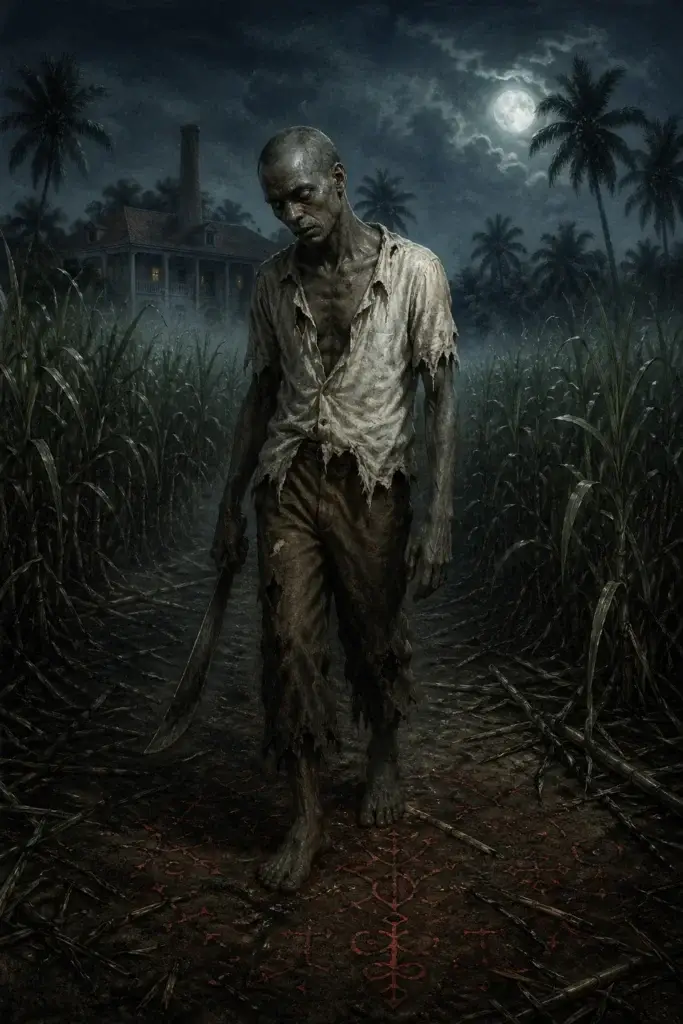
Bokor is a spirit of the Haitian tradition.
Master of dark magic, ruler over Zombis and curses. The Bokor is the dark counterpart to the Houngan (the benevolent Vodou priest). While the Houngan serves the Loa and heals the community, the Bokor serves himself and the shadowy forces.
His knowledge is real and feared: poisons, rituals of uprooting, zombification, harmful spells. The Bokor is not supernatural; he is a human being who applies his talent for magic and manipulation to malicious ends.
The Bokor is Haiti’s dark Vodou sorcerer, one who works with harmful magic.
Type: Vodou practice: black-magic Vodou priest (counterpart to the Houngan)
Pantheon: Vodou (Haiti), practitioner, not a being
Function: Black-magic practice, creation of Zombi, slave-binding relationships
Main attributes: black-and-red clothing, ouanga sachets, clay dolls, dark rites
Main cult sites: none official, secret Hounfor-like premises
Distinction: Houngan (light practice) vs. Bokor (dark practice)
The Bokor tradition developed in colonial Saint-Domingue alongside the orthodox Vodou priesthood. It represents a categorically dark, black-magic Vodou practice; the Bokor “works with both hands”.
The main period of ethnographic attention was the 19th to 20th century. Wade Davis’s The Serpent and the Rainbow (1985) brought the Bokor into Western consciousness. The tradition remains present in rural Haitian regions today.
Found primarily in rural Haitian regions. In Port-au-Prince the tradition has moved to the margins since the 20th century. In the Haitian diaspora (New Orleans, Miami, Brazilian Quimbanda) it is rare and covert. No Bokor maintains a public temple; the practice is clandestine and is carried out in private or in secret premises.
Key sources: Maya Deren’s Divine Horsemen (1953, brief mention), Wade Davis’s The Serpent and the Rainbow (1985, controversial Bokor ethnography), Davis’s academic follow-up study Passage of Darkness (1988).
From a history-of-religions perspective: Hurbon, Voodoo: Search for the Spirit; Métraux, Le Vaudou haïtien. Critical reflection: McAlister, Rara!; Ramsey, The Spirits and the Law.
This section presents an in-depth evaluation of the relevant standard literature.
This section will be filled in a forthcoming encyclopedia update.
The Bokor (Haitian Creole: bokò) is, within Haitian Vodou, the practitioner of the “left hand”, the black sorcerer, in contrast to the legitimate Houngan/Manbo of the Rada tradition (white magic). Bokors work with the Petro line of aggressive Loa and with the spirits of the dead.
Their practice encompasses sorcery (maji), harmful spells (wanga), Zombi creation, and spirit binding.
They operate at the margins of the orthodox Vodou community and are despised by Houngan and Manbo, yet feared (cf. Métraux, Voodoo in Haiti; Hurbon, Voodoo: Search for the Spirit; Davis, The Serpent and the Rainbow).
The most important aspects of Bokor practice at a glance. The following fields summarise tradition, function, appearance, practice, symbols, and parallels.
The Bokor stands in the Vodou tradition as the dark mirror of the Houngan (orthodox Vodou priest). While the Houngan helps with both hands, the Bokor “works with both hands” including the dark one, which can harm others through magic.
Training traditionally occurs through initiation under an older Bokor; the knowledge is passed on in strict secrecy. Bokors stand outside the orthodox Vodou hierarchy.
Functions: black-magic harm inflicted on enemies at a client’s request, creation of a Zombi from a recently deceased person, binding a person into a love or loyalty obligation against their will, healing in extreme cases (where Houngans cannot help).
Also protection for those who “purchase” services from the Bokor. Ethically condemned by the orthodox Vodou community.
Bokors are human practitioners with no fixed iconographic form. Traditionally they wear black or black-and-red, sometimes with Creole insignia (bones, skulls, bags of graveyard earth).
Tools: ouanga (magical sachets containing herbs, earths, and body parts), clay dolls, graveyard earth, skulls, tobacco leaves, black and red candles. Rites traditionally take place at night, often at crossroads or cemeteries.
Sphere of Influence: Bokor practice is feared in rural Haitian communities. Those who feel harmed by illness, family strife, business misfortune, or unwanted betrothal sometimes suspect that a Bokor has been hired against them.
Protection is sought through a visit to one’s own Houngan and counter-magic. Bokor rites are performed in secret; their clients often pay large sums. In modern Haiti the line between prejudice, genuine practice, and urban myth-making is difficult to draw.
Ouanga (magical sachets), clay dolls, graveyard earth, black and red candles, skulls and bones, mirrors, herbs (Datura, thorn apple, belladonna), powders (Davis: containing tetrodotoxin for Zombi creation). Sacred animals: black rooster, black dog. Sacred plants: Datura, belladonna, thorn apple.
Houngan (Vodou, orthodox counterpart), Mambo (female orthodox Vodou priestess). Global parallels among black-magic practitioners: Hexer (Germanic folk tradition), Brujo (Latin American), Kahuna ana’ana (Hawaiian, killing Kahuna), Tantrika of the Aghori tradition (Hinduism, not directly comparable but structurally ambivalent), asipu of black magic (Mesopotamia).
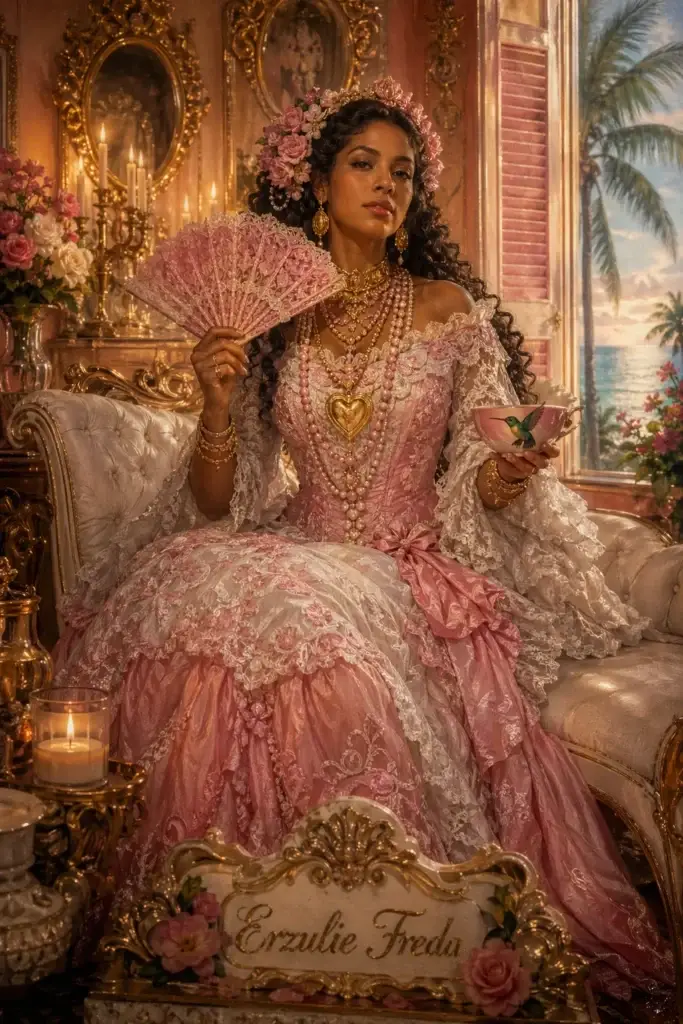
Protection against Bokor harmful magic is achieved through purifying Rada-Loa invocations, above all to Damballah and Erzulie Freda. Houngans perform purification rituals (laver tèt, “head washing”) with herbal preparations and invocations.
Protective baths with white flower petals (jasmine, orange blossom) and eau de cologne are standard practice. In urgent cases an experienced Houngan is consulted for counter-spells against the Bokor (cf. Deren, Divine Horsemen).
Anti-Bokor invocations call upon the bright Loa of the Rada tradition: “Ayibobo” as a healing cry, “Damballah Wèdo” as serpent-god protection. Creole purification songs (chants désorcelants) are recited during the purification baths.
Protective amulets (pakèt kongo), small fabric bundles containing healing herbs, gemstones, and inscribed prayers, are worn as protection against Bokor spells. Vèvè diagrams of the protective Loa (Damballah, Erzulie Freda, Loko) are placed on the household altar.
White candles are lit in honour of the Rada Loa. Anti-wanga wash baths with salt and nine drops of lavender oil serve as a weekly routine in households threatened by a Bokor.

The Bokor stands in the tradition of West African “left-hand” sorcerers, in particular the Yoruba babalawo schism and the Congolese nganga ya kindoki (witch doctor).
In the Bambara tradition of Mali the soma is known as a harm sorcerer. The Haitian Bokor tradition combines West African harm-sorcery concepts above all with Congolese death magic (cf. MacGaffey, Religion and Society in Central Africa).
Related black-sorcerer figures appear in the Jamaican Obeah man, the Cuban palero (practitioner of Palo Mayombe), the Trinidadian spiritualist, and the Hoodoo of the US South. The slave diaspora created a Creole-West African magic tradition whose black-magic components are similarly structured everywhere.
The Bokor was stylised in the North American Hollywood tradition (William Seabrook, Victor Halperin, Wes Craven) into the stereotypical “voodoo priest” of horror films, a drastic distortion of the nuanced Haitian practice.
Wes Craven’s The Serpent and the Rainbow (1988, based on Davis’s book) addresses the Bokor-Zombi transformation. Religious-studies research (Hurbon, McAlister) continually corrects these stereotypes.
The Bokor is a role designation within Haitian Vodou, referring to a specialist who deals with both sides of ritual power: the healing and the harmful.
This distinguishes him from the Houngan and the Mambo, the priests and priestesses whose work is predominantly associated with healing, protection, and service to the spirits, the Lwa. In common parlance it is said that the Bokor serves with both hands.
This duality is not to be understood as mere malice. The ethnological literature emphasises that the boundary between Houngan and Bokor can be fluid in practice and depends strongly on the respective social context and reputation. Some priests are labelled one or the other depending on the situation and the speaker.
The Bokor is embedded in a system of obligations, family lineages, and religious societies. His power is considered learned and transmitted, not arbitrarily available.
Religious-studies research therefore places the figure within the broader structure of Vodou, which emerged from West African, Central African, and Catholic elements under the conditions of slavery in the Caribbean. Further reading can be found in the overview article on Vodou.
The Bokor gained particular prominence through his connection to the concept of the Zombi.
In Haitian tradition, the Bokor is regarded as the figure capable of extracting a person’s soul or a portion of it, placing them in a state of total submission. The resulting Zombi is then said to serve the Bokor for labour or other purposes.
In the 1980s the ethnobotanist Wade Davis, in the books The Serpent and the Rainbow (1985) and Passage of Darkness (1988), advanced the thesis that pharmacologically active substances played a role in zombification, including a neurotoxin derived from puffer fish.
This thesis was controversially debated in toxicology and ethnology and criticised on several points. What is not disputed is that the Zombi concept in Haiti is closely linked to the social role of the Bokor.
Important for contextualisation: in Haitian perception it is not the Zombi itself that is considered truly terrifying, but the state of being turned into one.
The Bokor thus embodies a felt, real threat of a social nature, whether as a sanction authority or as a projection screen for conflicts. iWell Guard describes these ideas as cultural tradition and not as scientifically established fact.
The figure of the Bokor was shaped for a long time in the Western public imagination by distorted representations.
Travel accounts, sensationalist literature, and early film, such as White Zombie (1932), painted a picture of sinister black magic closely tied to colonial and racist stereotypes about Haiti. This external perception says more about the projections of the observers than about the religious practice itself.
Ethnological research in the 20th century sought more nuanced descriptions. Works by authors such as Zora Neale Hurston, Alfred Métraux with Le Vaudou haïtien (1958), and Maya Deren helped present Vodou as a complex religious system in which the Bokor is one of several specialist roles.
Later studies additionally emphasised the importance of local contexts and the diversity of practice.
In contemporary religious studies, the Bokor serves as an example of the ambivalence of ritual power, as found in many religions. Healing and harming are often regarded as two sides of the same capacity.
Those interested in related specialists and spirit beings will find connections in the articles on the Lwa and the figure of the Zombi.
Further standard works in the literature index.
Against its influence, cross-cultural tradition names these protective means:
Recommended protective means
The simplest protective means in this collection: 41 layers of fine gold 999, platinum, silver and silicon, manufactured in Ruhla, Thuringia. It requires no activation, is bound to no person, and is effective within a radius of around 50 meters, even without being worn.
Related Beings

Yuki-onna, the Japanese snow-spirit woman of the mountain regions. White breath, freezing gaze: f...

Meliai: ash nymphs born from the blood of Uranus. Origin in Hesiod, connection to the bronze race...

Tupilak is the artificially made revenge spirit of the Greenlandic Inuit, later a carved figure. ...

Yeongdeung Halmang, the wind and sea goddess of Jeju. Origin, the UNESCO ritual Yeongdeung-gut an...

Meža māte, the Latvian mother of the forest, rules over wild animals and woodland. Tradition of t...

Apu Verónica (Waqay Willka), the water and fertility Apu near Cusco. Origin, the name Holy Tear a...