The Mimi Spirits (also Mimih) are thin, shy rock and cave spirits of the Aboriginal tradition of western Arnhem Land in northern Australia. They are so thin that they can hide in rock crevices, and so shy that they appear only when the air is still.
The Mimi Spirits belong to the religious history of the Aboriginal communities of western Arnhem Land, in particular the Kunwinjku, Mayali, Dangbon and Rembarrnga.
From the internal perspective of the tradition they are real beings that live in the rocks and caves of the Arnhem Land plateau; from the external perspective of the ethnology of religion they are a family of place-bound spirits with teaching and admonishing functions.
Within the Aboriginal tradition the Mimi are especially interesting because the Aboriginal peoples themselves attribute the invention of rock painting to them: in the Dreaming, so the account goes, the Mimi painted the first pictures; people learned painting from them.
This mythical genealogy of the rock paintings makes the Mimi a key figure in Aboriginal art history.
In the phenomenology of religion the Mimi belong to the broad class of the “fairy people”, small, shy, place-bound spirits that occur in many indigenous traditions worldwide and are usually associated with teaching and admonishing functions.
The name Mimi (also Mimih) is attested in most of the Aboriginal languages of Arnhem Land. The etymology is not conclusively settled; a traditional derivation links the word to an onomatopoeic root that renders the quiet hiss or whisper of the spirits.
Among the Yolngu in eastern Arnhem Land they are called something different, Wapitja or Yawk, with partly differing characteristics. Howard Morphy systematically documented the regional variations in Aboriginal Art (1998).
In older ethnographic reports the Mimi are often referred to as “mimih spirits”, an anglicization that is less common today. The standard spelling today is Mimi-Geister (German) or Mimi spirits (English).
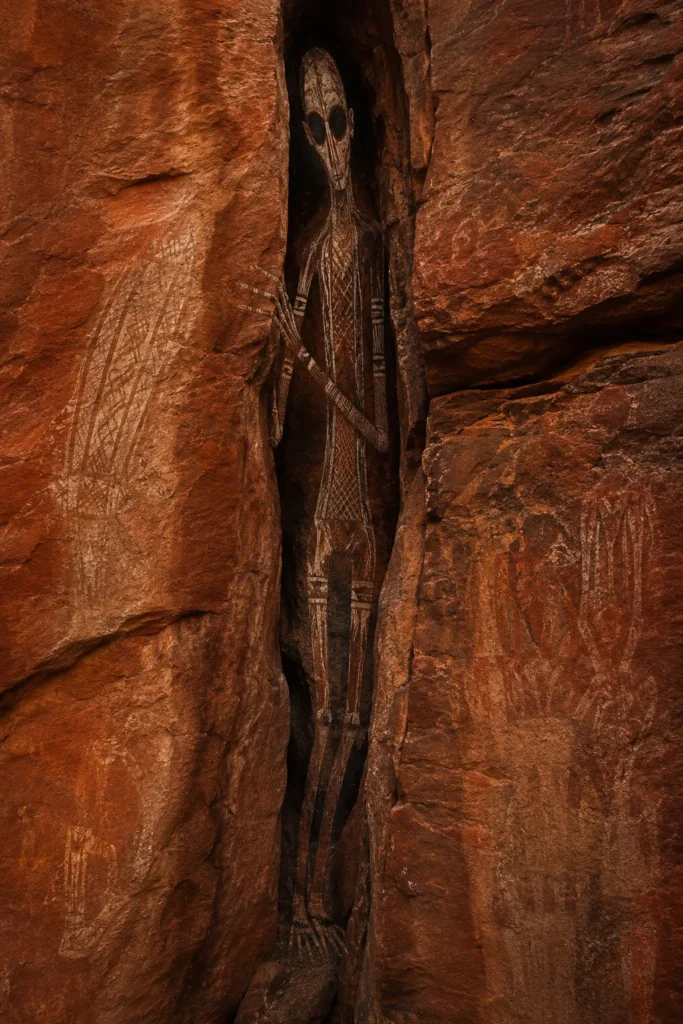
The Mimi are described as exceptionally thin, long beings, so thin that they can hide in rock crevices; so delicate that even a light wind would break their neck bones.
For this reason they leave their rock fissures only in complete calm. They have human faces but overly long limbs; they are often credited with a long spear in their hand.
The Mimi-style rock paintings are among the oldest surviving rock paintings of Arnhem Land. They typically show thin, vividly moving figures, hunters with spears, dancers, women with digging sticks.
This “dynamic figures style” is dated to as much as 12,000 years, which makes the Mimi rock paintings among the oldest surviving works of art in Australia.
The Mimi tradition holds particular significance in the bark painting of the twentieth century. Aboriginal artists such as Yirawala, Crusoe Kuningbal and Spider Namirrkki transferred Mimi themes into modern media. These works are now held in many museums worldwide (for example the National Museum Canberra, the British Museum, the Musee du Quai Branly in Paris).
The central Mimi narrative is that of the “Mimi teaching”: in the Dreaming the Mimi lived peacefully in the rocks. They were master hunters and master painters.
They saw the first humans and out of compassion taught them hunting, fire-making and painting. The art and culture of the Kunwinjku today is therefore a direct inheritance from the Mimi.
A second narrative describes the Mimi strategies of hiding: in wind the Mimi withdraw deep into the rocks; in calm they venture out. Anyone who sees a Mimi spirit should not address it, for they are shy and withdraw when hurt.
A third narrative reports dangerous Mimi encounters: if a hunter stays too long in a cave, he can be “taken away” by the Mimi, a motif that recalls the European fairy abductions and is used in many Aboriginal admonitory tales for children.
The Mimi have no formal cult; they are rather an object of everyday caution and occasional invocation. Before entering a cave one quietly “gives notice”: a brief whistle, a word of respect, sometimes touching the rock.
A particular practice is the annual “renewal” of certain Mimi rock paintings by the tribal elders: as with the Wandjina in the Kimberley, a rock painting is ritually repainted, which is understood as a confirmation of the living relationship between people and Mimi.
In the contemporary Aboriginal practice of Maningrida, Gunbalanya and other Arnhem Land communities, Mimi themes remain alive in art. Several artists work across generations in the “Mimi tradition”, which is significant both religiously and economically (sale of the works).
Described in religious-studies terms: apotropaic practices in the Mimi complex aim at respectful dealing with the caves and rocks. Forbidden are: loud speaking in caves, the unauthorized repainting of Mimi rock paintings, the removal of rock fragments, staying in a cave after sunset.
A particular protective practice is the carrying of small spears or carved wooden figures during a cave visit; these are regarded as a “gift” to the Mimi and ensure a peaceful encounter.
From the external ethnographic perspective these practices are rules that structure everyday life, combining ecological caution (protection of cave ecosystems) with religious practice (respect for the spirits). Mary Douglas described similar taboo structures in the anthropology of religion in Purity and Danger (1966).
Thin, shy rock spirits are broadly attested in the phenomenology of religion. Structurally comparable are: the Irish sidh beings, the Scottish faeries, the Japanese tsuchigumo in old versions, the North American Memegwesi of the Algonquian tradition. In all cases these are place-bound, shy beings with teaching and admonishing functions.
From the phenomenology of religion the connection of the Mimi with the teaching of hunting, fire and art is interesting. This “culture hero” function makes them typologically related to Prometheus (fire), Hermes (art) and many other culture-teacher figures.
The Aboriginal variant is particularly interesting because it employs not a single figure but a whole group of spirits as teachers.
In Siberia the Mimi resemble shamanic helper spirits such as Asbuiga, which likewise serve as teaching, mediating figures. A direct historical connection should, however, not be assumed; this is a case of typological convergence.
The most important early source is Charles P. Mountford’s Records of the American-Australian Scientific Expedition to Arnhem Land (1956), an extensive documentation that brings together much Mimi-related material. Ronald M. and Catherine H. Berndt deepened the study of the Mimi tradition in several works.
Howard Morphy’s Aboriginal Art (Phaidon 1998) and Luke Taylor’s Seeing the Inside (1996) are the most important contemporary art-historical studies of Mimi rock painting and its transfer into modern media.
In contemporary Aboriginal self-presentation the Mimi are present internationally through the bark painting tradition of the Maningrida region. The Bukit Larrtjpi artists’ association and other indigenous institutions maintain the Mimi tradition as cultural and economic heritage.
Several research debates surround the Mimi. First: how old is the Mimi tradition? The Mimi-style rock paintings are archaeologically dated to as much as 12,000 years, but whether the Mimi conception alive today descends continuously from these old pictures is not necessarily established.
Second: what is the relationship of the Mimi to the larger creator figures such as the Rainbow Serpent or the Wandjina? The Mimi are clearly “lesser” spirits, but their teaching function makes them important in the history of religion.
Third: what role do the Mimi play in contemporary Aboriginal art practice? The commercial exploitation of the Mimi images is interesting in the sociology of religion and touches on questions of indigenous property rights over traditional pictorial motifs.
The place of Mimi rock painting in Aboriginal art history merits closer study. The so-called “dynamic figures style” tradition is regarded as one of the oldest surviving art forms in the world; archaeological datings reach back into the late Pleistocene.
These rock paintings typically show thin, dynamically moving figures in hunting and dance scenes. Paul Tacon has carried out the dating and interpretation of these pictures in several essays; his work is the standard today.
The mythical identification of these pictures with the Mimi Spirits makes them particularly interesting in the history of religion. In the internal Aboriginal perspective the pictures are not works of humans but works of the Mimi, an ontology that challenges Western concepts of art.
The bark painting tradition of Arnhem Land has attracted international attention since the 1950s. Well-known artists such as Yirawala (Kunwinjku, 1903 to 1976), Crusoe Kuningbal, John Mawurndjul and Spider Namirrkki have transferred Mimi themes into modern media and made them available for the international art market.
Howard Morphy showed in Becoming Art (2007) how the transition from ritual rock painting to marketable bark painting changed the religious function of Mimi depiction. The pictures have become “independent” and are embedded in a global art market.
From the sociology of religion this development is ambivalent. On the one hand it secures the economic survival of the Aboriginal communities; on the other it transforms secret religious content into a public commodity. Aboriginal artists and their communities have developed mechanisms for dealing with this tension.
Several methodological problems arise in Mimi research. First: the archaeological dating of the Mimi rock paintings is difficult and the subject of ongoing debate. Different dating methods yield different results; a consensus chronology is still lacking.
Second: much Mimi knowledge is not “restricted” in the strictest sense, yet it is nonetheless deeply embedded in local practice. Respectful source work is required that is agreed upon with the traditional owners.
Third: the art-historical and the religious-anthropological perspectives on the Mimi should work together. Both disciplines have their strengths; an isolated treatment misses the depth of the Mimi tradition.
Anyone wishing to study the Mimi complex in its breadth will find on the overview page Aboriginal tradition the most important cross-references to related figures such as Wandjina, Rainbow Serpent and Namarrkon.
The Mimi tradition is present internationally today, above all through the bark painting tradition of the Maningrida region. Well-known artists such as John Mawurndjul, Spider Namirrkki and others have translated Mimi themes into an international artistic language.
Howard Morphy showed in Becoming Art (2007) how the transition from ritual rock painting to marketable bark painting transformed the Mimi tradition without abolishing it. The pictures circulate in a global market yet retain their ritual connection to the Maningrida community.
This dual function (commercial and ritual) is an interesting case study in the anthropology of religion. It illustrates how indigenous religion can survive and transform under modern market conditions.
The periodization of the Arnhem Land rock paintings merits art-historical deepening. Research distinguishes several stylistic phases: “Dynamic Figures” (presumably more than 10,000 years old, often Mimi rock paintings), “Yam Style”, “X-Ray Style” (younger, with beings such as Namarrkon).
Paul Tacon, Christopher Chippindale and George Chaloupka established this chronology in several standard works. The Mimi rock paintings are among the oldest surviving works of art in the world, a finding of outstanding importance in the history of religion.
In contemporary research this chronology is being refined and critically reflected upon. New dating methods (uranium-thorium dating) bring more precise results; some Mimi pictures are now dated to as much as 30,000 years, which reopens the dating discussion.
The question of secret knowledge merits particular methodological deepening. Much Mimi-related knowledge is not “restricted” in the strictest sense (that is, not requiring initiation), yet it is nonetheless embedded in local contexts in which it should not be presented publicly.
Howard Morphy proposed in Aboriginal Art (1998) a differentiated distinction of several levels of knowledge: “inside knowledge” (requiring initiation), “outside knowledge” (for the whole community), “public knowledge” (for the broad public). The Mimi tradition encompasses elements of all three levels.
For contemporary research this means: respectful source work must distinguish these levels and treat them appropriately according to context. This methodological care has been standard since the 1990s.
The Mimi as part of a broader Aboriginal knowledge tradition merit an in-depth study. The Aboriginal tradition understands itself not only as religious but as a holistic form of knowledge that combines religion, ecology, social order and practical skill.
Tyson Yunkaporta conceptualized the Aboriginal knowledge system as “relational pattern thinking” in Sand Talk (2019). The Mimi tradition fits into this system: it combines ecological caution (cave risks), artistic tradition (rock painting), pedagogical function (teaching of hunting) and religious practice (relationship with spirits).
From the phenomenology of religion this is an important observation: indigenous religion is not a separate sphere of “belief” but an integral part of a comprehensive ecology of knowledge. This view has influenced contemporary religious studies worldwide.
A current line of research concerns the archaeological dating of the Mimi rock paintings. The so-called “Dynamic Figures” were long dated to 6,000 to 8,000 years; newer dating methods (uranium-thorium, luminescence) sometimes yield older results.
Paul Tacon, Christopher Chippindale and others have discussed the dating question in several essays. Some rock paintings are now dated to as much as 30,000 years, which would make the Mimi tradition one of the oldest surviving art practices in the world.
For the history of religion this dating is of the greatest significance. It would mean that the conception of the Mimi Spirits is among the oldest religious concepts we know. Research is here in a methodologically productive phase.
The Mimih, often called Mimi Spirits in Western texts, are among the figures of Australian tradition most precisely tied to a body of images.
They are an integral part of the rock art of western Arnhem Land, a region in the north of the continent whose tribal territories are inhabited, among others, by speakers of Kunwinjku and related languages.
In the narratives of these communities the Mimih are thin, long-limbed beings that live in the crevices and hollows of the sandstone cliffs.
Their bodies are so fragile that a strong gust of wind would break their necks, which is why they emerge only when the air is still and disappear into the rock when in danger, inflating it like soft dough.
This conception stands in a remarkable relationship to the rock art itself. Many of the dynamic, finely drawn figures in the older layers of Arnhem Land painting show slender figures frozen in motion, hunting, running or dancing. In the tradition of the traditional owners, images of this kind are partly attributed to the Mimih themselves.
According to this interpretation it was not humans who painted the oldest images but the Mimih, who only afterwards showed humans hunting, painting and certain ceremonies. The Mimih thus appear as transmitters of cultural technique, similar to other pre-human beings of the Australian traditions.
Archaeological research, for example the work of George Chaloupka and later specialists, has worked out for the rock art of Arnhem Land a long sequence of stylistic phases reaching over many millennia. It is important not to play the indigenous attribution to the Mimih and the archaeological style chronology off against each other.
Both answer different questions. The archaeological chronology places the images in a temporal sequence; the indigenous tradition places them within an understanding of the world in which the boundary between human and pre-human authorship is drawn differently.
The Mimih are by no means purely creatures of the past. In numerous communities they are held to be present to this day, harmless to capricious, sometimes helpful, sometimes abducting people.
Carved Mimih figures of wood have, since the second half of the twentieth century, also belonged to the supra-regionally known art production of the region, an example of how an old conception of spirits passes into new forms of expression without losing its place in the living tradition.

The myth of the Mimi Spirits hands them down as gaunt dwellers of the rock crevices of Arnhem Land who taught humans hunting, dance and fire; the most important sources are rock paintings as well as accounts of the Yolngu and Kunwinjku language communities.
Related key terms: Mimi Mimih Arnhem Land rock spirits hunting teachers Kunwinjku.
iWell Guard draws on the cultural-historical tradition of portable protective objects, in the tradition of Aboriginal and many other cultures worldwide. 41 layers, solid gold, platinum, silver, made in Germany. 30-day right of return.
Personal experiences can vary. Not a medical device. No promise of healing.
Against its influence, cross-cultural tradition names these protective means:
Compare in the Protection Compass →Recommended protective means
The simplest protective means in this collection: 41 layers of fine gold 999, platinum, silver and silicon, manufactured in Ruhla, Thuringia. It requires no activation, is bound to no person, and is effective within a radius of around 50 meters, even without being worn.
Related Beings

In Mesopotamian demonology, the Edimmu is not a created figure but the consequence of human negle...

La Llorona, the weeping woman of Mexico. Origin, the drowned children, the search at bodies of wa...

The Shellycoat, a shell-hung water spirit of the Scottish Borders. Origin, the clattering garment...

Rolling Calf, Jamaica's vengeful spirit in calf form. Origin, the glowing eyes and the chain, and...

The Dellermännle, the little penitent mountain spirit of the Kleinwalsertal. Origin, the thin evi...

Melusine: the legend of the serpent-bodied ancestress of the Lusignan, of the Saturday bath and t...