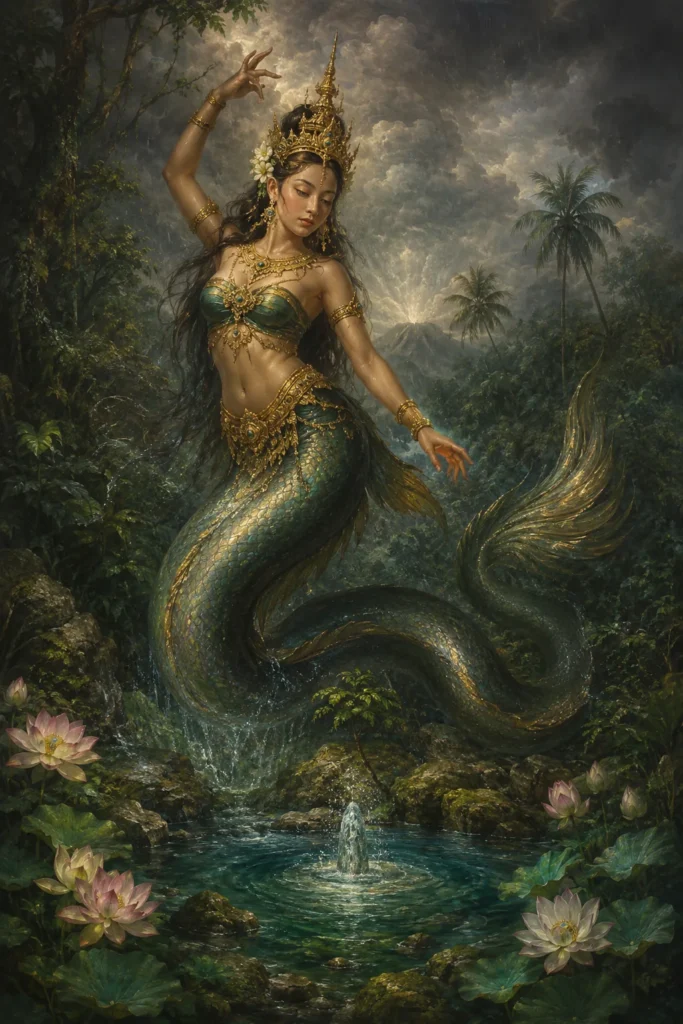
Lihangin, wind father of the Visayan cosmogony
By Ralf Ittermann · last reviewed on
Lihangin is a god of the Visayan tradition of the Philippines.
Son of the sky, husband of the sea, father of the stars.
Lihangin is the Visayan wind god in the creation legend of the Philippines. As the son of the sky god Kaptan and husband of the sea goddess Lidagat, he fathers the children from whom the sun, moon, stars and earth emerge.
He is, above all, a link in the cosmogonic genealogy: barely elaborated, yet indispensable to the course of the narrative, which leads from the primordial pair of sky and sea to an ordered world.
Type: Cosmogonic wind god and genealogical link
Origin: Visaya, Philippines
Texts: Cole, Philippine Folk Tales 1916
Period: Collected 1916, oral basis older
Appearance: barely elaborated, no iconography

Textual history
Period of the Texts
The source is the Visayan creation legend in Cole’s 1916 collection; the oral basis is older, though the name does not appear in Loarca 1582.
Area of Diffusion
The Visayan islands of the Philippines, whose creation legend of the primordial pair Kaptan and Maguayan remains school material to this day.
Sources
Good for the source Cole 1916; it is authentic, but an early 20th century compilation in English retelling, not a precolonial testimony.
Name and variants
Visayan: Lihangin derives from Visayan and Tagalog hangin, wind. The prefix Li- recurs in the names of his children, such as Liadlaw from adlaw, sun, and Libulan from bulan, moon.
Nature and effect
Appearance
Lihangin is barely elaborated, mainly a genealogical link as son of the sky, husband of the sea and father of the stars. No iconography exists.
Effect
With Lidagat, Lihangin fathers the star and earth children Likalibutan, earth and rock, Liadlaw, sun, Libulan, moon, and Lisuga, stars, thereby driving the cosmogony forward; he dies early in the narrative.
Profile: Lihangin
The key aspects of the wind father at a glance.
A link in the Visayan Kaptan-Maguayan cycle: the sky’s son, Wind, marries the sea’s daughter, Sea.
The creation myth itself: from the marriage of Wind and Sea come the children who become sun, moon, stars and earth.
No iconography; in the source, Lihangin remains a narrative figure without a fixed image.
Driving force of the cosmogony: father of Likalibutan, Liadlaw, Libulan and Lisuga, whose fates bring forth the order of the world.
No documented Lihangin cult exists; he is a purely narrative-genealogical figure of the creation legend.
The Kaptan-Maguayan cycle and its source
The source is Mabel Cook Cole’s Philippine Folk Tales of 1916, in the story of creation: the sky god Kaptan and the sea goddess Maguayan; Kaptan’s son Lihangin, the wind, marries Maguayan’s daughter Lidagat, the sea. Cole 1916 is authentic, but an early 20th century compilation in English retelling, not a precolonial testimony; the name Lihangin does not appear in Loarca 1582.
In the narrative, Lihangin dies early. Through the rebellion of his son Likalibutan against his grandfather Kaptan, the order of sun, moon, stars and earth arises from the wreckage: the wind father continues to act through his children, not through deeds of his own.
School material and classification
The legend is standard school material in the Philippines and is widely retold in anthologies as well as online; it forms the basis of many popular accounts of the Kaptan-Maguayan family.
From a religious-studies perspective, Lihangin is a cosmogonic ancestral figure with no threatening traits. Important clarifications: the legend is genuine, but a compilation from the early 20th century, not precolonial evidence; in the source, Lihangin is primarily a family link, not a major wind god; and he should not be confused with the Tagalog monsoon terms Amihan and Habagat, but belongs instead to the Visayan Kaptan-Maguayan cycle.
A figure without a cult
No documented Lihangin cult exists; he is a purely narrative-genealogical figure, and this should be stated honestly. His significance lies not in rites or offerings but in the narrative itself: without the marriage of Wind and Sea, this cosmogony would have neither stars nor earth.
Wind and water at the beginning of the world
Lihangin belongs to the classical cosmogony of sky and sea, or wind and water, from which the stars emerge. The generational conflict, in which the grandson overthrows the grandfather, is distantly related to the Uranus-Gaia structure of Greek mythology. Within the Philippines, the monsoon winds Amihan and Habagat must be clearly distinguished: they are Tagalog weather terms, whereas Lihangin is a figure from the Visayan creation narrative.
Frequently asked questions about Lihangin
Who is Lihangin?
The Visayan wind god of the creation myth, son of the sky Kaptan and husband of the sea Lidagat.
Is the myth pre-colonial?
It is genuine, but a collection from the early 20th century by Cole 1916, not a pre-colonial record.
Is Lihangin the same as Amihan?
No. Amihan and Habagat are Tagalog monsoon terms; Lihangin belongs to the Visayan Kaptan-Maguayan cycle.
Further links
Further reading:
- Amihan – the northeast monsoon of the Philippines
- Habagat – the southwest monsoon of the Philippines
- Maria Makiling – the mountain lady of Philippine tradition
- Amulet, protective candle, salt – traditional protective means
- Protection Compass – protective means at a glance
Literature (selection)
Further standard works in the bibliography.
As the Visayan wind god, Lihangin stands at the beginning of the best-known creation myth of the Philippines: a silent wind father whose children become sun, moon, stars and earth.