iWell Guard

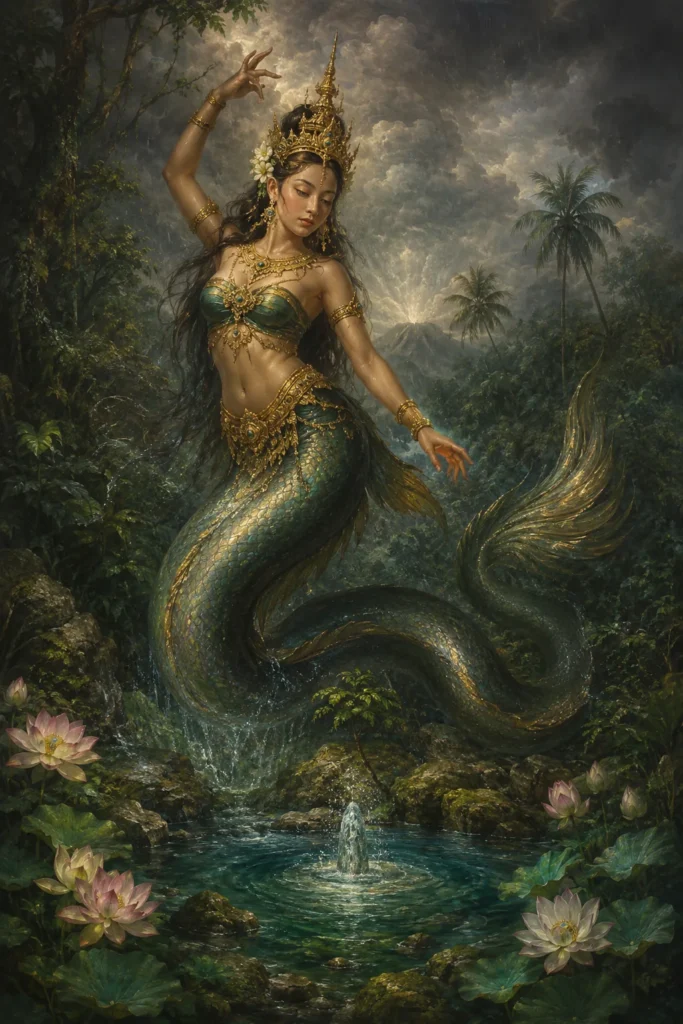
Lalahon, mistress of the harvest in the fire-spewing mountain

Lalahon is a goddess of the Philippine Visaya tradition.

The harvest goddess in the volcano, who sends locusts in anger.

GoddessPhilippines

Table of Contents

Lalahon, the harvest and volcano goddess of the Visaya
Lalahon

Lalahon is the harvest and volcano goddess of the Visaya, dwelling in the fire-spewing volcano on Negros. She is invoked for a good harvest and, in anger, sends locusts that ruin the crops.

She is the best-attested of the Philippine fire and volcano beings: Miguel de Loarca names her explicitly in 1582 in his Relación de las Yslas Filipinas, a rare direct primary source, which moreover explicitly describes her as female.

Overview: Lalahon

Type: Harvest and volcano goddess
Origin: Visaya, especially Negros, Philippines
Texts: directly attested by Loarca in 1582
Period: early colonial
Appearance: not described pictorially in the source, dwelling in the volcano

The primary source of 1582

Period of the Texts

Attested early in colonial times and directly: Miguel de Loarca names Lalahon in 1582 in his Relación de las Yslas Filipinas, a direct primary source rare for Philippine deities.

Area of Diffusion

The Visaya, especially Negros: her dwelling is the volcano Kanlaon on this island, not Mayon.

Sources

Good: the direct mention by Loarca in 1582 makes Lalahon the most securely attested Philippine volcano being; the standard edition of the sources is Blair and Robertson.

Name and variants

Visaya: Lalahon, also Lahon, is related to Laon, the Ancient One; a male aspect is called Makapatag, the Equaliser. Loarca states literally that Lahon is a woman.

Appearance and effect

Appearance

In the primary source, Lalahon is not described pictorially; modern depictions as a fiery Diwata are pop culture. Her dwelling in the volcano and her connection to harvest and locusts form her symbolism.

Effect

Lalahon is a harvest goddess: she is invoked for a good harvest. When angered, she sends a plague of locusts that ruins the crops, not primarily fire. Her dwelling is the volcano Kanlaon on Negros.

Profile: Lalahon

The key aspects of the harvest goddess at a glance.

Tradition

Ambivalent harvest and fertility goddess of the Visaya, related to Laon, the Ancient One; directly attested by Loarca in 1582.

Relates To

Farmers and their fields: Lalahon is invoked for sowing and a good harvest.

Depiction

Not described pictorially in the source; the fiery Diwata of modern images is pop culture, only her dwelling in the volcano is confirmed.

Sphere of Influence

Blessing and plague of the fields: a good harvest upon invocation, and in anger the plague of locusts that ruins the crops.

Dealing with it

The invocation for the fields is attested according to Loarca; the source does not mention specific sacrificial rituals, and beyond this the cult form remains unattested.

Distinctions

Kan-Laon as the modern personal god of the same volcano; typologically comparable to the Greek Demeter as an ambivalent harvest power.

Loarca 1582: the goddess in the fire-spewing mountain

Miguel de Loarca explicitly names Lalahon in his Relación de las Yslas Filipinas of 1582: she lives in a fire-spewing volcano on Negros, is invoked for the fields and sowing, and sends locusts when angered. Loarca states literally that Lahon is a woman. This makes Lalahon directly attested in a primary source, which is exceptional among the Philippine volcano beings.

The name Lalahon, also Lahon, is related to Laon, the Ancient One, whom Chirino in 1604 names as a creator deity; a male aspect is called Makapatag, the Equaliser. At the core of this figure is the harvest goddess, whose blessing and punishment both come over the fields.

The mistranslation of 1903 and its consequences

Lalahon is popularly known as a fire or volcano goddess, which is largely based on a mistranslation, and she is present in fan art, blogs and the Anito revival.

From a religious studies perspective, Lalahon is the most securely documented Philippine volcano being, owing to Loarca’s direct testimony. Important clarifications: the fire attribution rests on a translation error from 1903, which transferred the fire-spewing volcano onto the goddess. She is primarily a harvest and locust deity. She belongs to Kanlaon on Negros, not to Mayon. And Loarca explicitly identifies her as female.

Invocation for the fields

The invocation for the fields is attested according to Loarca: farmers turned to Lalahon for sowing and a good harvest. The source does not mention specific sacrificial rituals; beyond this, the cult form must honestly be labelled as unattested. The core is the plea for a good harvest and the warding off of the plague of locusts, the goddess’s feared punishment.

Lalahon and Kan-Laon: the same mountain, two names

Within the Visaya tradition, Lalahon is closely related to Laon and Kan-Laon: both belong to the volcano Kanlaon on Negros, but while Kan-Laon is the modern personal derivation from the mountain’s name, Lalahon is the goddess in the mountain directly attested in 1582. As an ambivalent harvest and fertility goddess, whose blessing and plague lie close together, she is comparable to the Greek Demeter; the plague of locusts as divine punishment is a widespread motif. Also in this neighbourhood is Gugurang, the highest god of the Bicol.

Frequently asked questions about Lalahon

Who is Lalahon?

A harvest and volcano goddess of the Visaya, invoked for the fields, who sends locusts when angered.

Is she a fire goddess?

This attribution rests on a mistranslation; the fire refers to the volcano, not to the goddess.

Which volcano does she belong to?

To Kanlaon on Negros, not to Mayon.

Further links

Recommended internal links:

Literature (selection)

A selection of key sources and studies:
  • Loarca, Miguel de: Relación de las Yslas Filipinas. 1582.
  • Blair, Emma / Robertson, James (eds.): The Philippine Islands, 1493 to 1803, Volume 5. Cleveland 1903.
  • Scott, William Henry: Barangay. Sixteenth-Century Philippine Culture and Society. Quezon City 1994.

Further standard works in the bibliography.

Lalahon has remained a harvest goddess among the Visaya, even though pop culture has styled her as a power of fire: as goddess of the volcano Kanlaon, she connects the fire-spewing mountain with the fields at its foot, whose blessing and plague come from the same hand.

Classification & Protection

IIILEVEL
The Protection Compass assigns this being to influence level III, Burdensome influence.

Against its influence, cross-cultural tradition names these protective means:

Compare in the Protection Compass →

Recommended protective means

iWell Guard

The simplest protective means in this collection: 41 layers of fine gold 999, platinum, silver and silicon, manufactured in Ruhla, Thuringia. It requires no activation, is bound to no person, and is effective within a radius of around 50 meters, even without being worn.

All protective means at a glance →