iWell Guard

Ptah, God of the Egyptian Tradition

Ptah is a god of the Egyptian tradition.

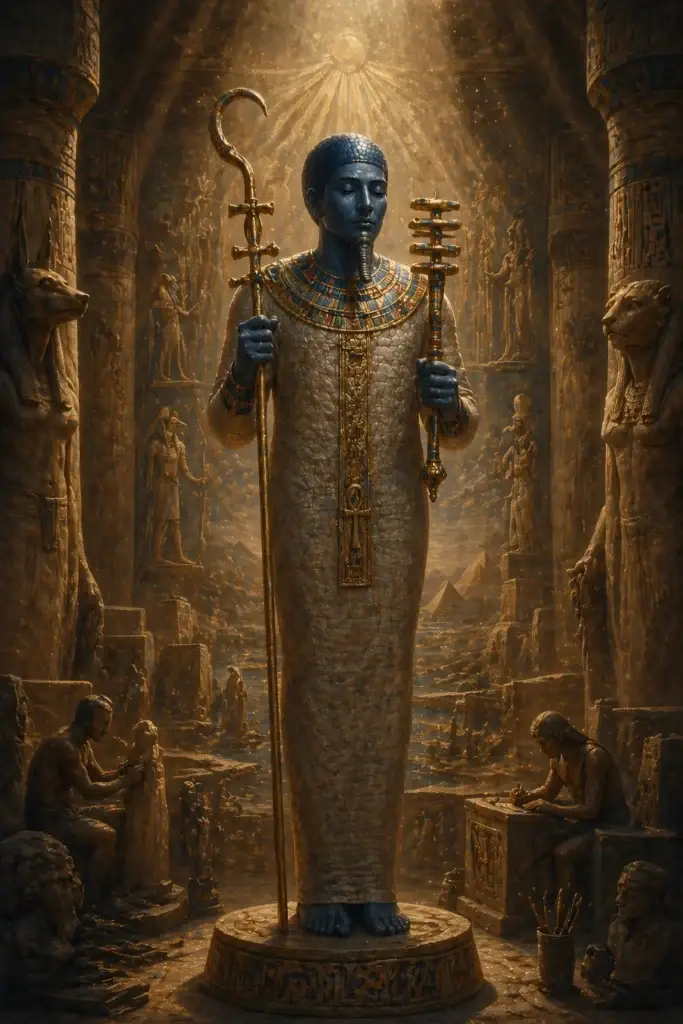
Creator god through the word, patron of craftsmen, god of Memphis. Ptah created the world not through force or sexual power, but through the spoken word: his heart thought, his mouth spoke, and it came to be. With a human face, wrapped in close-fitting linen and holding a creator’s scepter, he is the intellectual rather than emotional god, the planner behind the order.

His workshop is Memphis; his engineers built the pyramids.

Ptah is an Egyptian creator god of the city of Memphis.

Table of Contents

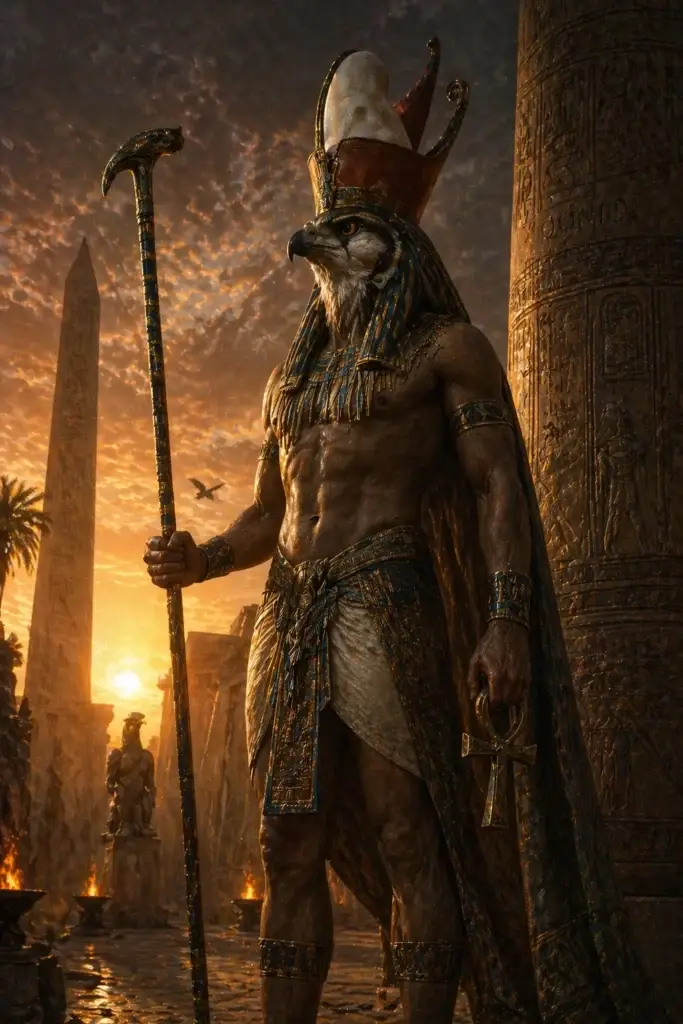
Ptah - gods from the Egyptian tradition, historical-illustrative
Ptah

Quick Overview: Ptah

Type: Egyptian chief deity, creator god and patron of craftsmen
Pantheon: Egypt (all dynasties, especially the Memphis tradition)
Function: Creation through the word, patron of craftsmen, architects, sculptors
Main attributes: Mummiform shape, blue or green skin color, Was-Djed-Ankh scepter
Main cult site: Memphis (main cult site, temple Hut-ka-Ptah; from which the name Aigyptos = Egypt)
Triad: Ptah, Sekhmet, Nefertem (Memphite triad)

Context

Period of the Texts

Ptah is attested since the Early Dynastic Period (c. 2900 BCE), the chief god of Memphis, which was the capital of Egypt from the 1st dynasty to the end of the Old Kingdom (c. 2200 BCE).

Main flourishing period of Ptah theology: Memphite theology (Shabaka Stone, c. 700 BCE but copied from an original of the Old Kingdom).

In this creation theology Ptah creates the world through thought (heart) and word (tongue), a remarkably „intellectual“ doctrine of creation that anticipates Christian and Johannine Logos theology. Identified through the Greek syncretism with Hephaistos.

Area of Distribution

The main cult site was Memphis (today Mit Rahina) with the temple Hut-ka-Ptah („House of the Ka of Ptah“), one of the largest and oldest temple complexes of Egypt. From the Greek pronunciation Aigyptos of this temple name arises the name „Egypt“.

In addition the Apis temple (the Apis bull as Ptah’s living image), Heliopolis (temple annex), Thebes (secondary). In the Hellenistic period the Apis bull served as the main cult symbol; from the Apis-Osiris syncretism arises the Ptolemaic chief god Serapis.

Source Situation

Central sources: Shabaka Stone (Memphite theology, British Museum EA 498), Pyramid Texts, Coffin Texts, inscriptions from the Hut-ka-Ptah temple, Apis stelae from Saqqara. Secondary literature: Sandman Holmberg, The God Ptah (standard work); Erman, Die Religion der Ägypter; Bonnet, Reallexikon; Wilkinson, Complete Gods and Goddesses.

Designation and Spellings

Ptah is depicted as a mummified man, wrapped in close-fitting linen, often with a blue beard. He carries a scepter composed of three symbols: the Ankh (life), the Was (power) and the Djed pillar (stability).

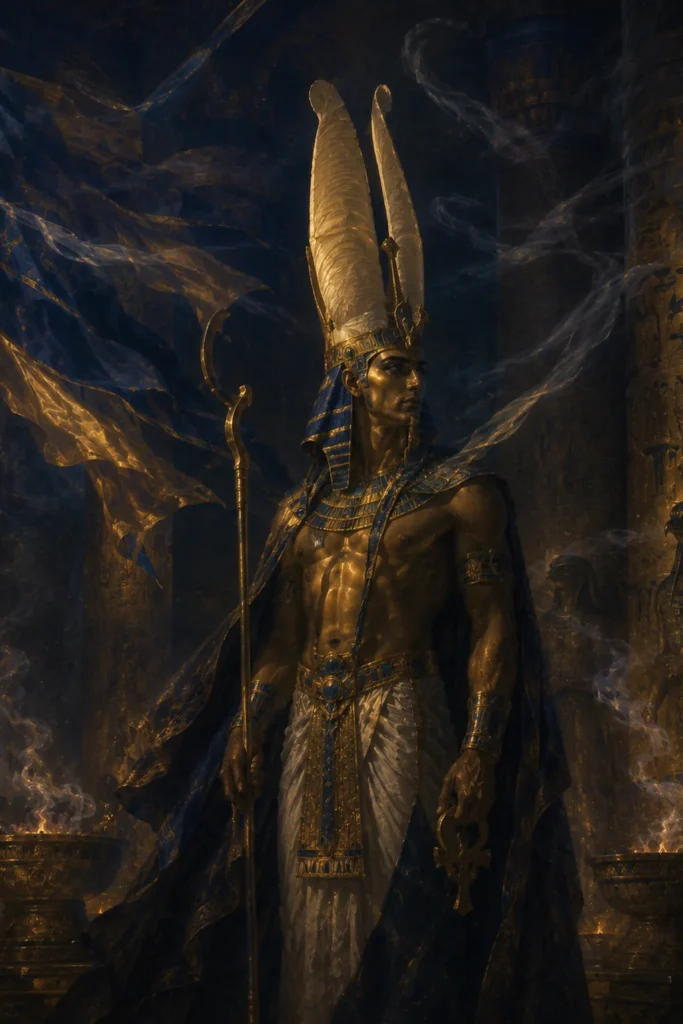
Sometimes he holds a tool, the Wag balance or a hammer. His head is sometimes adorned with a crown (the Aten symbol or the Atef crown). He is rarely shown with animal features; his power is abstract and intellectual.

Characteristics

Ptah created the world and all things through his heart (intellect) and his word (Logos). This theology is unique within Egyptian mythology: not Atum, not Ra, but Ptah is the first thought. Craftsmen and architects prayed to Ptah.

The Memphis temple was vast and wealthy. Pharaohs (especially Thutmose III) styled themselves as «beloved of Ptah» rulers. In the New Kingdom statues and temples were erected in memory of the old Memphis theology. Priest-scribes documented the myths and rituals of Ptah in papyri.

Appearance and Symbolism

Ptah is depicted as mummified, in close-fitting garb, with a smooth, close-fitting cap and a long beard. In his hand he holds the Ankh cross and the Djed pillar scepter, symbols of eternal life and stability.

His eyes are penetrating, since he sees and creates all. The color of his body is often green or gold. A scarab represents his creative process: as the insect carries the sun with it, so Ptah carries creation.

Profile: Ptah

The most important aspects of Ptah at a glance. The following fields summarize origin, function, appearance, veneration, symbols, and cultural parallels.

Origin

In Memphite theology Ptah is the creator par excellence: he thinks the world with the heart and speaks it out with the tongue. Husband of Sekhmet (the lion-headed goddess of war and healing), father of the lotus god Nefertem, together the Memphite triad.

In later traditions father of Imhotep (historically the architect of the Step Pyramid, later deified as a healing god, identified with the Greek Asclepius).

Related To

Creator god through word and thought, unique in world mythology as an „intellectual“ creator (in contrast to Atum’s sexual creation in Heliopolis). Patron of all craftsmen: sculptors, architects, goldsmiths, carpenters. In personal cult, invocation for success in craft professions, for healing (through Imhotep’s medical tradition), for protection from disasters.

Appearance

Anthropomorphic as a mummiform shape, with close-fitting mummy wrappings, blue or green skin color (symbol of rebirth and vegetative fertility). On the head a close-fitting smooth skullcap. In the hand the Was-Djed-Ankh scepter, a combination of the Was staff (power), Djed pillar (stability) and Ankh (life).

Beard, cut straight. Standing on a platform (symbol of the cosmic order). Frequently depicted enclosed in a cella: in contrast to most gods, who act in the world, Ptah is the reserved creator.

Function

Sphere of effect: Ptah was invoked daily by craftsmen and architects. In the Hut-ka-Ptah temple the living Apis bull was his sacred animal, a perfectly bred bull (with particular white markings) venerated as Ptah’s manifestation.

At the death of each Apis bull a great mourning ceremony was held; its mummy was buried in the Serapeum of Saqqara. In the Late Period the Serapeum drew thousands of pilgrims. In personal cult, invocation for success in craft professions.

Means of Protection

Was-Djed-Ankh scepter (main attribute), mummy wrappings, skullcap, blue/green skin color, Apis bull (sacred animal), platform (cosmic order). Sacred plants: persea tree. Sacred number: none specific.

Counterparts

Hephaistos (Greece, smith and craftsman god, syncretized in the Hellenistic period), Vulcanus (Rome, mediated through Hephaistos), Tvaṣṭṛ (Hinduism, Vedic architect god), Vishvakarman (Hinduism, architect of the gods), Goibniu (Celtic, smith), Ilmarinen (Finnish, creator-smith in the Kalevala).

The Shabaka Stone Logos shows a remarkable parallel to the Johannine Logos theology (John 1: „In the beginning was the Word“) and to the Stoic doctrine of the Logos.

Protective Practice

Veneration in Daily Life

Rituals and Invocations
At the center stood the temple cult of Memphis. The Apis bull was venerated as the living cult sign of Ptah. As protective god of craftsmen, Ptah enjoyed a particular piety in the workshops.

Conjurations and Invocations

Textual Transmission and Formulas
The Memphite theology on the Shabaka Stone presents Ptah as creator through heart and tongue. Pyramid Texts and Ptah hymns supplement the transmission of the Memphite chief god.

Amulets and Protective Symbols

Material apotropaia and archaeological evidence
Widespread were Ptah-Pataikos amulets in dwarf form, intended especially to protect children from dangerous animals, as well as Ptah figures of faience from temple and tomb contexts.

Ptah, Parallels in Other Cultures

Ptah resembles the Judeo-Christian God (creation through the word), the Greek Nous (intellect), and Brahman (Hinduism). The concept of creation through thought and speech is universal; Ptah is a particularly early and systematic formulation of it. His role as patron of craftsmen resembles Hephaestus (Greece) and Odin-as-artisan (Scandinavia).

The Monument of Memphite Theology

The theologically most sophisticated source on Ptah is a text known in scholarship as the Monument of Memphite theology. It is transmitted on a stone slab that King Shabaka had made in the twenty-fifth dynasty. A note on the stone claims that the text was copied from a worm-eaten older exemplar.

How old the content actually is was long disputed. While part of the older scholarship assumed a very early origin, the more recent discussion tends rather to regard the text as a work of the first millennium before our era, one that takes up older ideas and summarizes them in a learned manner.

In terms of content, the text sets out a doctrine of creation in which Ptah plays the central role. Unlike in creation narratives in which the world arises through bodily acts or through the working of the sun god, Ptah here creates through heart and tongue, that is, through thought and word.

What Ptah thinks and speaks becomes real. In this way the text subordinates the other gods and the ordered world to him without denying them: they are, as it were, realizations of what Ptah conceived and named.

This text has received particular attention in the history of religion, because the idea of a creation of the world through the word recalls notions that are also encountered in other traditions.

Such comparisons are to be drawn with reservation, since similar ideas can arise independently. It is certain that the Memphite text shows a high degree of theological reflection and presents Ptah as a creator god whose working originates in the spiritual.

Ptah, the Craftsmen, and the High Priest of Memphis

Ptah was regarded as the god of craftsmen, of sculptors, metalworkers, and builders. This responsibility is closely connected with his role as creator: whoever forms the world is also the patron of those who work and shape matter.

In Memphis, the old administrative and craft center of Egypt, this connection was firmly anchored in the cult.

The high priest of Ptah in Memphis bore a telling title, often rendered as Chief of the Directors of Craftsmanship or similar. Thus the highest priestly office was at the same time linked with oversight of the arts and crafts.

The Memphite workshops enjoyed high esteem, and Ptah as their god had a share in it. In some texts he also appears as the one who bestowed the precious materials and the skills with which temples and cult images were produced.

From this craft sphere probably also comes an observation much discussed in the history of language. One of the names of the Ptah temple in Memphis read in a form that contains the Egyptian word for the soul of Ptah.

From this designation part of the scholarship derives the Greek name Aigyptos and thus our word Egypt.

This derivation is regarded as plausible, but is not entirely certain. What is certain, by contrast, is that Memphis as the city of Ptah was for a long time one of the most important metropolises of the country, and that the craft god thereby stood at the heart of Egyptian high culture.

Ptah-Sokar-Osiris: the Connection with the Underworld

Over the course of Egyptian religious history, Ptah joined with other gods to form composite figures.

Particularly significant is the merging with the Memphite god of the dead Sokar and with Osiris, the lord of the underworld, into the threefold figure Ptah-Sokar-Osiris. In this combination Ptah’s creative power joined with the notions of death, renewal, and continued life.

This figure becomes visible above all in a distinct group of grave goods, the so-called Ptah-Sokar-Osiris statuettes. They are preserved in large numbers from the Late Period, mostly as painted wooden figures in mummiform shape, often on a base that sometimes served as a cavity for a papyrus or text strip.

These figures were placed in the tomb with the dead and were intended to give a share in the protection and renewal of the deceased.

The existence of such a figure connected with the underworld shows that Ptah was not confined to the role of world and craft god. Egyptian religion tended to place gods in new contexts through connection and assimilation, without the original figures thereby disappearing.

Ptah could thus at the same time be the creator through the word, the patron of craftsmen, and a part of the divine world of the dead.

This multilayered character is not a contradiction but corresponds to the working method of Egyptian religious thought, which allowed various aspects of a power to exist side by side. Closely connected with this sphere is Osiris.

Sources and Literature

  • Sandman Holmberg, Maj: The God Ptah. Lund 1946 (standard work).
  • Erman, Adolf: Die Religion der Ägypter. Berlin 1934.
  • Junker, Hermann: Die Götterlehre von Memphis. Berlin 1940 (Shabaka Stone commentary).
  • Walde, Christine (ed.): Der Neue Pauly (entry „Ptah“).

Further standard works in the literature index.

Frequently Asked Questions about Ptah

Who was Ptah in Egyptian mythology?

Ptah was the chief god of Memphis, the oldest capital of Egypt, god of craftsmen, architects, and of creation through the word. He is typically depicted in mummified form with a green face (or black skin), close-fitting headgear, and a composite scepter (Was, Djed, Ankh).

In Memphite theology (Shabaka Stone, about 700 BCE) Ptah is the highest creator god: he creates the world not through bodily action, but through thinking in the heart and speaking with the tongue.

What is the significance of Memphite theology?

Memphite theology is one of the most striking religio-philosophical texts of antiquity. It describes a Logos theology about 2500 years before the Gospel of John: Ptah creates the world through thinking (heart) and speaking (tongue) the words of creation.

The other gods are only aspects or servants of Ptah. This intellectual creation theology had a direct influence on Greek philosophy (the concept of Logos) and, by way of Hellenistic Middle Platonism, also on early Christianity. The Shabaka Stone is today in the British Museum.

Classification & Protection

ILEVEL
The Protection Compass assigns this being to influence level I, Minor influence.

Against its influence, cross-cultural tradition names these protective means:

Compare in the Protection Compass →

Recommended protective means

iWell Guard

The simplest protective means in this collection: 41 layers of fine gold 999, platinum, silver and silicon, manufactured in Ruhla, Thuringia. It requires no activation, is bound to no person, and is effective within a radius of around 50 meters, even without being worn.

All protective means at a glance →