Janus, Roman god of beginnings
By Ralf Ittermann · last reviewed on
Janus is the Roman god of beginnings, of doors and of transitions, to whom the start of the year and every new undertaking were consecrated. Janus is the two-faced Roman god of beginnings, endings, gates and transition.
He holds a special position in Italic religion because he has no direct Greek or Etruscan equivalent and is regarded as an originally Roman deity.
His sanctuary on the Forum, the Ianus geminus, symbolically regulated war and peace for the entire city. At every prayer his name was spoken first, which gave him a privileged position in religious prayer ranking.
Profile: Janus
Janus: the most important aspects at a glance. The following fields summarise origin, function, appearance, veneration, symbols and parallels.
Janus is regarded as an originally Roman deity without a Greek or Etruscan equivalent. His name is traced back to Latin ianua, “gate” or “passage”. Macrobius describes him as an Italic ruler figure who came from the East to Latium and received Saturn.
Janus is the god of beginnings, doors, gates and transition, to whom the start of the year was consecrated. He decides over opening and closing and was invoked as personal protection of the house. His name stood first in every prayer because he opened access to the other gods.
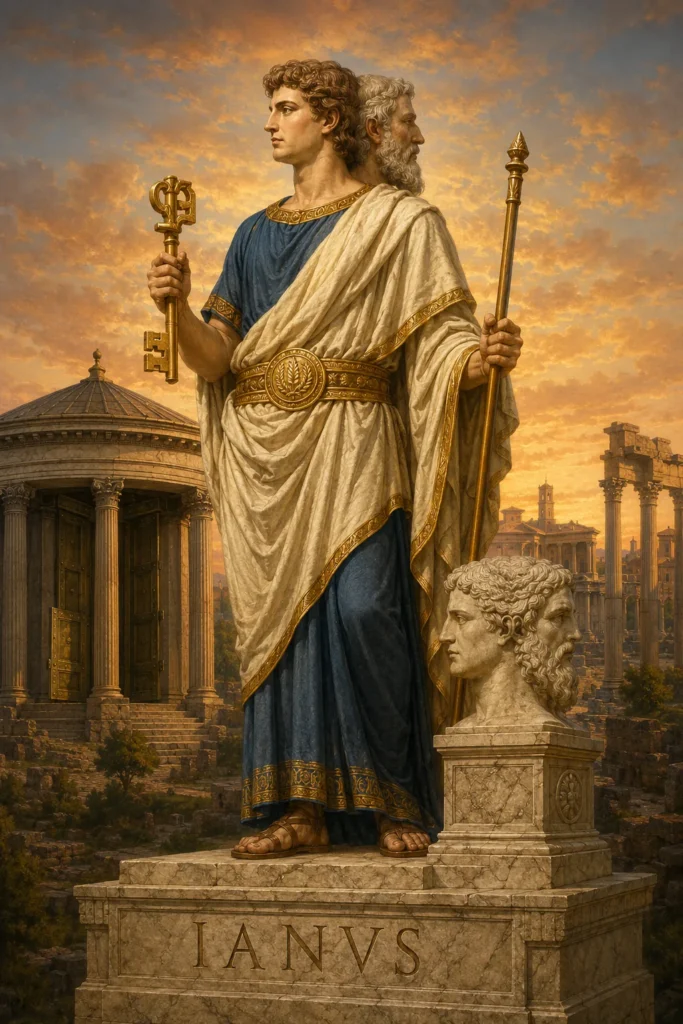
On coins and reliefs Janus appears as a bearded old man with two faces turned in opposite directions. He holds staff and key, in some depictions twelve keys for the months of the year. The annual asses of the Roman Republic show him thus.
His main festival was 1 January, on which Romans exchanged small gifts, the strenae. The most important sanctuary was the Ianus geminus on the Forum, whose gates remained closed in times of peace and open in times of war. In addition there were smaller sanctuaries in Rome and rural altars in Latium and Etruria.
The central symbol is the double face, to which are added staff and key as guardian of paths and gates. The Janus Quadrifrons in the Forum Boarium, a four-faced gateway, marked the thresholds in all four cardinal directions. The Ianus geminus with its two gates also belongs among his signs.
The Greek Hermes mediates only movements, whereas Janus embodies the threshold itself. A direct Greek equivalent is lacking. In Etruscan imagery there is a parallel in the two-faced Culsans, but the genetic relationship is disputed.
Myth and Origin
The name Janus is traced linguistically to the Latin word ianua, meaning “gate” or “passage”. Both terms share an Indo-European root with the meaning “to go”, which also recurs in Sanskrit and Avestan terms. Etymologically, Janus is thus the god of passing through.
Macrobius reports in the “Saturnalia” that Janus was originally an Italic ruler figure. According to this tradition he came from the East into western Latium, took in Saturn, who had to flee from Iuppiter, and together with him founded the old Golden Age of Italy.
Ovid takes up the same account in the “Fasti” and begins his work with Janus, who opens the entire year. In dialogue with the poet, the god in the “Fasti” explains his functions himself.
The two-facedness, called Bifrons, indicates an ancient conception in which a god looks in two directions at once. Mythologically it is usually interpreted as a gaze into past and future, in some places as a gaze inward and outward or toward East and West.
Unlike the Greek Hermes, who only mediates movements, Janus sits at the threshold itself and embodies it. This theological conception is unique in the ancient world and makes him a favorite subject of modern philosophy of religion.
Janus probably had no Indo-European predecessor but emerged from an originally Italic stratum in which the door as the threshold of the house held particular cultic dignity.
In every Roman house the ianua was associated with its own rites, and the god of thresholds was invoked as personal protection against harmful influences. The connection between the domestic and the civic threshold is a key to understanding this deity.
Symbols and Attributes
The central symbol of Janus is his double face. On coins and reliefs he usually appears as a bearded old man with two faces turned in opposite directions. The annual asses of the Roman Republic depict him this way, and the image motif remained a standard motif of state representation into the imperial period.
Staff and key are his most important attributes. The staff marks him as guardian of the ways, the key as guardian of the gates.
Together both characterize the specific function of a threshold deity who decides over opening and closing. In some depictions he carries twelve keys, one for each month of the year, which he opens as god of the first month.
The Ianus geminus on the Forum, a double archway structure between the Forum Romanum and the Argiletum, was his most important sanctuary. Its two gates remained closed in times of peace and open in times of war.
Livy reports that before Augustus these gates had been closed only twice in history, which underscores the rare extent of Roman times of peace. Augustus himself boasts in the “Res gestae” that he closed the gates three times during his reign.
Another structure connected with Janus is the Janus Quadrifrons on the Forum Boarium, a four-faced gate structure that marked the thresholds in all four cardinal directions. This building from late antiquity still stands largely preserved at the Boarium today and is regarded as the last great testimony of the Janus cult.
Cult and Veneration
Janus stood at the beginning of every Roman prayer and every religious ritual. Before every sacrifice an invocation was offered to him first, because he opened access to the other gods. This first-rank function appears uniformly in inscriptions, prayer formulas and literary sources. Cicero and Macrobius discuss it in detail.
His main festival fell on January 1, New Year’s Day. Already in the Julian calendar the month Ianuarius stood under his patronage. On New Year’s Day Romans exchanged small gifts called strenae, which contained sweets, dates or coins.
This gesture had a fate-determining character, because what was done on New Year’s Day was meant to shape the entire year. This practice lives on to this day in the French étrennes and the Italian strenne as a New Year’s gift.
Important military operations began at the Ianus geminus. The gates were opened by the consul or princeps, the army symbolically passed through, and the war was considered opened.
On return and conclusion of peace the gates were closed in a reverse ceremony. Augustus emphasized in his “Res Gestae” that he had the gates closed three times during his reign, which previously had occurred only twice in all of Roman history.
In addition there were smaller Janus sanctuaries in Rome. Provincial sanctuaries are more rarely attested, which underscores the specifically Roman-urban rooting of the Janus cult. In Latium and Etruria, nonetheless, several rural Janus altars are known, which were mostly erected at the entrance to villages or at crossroads.
Janus also took on a special role in the Salian song book, an old prayer collection of the Salian priests. Here he was invoked as king of the gods before Iuppiter, which shows the archaic stratification of Roman theology, in which Janus held a timeless precedence.
Important Myths
The most important mythical account describes the rescue of Rome from the Sabines. According to Livy and Ovid, the Sabines attacked Rome, broke in over the Capitoline Hill and came close to the Forum.
At a decisive moment Janus caused a hot spring to burst from the ground, which drove back the attacking Sabines and gave the city time to regroup.
In gratitude the Romans consecrated the sanctuary at the site of the spring and decided to keep the gates open in times of war so that the god could intervene if needed.
A second account connects Janus with Saturn. According to Macrobius and Virgil, Saturn fled from Olympus before the victory of his son Iuppiter and came to Latium, where Janus received him. Both ruled together and brought a time of peace and abundance, which entered the cultural memory of Italy as the Golden Age.
Later Janus is said to have remained alone and to have developed laws and agriculture. This account gives him the position of a culture-bringer at the threshold between mythical and historical time.
A third account concerns the nymph Carna or Cardea, whom Janus loved and to whom he granted power over the door hinges. In Ovid’s “Fasti” the myth is told in which Cardea is established as goddess of thresholds and of the family.
She protects the children in the house, which is why on June 1, her festival, fresh beans and bacon were eaten to keep evil away. The account connects Janus with the everyday life of the family and shows his effectiveness beyond the urban-civic sphere.
A fourth mythical account reports of Janus and Iuturna. Janus is regarded as the husband of the nymph Iuturna, upon whom Iuppiter bestowed immortality and who thus became goddess of the springs.
This episode, touched on by Virgil in the “Aeneid”, links Janus with the rural spring cult.
Relationships in the Pantheon
Janus stands at the head of almost all Roman invocation lists. In the inscriptions of the Arval Brethren, an old priesthood, Janus is always named before Iuppiter, which makes the ritual opening function clear.
Nevertheless, in the hierarchical sense Iuppiter is the highest deity, which is why Janus is often called the “opener of Iuppiter”.
With Saturn he is connected by the mythical Golden Age, with Vesta by the care of threshold and house, with Mars and Mercury by the patronage of going out, with Quirinus by the function for the people of Rome.
In older prayer texts the sequence Ianus, Iuppiter, Mars, Quirinus appears as the core Roman succession of gods.
In Hellenistic syncretism Janus remained untouched, because he has no direct Greek equivalent. This made him, for Roman theologians such as Varro and Cicero, a privileged example of the independence of Roman religion from Greek mythology. In the Etruscan visual world a parallel exists with the two-faced Culsans, yet the genetic relationship is disputed.
Janus appears in an old triad with Iuppiter and Saturnus, which in scholarship is interpreted as a pre-Capitoline layer.
This triad, which Macrobius already mentions in the “Saturnalia” (I, 9), is younger than the Capitoline triad of Iuppiter, Iuno and Minerva, but older than the state-theological representative phase. Dumézil sees in the connection of Janus, Iuppiter and Saturnus an archaic complex of opening, ruling and sowing function.
With Carna, an old goddess of the door hinges, Janus was, in Ovid’s “Fasti” VI, paired or married. Carna was responsible for the healthy growth of children and for the inner firmness of the door hinges and lock parts.
This connection marks the inner side of the threshold world, whose outer side was Janus himself. The double occupancy shows the consistency with which Roman religion personified all aspects of transition.
Reception and Influence
In the Renaissance Janus became the preferred symbol of prudence and foresight. Andrea Alciato and other emblematists depicted him as an emblem of historical learning that looks in both directions.
In coats of arms and printers’ marks his double face appears frequently, especially in publishing houses that wanted to establish connections between antiquity and the present.
In architecture the Janus motif shaped the design of triumphal arches, city gates and harbor facilities. The Arch of the Argentarii in Rome and numerous city gates in France and Spain take up the double arch motif of the Ianus geminus.
In the 19th century the two-faced Janus became the emblem of historical scholarship itself, which questions past and future at the same time.
In modern scientific language the word Janus face or Janus-faced has the character of a standard metaphor for ambivalence. The international Janus kinase, an important enzyme system, was named in 1989 in allusion to the two-faced deity.
The astronomical observation of a moon of Saturn named Janus, which exchanges its orbit with the moon Epimetheus, likewise ties in with the mythical two-facedness.
In the Middle Ages Janus was carried forward beyond the month name Ianuarius in astronomical textbooks. Isidore of Seville honored him in the “Etymologiae” (V, 33) as a personification of the new beginning.
In Gothic architectural sculpture Janus heads are found on monastery portals and city gates, especially in Lombardy and in the southern French region, where the ancient threshold god experienced a renaissance of its own.
In the psychological language of the present Janus appears as a “Janus face” in the sense of ambivalence. C. G. Jung uses the image in the “Mysterium Coniunctionis” as an example of the double nature of psychic contents.
In the economic sciences “Janus strategy” is a term for companies that are active in both old and new markets at the same time. This modern coinage shows how an archaic image lives on in reflective language over two millennia.
Religious-Studies Classification
Georges Dumézil has shown in several studies that Janus holds a special position within the three Indo-European functions.
He does not stand in one of the three functions itself, but at their beginning, as it were as an opening pre-function. This interpretation was widely received in scholarship and belongs to the least disputed parts of Dumézil’s system.
Robert Schilling and Kurt Latte underscore the specifically Italic origin of the Janus cult. Unlike with many other deities, there is no Etruscan equivalent. Janus thus appears as one of the few purely Italic-Roman cult cushions without a Greek or Etruscan model.
Mary Beard, John North and Simon Price place the cult within its political function and show how the opening and closing of the Ianus geminus became a state-supporting symbolic act.
John Scheid reconstructed the ritual practice at the Forum sanctuary and showed how the god was integrated into the daily sacrificial life. Jörg Rüpke brings out the significance of Janus for the calendar system and the Augustan representation, especially in relation to the “Res Gestae”.
Annie Dubourdieu, in her study “Les origines et le développement du culte des Pénates à Rome”, brought out the interweaving of Janus with the Penates and domestic religion.
Temple of Janus and Topography
The most famous temple of Janus was the Janus Geminus on the Forum Romanum, a small, transverse rectangular building with two opposing doors. The doors were closed in times of peace and opened in times of war.
Livy reports in “Ab urbe condita” (I, 19, 2) that in all of Roman history before Augustus the doors had been closed only twice, namely under Numa Pompilius and after the First Punic War in 235 BC. Augustus had the doors closed in 29 BC after Actium, in 25 BC after the Cantabrian Wars and in 8 BC after the Germanic campaigns, which he celebrated in his record of deeds, the Res gestae divi Augusti (13), as the high point of his peace policy.
This threefold closing became the ideological symbol of the Pax Augusta.
Other Janus structures included an arch at the Argiletum that marked the booksellers’ and bootmakers’ district, and the Janus Pater on the Mons Janiculus, a hill on the right bank of the Tiber, visited above all by farmers and soldiers.
These three Janus sanctuaries marked the thresholds of the city in the topographical sense, because Janus was responsible as god of transitions. The Argiletum arch was at the same time a market orientation point, which illustrates the interweaving of cultic and commercial function in Rome.
In research terms, Filippo Coarelli has refined the localization of the Janus Geminus between the Basilica Aemilia and the Curia Iulia. On sestertii of Nero with the inscription Pace populi terra mariq parta Ianum clusit the building is depicted in an architecturally detailed form.
This numismatic source is one of the most important pictorial testimonies for the appearance of the temple. In late antiquity the temple of Janus was closed in the course of the Christianization process and demolished under Honorius in the 5th century.
Carmen Saliare and Liturgy
Janus stood at the beginning of all Roman prayers. In the ancient order of invocation of the gods his name was named first, because as god of transitions he also symbolized the transition from silence into word.
Cicero comments in “De natura deorum” (II, 67) that the Romans, at the sacrifice, invoked Janus first and only then the responsible main deity. This ritual precedence underscores his cosmological position as the entrance god.
The Carmen Saliare, an archaic priestly song sung by the Salii, a twelve-member priestly college, during the March procession, contained a Janus stanza that was no longer fully understood already in the late Republic.
Varro in “De lingua Latina” (VII, 26 ff.) attempted to explain individual words, but stated that the Saliare sayings were “too archaic” to be interpreted unambiguously.
The preserved fragments name Cerus manus duonus Cerus es, which has been reconstructed as “creator good man creator you are”, a possible invocation of Cerus, a creator god connected with Janus.
The Rex sacrorum, a priestly office that continued the religious functions of the republican monarchy, was responsible for the Janus cult.
He carried out the Janus sacrifices on the kalends of each month, but above all on the ides of March, on the old New Year’s Day, and on January 9, the Agonalia festival of Janus.
The liturgical regulations are partly preserved in the Acta fratrum Arvalium, the protocols of the Arval priests, and provide insight into ritual practice.
Numismatics and Pictorial Tradition
The Janus head, the Ianus bifrons with two opposing faces, is one of the strongest pictorial creations of Rome. The earliest Roman asses already showed the Janus head from the 3rd century BC, because the as, as the smallest unit of value, held a fundamental threshold position in the monetary system.
This tradition continued over centuries: republican asses, denarii and sestertii bear the Bifrons throughout the entire imperial period. Even under Diocletian and Constantine Janus coins were still minted.
A rare variant is the Ianus Quadrifrons with four faces, which appears on some sestertii of Hadrian. This form is a philosophical extension in which Janus beholds all four cardinal directions or the four seasons at once.
The Forum Transitorium, a smaller forum complex of Domitian, was adorned with an Ianus Quadrifrons arch, which today survives only in Renaissance drawings.
In Christian late antiquity the image of the Bifrons was given negative connotations and equated with cunning. Augustine polemicizes in “De civitate Dei” (VII, 7) against the “two faces” of Janus as a symbol of slyness.
This reinterpretation continued into the Middle Ages, in which “Janus-faced” became the epitome of duplicity. Only the Renaissance rehabilitated the Janus head as an emblem of prudent foresight, for example in Alciato’s emblem book of 1531, where Janus illustrates the maxim Prudens futuri.
Sources and Further Reading
Ancient sources: Virgil “Aeneid”, Ovid “Fasti”, Livy “Ab urbe condita”, Cicero “De natura deorum”, Varro “De lingua latina”, Macrobius “Saturnalia”, Augustus “Res gestae divi Augusti”, Servius commentary, Plutarch “Numa”.
Research literature: Georges Dumézil, “La religion romaine archaïque”, Paris 1966. Robert Schilling, “Rites, cultes, dieux de Rome”, Paris 1979. Kurt Latte, “Römische Religionsgeschichte”, Munich 1960. Mary Beard, John North, Simon Price, “Religions of Rome”, Cambridge 1998. John Scheid, “An Introduction to Roman Religion”, Edinburgh 2003. Jörg Rüpke, “Die Religion der Römer”, Munich 2001.