Minerva, Roman goddess of wisdom
By Ralf Ittermann · last reviewed on
Minerva is the Roman goddess of wisdom, craftsmanship and strategic warfare. Together with Jupiter and Juno she belongs to the Capitoline Triad, which formed the religious center of the Roman state. Unlike the impetuous Mars, she embodies the planning, technical aspect of war.
Her cult united craftsmen’s guilds, teachers, physicians and musicians, and reached from Etruscan roots into late antiquity. To this day Minerva stands in the European educational tradition as a symbol of knowledge that grows out of experience and discipline.
Myth and Origin
The Roman Minerva is closely related to the Etruscan Menrva, who in turn belongs to the broad Italic world of gods of Tarquinian Rome. As early as the regal period, when Etruscan influences shaped Roman religion, Menrva was a central deity of war, craft and birth.
With the Etruscan Capitoline triad she came to the main Capitoline cult and became, under the name Minerva, a goddess alongside Jupiter Optimus Maximus and Juno Regina.
The combination of three deities under one roof in three adjacent cellae was not self-evident in the Italic region and is regarded in the history of religion as an indication of Etruscan temple architecture.
In Hellenistically shaped Rome an extensive identification with the Greek Athena took place early on. In the «Metamorphoses» Ovid presents Minerva as the patroness of weaving, who turns Arachne into a spider because of her hubris.
This tale originally belongs to the Greek cycle of myths, but was firmly integrated into the Roman image of the gods in the Latin language.
In the «Aeneid» Virgil repeatedly mentions the Pallas image of Minerva, that wooden cult object which stood in Troy and was, according to Roman tradition, brought to Italy by Aeneas.
The idea that this Palladium was kept in the temple of Vesta in the Forum linked Minerva closely to the state cult and gave her a central role in Augustan state mythology.
The birth of Minerva from the head of Jupiter is a common topos of the literary tradition. In religious practice this mythical filiation played a lesser role than her function as patroness of knowledge and craftsmanly precision.
Varro and Cicero treat Minerva as one of the most important goddesses of the Roman pantheon, with Cicero in «De natura deorum» distinguishing several Minervae and thus showing that even ancient scholars tried to separate different cult lines.
In the theological layered model of the Late Republic, alongside the Capitoline Minerva there were a warlike, a medical and a more commercially shaped Minerva. This multiformity speaks for an old bundle of various Italic cults under one name.
The etymological derivation is discussed inconsistently in modern scholarship. Probably an Indo-European root with the meaning «to think» or «to measure» underlies it, from which the Latin word mens, that is «mind», is also derived.
Thus Minerva is, linguistically from the very beginning, the goddess of the intellectual measuring of the world, whether in the form of craft, writing or strategic planning.
Symbols and Attributes
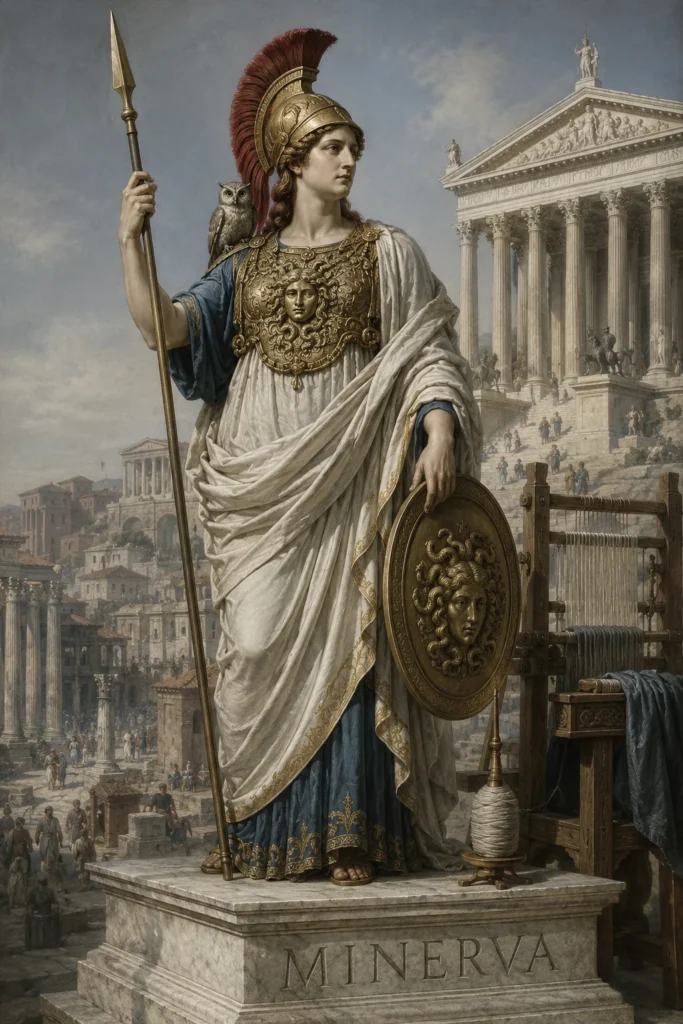
Minerva usually appears in pictorial art with helmet, lance and shield. On the shield or breastplate the Gorgoneion frequently appears, the head of Medusa, a protective sign that wards off evil and indicates the connection to the Greek Athena.
Her helmet is usually Corinthian in shape and in the imperial period often fitted with elaborate plumage. The lance is not aggressively raised but planted, an indication of her function as a watcher rather than an attacker.
The owl is regarded as her sacred animal and symbolizes the keen gaze of the wise. In Roman numismatics the owl appears on coins that take up craft or scholarly themes. Beside it, the snake is an accompanying attribute that points to the goddess’s former chthonic layer.
The olive tree, central in Greece for Athena, plays a lesser but, in the context of agricultural instruction, demonstrable role in Rome. In inscriptions from Pompeii and Ostia, Minerva is depicted with an olive branch and bowl, which suggests a cultic significance of the olive tree in a rural craft context.
Professionally relevant are the spindle, the weaving shuttle and the stylus, that is, the implements of textile and written craft. At festivals of the wool workers and teachers, these tools were laid symbolically before her image.
The square too, conceived as a measure of precision, appears in late antique allegories in which Minerva is understood as patroness of the septem artes liberales. A less well known attribute is the flute, whose invention was attributed to her, but which she herself, according to myth, discarded again.
In late antiquity Minerva appears with a book scroll and stylus or before a columned architecture that symbolizes geometric measure. This iconographic shift shows the change from the state-bearing war goddess to the patroness of learned education, which prepared the transition into the Christian allegoresis of Sapientia.
Cult and Veneration
The most important Roman sanctuary of Minerva was on the Aventine and was called Aedes Minervae. It was traditionally the assembly place of the scribae and histriones, that is, the scribes and stage performers, who organized their professional associations here.
This temple was regarded as the central point of contact for teachers and physicians, which is why late sources understood Minerva as the goddess of education as such. The location on the Aventine, the plebeian hill, gave the cult a social focus beyond the senatorial upper class.
In the Capitoline temple she had a cella of her own alongside Jupiter and Juno. In this function she was a state goddess in the strictest sense.
Consuls and magistrates offered her sacrifices on taking office, and military commanders laid down spoils before her as votive offerings after victories. Inscriptions from the imperial period frequently name her together with Jupiter Conservator as a preserving deity of the empire.
The most important festival was the Quinquatrus, which was celebrated from 19 to 23 March. Ovid devotes a detailed section to this festival in the «Fasti» and describes the connections to teachers, pupils, physicians, dyers and wool workers. On the first days warlike activities rested, after which gladiatorial games and artistic competitions followed.
A second, smaller festival, the Quinquatrus minusculae in June, was dedicated to the flute players, whose professional association was closely connected to the temple. Both festivals were important occasions for professional associations to renew statutes and pass joint resolutions.
In the provinces Minerva was often syncretized with local goddesses. In Britain she merged with Sulis into Sulis Minerva, whose healing spring at Aquae Sulis was an important center of pilgrimage. In Gaul she appears as patroness of smiths, weavers and scribes; in the Danube region she occurs in inscriptions together with native craft deities.
In North Africa she is attested as Minerva Augusta, closely linked to the imperial cult of the Severan dynasty. This provincial multiformity illustrates the ability of the Roman religious system to integrate local references into a theology uniform across the empire, a theology that bound the realm together.
Horse races, the start of school terms and a child’s first attempt at writing were preferably timed to the Quinquatrus. This interweaving of everyday life and festival calendar shows that Minerva was invoked not only on special occasions but also in the daily teaching routine.
On her feast day teachers received the Minerval, a kind of school fee; the term lives on in the French minerval.
Important Myths
In the «Metamorphoses» Ovid recounts the episode of Arachne. The Lydian weaver Arachne challenges Minerva to a contest, whereupon the goddess appears in the guise of an old woman, warns her and finally accepts the contest.
Minerva weaves the gods in Olympian dignity, while Arachne depicts the amorous adventures of the gods in a mocking manner.
Hurt by the disparagement, Minerva turns her rival into a spider. The tale condenses the Roman conception of hubris against divine order and at the same time illustrates Minerva’s role as patroness of the textile art. Literarily, it is a reflection on the limits of human art in the face of the divine.
A second tale concerns the Palladium, that old cult image of Minerva. According to Roman tradition, Aeneas rescues the image from burning Troy. Later it is kept in the temple of Vesta in the Forum, because its whereabouts were held to be tied to the fate of Rome.
The Vestals watched over the image under the supervision of the Pontifex Maximus, and in times of crisis it was invoked as the sacred pledge of the city.
This connection of Minerva and Vesta shows how closely state protection and the protection of knowledge were conceived in Roman religion. Cicero and Livy report several occasions on which the Palladium was publicly shown or recovered because the city saw itself in danger.
A third mythical memory concerns the flute player Marsyas. Minerva is said to have invented the flute, but to have discarded it when she saw her own image in the water’s mirror with puffed-out cheeks. The satyr Marsyas picked up the instrument and later challenged Apollo to a musical duel.
Apollo won and had Marsyas flayed. In Roman reading the episode is a warning of the limits of artistic ambition and underlines Minerva’s protective function for worthy, measured art. At the same time it reflects the Roman rejection of the intoxicated Dionysian, to which the flute was symbolically assigned.
A fourth tale reports the olive contest of Minerva and Neptune over the patronage of Athens. Ovid takes over this Greek tale in the «Metamorphoses» and places it as the image on Minerva’s loom, which underlines the thematic interlocking with the Arachne episode.
Minerva wins, through the useful gift of the olive tree, over Neptune’s horse, which marks the superiority of peaceful, nourishing culture over raw natural force.
Relationships within the Pantheon
In the Capitoline Triad Minerva stands alongside Jupiter and Juno. This constellation, already attested in Etruscan times, expresses the interplay of rule, family and knowledge that, by Roman self-understanding, sustains the state.
Jupiter is the supreme guide, Juno protects women and marriage, Minerva secures the intellectual and craftsmanly substance. The three form a state-theological program that repeats itself on nearly all public buildings of Rome and in the municipal towns of Italy.
Minerva is closely related to Mars, yet their roles are clearly distinguished. Mars embodies warlike bravery, Minerva strategic prudence. Cicero emphasizes this distinction in «De natura deorum» and sees in Minerva the «rational» side of military art.
With Vesta she shares the care for the state’s pledge, the Palladium; with Apollo the musical sphere; with Mercury the patronage over trade and commerce.
In Hellenistic syncretism Minerva took over almost entirely the cycle of myths of Athena. In late antique allegoresis she frequently appeared as personified Sapientia, through which her figure exerted influence on the Christian-philosophical tradition.
Augustine, who judges the pagan gods critically, nevertheless recognizes in «De civitate Dei» the specifically Latin dignity of Minerva and uses her as an allegory of human reasoning power.
Reception and Influence
Already in the imperial period Minerva was a favored motif of state representation. Emperor Domitian understood himself as a special devotee of the goddess and had her depicted on many of his coins.
Suetonius reports the annual Quinquatria Minervae of Domitian on the Albanus, together with a college of priests. This personal attachment of the emperor to Minerva shows how elastic the cult was, which remained accessible both publicly and privately at the same time.
In the Renaissance Minerva experienced a new flowering as an allegory of wisdom. Botticelli painted her in «Pallas and the Centaur», Vasari placed her in the program pictures of the Medici.
Universities and academies chose her figure as a heraldic device. The Paris Bibliothèque nationale, the Berlin University and numerous other educational institutions present Minerva as patroness of learned work.
In the modern era she appears in state allegories, for instance on seals, banknotes and monuments. The Roman goddess became the epitome of republican virtue, understood there as a sober, instructive spirit against military presumption.
In the history of science the owl of Minerva, which according to Hegel «begins its flight only with the falling of dusk», has become a much-quoted image of philosophical reflection. Hegel formulated this thought in the preface to the «Elements of the Philosophy of Right» and regards philosophy in it as a late, retrospective business.
The name also lives on in modern academic life. The Minerva distribution platform of Yale University, a series of professorships and foundations, the Minerva program of the Max Planck Society and numerous research prizes bear her name. Astronomy honors her with the asteroid 93 Minerva, which was discovered in 1867 by James Craig Watson.
Religious-Studies Classification
Georges Dumézil places Minerva within his Indo-European theory of three functions and sees in her a representative of the first and second function, that is, of priestly-juridical sovereignty and of warlike force, though in a specific interlinkage with craftsmanly knowledge.
This interpretation is contested, because Minerva as an Italic goddess has her own roots in Etruscan religion, which do not lie within the narrower Indo-European comparison.
Robert Schilling, in his studies on Roman religion, emphasizes the Etruscan prehistory and sees in Menrva an originally lightning-hurling goddess whose functions only later shifted to the craftsmanly.
Mary Beard and John North work out the social function of the Aventine cult and show how strongly Minerva functioned as an assembly goddess of organized professional groups.
Jörg Rüpke emphasizes Minerva’s close interweaving with the educational system and professional associations. From this perspective Minerva is not primarily a war goddess but a goddess of knowledge.
Kurt Latte, in his «Roman History of Religion», assigns her to the older Italic layered model and draws attention to the independence of the Italic cult lines vis-à-vis the Greek Athena.
John Scheid, in his introduction to Roman religion, places the ritual practice at the Aventine temple at the center, whose form points to an independent tradition beyond Greek models.
In the 20th century archaeological research delivered new finds in particular at the Aventine sanctuary and in the provincial cults of Sulis Minerva and of Minerva Medica on the Esquiline.
These finds, namely votive offerings and inscriptions, attest to the social breadth of her cult over the centuries and underline her role as a mediator between public religion and professional identity.
Sources and Further Reading
Ancient sources: Virgil «Aeneid», Ovid «Metamorphoses» and «Fasti», Livy «Ab urbe condita», Cicero «De natura deorum», Varro «De lingua latina», Macrobius «Saturnalia», Servius commentary on the «Aeneid», Augustine «De civitate Dei».
Research literature: Georges Dumézil, «La religion romaine archaïque», Paris 1966. Robert Schilling, «Rites, cultes, dieux de Rome», Paris 1979. Mary Beard, John North, Simon Price, «Religions of Rome», Cambridge 1998. Jörg Rüpke, «Die Religion der Römer», Munich 2001. Kurt Latte, «Römische Religionsgeschichte», Munich 1960. John Scheid, «An Introduction to Roman Religion», Edinburgh 2003.