You-hun-ye-gui, the host of the unsacrificed dead
By Ralf Ittermann · last reviewed on
You-hun-ye-gui is a spirit of Chinese tradition.
Ownerless dead who roam the world during the Ghost Month. The tradition portrays a host of unsacrificed dead who wander the world without a resting place.
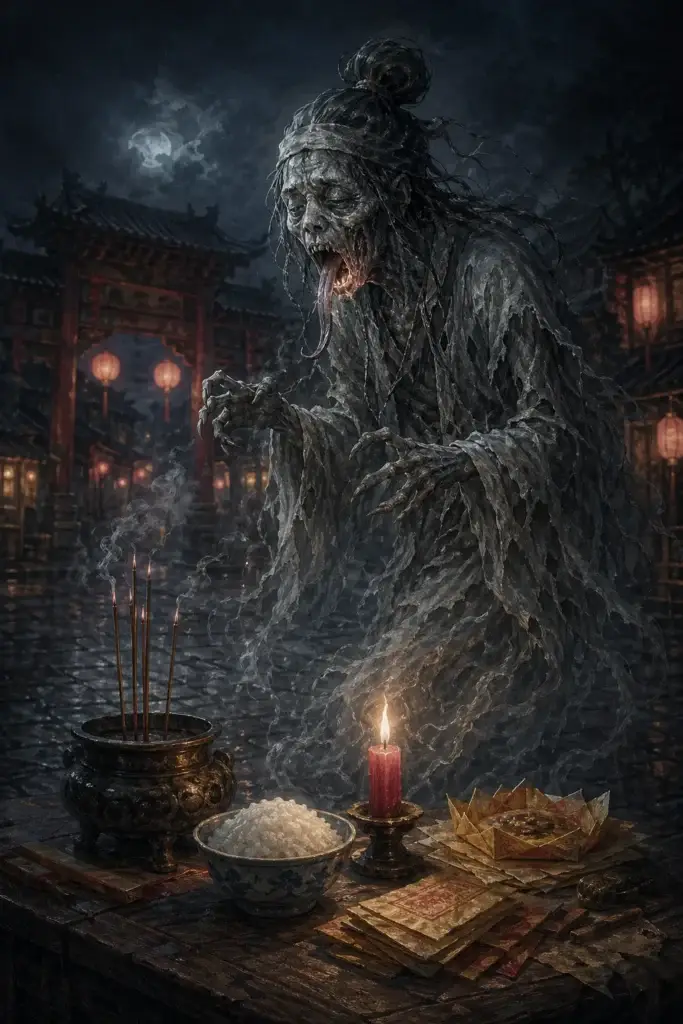
You hun ye gui (You-hun-ye-gui) are the wandering souls and wild spirits of Chinese folk religion: the homeless dead who lack living relatives and a resting place. Especially during the seventh lunar month, the Ghost Month, they roam the world of the living and are appeased with offerings.
The collective term is widespread throughout the Chinese cultural sphere, especially in Taiwan and Hong Kong, and is well attested. It groups together the typical unattended dead who lack descendants and offerings or who cannot find their way back to the underworld, whether vengeful or hungry spirits.
Type: Collective term for China’s homeless, unattended dead
Origin: Chinese folk religion, closely tied to the Zhongyuan Ghost Festival
Texts: Folk-religious tradition, researched among others by Teiser and Jordan
Period: Collective term with no fixed dating, always tied to the Ghost Month
Appearance: Collective of the dead without a fixed individual form

Source context
Period of the Texts
As a collective term of Chinese folk religion, it is not assigned to any single era but is closely tied to the recurring Ghost Month.
Area of Diffusion
The entire Chinese cultural sphere, especially vibrant in Taiwan and Hong Kong, where dedicated shrines exist for ownerless spirits.
Sources
Good: a broad folk-religious tradition, plus the studies of Teiser and Jordan as well as the tales of Pu Songling.
Name and variants
Chinese: The name combines you, to wander, hun, soul, ye, wild or ownerless, and gui, spirit: wandering souls and ownerless spirits. The collective term includes both vengeful and hungry spirits.
Appearance
Appearance
You-hun-ye-gui have no fixed individual form but form a collective: they embody the fundamental problem of Chinese death religion, the ownerless dead not integrated into ancestor worship. In Taiwan, dedicated shrines and temples are built for such lost spirits so they will not harm the living.
Effect
They do not have a substitute-victim motif. Their effect ranges from pranks and illness to general misfortune and bad luck, especially when they remain without offerings. They can be appeased through offerings.
Profile: You-hun-ye-gui
The key aspects of the ownerless spirits at a glance.
Collective term of Chinese folk religion for the unattended dead, closely linked to the Ghost Festival.
The living in general, especially during the Ghost Month, when the gates of the underworld stand open.
Collective without a fixed individual form: the mass of China’s homeless, unattended dead.
Pranks, illness and misfortune, especially when they remain without offerings; no substitute-victim motif.
Offerings, the burning of joss paper and the Zhongyuan Ghost Festival; in Taiwan, dedicated shrines for ownerless spirits.
Yuan-gui as a justice-seeking grudge spirit, plus Shuigui and Diao-si-gui as substitute-victim-seeking relatives.
When the gates of the underworld open
The name You-hun-ye-gui combines you, to wander, with hun, soul, ye, wild or ownerless, and gui, spirit: wandering souls and ownerless spirits. The collective term includes both vengeful and hungry spirits, and thus denotes not a single figure but an entire category of Chinese death religion.
They wander because they lack living relatives or a resting place, or because they cannot find their way back to the underworld: the typical unattended dead without descendants or offerings. Especially during the seventh lunar month, when according to folk belief the gates of the underworld stand open, they roam the world of the living until the Ghost Festival appeases them again.
Avoidance rules and narrative culture
You-hun-ye-gui continue to shape the avoidance rules of the Ghost Month to this day: during this time, it is traditionally avoided to swim, marry or move house. They are a fixed part of Chinese folk belief and narrative culture.
From a religious-studies perspective, the You-hun-ye-gui are the collective type of the unattended dead without descendants or offerings. They illustrate the fundamental axis of Chinese death religion between provided-for ancestors and restless spirits, as well as the role of the Ghost Festival as a collective appeasement.
The Zhongyuan Ghost Festival and its offerings
Central is the Zhongyuan Ghost Festival on the fifteenth day of the seventh lunar month: offerings, the burning of joss paper and incense, and collective gifts for all wandering spirits form its core. In Taiwan, there is also a dedicated cult for ownerless spirits with its own shrines. Blessed water is regarded as a sign in dealing with the wandering souls, and the sound of blessed bells was regarded as a protective sign during the Ghost Month.
Poor souls, the Wild Hunt and China's gui series
You-hun-ye-gui correspond most closely to the Catholic poor souls in Purgatory, who are especially remembered on All Souls’ Day: both are unredeemed dead who depend on intercession and gifts from the living. Also related are the Germanic Wild Hunt as a procession of restless dead and the ancient notion of unburied dead who find no rest.
Within the Chinese gui series, the collective term You-hun-ye-gui stands alongside more individualised figures such as Diao-si-gui, Gui-po and Shuigui: where these are bound to a specific person or manner of death, the You-hun-ye-gui remain nameless and uncounted. The Yuan-gui stands out most sharply, as its personal grudge makes it an individual figure, while the collective term You-hun-ye-gui covers vengeful as well as hungry spirits.
Frequently asked questions about You-hun-ye-gui
Why do You-hun-ye-gui wander especially during the seventh lunar month?
During the Ghost Month, according to folk belief, the gates of the underworld open, and the ownerless dead roam the world of the living.
How are they appeased?
Through offerings, the burning of joss paper and the Zhongyuan Ghost Festival, which provides them with food and gifts.
Are they comparable to the Catholic poor souls?
Structurally, yes: both are unredeemed dead who depend on intercession and gifts from the living.
Further links
Further reading:
- China – all beings of Chinese tradition
- Yuan-gui – the spirit with a personal grudge
- Diao-si-gui, Shuigui – related gui with a substitute-victim motif
- Gui-po – another figure of the Chinese gui series
- Incense burning, holy water, bells – traditional protective means
Literature (selection)
Further standard works in the bibliography.
As masterless spirits and wandering souls, the You-hun-ye-gui are the symbol of China’s unattended dead: without descendants, without a resting place, but not without care, as long as the Ghost Festival grants them offerings anew each year.