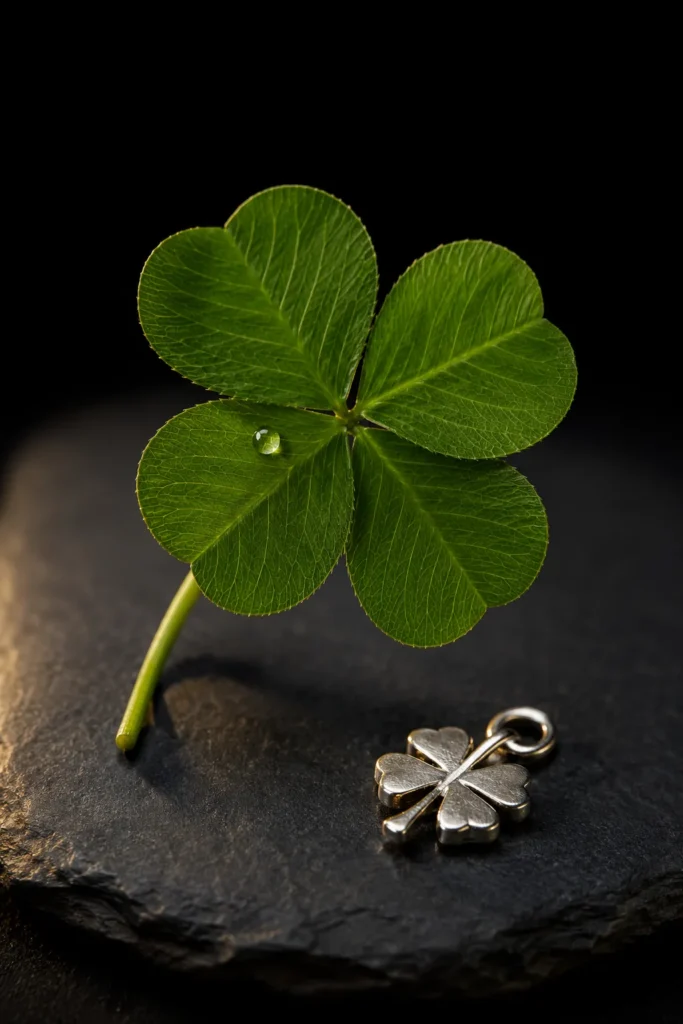
The four-leaf clover is one of the best-known good-luck and protective signs in Europe. Its meaning rests on a simple fact: it is rare, and whoever finds one holds something extraordinary in their hand. From this rarity grew a rich wreath of ideas.
The four-leaf clover is a good-luck and protective sign firmly rooted in European folk belief. Unlike most protective signs, it is not a manufactured object but a rare whim of nature.
Ordinary clover bears three leaves. Only in rare cases does a plant form a fourth leaf. It is precisely this fourth leaf that turns an everyday plant into a special sign.
According to old belief, whoever finds a four-leaf clover is favoured by fortune. The leaf is pressed, kept, carried in a wallet or given as a gift. In each of these forms it accompanies its owner as a sign of good luck.
Beyond good luck, the four-leaf clover was also formerly credited with a protective effect. It was meant to guard against evil magic and to open the eye for hidden things.
The clover is thus a good example of how a natural object can become a sign. Its meaning is grounded not in a religion but in the observation of nature and in the stories that became attached to it.
The ordinary clover from which the lucky leaves come is usually white clover, one of the most common plants in our meadows. Precisely because three-leaf clover is so ubiquitous, the rare fourth leaf stands out all the more.
Occasionally one even finds leaves with five or more parts. They are still rarer and are interpreted in various ways in folk belief, sometimes as heightened luck, sometimes as a sign one had better avoid. The firm place in customary tradition belongs to the four-leaf clover alone.
The core of the meaning lies in its rarity. Four-leaf clovers are vastly rarer than the ordinary three-leaf ones. For every many thousand plants there is only a single leaf with four parts.
This rarity explains why the fourth leaf in particular was considered significant. What is rare stands out and is perceived as extraordinary. A find that succeeds only rarely easily appears as a hint of fate.
The four-leaf clover shares this logic with other good-luck signs. A found horseshoe or a rare stone, too, often owed their meaning to the circumstance that one did not come across them every day.
Natural science explains the fourth leaf as a rare deviation in the plant’s growth, conditioned by hereditary factors and environmental influences. This explanation takes nothing away from the appeal of the find; it merely places it in context.
By now there are also specially cultivated clover varieties that bear four leaves more frequently. The actual good-luck sign, however, remains the leaf found by chance in an ordinary meadow, for it is to this that the old idea is attached.
How rare a four-leaf clover actually is can be put into figures. Estimates assume that for every several thousand ordinary clovers there is only a single one with four parts.
Those who nevertheless find them regularly have usually developed an eye for them over a long time. The patient searching and the sudden recognition belong to the appeal of the custom. Precisely because the find cannot be forced, it is experienced as a small piece of luck.
The four-leaf clover is frequently confused with the shamrock, the three-leaf clover that is an emblem of Ireland. Both belong to the clover, yet their meaning is different.
The shamrock has three leaves and is the national sign of Ireland. According to tradition, Saint Patrick is said to have used the three-leaf clover to explain the Christian doctrine of the Trinity.
The shamrock is thus a Christianly interpreted and a national symbol. The four-leaf clover, by contrast, is a good-luck and protective sign of general folk belief, not assigned to any single religion or nation.
The confusion of the two is widespread, because both derive from the same type of plant and resemble one another. For a clear account, the distinction is nevertheless important.
With the shamrock, the third leaf stands at the centre of the interpretation; with the lucky clover, the fourth leaf. It is precisely this additional, rare leaf that carries the whole meaning of the good-luck sign.
The shamrock plays a major role above all on Saint Patrick’s Day, on which the three-leaf clover is worn everywhere in Ireland and in the Irish world. Its green has become an emblem of the whole island.
The German word Kleeblatt and the English shamrock both refer simply to the plant itself. Despite this linguistic closeness, the difference remains clear: the shamrock is a national and religious sign, the lucky clover a sign of folk belief.
A widespread narrative tradition connects the four-leaf clover with the Celts and the Druids. In these ideas, clover was regarded as an esteemed plant.
The rare four-leaf clover was credited with a special power in this context. It was meant to open, for whoever possessed it, the eye for what was otherwise hidden.
According to this tradition, a person with a four-leaf clover could perceive spirits and other hidden beings that remained invisible to others. The leaf granted them, as it were, an extended sight.
Bound up with this was the idea of protection. Whoever could recognise harmful powers and evil magic was less at their mercy. The clover protected by making the invisible visible.
How far these ideas actually reach back into Celtic times cannot be established with certainty. What is certain is that the four-leaf clover was long regarded in European folk belief as a means against magic and as protection.
Clover had been familiar to people from time immemorial as a fodder plant. It grew in the meadows where the livestock grazed and belonged to the everyday picture of the landscape. It was precisely this contrast that made the four-leaf clover so striking.
Out of a wholly ordinary, everywhere available plant, something rare suddenly emerged. The lucky clover was thus not a distant, precious thing but a wonder by the wayside that could meet anyone who looked attentively enough.
A well-known legend connects the four-leaf clover with paradise. It tells that Eve, on leaving the Garden of Eden, took a four-leaf clover with her.
According to this narrative, the four-leaf clover is a keepsake of the lost paradise. To find one therefore means to hold a small piece of paradise in one’s hand.
This legend gives the luck of the find a depth of its own. In it, the clover is not merely a chance stroke of fortune but a reference to a state of perfect well-being.
Such narratives are typical of good-luck and protective signs. They give a custom a vivid justification and make it easier to pass on, because a story is easier to remember than a mere rule.
Whether the legend is old or only arose later can hardly be decided. What matters is that it connected the four-leaf clover with a strong image and so consolidated its meaning as a good-luck sign.
The legend of Eve and paradise does not stand alone. Other plants, too, were connected in narratives with the lost garden or with heavenly origin. Such stories gave an inconspicuous plant a high rank.
With the clover, the fresh green of the growing plant was additionally bound up with hope and with the idea of the living. The legend of paradise turned the find into more than a stroke of luck, namely into a touch with a better world.
Over the course of time, individual meanings were assigned to the four leaves of the lucky clover. A widespread interpretation connects them with faith, hope, love and luck.
In this reading, the clover carries three values that are also known as virtues in the Christian tradition, and adds luck to them as a fourth. The rare fourth leaf thus stands precisely for luck itself.
Other interpretations assign fame, wealth, love and health to the leaves, or leave the meaning open so that the finder can determine it themselves.
This variety shows that there is no single binding interpretation. The assignments arose in folk custom and were given differently from place to place and from time to time.
Common to all interpretations is that the fourth leaf is considered the truly valuable one. It is the rare addition that turns ordinary clover into the good-luck sign.
That it is specifically the number four that lends the leaves their meaning fits into folk thinking about numbers. The four was widely regarded as the number of completeness; one need only think of the four cardinal directions or the four seasons.
In this view, the fourth leaf completes the clover into something whole. While the three leaves form the ordinary, the fourth raises the plant onto another level. The interpretations of the individual leaves build on this basic idea of completion.
In folk belief, what mattered was to find the four-leaf clover oneself. The find counted as the decisive thing, not mere possession.
The chance find held special significance. A clover that caught one’s eye unexpectedly counted as a genuine good-luck sign. Those who, by contrast, searched for it deliberately and with effort were promised less by the custom.
In this the clover resembles the found horseshoe. There, too, the unexpected find counted as the actual luck, because it was understood as an unplanned hint.
The found leaf was treated carefully. Frequently it was pressed and dried to make it durable, and then kept in a book, in a wallet or in a locket.
This treatment shows that the clover was taken seriously as a protective and good-luck sign. It was guarded like a small amulet and accompanied its finder over a long time.
That the meaning of the four leaves is often left open has an appeal of its own. The finder can assign their own wish to the leaf, and so the clover becomes a personal sign.
With the giving of a gift, a good wish for the other person is bound up with it. The found and passed-on clover therefore carries not only luck in general but a particular concern that the giver sends with the recipient on their way.
The four-leaf clover is known as a good-luck sign across large parts of Europe and has spread further from there. It is among the most common bringers of luck of all.
It thereby stands in a line with other good-luck signs. The horseshoe, the chimney sweep, the pig and the ladybird are regarded as luck-bringing in a similar way.
These signs frequently appear together, for instance on greeting cards for the turn of the year. The four-leaf clover is almost always represented in such compilations.
Unlike the horseshoe or the chimney sweep, however, the clover is a living plant. This connection to nature distinguishes it from the object-based good-luck signs and gives it an appeal of its own.
The older idea of protection, the clover as a means against magic, has today largely receded. What has remained above all is its meaning as a general good-luck sign.
The pressing and keeping of plants was formerly widespread and not limited to the clover. Blossoms and leaves were dried between the pages of books and kept as keepsakes. With the lucky clover, this practice took on a special meaning.
The pressed leaf could be kept over years and thus remained a lasting companion. Many a clover was passed on from one generation to the next and thereby connected luck with the memory of a particular person.
The four-leaf clover is today one of the best-known good-luck signs of all. It appears as a jewellery pendant, as a motif on cards and gifts, and as a general sign for luck.
In this use, the connection to the rare plant is often only indirectly present. The clover is used as a form and sign without an actual find lying behind it.
At the same time, the old custom has not disappeared. People still search meadows for the rare fourth leaf, and a genuine find still triggers joy.
The protective aspect, the clover as a means against evil magic, is by contrast hardly still present in awareness. Here the same shift shows itself as with many protective signs that have become pure symbols of luck.
The four-leaf clover thus remains a vivid example. It shows how, out of a rare natural phenomenon, by way of legends and folk belief, a sign arose that is associated with luck and protection to this day.
The clover has, beyond mere customary tradition, entered many domains. It appears in coats of arms, in the signs of clubs and in sport, where it is meant to stand for luck and success.
In this respect it shares the fate of other good-luck signs that have passed from folk custom into general visual language. Within the row of well-known luck-bringers, the clover holds a firm place and is perhaps the most frequently depicted of all.

Related pages in the lexicon: an overview of the protective symbols at a glance as well as the page on the luck-bringer.
Related key terms: four-leaf clover lucky clover shamrock good-luck sign Druids Eve horseshoe folk belief.
iWell Guard stands in the cultural-historical line of portable protective objects, to which the four-leaf clover also belongs. A modern companion for people who live with protective symbols: manufactured in Germany, 41 layers of solid gold, platinum and silver, with a 30-day right of return.
Personal experiences may vary. Not a medical device. No healing promise.