Papatūānuku: the earth mother in the Māori world view
By Ralf Ittermann · last reviewed on
Papatūānuku is the earth mother of Māori cosmology. Together with the sky father Ranginui she forms the primordial parental pair, from whose close embrace the gods and all living things emerge. Her separation from Ranginui by their shared sons is the central creation myth of the Māori.
Papatūānuku embodies the earth mother in the Polynesian world view and forms the primordial pair together with Ranginui.
Classification
Papatūānuku, often called Papa for short, is in Māori cosmology the earth itself, conceived as a female primordial figure and mother. She belongs to the first generation of personified powers that come forth after the mythical emergence of the cosmos.
Together with the sky father Ranginui she forms the primordial parental pair from which the gods, the realms of nature and human beings descend.
Within the religion of the Polynesia / Māori, Papatūānuku is not a distant deity but a continually experienced reality: she is the ground on which one stands, the land that nourishes, and the earth to which the dead return.
In religious studies she belongs to the widespread type of the earth mother who forms a cosmic pair with a sky father. This motif appears in numerous mythologies of Polynesia and beyond.
Characteristic of Māori cosmology is that the world is not created out of nothing but unfolds over generations. Papatūānuku stands at the beginning of this genealogical sequence, the whakapapa.
This line of descent links gods, land and people into a single kinship order, in which the human being does not stand above nature but is kin within it and with it.
Name and etymology
The name Papatūānuku is a compound. The element papa denotes in Māori a flat, spread-out surface, a layer or the ground.
The further component is usually traced back to tū, to stand or to be fixed, and nuku, breadth or extent. The name can thus be read as the far-spread, fixed surface of the earth.
The short form Papa appears frequently and is used in most of the narratives. Alongside it occur honorific and descriptive bynames that characterise Papatūānuku as the nourishing mother and as the ground of all life. In some traditions she is also addressed with designations that emphasise her role as receiver of the dead.
The close link between name and thing is significant in Māori thought: Papatūānuku is not a deity who rules over the earth, but she is the earth. The name thus designates at once a personal figure and a physical reality.
The same duality applies to Ranginui, the sky. Related names for earth and sky figures are found in other Polynesian languages, which points to a shared mythological stock.
Description and forms of appearance
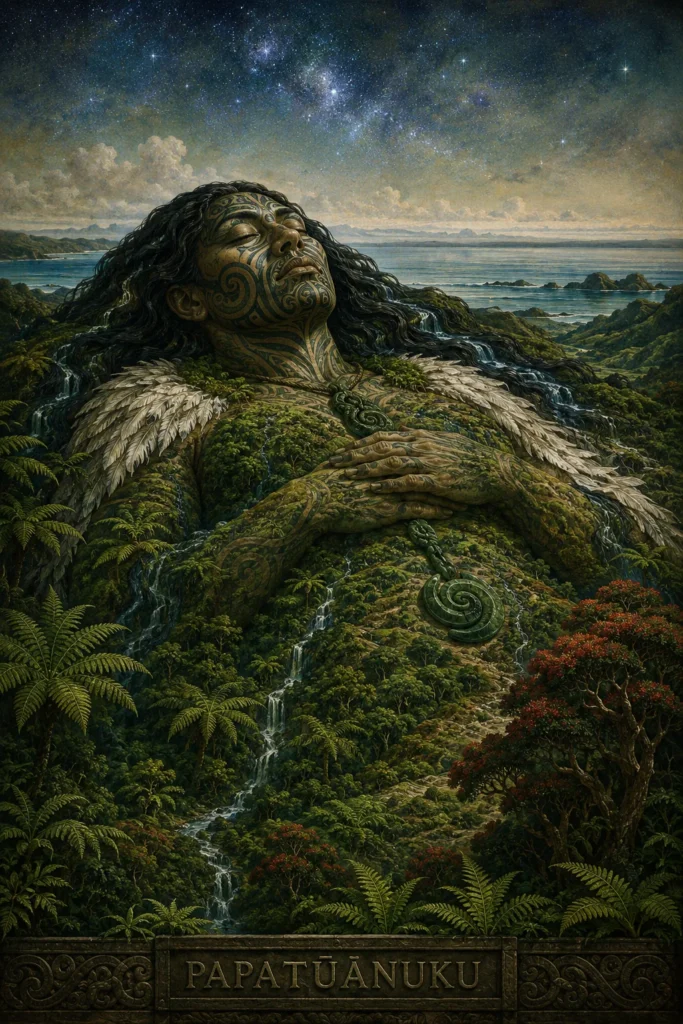
Papatūānuku is imagined as a reclining female figure whose body is the landscape. Mountains, plains, rivers and forests are regarded as parts of her body; the fertile land is her nourishing womb.
In this view, every experience of the ground is at the same time an encounter with the earth mother. She does not appear in changing forms like a trickster god, but in the lasting constancy of the earth itself.
In the narratives of the beginning, Papatūānuku lies in close embrace with Ranginui. From this union come her children, who live enclosed in darkness between the bodies of their parents. After the separation Papatūānuku remains below, turned towards the sky. Her longing for the parted spouse becomes a fixed image of the tradition.
The forms in which Papatūānuku appears are the concrete phenomena of the land: the mist rising over moist ground, which is interpreted as her sighing; the warm springs and the volcanic fire inside the earth; the growing vegetation that her body brings forth.
According to a widespread tradition, the human being too is formed from the red earth, that is, directly from the substance of Papatūānuku, and returns to her in death.
Mythology and tradition
The central myth surrounding Papatūānuku is the separation of the primordial parental pair. In the beginning Papatūānuku and Ranginui lie in such close embrace that no space remains between them.
Their children, powerful divine sons, live in the narrowness and darkness between the parents and consider how they might gain light and space. They weigh killing the parents but then decide on separation instead.
One son after another tries to push apart sky and earth, and fails. Finally Tāne, the god of the forests, succeeds: he braces his back against the earth and his feet against the sky and so raises Ranginui aloft.
Only thereby does the world of light come into being, in which life becomes possible. Another son, Tāwhirimātea, the god of storms, does not approve of the separation and rises up to his father, from where he has ever since sent wind and tempest against his brothers.
The separation remains painful for both parents. Ranginui weeps, and the fall of his tears is the rain and the dew; Papatūānuku sends her sigh upward as rising mist. In the myth this mutual longing explains the ever-renewed joining of sky and earth through rain and haze.
The separation is also recounted in the creation account that the scholar Te Rangikāheke recorded in the nineteenth century for George Grey, which became one of the best-known versions. There are, however, numerous regional variants in which the order, the gods involved and the details differ.
In many traditions the separation myth is preceded by a series of states of the world that unfold before the earth mother.
Te Rangikāheke’s account places before the personal birth a genealogical sequence of stages, in which out of nothingness and the void there gradually emerge night, seeking and thinking, before Papatūānuku and Ranginui come forth.
The earth mother thus does not stand quite at the very beginning, but as the first graspable figure at the transition from the undivided primordial state to the ordered world.
The fate of the children after the separation also belongs to the myth. Tāne, who pushed the parents apart, later seeks the female element in order to beget humankind and, according to a widespread narrative, forms the first woman from the red earth, that is, from the substance of Papatūānuku herself.
Thus the arc closes: the human being arises directly from the body of the earth mother, and the whakapapa leads without break from her through the gods to the tribes living today.
Individual iwi, for example in the Taranaki region or on the East Coast, know their own names for the figures involved and each emphasise different sons as the main acting characters.
Cult and veneration
The Māori knew no temple and no fixed priesthood for Papatūānuku in the sense of organised cult communities. Her veneration was embedded in a comprehensive ritual order that regulated the relationship between people and land.
Central to this was the concept of tapu, the ritual inviolability of certain places, actions and times, and its counter-concept noa, the ordinary state.
Respect for Papatūānuku showed itself in prayers, the karakia, spoken before tilling the soil, before clearing, planting and harvesting. Whoever intervened in the earth thereby acknowledged that they were dealing with the earth mother and asked for her favour.
At important works, first-fruit offerings were presented. Birth and death bound people especially closely to Papatūānuku: the afterbirth, in Māori likewise called whenua, as is the word for land, was returned to the earth, and the dead were entrusted to her.
In the present, the veneration of Papatūānuku has gained a new public significance. She is invoked in speeches on the marae, the meeting place, in the greeting of the land and in ceremonies that express a relationship of responsibility towards the environment.
In this way the old idea of kinship bonds to the earth is joined with present-day concerns.
Protective practice and the apotropaic
Protection in connection with Papatūānuku is less the warding off of an evil than the keeping of a right order. The human being who lives on the body of the earth mother and feeds from it must maintain the balance between intervention and respect.
If this order is violated, for example by disregarding a place laid under tapu, misfortune, illness or the failing of fertility threatens.
Protective practice therefore consisted above all in the correct observance of tapu and in the karakia, with which risky actions were ritually secured.
The clearing of a patch of forest, the laying out of a garden or the burial of a dead person were surrounded by formulae meant to preserve people from the consequences of intervening in the body of Papatūānuku. Certain places were considered especially powerful and were avoided or entered only with precautions.
An important role was played by the practice of rāhui, a temporary prohibition by which an area, a fishing ground or a patch of forest was withdrawn from use. The rāhui protected both the resource and the people, by preventing overuse and bringing the relationship with the earth back into balance.
In religious studies this shows that protection in Māori thought aims at relationship and moderation, not at magical objects. Boundary stones and marked places too had less the function of an amulet than that of a visible reminder of the ritual order.
Whakapapa and the place in the world view
Papatūānuku can only be understood within the context of the whakapapa, the genealogical order that underpins the entire Māori world view. Whakapapa is not merely a list of ancestors but a model of thought that arranges all that exists into lines of descent.
Mountains, rivers, plants, animals, gods and people stand within it in demonstrable kinship relations. In this order Papatūānuku is one of the earliest nameable figures and thus a common ancestor of everything that inhabits the land.
Practical consequences follow from this position. A tribe, an iwi, derives its identity from a particular mountain, a river and a stretch of land, and names these in the formulaic self-introduction, the pepeha.
In doing so it also appeals to Papatūānuku, for the mountain and the river are parts of her body. The relationship to the land is thus not a relationship of ownership but a relationship of kinship, which grounds rights and duties alike.
What is remarkable about this in religious studies is that the cosmology is not separated from the social order. The creation myth of the earth mother explains not only the emergence of the world but also grounds the bond of every community to its concrete land.
Concepts such as kaitiakitanga, the responsibility of care for an area, and mana whenua, the authority arising from the bond to land, cannot be understood without the idea of the kindred earth mother. Papatūānuku is thus at once a cosmological primordial figure and the foundation of a social order.
Parallels in other cultures
The primordial parental pair of earth mother and sky father is widespread throughout Polynesia. In Hawaii, in the Society Islands region and elsewhere, related figures and narratives of the separation of sky and earth are encountered. These correspondences point to a shared Polynesian stock of myths that spread with the settlement of the Pacific.
Beyond Polynesia, Papatūānuku belongs to the worldwide attested type of the earth mother. In the Greek tradition, Gaia forms a comparable pair with the sky Uranos, whose close union is forcibly broken by the children, a motif that comes strikingly close in structure to the Māori narrative.
In numerous other mythologies too, the earth appears as the nourishing mother and the sky as the begetting father.
In religious studies it must be stressed that such parallels do not permit the inference of direct contact. Rather, they show that the experience of earth and sky as a fundamental opposition and at the same time as a begetting pair belongs to the most widespread interpretive patterns of human cosmology.
The Māori version differs from others above all through its embedding in the whakapapa, the genealogical order that joins gods, land and people without break.
Present-day reception and research
Scholarly engagement with Papatūānuku began in the nineteenth century with the collections of George Grey and the extensive ethnographic works of Elsdon Best, who documented Māori religion in detailed studies.
Edward Tregear produced a comparative dictionary that made the Polynesian connections visible. Later researchers such as Margaret Orbell systematised and critically commented on the myths and pointed to the diversity of regional traditions.
The older research is to be read with caution, since colonial editors often unified, smoothed and adapted the narratives to European notions.
Te Rangikāheke’s creation account became, through Grey’s publication, the apparently authoritative version, although it represents only one of many tribal traditions. Newer research therefore takes care to emphasise the tribal diversity and the voices of the Māori themselves.
In the present, Papatūānuku is present far beyond the religious tradition. She has become a central figure of cultural self-understanding and is invoked in education, art and public discourse.
The concept found particular attention in New Zealand’s environmental policy: the legal recognition of rivers and landscapes as independent beings with rights ties expressly to the notion that the earth is a kindred body and not a mere possession. In this way the old myth of the earth mother carries over into new social contexts.
Literature (selection)
- Elsdon Best: Maori Religion and Mythology (1924)
- George Grey: Polynesian Mythology (1855)
- Margaret Orbell: The Illustrated Encyclopedia of Māori Myth and Legend (1995)
- Edward Tregear: The Maori-Polynesian Comparative Dictionary (1891)
- Cleve Barlow: Tikanga Whakaaro. Key Concepts in Māori Culture (1991)
Related key terms: Papatuanuku Ranginui Maori earth mother Tane whakapapa whenua tapu karakia.
iWell Guard and protective traditions
iWell Guard ties into the cultural-historical tradition of portable protective objects, in the tradition of Polynesia / Māori and many other cultures worldwide. 41 layers, solid gold, platinum, silver, made in Germany. 30-day right of return.
Personal experiences may vary. Not a medical device. No healing claim.