iWell Guard

Tane Mahuta: Maori God of Forests, Birds, and the Light-Bringing Separation

Tane Mahuta, often simply called Tane, is regarded in Maori religion as the god of forests, birds, and all forested living environments.

At the same time, he is the one who, according to the central creation myth, separated the sky father Ranginui from the earth mother Papatuanuku, thereby bringing light and living space into the world.

The following account describes his position in the religious studies context within the Polynesian pantheon, his iconographic traces, and his role in ritual life.

GodPolynesia / MaoriForest and Creation Deity

Table of Contents

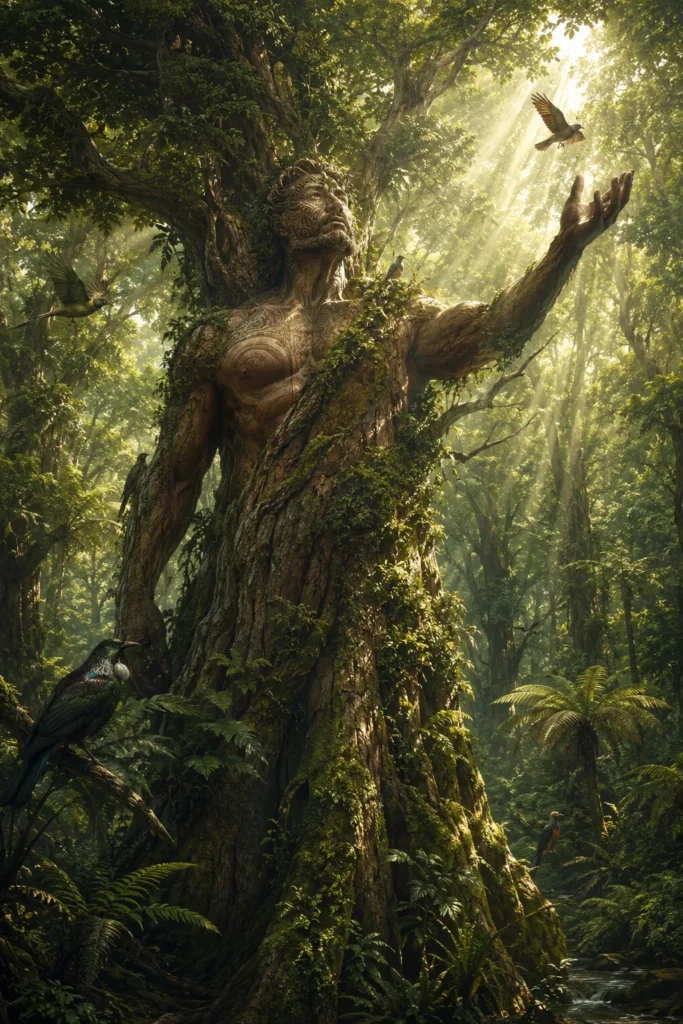
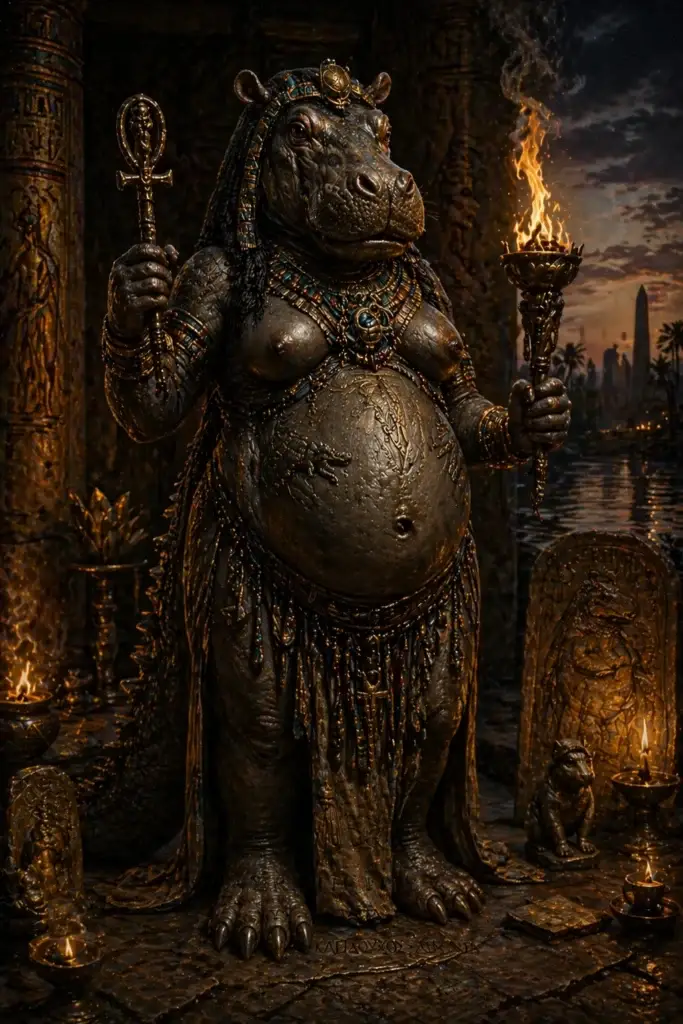
Tane Mahuta: Gods from the Polynesian-Maori tradition, historical-illustrative

Tane Mahuta is the Maori god of forests and birds.

Tane Mahuta, the Maori forest god, separated sky and earth in the creation narrative and brought light into the world.

Classification in the Polynesian Pantheon

Tane Mahuta is one of the central Atua (gods) of Maori cosmology and corresponds in his function to Polynesian parallel figures such as Kane in Hawaii or Tane in Tahiti and on the Cook Islands.

He is one of the sons of Ranginui (sky father) and Papatuanuku (earth mother) and is regarded as the brother of Tangaroa, Tu Matauenga, Rongo, Tawhirimatea (god of storms), and Haumia-tiketike (god of uncultivated food).

Unlike monotheistic conceptions, Tane is not a supreme deity standing above all others, but part of a polycentric divine framework in which each Atua covers a clearly defined domain.

Margaret Orbell highlights in her standard reference The Illustrated Encyclopedia of Maori Myth and Legend (1995) that Maori theology has not been transmitted as a closed system, but receives its own emphases in regional variants and tribal traditions.

Tane himself appears under epithets such as Tane-mahuta, Tane-te-wananga, Tane-nui-a-Rangi, or Tane-matua, depending on the functional focus. From a religious studies perspective, this multiplicity of names is not a contradiction, but an expression of a theology that defines a god not through a single attribute, but through relationships, actions, and genealogies (whakapapa).

Patrick Kirch (On the Road of the Winds, 2000) shows that this principle operates throughout the Austronesian religious family and can be traced back to proto-Austronesian religious history several thousand years ago.

From a religious studies perspective, Tangaroa is therefore a figure whose significance can only be understood in the context of the respective island society.

In Aotearoa, an island with dense forests and an extensive coastline, the rivalry between forest (Tane) and sea (Tangaroa) dominates; in Tahiti, a volcanic island group with a pronounced Marae religion, Tangaroa is the creator.

Within Maori theology, Tu is therefore the Atua through whom the human share in the divine web is articulated. Without Tu there would be no “human-as-agent” capable of interacting with the other Atua. This cosmological position has been transmitted since the records of Te Rangikaheke and is central to modern Maori religious philosophy.

Name and Etymology

The name Tane means simply “man” or “male being” in Maori (te reo Maori) and in related Polynesian languages. The common epithet Mahuta is translated as “to spring up” or “to rise” and refers to the act by which he pushed the sky away from the earth.

The variant Tane-nui-a-Rangi can be rendered as “Tane, the Great, the Son of Rangi.” Tane-te-wananga means “Tane of sacred teaching,” Tane-mahuta “Tane of the raising.”

Bruce Biggs (The Complete English-Maori Dictionary, 1981) shows that the lexeme tane is used both mythologically and in everyday speech.

In ritual contexts it frequently appears in the fused expression Tane-te-wananga, referring to Tane as the keeper of accumulated bodies of knowledge, the wananga. The multiple meanings (“man” as a generic term and “Tane” as a god) make the name unusually productive.

The Polynesian language community knows cognates of this theonym on far-distant islands: Kane in Hawaii, Tane in Tahiti, Kane or Tane in the Marquesas.

This linguistic distribution is regarded by linguists as one of the pieces of evidence for a common proto-Polynesian mythic tradition whose roots probably reach back into the late first millennium. The sound laws of Maori (preserved t-) and Hawaiian (shift of t- to k-) explain the regional variation.

Anne Salmond emphasizes in Aphrodite’s Island (2009) that nineteenth-century English-language scholarship often suppressed regional variations and constructed a unified “Polynesian pantheon” that never existed in this form. Linguistic research over the last 50 years has corrected this.

The genealogical designation “Nga uri o Tu” (“descendants of Tu”) is alive in public Maori language today: it appears in speeches at hui (assemblies), in tangihanga (funeral ceremonies), and in political debates, expressing the Maori self-identification as an active, fighting, surviving community.

Description and Iconography

In Maori visual art, Tane Mahuta does not appear in a uniformly fixed form. In contrast to the classical Greco-Roman pictorial tradition, Polynesian religion has no standing anthropomorphic statuary that fixes a god in a canonical form.

Instead, carvings (whakairo) on meeting houses (whare whakairo), on bow and stern posts of canoes, and on the outer precincts of Marae are symbolic condensations.

In such carvings, Tane is frequently indicated by large, open eyes, an outstretched tongue, and stylized spiral limbs that signal his position between sky and earth.

Roger Neich (Painted Histories, 1993) describes how regional workshops used different codes. In a broader sense, every large tree, especially the monumental kauri (Agathis australis), is regarded as the visible body of Tane.

The famous kauri tree in the Waipoua Forest, whose proper name is precisely “Tane Mahuta,” is the iconographic materialization of the god himself. It stands over 50 metres tall, measures more than 13 metres in trunk circumference, and its age is estimated at 1,500 to 2,500 years.

In oral imagery, Tane is often described as a tall, upright man who pushes sky and earth apart with shoulders and legs, while Ranginui retains bloody wounds from the tearing and Papatuanuku mourns beneath him. Such images are found equally in transmitted karakia and in modern Maori poetry.

Symbolically, Tangaroa is also suggested by the nautilus shell pattern and by certain spiral forms (koru) in Maori art. The koru spiral refers to the rolling of the wave and the unfurling of kelp. In modern Maori jewellery and tattooing, these motifs remain alive and carry the Tangaroa reference into everyday life.

Tu motifs are common in modern tattooing (ta moko): spirals (koru) in dense arrangements, sharp lines, emphasized eye symbolism. The tradition of ta moko, which had nearly died out in the nineteenth century, has been reviving since the 1990s and explicitly includes Tu references.

The Myth of the Separation of Sky and Earth

The central narrative around Tane Mahuta is the separation of the world parents.

According to the account that the Maori historian Te Rangikaheke recorded in the nineteenth century, and that entered European discourse through Sir George Grey in Polynesian Mythology (1854), Ranginui and Papatuanuku lay at first in a tight embrace. Their children had to live in complete darkness between them.

The sons debated whether they should kill or separate their parents. Tu Matauenga, god of war, argued for killing. Tane Mahuta argued against it and prevailed. Several sons tried unsuccessfully to lift the sky from the earth.

Only Tane succeeded: he stood on his head, pressed his feet against the sky, and pushed it upward. Thus Te Ao Marama, the world of light, came into being.

From a religious studies perspective, this myth is a classic separation myth, as Mircea Eliade describes the type in Die Schöpfungsmythen (1976). It explains not only the world, but also legitimizes the existence of knowledge and insight. Only the separation creates the space in which the subsequent acts of creation can take place.

The parents do not remain undisturbed: Ranginui weeps to this day, the rain is his tears, the morning mist the breath of Papatuanuku rising toward him. This poetic connection between weather phenomena and myth is living and rooted in the Maori language.

Tane as Creator of the First Woman and of Humanity

A second central Tane narrative tells how Tane forms the first woman. After several unsuccessful unions with non-human beings, including springs, stones, and trees, Tane shapes from red clay (one) on the beach at Kurawaka the first woman, Hineahuone (“woman formed from earth”).

From her union with Tane comes Hinetitama, the figure of the dawn, who, upon discovering her origins, goes to the underworld and there becomes Hine-nui-te-po, the great woman of the night.

Te Rangihiroa (Sir Peter Buck) interprets in The Coming of the Maori (1949) this sequence as the ritual establishment of the gender order and of mortality.

Tane represents an act of creation, and beyond that he anchors the tension between day and night, life and death, in Maori anthropology. The clay of Kurawaka remains a remembered place among many Iwi to this day.

The narrative has been examined in detail from a tribal-historical perspective by Anne Salmond (Two Worlds, 1991) and Judith Binney (Encircled Lands, 2009).

They point out that the Tane-Hineahuone narrative must not be misread as a “pagan fall-of-man myth,” as nineteenth-century Christian missionaries attempted. It is an independent theological statement about the relationship of human beings to the earth from which they are literally formed.

Tane as Bringer of the Three Baskets of Knowledge

Another narrative describes how Tane retrieves the three baskets of knowledge (nga kete o te wananga) from the highest heaven.

He ascends through the twelve heavens, overcomes guards and trials, and returns with the knowledge: te kete tuauri (the sacred knowledge), te kete tuatea (the secular knowledge), and te kete aronui (the visible everyday knowledge). In addition, he brings two stones that take on the function of a seal.

This narrative anchors a theology of knowledge; it also legitimizes the historical institution of the wananga, the teaching school. Maori universities such as Te Whare Wananga o Awanuiarangi incorporate this term in their names to this day.

From a religious studies perspective, the motif corresponds to the widespread myth of the culture hero who brings heavenly knowledge down to earth, comparable to Prometheus or the Germanic Odin.

The cosmological depth of this motif lies in the fact that knowledge is not freely accessible, but is passed on through ritualized transmission. Those initiated into the wananga were subject to strict tapu rules.

Elsdon Best (The Maori School of Learning, 1923) describes these structures in detail. Here too the characteristic feature of Maori theology is apparent: knowledge is embedded in relationship, not in abstract theory.

Cult, Rituals, and Tapu

The cult of Tane is not characterized by central temples or a priestly college, as parts of the Polynesian island world in the narrower sense (Tahiti, Hawaii) partly developed. In Aotearoa (New Zealand), the veneration of Tane takes place primarily in connection with the forest, the world of birds, and the construction of buildings.

Anyone who felled a tree, for example for a canoe (waka), a meeting house, or a post, had first to carry out the necessary karakia (prayers) and rituals in order to ask Tane’s permission and lift the taboo (tapu) over the tree.

Elsdon Best describes in detail the bird and tree rituals in Forest Lore of the Maori (1942). Bird catchers purified themselves and spoke karakia so as not to offend the world of birds belonging to Tane.

At the opening of a new meeting house, a karakia to Tane remains part of the ceremony to this day. This practice survived the Christianization of the nineteenth century and was renewed and strengthened in the course of the Maori Renaissance from the 1970s onward.

In the modern public life of Aotearoa, Tane karakia are regularly present at tree-planting ceremonies, at the opening of new buildings, and at conservation activities. They are spoken by tohunga (specialists) or by kaumatua (senior dignitaries) and are neither a folkloristic addition nor an antiquarian practice, but living religion.

Protective Traditions and Apotropaic References

In Maori religion there is no sharply defined apotropaic system comparable to the Mediterranean evil-eye concept. Protective actions are embedded in the comprehensive system of tapu (taboo), noa (free, secular), mauri (life force), and mana (spiritual-social authority).

Tane is invoked in such actions when it comes to protection in the forest, when traveling through unfamiliar terrain, or when erecting buildings.

Protective objects are often wooden figures (tiki), carvings on posts or at the entrance of a house, as well as amulets of pounamu (greenstone) that have been consecrated in Tane’s name.

Hirini Moko Mead describes in Tikanga Maori (2003) the categorization of such practices. The essential point is this: they do not constitute magic in the modern sense, but rather the ritual cultivation of a relationship between human beings and Atua understood as living.

Anyone entering the forest, whether to hunt, gather wood, or hike, may speak a brief karakia to Tane that asks permission and at the same time sharpens one’s own alertness. This practice is widespread today even among non-religiously oriented residents of Aotearoa, often more as a cultural practice than a religious commitment.

Parallels in Other Cultures

Tane Mahuta can be placed in comparative religious studies in relation to several figures. Within the Polynesian sphere he corresponds to the Hawaiian Kane, with whom he also agrees in the creation myth. Beckwith’s Hawaiian Mythology (1940) presents the parallels in detail. In Tahiti, Tane is the brother of Ta’aroa and shares functions with Atea.

From the perspective of the phenomenology of religion, Tane can be compared with separation gods such as the Egyptian Shu, who likewise pushes sky (Nut) and earth (Geb) apart. The Babylonian Enuma Elish also knows a similar act of separation when Marduk divides Tiamat.

Such parallels are not to be read as historical dependencies, but as independently developed responses to the same cosmological question: how could an ordered world emerge from an undifferentiated primordial world?

When comparing Tane as a forest and tree god, parallels emerge with the Celtic Cernunnos, the Slavic Veles, the Native American concept of the “Tree People,” and Yggdrasil in Norse mythology.

Eliade and later Joseph Campbell systematized such parallels as the “world tree motif.” What is important, however, is the Polynesian specificity: Tane is not the world tree itself, but the god who erects and tends it.

Reception, Research, and Contemporary Significance

Tane Mahuta is today part of the Maori Renaissance, which has been shaping the public life of Aotearoa since the 1970s. The kauri tree “Tane Mahuta” in the Waipoua Forest is a nationally significant place of pilgrimage.

Conservation campaigns against the plant disease Kauri Dieback invoke the protection of Tane as a religious and ecological imperative. Anne Salmond shows in Tears of Rangi (2017) how Tane operates as a cosmological reference in contemporary eco-political debates.

Religious studies research (Orbell, Salmond, Mead, Best) has systematically documented the myth. At the same time, Maori scholars such as Hirini Mead emphasize the need for iwi and hapu to speak about their own traditions, rather than being merely the object of academic description.

Tane Mahuta is thus an example of a living religion that is simultaneously the subject and the object of research.

Connections to the Polynesian Maori pantheon as a whole remain central throughout. Research has moved on from the earlier collector-and-categorization logic (Best, Grey) to a dialogical religious ethnography that recognizes Maori authorities as equal partners in conversation. In this context, Tane Mahuta remains a living reference point for religion, ecology, and cultural identity in Aotearoa.

The Separation of Rangi and Papa

The central narrative in which Tane plays a decisive role is the separation of the primordial parents in Maori cosmogony. Ranginui, the sky father, and Papatuanuku, the earth mother, lie in a firm embrace, and enclosed between their bodies their children live in darkness and confinement.

The sons deliberate on how they might escape this condition. Some wish to kill the parents, but Tane prevails with the proposal to separate them.

Several of the brothers try in vain to push sky and earth apart. Tane eventually succeeds, not by relying on his arms, but by lying on his back and pushing with his legs.

Slowly Ranginui withdraws upward, Papatuanuku remains below, and into the space thus created flows the light, te ao marama, the world of light. This act makes Tane the figure who first opens up the living space for human beings.

The narrative was recorded in the nineteenth century by several collectors, most influentially by George Grey in Nga Mahi a nga Tupuna and in the English version Polynesian Mythology (1855), and later in the records going back to the tohunga Te Matorohanga and edited by S. Percy Smith.

From a religious studies perspective it is noteworthy that the separation is not narrated as a pure liberation: Ranginui and Papatuanuku mourn each other, the dew is considered the tears of the sky, the rising mist the longing of the earth.

Tane’s act is thus at once creation and an irrevocable rupture. His brother Tangaroa withdraws into the sea, and with this the myth distributes the great realms of nature among the siblings.

Tane Retrieves the Three Baskets of Knowledge

Another significant Tane narrative, particularly well developed in the tradition of the east coast of the North Island, describes his ascent to the highest heaven in order to retrieve the nga kete o te wananga, the baskets of knowledge.

According to this tradition, which is associated with the teaching circle of Te Matorohanga and the text The Lore of the Whare-wananga, Tane ascends through the layered heavens up to the highest level, where the supreme being Io resides.

There he receives three baskets: te kete tuauri, te kete tuatea, and te kete aronui, to which different domains of knowledge are assigned, ranging from ritual and cosmic knowledge, through harmful knowledge, to that which serves human beings in everyday life.

Tane brings the baskets back down, and with them ordered knowledge enters the world. Some versions additionally associate two sacred stones with this.

This narrative is particularly sensitive from a source-critical perspective.

The Io tradition and the baskets episode were committed to writing only late and within a limited regional framework, and since the work of Jonathan Z. Smith and, in New Zealand scholarship, Bronwyn Elsmore and others, there has been debate about how strongly Christian influence shaped this tradition.

A supreme deity Io standing above the other gods could partly be a response to Christianity, or partly an older esoteric teaching of the tohunga.

From a religious studies perspective the episode is nonetheless important, because it extends Tane’s role beyond that of the separator and makes him the mediator of knowledge, placing him at the center of the educational tradition of the whare wananga, the teaching houses.

The Kauri Tree Tane Mahuta in the Waipoua Forest

The epithet Mahuta connects the god closely with the forest and its trees, and in the present day this connection has been concentrated at a specific location.

In the Waipoua Forest in the north of the North Island stands an enormous kauri tree, Agathis australis, bearing the name Tane Mahuta and regarded as the largest known living kauri. Its age is estimated at many centuries, though precise figures remain uncertain in the absence of non-destructive dating methods.

For the Maori, and in particular for the local iwi Te Roroa, the tree is not merely a natural monument but an expression of the continuing presence of Tane as the atua of the forest and all its living beings.

In cosmogony, Tane is the father of trees, birds, and insects; a single ancient kauri embodies this kinship in a tangible way. Visitors are asked to approach the tree with respect, and ritual greetings are customary.

In recent years, Tane Mahuta has at the same time become a symbol of an ecological crisis. The Kauri Dieback disease, caused by the pathogen Phytophthora agathidicida, threatens New Zealand’s kauri populations.

To afford protection, trails in the Waipoua Forest have been equipped with cleaning stations, and Te Roroa together with government agencies are working on protective measures.

The tree thus connects three levels: the mythical figure of the forest god, the cultural bond of a specific iwi to a specific place, and an ongoing conservation debate.

From a religious studies perspective, this shows how a cosmogonic god remains experientially present in the contemporary world through a real, endangered living being, and how traditional notions of kaitiakitanga, guardianship over nature, extend into modern environmental protection.

Selected Bibliography

  • Margaret Orbell: The Illustrated Encyclopedia of Maori Myth and Legend (1995)
  • Sir George Grey: Polynesian Mythology (1854)
  • Elsdon Best: Forest Lore of the Maori (1942)
  • Te Rangihiroa (Peter Buck): The Coming of the Maori (1949)
  • Anne Salmond: Tears of Rangi (2017)
  • Hirini Moko Mead: Tikanga Maori (2003)
  • Roger Neich: Painted Histories (1993)

In Maori tradition, Tane Mahuta stands for the light-bringing separation of the sky father Ranginui and the earth mother Papatuanuku, through which daylight, forest, and the world of birds could first come into being.

Related key terms: Tane Mahuta Maori forest god kauri Waipoua wananga Ranginui Papatuanuku.

iWell Guard and Protective Traditions

iWell Guard draws on the cultural-historical tradition of wearable protective objects, in the tradition of Polynesia / Maori and many other cultures worldwide. 41 levels, real gold, platinum, silver, crafted in Germany. 30-day right of return.

Personal experiences may vary. Not a medical device. No healing promises.

Classification & Protection

IILEVEL
The Protection Compass assigns this being to influence level II, Noticeable influence.

Against its influence, cross-cultural tradition names these protective means:

Compare in the Protection Compass →

Recommended protective means

iWell Guard

The simplest protective means in this collection: 41 layers of fine gold 999, platinum, silver and silicon, manufactured in Ruhla, Thuringia. It requires no activation, is bound to no person, and is effective within a radius of around 50 meters, even without being worn.

All protective means at a glance →