Anu, Hattic-Hurrian Sky God in the Kumarbi Cycle
By Ralf Ittermann · last reviewed on
Anu, Sumerian An, is the second king in heaven after Alalu in the Hurrian-Hittite Kumarbi Cycle. In the opening myth of the divine succession, Kumarbi castrates him with his teeth and assumes rule; from Anu’s seed, Teshub and his brothers grow inside Kumarbi.
Anu (in the Hittite variant) is regarded as a sky god and predecessor of Kumarbi in the Hattic-Hurrian pantheon.
Classification and Brief Profile
Anu is originally the supreme sky god of the Sumerian-Akkadian tradition; in Sumerian his name simply means ‘sky’. In the Hurrian-Hittite reception he appears as the second king in heaven in the Kumarbi Cycle, a position that makes him a central, though transitional, figure of the theogony.
In Geschichte der hethitischen Religion (1994), Volkert Haas described in detail the adoption of Mesopotamian gods into the Hurrian pantheon.
In the history of religion, Anu is an example of the migration of Mesopotamian theology into the Anatolian-Syrian region.
While he remained the highest sky deity in Sumer and Akkad into the first millennium BC, in the Hittite tradition he is above all part of the theogonic myth and scarcely appears independently in cult. This difference between theological position and cultic practice is illuminating for the history of religion.
In The Kingdom of the Hittites (2005), Trevor Bryce pointed to Anu’s theological function as the ‘passed-over’ king of heaven: his castration is the act of creation from which the younger divine regime emerges.
This position shapes his perception in Hittite religion more strongly than his independent profile. In From Hittite to Homer (2016), Mary Bachvarova traced in detail the transmission of Anu from the Mesopotamian region through the Hurrian tradition into the Greek theogony as Uranus.
Compared with his Mesopotamian model, the Hittite Anu is therefore more a literary figure than a cultically living god. This shift in functional emphasis is typical of the Hittite adoption of Mesopotamian gods, which were mostly integrated within a theological-mythological framework, without importing the full cultic apparatus.
Name and Etymology
The name Anu is Sumerian and literally means ‘sky’ or ‘the sky’. In Akkadian he is written as Anu, in Hittite logographically as DAN-NA or phonetically as A-nu-uš. In the Hurrian Kumarbi Cycle he appears as Anuš. In Hieroglyphic Luwian he is not independently attested; the logogram DEUS.CAELUM (‘god of the sky’) points rather to other hypostases.
The theological meaning ‘sky’ is extremely old in Sumerian and is understood in the theogony as a cosmic fundamental category. Anu is not a god of the sky but the sky itself, a conception that also persists in the Hurrian reception.
This identity of god and cosmic domain is an archaic feature that recedes in the later Mesopotamian pantheon in favor of a more strongly personalized conception of the gods.
In Akkadian he frequently appears in god lists as the supreme god; in the god lists of Boğazköy he stands in second place after Alalu and before Kumarbi.
In the Hittite vassal treaties he is occasionally invoked as ‘the sky’ as a cosmic witness to oaths, a function that reflects his cosmic representation.
Description and Iconography
Anu has no fixed image of his own in Hurrian-Hittite iconography. At Yazılıkaya he is not clearly identified. On some seals from Nuzi and Alalaḫ an ‘Anu with horned crown’ may appear, but the identification is disputed. Volkert Haas has pointed out that Anu is more a ‘theological construct’ than an iconographic figure.
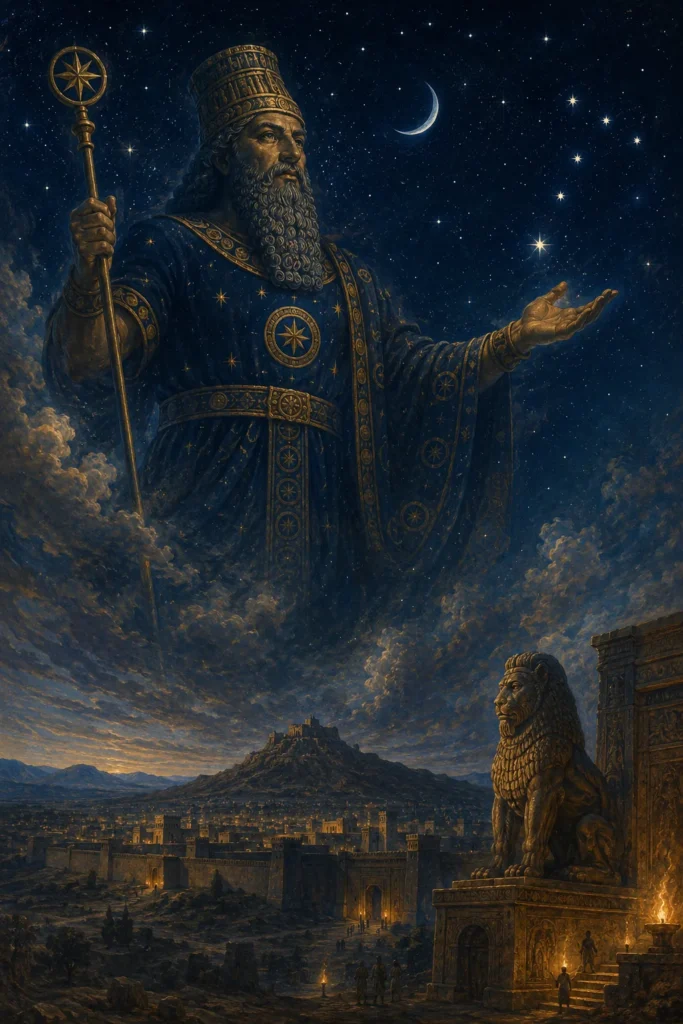
In the Mesopotamian context he appears as an enthroned god with horned crown and scepter; in some late depictions with a frame of stars symbolizing the nocturnal sky. In the Hittite texts no specific animal or plant symbolism is assigned to him.
One particularity is his cosmic extension: Anu is simultaneously the supreme heavenly region and the personification of that region. This dual function makes him difficult to grasp iconographically. In religious studies he belongs to the type of the cosmic creator god, characterized by his precedence in the theogonic scheme rather than by personal activity.
Mythological Narratives
The main source for Anu in the Hurrian-Hittite context is the ‘Song of Kingship in Heaven’ (CTH 344), part of the Kumarbi Cycle. The text was edited by Hans Güterbock (1946) and translated by Hoffner in Hittite Myths (1998).
The plot in outline: Alalu was the first king in heaven; after nine years Anu overthrew him and sent him into the underworld. Anu reigned for nine years, then Kumarbi overthrew him, seizing him and biting off his testicles with his teeth.
Anu’s ‘manly seed’ then flowed into Kumarbi; from the seed three gods grew inside Kumarbi: Teshub, the Tigris god Aranzaḫ, and a further god. Anu laughs from heaven at Kumarbi’s pains, announces the coming birth of his avenging offspring, and escapes into heaven.
This narrative is one of the most famous theogony episodes of ancient Near Eastern literature and is discussed in comparative religious studies as the most important model for the Greek Uranus myth. In Die orientalisierende Epoche (1984) and in Babylon, Memphis, Persepolis (2004), Walter Burkert treated the parallels in detail.
Both the structural similarity (succession of generations, castration of the father by the son) and the shared motif of impregnation through outflowing semen make the dependence in the history of religion probable, even if the exact channels of transmission remain disputed.
In a further fragmentarily preserved narrative, the cosmic order is redistributed: Anu receives the sky, Kumarbi the earth, Teshub the air. This cosmological division, which recalls the Greek distribution between Zeus, Poseidon, and Hades, is remarkable in the history of religion.
In the Hurrian god lists it is designated as the ‘Three Worlds’ and forms the basis of the theological structure of the Hurrian pantheon.
Cult and Veneration
Unlike in Mesopotamia, where Anu had his own temple in Uruk (Eanna, shared with Inanna/Ištar), in Anatolia there are no larger independent Anu sanctuaries. Volkert Haas shows that Anu appears regularly in Hittite god lists but scarcely in festival calendars or in the daily temple cult.
An exception is formed by the Hurrian-Hittite oath rituals, in which Anu is invoked as ‘sky’ and witness to the oath. The oath formula ‘May heaven and earth hear it’ is widespread in the ancient Near East and attested in Hittite treaties; in such contexts Anu personifies the ‘sky’.
In Hurrian pantheon lists, such as in the god lists from Boğazköy, Anu stands regularly in the upper rows, which indicates theological appreciation without practical cultic activity. In the history of religion, precisely this gap between theological rank and absent cultic practice is illuminating.
In festival offering lists he appears as the recipient of small offering portions, bread, beer, wine, which are mostly allotted collectively within the framework of the god list, without independent cultic attention.
In the Hurrian itkahi oath rituals, Anu is invoked together with ‘earth, mountains, rivers, springs, wind, and clouds’ as a cosmic witness. This ritualized invocation of nature belongs to the standard ancient Near Eastern formula for treaty oaths and shows Anu’s function as the personified cosmos, not as an individualized god.
Protective Practice and the Apotropaic
In his Hittite context, Anu was scarcely invoked as a protective god; his function is theogonic and cosmological rather than individually protective. In oath rituals his ‘hearing’ as a witness to oaths is attested; a direct protective act for the one taking the oath is not transmitted.
Apotropaic practices with direct reference to Anu are not attested in the Hittite sources. In Mesopotamian magic rituals he is occasionally invoked, but scarcely in the Hittite context.
In Materia Magica et Medica Hethitica (2003), Volkert Haas showed that Hittite protective ritual practice primarily drew on local Anatolian deities, then Hurrian, and only marginally on Mesopotamian imports.
This cultic reticence underscores the theological-functional character of Anu in the Hittite pantheon: he is more a position in the theogonic sequence than a cultically living figure. The iWell Guard records him as a historical-mythological figure without a current protective function.
His significance is exhausted in the theogonic narrative and in his mediating role for the transmission of the theogony between the Orient and Hellas in the history of religion.
Despite his cultic marginality, Anu remains present in the oath formulas as a guarantor. In the vassal treaties the oath formula ‘May heaven and earth hear it’ is often expanded by invoking Anu, earth, mountains, and rivers individually.
This ritualized invocation of nature shows that Anu remained alive not as a personal protective figure but as a cosmic oath authority.
Parallels in Other Cultures
The most important parallel is the Greek Uranus: like Anu, Uranus is castrated by his son, here by Kronos with a sickle, and the outflowing semen generates divine and monstrous beings.
Aphrodite arises from the semen that fell into the sea. The parallels to the Hurrian-Hittite Anu-Kumarbi myth are so close that Hans Güterbock as early as 1946, and Walter Burkert in several studies, postulated a direct influence.
In the Phoenician pantheon a corresponding castration theogony is not explicitly attested; Philo of Byblos, however, quotes theogony fragments that recognize structurally similar successions of generations. In The Phoenician History of Philo of Byblos (1981), Albert Baumgarten discussed the parallels in detail.
In the history of religion, Anu is a key witness for the Mesopotamian-Anatolian-Greek transmission of the theogony.
In From Hittite to Homer (2016), Mary Bachvarova examined the mechanisms of transmission in detail and showed that the Hurrian singers (kaluti) and transmission via the North Syrian and Cypriot contact zones represented the most important routes of conveyance.
A particular difficulty of Anu research in the Hittite context lies in the distinction between ‘Anu the Mesopotamian high god’ and ‘Anu in the Kumarbi Cycle as a theogony position’. The two do belong together, but their functional domains differ: in the Mesopotamian sphere Anu is cultically active, in the Hittite material above all mythical and literary.
Compared with the West Semitic El, who exercises similar father-god functions, Anu’s mythological profile is even more clearly restricted to the succession of creation. El remains active in the Ugaritic texts as supreme father god; Anu is pushed into the background by the succession of generations. This difference is significant in the history of religion.
Contemporary Reception and Research
Anu research in the Hittite context is primarily part of Kumarbi Cycle research. Important contributions come from Güterbock, Beckman, Hoffner, Bachvarova, and Burkert. In the wider Mesopotamian context, the Anu research of Wolfgang Heimpel and Andrew George is a standard reference.
The edition of the Eanna archive from Uruk by Bertin and Beaulieu provides material on the cultic veneration of Anu in the Mesopotamian region.
Anu is scarcely known in popular culture; he appears occasionally in fictional adaptations of ancient Near Eastern mythology. In academic religious research he is a central object of study for theogony and the succession of generations of the gods. A spiritual revival in the neopagan sense is absent.
In religious studies, Anu in the Hittite context is regarded as an important link in the theogonic chain and as a key witness for the ancient Near Eastern-Greek connection of myths. The iWell Guard accordingly lists him as a historical-mythological figure without a current protective reference.
An intriguing current research question is the transmission of the Anu theogony via the Phoenician tradition into the Greek world. Albert Baumgarten’s edition of Philo of Byblos, as well as Bonnet’s studies on Phoenician-Greek contacts, show that the theogony motifs seeped into the Hellenic sphere along several paths.
Literature and Sources
Important standard works on Anu research in the Hittite context are compiled in the following selection; they encompass theogony editions, comparative religious studies, and syntheses. Hans Güterbock’s first edition of the Kumarbi Cycle is the philological foundation; Hoffner’s translation makes the material accessible in English.
Walter Burkert’s two works on the orientalizing epoch and on the transmission of the theogony are the most important comparative contributions. Bachvarova’s synthesis offers the current view of the Hittite-Homer connection with detailed routes of transmission.
Anu in the Kumarbi Cycle of the Hittite Clay Tablets
The Hittite Anu is not identical to the Mesopotamian sky god Anu, even though he bears the same name. He appears above all in the clay tablets of the so-called Kumarbi Cycle from Hattuša, a group of Hurrian-Hittite narratives about the succession of the divine kings.
The central text of this group is in research usually designated as Kingship in Heaven or Theogony and was first comprehensively edited by Hans Gustav Güterbock.
In this text Anu stands at the beginning of a series of rulers. Before him Alalu had reigned for nine years, until Anu overthrew him and banished him into the underworld.
Anu himself likewise rules for nine years, until Kumarbi rises against him. This succession of generations gives the cycle its basic structure: each ruler is violently replaced by the next.
The tablets are composed in the Hittite language but go back to Hurrian models, so that Anu here appears as a figure of a mediated, repeatedly translated body of narrative. The preservation is fragmentary, and individual passages can only be supplemented through parallel passages.
In the history of religion the Hittite Anu is therefore significant less as an independent cultic deity than as a link in a literary narrative of succession. His name signals the old connection of Anatolian tradition with Mesopotamian conceptions, without thereby attesting a complete adoption of the Mesopotamian Anu concept.
The Castration of Anu and Its Consequences
The most consequential episode involving the Hittite Anu is his castration by Kumarbi. When Kumarbi steps forward to fight against Anu, Anu at first submits, but then flees up to heaven.
Kumarbi grabs him by the feet, pulls him down, and bites off his genitals. Through this Kumarbi becomes pregnant and carries several deities within himself, among them the future weather god Tešub.
The text subsequently describes that Kumarbi tries to rid himself again of what has come to be within him, and that the gods inside him come to light through various bodily openings or places.
The details are partly unclear due to damage to the tablets, but the basic event is secured: from the violent act against Anu the next generation of gods emerges, which will later overthrow Kumarbi himself.
This episode has received great attention in classical scholarship because it structurally recalls the Greek theogony of Hesiod, in which Kronos castrates his father Uranus. Researchers such as Güterbock and, after him, numerous Hellenists and Assyriologists have therefore spoken of a connection of motifs between Anatolian-Hurrian and Greek tradition.
The exact routes of transmission remain disputed, and it is not secured that a direct literary dependence exists. It is certain, however, that the castration episode has made the Hittite Anu a central point of reference for comparative research on mythology.
Within the cycle it explains at the same time the origin of Tešub and thereby the precondition for his later battle against Ullikummi.
Literature (Selection)
- Hans Güterbock: Kumarbi. Mythen vom churritischen Kronos (Zürich 1946)
- Harry A. Hoffner Jr.: Hittite Myths (ed. Gary Beckman, SBL 1998)
- Walter Burkert: Die orientalisierende Epoche (Heidelberg 1984)
- Walter Burkert: Babylon, Memphis, Persepolis (Cambridge MA 2004)
- Mary Bachvarova: From Hittite to Homer (Cambridge 2016)
- Volkert Haas: Geschichte der hethitischen Religion (Leiden 1994)
The Anu of the Hittite tradition rests on an older Hattic substrate layer: Anatolian religion, as it becomes tangible in the tablets of Ḫattuša, adopted Hattic god names, cult sites, and festival sequences and interwove them with Hurrian myths such as the Kumarbi Cycle.
Anu himself is indeed of Hurrian-Mesopotamian origin, yet his Hittite profile remains unintelligible without the Hattic background of the cultic language and priestly offices.
In the Hattic-Hurrian Kumarbi Cycle, Anu is the older sky god, whose disempowerment by Kumarbi sets the dynastic succession of the gods in motion and marks the Anatolian counterpart to Mesopotamian images of the sky.
Related key terms: Anu Hittite Hurrian Kumarbi Cycle Alalu Theogony Sky God Castration.
iWell Guard and Protective Traditions
iWell Guard ties in with the cultural-historical tradition of portable protective objects, in the tradition of Hittite and many other cultures worldwide. 41 layers, solid gold, platinum, silver, made in Germany. 30-day right of return.
Personal experiences may vary. Not a medical device. No promise of healing.