Kumarbi is considered the central father deity of the Hurrian-Hittite pantheon.
Kumarbi belongs to the Hurrian-Hittite religious stratum and is the ‘father of the gods’ (Hurrian atte enna) in the Hurrian pantheon.
In Geschichte der hethitischen Religion (1994), Volkert Haas showed that Hurrian theology seeped deeply into Hittite religion during the 15th and 14th centuries BCE, and that Kumarbi, as the father of Teshub, acquired a central position. Within the Hittite tradition he is the most prominent representative of the Hurrian religious component.
His religious-historical profile is ambivalent: on the one hand he is the creator and guarantor of an earlier divine order, on the other, after his dethronement by Teshub, he is the great adversary of the weather god and incites uprisings through stone giants and sea monsters.
In Die Wettergottgestalten (2001), Daniel Schwemer aptly characterized him as a ‘fallen father god’. This ambivalence makes him one of the theologically most interesting figures in all of ancient Near Eastern mythology.
The Kumarbi Cycle is the most significant mythological composition of the Hittite-Hurrian tradition and ranks among the most important narrative sources of ancient Near Eastern theogony as a whole.
Its importance reaches far beyond Anatolia, because it contains structural parallels to the Greek theogony of Hesiod and, since Hans Güterbock’s groundbreaking edition of 1946, has been regarded as a key witness to the oriental-Greek connection of myths.
The name Kumarbi is of Hurrian origin. Volkert Haas proposed the etymology ‘the one of Kumar’, where Kumar was presumably the original cult site.
An alternative interpretation sees in the element -bi a Hurrian adjectival suffix; Kumarbi would then mean ‘the Kumarian’. Both interpretations point to an urban-divine origin that was subsequently generalized in theological terms.
In cuneiform texts his name appears as Ku-mar-bi, occasionally written logographically as DKUM or DNISABA (the Sumerian grain god), which points to a functional similarity with vegetation and grain deities.
This identification with the Mesopotamian grain god is informative for the history of religion, because Kumarbi did in fact also carry grain and fertility functions. In some texts he is referred to as ‘father of the grain’.
In Ugaritic he corresponds to El, the aged father of the gods; there too the constellation ‘old father god, young storm god’ is a central theological motif.
In the Phoenician tradition El likewise appears in this role, although mostly receding behind Baal-Hadad. There is no direct etymological connection between Kumarbi and El; the parallel is purely functional.
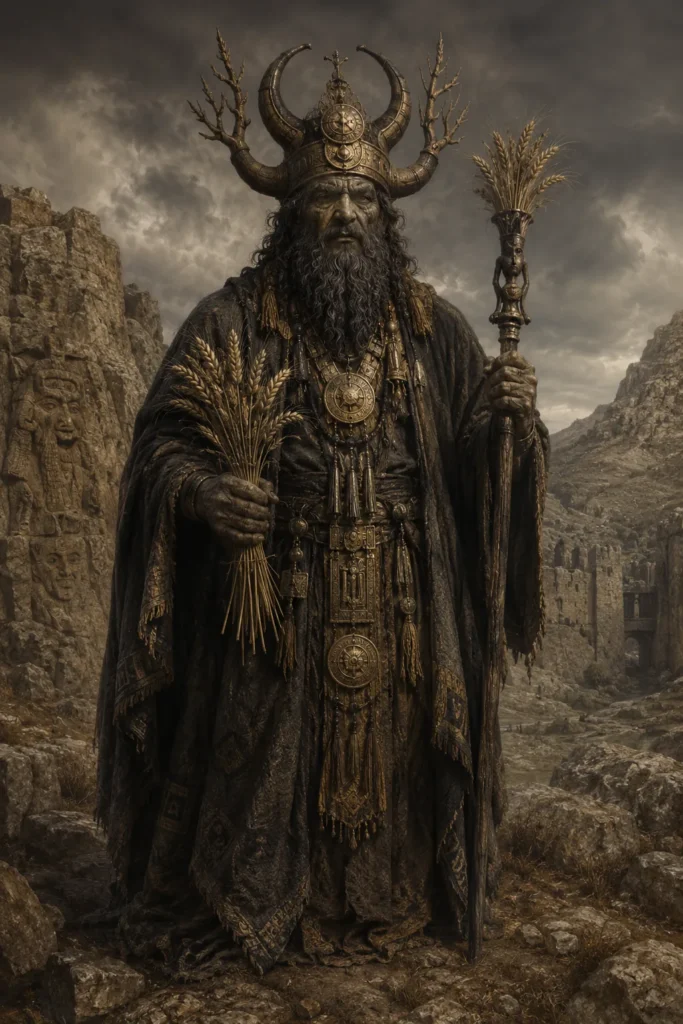
Iconographically, Kumarbi is hard to pin down. At Yazılıkaya, the great rock sanctuary near Ḫattuša, he appears in the main chamber A in the second row of the male divine procession, behind Teshub.
He wears a long pleated robe and a pointed divine cap and holds a scepter in his hand. On some seals from Nuzi and Alalaḫ he appears with grain or plant attributes, which underlines his character as a vegetation father god.
His sacred animal is not unambiguously attested; in some texts he appears with a bull that carries him on its back, in others with a stag.
Volkert Haas interpreted this as an indication of his merging with local Anatolian vegetation and protective deities. In the Hattic-Hittite standard service of Alaca Höyük there are stag depictions that may possibly be assigned to Kumarbi, although the identification is disputed.
A particular pictorial tradition shows Kumarbi with a sickle; in the myth this sickle is the tool with which he castrates his father Anu (Hittite), although according to the textual tradition he bites him, and the sickle is a secondary pictorial metaphor.
The parallel to the Greek sickle of Kronos is striking and has been discussed in comparative religious studies ever since Hans Güterbock’s edition of the Kumarbi Cycle in 1946.
The Kumarbi Cycle (CTH 344 and others) comprises several texts: the ‘Song of Kumarbi’ (also ‘Song of Kingship in Heaven’), the ‘Song of Ullikummi’, the ‘Song of Hedammu’ and further fragmentarily preserved pieces. The edition by Hans Güterbock (1946) and the translations by Beckman and Hoffner (Hittite Myths, 1998) are the standard references.
The opening text describes the succession of the gods: first Alalu was king in heaven, overthrown after nine years by Anu (Hittite); after a further nine years Anu was overthrown by Kumarbi, who castrated him with his teeth and thereby became pregnant with Anu’s ‘manly seed’. From inside Kumarbi three gods then grew, among them Teshub, who was to break Kumarbi’s rule.
There follows Kumarbi’s attempt to regain power with various monsters: he begets with the daughter of the sea the stone giant Ullikummi, who grows toward heaven on the shoulder of the giant Upelluri; he begets the sea monster Hedammu; he unleashes the silver creature and other beings.
In every case Teshub triumphs in the end with the help of his sister Šaušga-Ištar and the smith god Ḫašammilu (Ea).
In the ‘Song of Silver’ (CTH 364) Kumarbi creates yet another being, the silver creature, half human, half mineral, which is to instigate a cosmic uprising.
The text is fragmentary, but the plot follows the same scheme: Kumarbi begets with a mortal or half-divine mother a being meant to overthrow Teshub, and the being is ultimately defeated.
This narrative pattern of repeated attempts constitutes the tragedy of Kumarbi: he is the great father who sets himself against the course of history and repeatedly fails against his more powerful son.
From the perspective of the history of religion this is a remarkable motif: not the linear victory, but the repeated attempt of a deposed patriarch to overturn the order of the gods, is the central narrative axis.

Kumarbi’s main cult was located in the city of Urkeš (today Tell Mozan in Syria), one of the oldest Hurrian city foundations. Archaeological excavations under Giorgio Buccellati and Marilyn Kelly-Buccellati identified there a temple that was probably consecrated to Kumarbi. In Ḫattuša he had his own temple as part of the imperial pantheon.
In the Hittite imperial calendar Kumarbi belonged to the deities to whom offerings were brought during the great imperial festivals, although mostly in a second rank after Teshub and Hebat.
He held a special position in the Hurrian festival calendar, above all during the ‘Great Assembly’ (itkalzi) and in the oath ritual itkahi. In the imperial calendar the festival (EZEN) ḫišuwa was dedicated to him, a multi-day festival described in detail in the temple inventories.
The priestly organization of his cult was twofold: Hurrian priests (kaluti) performed the Hurrian rituals, Hittite priests the Hittite ones. This ritual bilingualism is well documented, in particular by Joost Hazenbos in The Organization of the Anatolian Local Cults (2003).
The Hurrian festival songs were performed in the Hurrian language, even though the language had long since been replaced by Hittite as the everyday vernacular.
Kumarbi was not a classic protective god of the individual person; his function lay rather in the cosmic and political sphere. In oath rituals and oath texts he appears regularly as a guarantor.
The itkahi oath ceremony linked his name with that of Teshub and Hebat in a kind of divine triad. In the Hurrian oath formula he was invoked as ‘father of the gods’.
Apotropaically, clay figures representing Kumarbi and his brood were used in Hurrian magic rituals; they were symbolically bound or buried in order to bind uprisings, illnesses or hostile powers.
The practice stands in the tradition of Mesopotamian apotropaic figurines and is part of the comprehensive protective ritual repertoire of Hurrian-Hittite religion. In Materia Magica et Medica Hethitica (2003) Volkert Haas presented the corresponding text editions.
From a religious-studies perspective, Kumarbi is an example of the theological ambivalence of creator gods who are at the same time deposed and potentially dangerous. A modern protective practice does not draw on his figure. iWell Guard regards him as a historical, religious-historical figure with no current reference to any healing promise.
In Hittite festival calendars Kumarbi occasionally appears as a recipient of specific offerings from the royal treasury: silver ingots, woolen garments, kinds of bread and beer.
The offering quantities are recorded in temple inventories and provide information about the economic outlay of the Hurrian festival cult. A complete edition of these inventories is available from Trémouille and Pecchioli Daddi.
The parallels to the Greek Kronos myth are especially striking: just as Kumarbi castrates his father Anu and thereby produces divine beings, Kronos castrates his father Uranos and thus frees the Hecatoncheires and Cyclopes.
Just as Kumarbi is overthrown by Teshub, Kronos is overthrown by Zeus. As early as 1946 Hans Güterbock interpreted these parallels as an indication of oriental influence on the Greek theogony; Walter Burkert treated them at length in Die orientalisierende Epoche (1984).
The configuration ‘old father god, young storm god’ recurs in the Ugaritic Baal Cycle as well (El opposite Baal); there, however, El is not actively hostile toward Baal. In the Phoenician pantheon of the late Iron Age the figure has receded sharply and is frequently depicted as an aged patriarch in the background.
In the Akkadian Atraḫasis myth and in the Enuma Elish structural parallels can be drawn, even if there is no direct identification. For the history of religion, Kumarbi is a central connecting link between Anatolian, Syrian and Aegean theogony.
In From Hittite to Homer (2016) Mary Bachvarova traced in detail the transmission paths of the theogony motifs via Phoenician and northern Syrian intermediate stations.
Current research by Stefano de Martino and Massimiliano Marazzi additionally discusses the question of the relationship between Kumarbi and the mythical element ‘mountain’; some of his epithets point to mountain sanctuaries, which places him in line with other Anatolian mountain deities and indicates his rootedness in the local cult.
Since Güterbock’s edition (1946) the Kumarbi Cycle has been a standard subject of ancient Near Eastern religious research. Important more recent contributions have been made by Beckman, Hoffner, Mary Bachvarova and Volkert Haas.
In From Hittite to Homer (2016) Bachvarova comprehensively examined the mechanisms of transmission between Anatolian and Greek mythology and showed that the transitions run across several linguistic and cultural domains.
In modern Turkey and Syria Kumarbi is hardly received in popular culture; the Hurrian identity is scarcely present any longer in the contemporary population. The myth attracts scholarly attention above all in comparative theogony studies. The excavations at Tell Mozan/Urkeš since the 1980s have substantially expanded the archaeological picture of the Kumarbi cult.
In religious studies, Kumarbi is today regarded as a central example of generational succession in divine cycles and of the connection between creation and conflict in ancient Near Eastern thought.
A spiritual revival in the neo-pagan sense is lacking; the figure is too alien and mythically complex to connect with modern forms of piety. iWell Guard records him as a historical figure with no reference to contemporary protective practice.
Standard works on Kumarbi research and on the Kumarbi Cycle are compiled in the following selection; they bring together the most important editions, translations and religious-historical syntheses. Hans Güterbock’s first edition of 1946 is still an indispensable foundation methodologically and philologically; Beckman’s translation makes the text accessible in English.
Walter Burkert and Mary Bachvarova offer the most important comparative-religion studies on the Greek parallels, while Schwemer systematizes the connection to the West Semitic and Mesopotamian weather-god tradition.
The foundational text of the Kumarbi circle bears in scholarship the title Kingship in Heaven or, after the Hittite incipit, the Song of Origin. It depicts a succession of divine rulers.
First Alalu reigns, then Anu, the sky god, overthrows him and makes him a servant. After nine years Kumarbi rises against Anu, chases him, seizes him by the feet and, as he falls from heaven, bites off his genitals.
Through this act Kumarbi becomes pregnant. Inside him several deities grow, among them the weather god Teshub, the river Tigris and the god Tasmisu.
The text depicts a grotesque, physically concrete birth in which the gods seek a way out of Kumarbi. With that the constellation for the rest of the mythic circle is set: Teshub will come to power, and Kumarbi will seek to overthrow him.
The religious-historical significance of this text lies in its striking closeness to the Greek theogony of Hesiod. There too Uranos is followed by Kronos, who castrates him, and Kronos by the weather god Zeus.
Franz Dornseiff and above all Hans Gustav Güterbock worked out this parallel early on, and it has since been regarded as one of the most important pieces of evidence for the influence of ancient Near Eastern mythology on early Greek poetry.
The transmission probably took place via northern Syria and Hurrian culture. The text is preserved on Hittite clay tablets from Hattusa and goes back to a Hurrian model.
The Kumarbi circle is not a single narrative but a sequence of songs that all revolve around the same conflict: Kumarbi tries again and again to beget or create a being that can overthrow the weather god Teshub.
The best known of these attempts is the Song of Ullikummi, the stone being. Alongside it stand further texts, often preserved only fragmentarily.
In the so-called Song of Silver the hero is a being named Ušḫune, whose name means silver and who is likewise a son of Kumarbi.
It grows up, learns of its descent and threatens the order of heaven, until the Sun and the Moon confront it. Another text, the Song of Hedammu, tells of a snakelike sea monster, a son of Kumarbi and the sea deity, that threatens to devour humankind.
Here it is the goddess Šauška, the Hurrian counterpart of Ištar, who soothes Hedammu with her power of seduction and thereby renders it harmless.
In all these songs Kumarbi stands for the old, deposed generation that wants to regain its rule, while Teshub embodies the established order. It is characteristic that Teshub never averts the danger alone. It requires the cunning of Ea, the seduction by a goddess or ancient tools from the time of the world’s creation.
The Hittite-Hurrian mythology thus portrays rule as something contested, which has to be defended against the constantly recurring claims of the previous generation. These songs were gathered in Hattusa and are today, supplemented by newer finds from Anatolia, accessible in the editions of the Hittite mythic texts.
Kumarbi is a genuinely Hurrian deity. His main cult site was the northern Syrian city of Urkesch, today Tell Mozan, where German and American excavations under Giorgio Buccellati and Marilyn Kelly-Buccellati uncovered a significant Hurrian city of the third millennium before our era. Already in very early times Kumarbi appears there as city god.
The Hittites adopted Kumarbi together with the entire mythic circle from the Hurrian tradition. In the Hittite god lists Kumarbi is occasionally equated with the Mesopotamian grain god Dagan or with the Sumerian Enlil. These equations are informative.
The connection to Dagan and to grain suggests that, alongside his role as deposed king of the gods, Kumarbi also bore traits of a grain or father god. In the myths he is frequently called the father of the gods.
Research debates whether the Hurrian Kingship-in-Heaven song in turn reworks older Mesopotamian models. Some elements, such as the generational succession of divine rulers, could go back to Babylonian or even older traditions.
Volkert Haas and Gernot Wilhelm opened up Hurrian religion in several works and singled out Kumarbi as a central figure within it. It is certain that with Kumarbi the Hittites adopted far more than a single god: they took over an entire mythological narrative tradition, which through Hurrian mediation finally radiated as far as the Greek world.
Kumarbi is thus a key to the question of how ancient Near Eastern mythology reached the West.
The Kumarbi Cycle, deriving from the Hittite tradition, describes the overthrow of the sky god and the begetting of stone giants, which is why Kumarbi has also entered religious-historical research as the father of stone giants.
Related key terms: Kumarbi Hurrians Anu Teshub Ullikummi Hedammu itkahi Urkeš.
iWell Guard ties in with the cultural-historical tradition of portable protective objects, in the tradition of Hittite culture and many other cultures worldwide. 41 layers, solid gold, platinum, silver, crafted in Germany. 30-day right of return.
Personal experiences may vary. Not a medical device. No healing promise.
Against its influence, cross-cultural tradition names these protective means:
Recommended protective means
The simplest protective means in this collection: 41 layers of fine gold 999, platinum, silver and silicon, manufactured in Ruhla, Thuringia. It requires no activation, is bound to no person, and is effective within a radius of around 50 meters, even without being worn.
Related Beings

Asura, the counter-gods of the Hindu tradition, siblings of the Devas in the eternal cosmic conte...

Bieggegaellies, the Sami wind elder and name variant of the wind man Bieggolmai. Origin, drum dep...

Pachakamak, oracle god of the central Andean Pacific coast, was the patron of the most significan...

Akkorokamui, the giant red sea god of the Ainu. Origin, Uchiura Bay, self-healing power and symbo...

Atum is the Egyptian creator god of Heliopolis, father of the Ennead and primal ancestor of the p...

Hotoru, the wind spirit and breath-giver of the Pawnee. Origin, the Hako ceremony and the religio...