Ullikummi, Hurrian-Hittite Stone Giant and Challenger of the Gods
By Ralf Ittermann · last reviewed on
Ullikummi is a diorite stone giant from the Hurrian-Hittite Kumarbi cycle. His father Kumarbi begot him with a rock woman in order to overthrow the divine regime of Teshub.
On the shoulder of the primordial giant Upelluri, Ullikummi grows skyward and threatens the realm of the gods, until Ea separates him with the saw of creation.
Profile: Ullikummi
Ullikummi: the most important aspects at a glance. The following fields summarise origin, effect, appearance, function, protection and parallels.
Ullikummi comes from the Kumarbi Cycle of the Hurrians and Hittites. His father Kumarbi begot him with a rock woman as an instrument to overthrow the rule of Teshub. The name probably means “destroyer of Kummiya”, the dwelling place of Teshub.
Ullikummi turns against the divine order and against Teshub’s temple sanctuary in Kummiya, which he threatens to conquer. The gods’ first attack fails. Šaušga’s attempt to bewitch him with music and dance also remains ineffective, for he is blind and deaf.
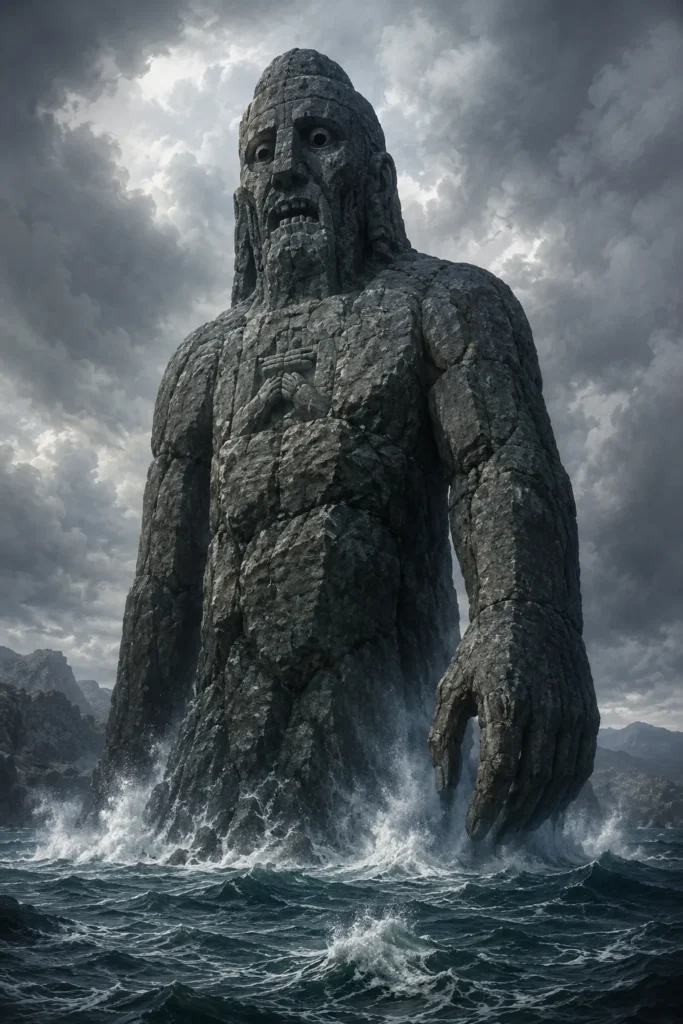
Ullikummi consists of diorite, a hard dark stone, and is blind and deaf from birth. He grows ever faster “like a tall tree” until he reaches the sky. His seat is the shoulder of the primeval giant Upelluri. Unambiguous depictions are not secured.
As a deliberately engendered instrument of Kumarbi, Ullikummi is a chaos being and cosmic adversary who challenges the divine order and is defeated. He was not an object of cult. The myth was recited in the imperial cult and thus confirmed the divine order against chaos.
Ea fetches the old saw with which heaven and earth were once separated, and cuts Ullikummi off from Upelluri’s shoulder. In protective rituals he appears as an example of the cosmic danger that must be averted by divine intervention; his defeat is ritually repeated.
The most important parallel is the Greek Typhon, a giant who reaches to the sky and fights against Zeus; like Ullikummi, he is defeated by the weather god. In the Western Semitic sphere, Yam from the Baal Cycle corresponds to him functionally, but he is a god. Upelluri is regarded as a possible forerunner of the Greek Atlas.
Classification and Brief Profile
Ullikummi belongs to the most remarkable figures of ancient Near Eastern mythology. He is not a god in the classical sense, but a chaos being made of stone, begotten by Kumarbi as a tool for regaining divine rule.
His myth, the ‘Song of Ullikummi’ (CTH 345), is one of the most literarily impressive pieces of Hurrian mythology and was presented by Hans Gueterbock in 1951/1952 in a detailed edition.
In terms of the history of religion, Ullikummi represents the type of the cosmic anti-hero who challenges the divine order and is ultimately defeated. His growth ‘like a tall tree’ up to the sky and his muteness (he can neither see nor hear) make him a truly uncanny figure.
This configuration of a blind and deaf stone giant is singular in ancient Near Eastern mythology and makes Ullikummi one of the most striking chaos-being figures of all.
Trevor Bryce, in The Kingdom of the Hittites (2005), pointed out the parallel structure to the Greek Typhon; Ullikummi belongs to the international family of chaos giants who fight against the Olympian or Anatolian celestial order. Within the Hittite tradition he is the most prominent anti-god of the Kumarbi cycle.
A particular theological point of the myth lies in the fact that Ullikummi does not arise out of malice or hatred, but as a deliberately created tool.
Kumarbi shapes him programmatically, with a clear task and a telling name. This ‘instrumental’ creation of a chaos being is unusual in the history of religion and constitutes a category of its own in mythology.
Name and Etymology
The name Ullikummi is Hurrian and presumably means ‘Destroyer of Kummiya’, Kummiya being the dwelling place of Teshub. Volkert Haas, in Geschichte der hethitischen Religion (1994), discussed this etymology as the most likely one; the element ulli- is linked to ‘destroy’, -kummi as a place name.
In cuneiform texts the name appears as Ul-li-kum-mi; in Hittite, various grammatical endings are attested. An alternative interpretation sees in the name an appellative meaning ‘the one to be destroyed’ or ‘the tall one’; this, however, is less well attested.
The name therefore programmatically states what the giant is meant to do: destroy Teshub’s dwelling place and thereby the divine order. In the myth he almost fulfills this directive.
This practice of giving a narrative figure a ‘telling’ name is frequent in ancient Near Eastern narrative material; it belongs to the strategies of mythic characterization. Volkert Haas discussed similar cases with other chaos beings such as Hedammu and the Silver creature.
In Hieroglyphic Luwian the name is not unambiguously attested, which underlines the purely Hurrian rooting of the figure. In Urartian too, in which many Hurrian theonyms live on, Ullikummi is absent; he remains a narrative figure of the Kumarbi cycle, not of a living cult.
Description and Iconography
Ullikummi consists of diorite, an extremely hard dark stone. He is blind and deaf from birth; neither gods nor humans can make contact with him.
He grows steadily: ‘Like a tall tree, like a reed, ever faster he grew.’ At first he stands in the sea, until his shoulders rise out of the waves, then he grows further, until he reaches the summit of the sky.
Iconographically, Ullikummi cannot be grasped unambiguously; possible depictions on Late Hittite reliefs are disputed. In modern Hittitology he is often visualized conceptually as a ‘stone column’. His seat is the right shoulder of the primordial giant Upelluri, an Atlas figure who does not notice that a giant is growing on his shoulder.
This notion of a sleeping Atlas giant on whose shoulder cosmic events unfold is one of the most unusual cosmology images of ancient Near Eastern mythology and was discussed by Mary Bachvarova as a possible forerunner of the Greek Atlas conception.
The idea of Upelluri as a primordial giant carrying worlds on his shoulder also recalls later mythological images of the world-bearer in several Mediterranean cultures.
Mythological Narratives
The ‘Song of Ullikummi’ (CTH 345) is preserved on three tablets, none of which is complete; the ending can be reconstructed only in part. The plot: Kumarbi seeks an avenger against his son Teshub. He goes to a rock in the sea that contains a female spirit.
From their union Ullikummi is born. Kumarbi gives him the name with its programmatic meaning and hands him over to the Irshirra goddesses, who place him on Upelluri’s shoulder.
Ullikummi grows steadily. The sun goddess discovers him first and reports it to Teshub, who, alarmed, climbs Mount Hazzi (Mons Casius near Antioch) and sees the monster.
Teshub’s sister Shaushga tries to charm Ullikummi with music and dance, but his blind and deaf nature is unmoved. The gods’ first attack also fails; Ullikummi threatens to seize Teshub’s temple sanctuary in Kummiya.
Finally Teshub visits the wise god Ea (Hurrian Hashammilu) in the underworld. Ea fetches the old saw from the storehouse, with which heaven and earth were once separated, and with it separates Ullikummi from his base on Upelluri’s shoulder.
Weakened, Ullikummi is now defeated in battle against Teshub, though the end of the text is fragmentary. The central theological point: not Teshub’s raw force alone, but Ea’s knowledge of the cosmic tools decides the battle.
A separate episode describes the gathering of the gods on Mount Hazzi, where they deliberate over the threat. This assembly of the gods is one of the most impressive scenes of Hurrian mythology and at the same time forms the narrative center of the song.
Hazzi is to be identified with Mons Casius (today Cebel Akra in Turkey and Syria), a sacred mountain that also appears in the Ugaritic Baal myth as the dwelling place of Baal.
Cult and Veneration
Ullikummi was not an addressee of cult; as a chaos being he was not venerated, but ritually combated or invoked as a negative foil. In some protective rituals he appears as a prototypical example of the cosmic danger that must be warded off through divine intervention.
His myth, however, was recited in the state cult; presumably the ‘Song of Ullikummi’ belonged to the repertoire of the Hurrian singers (kaluti), who performed the divine epics at great festivals. Joost Hazenbos, in The Organization of the Anatolian Local Cults (2003), examined the priestly organization of these recitations.
The religious-historical function of the myth is the affirmation of the divine order against chaos. By reciting the myth, the defeat of the chaos being was reproduced in cult and the cosmic balance thereby strengthened.
This function of the ‘ritual repetition of mythic defeats of chaos’ belongs to the basic structures of ancient Near Eastern religion and is also found in the Akkadian Enuma Elish recitation at the New Year festival as well as in the Ugaritic Baal cycle recital.
The ritual function of myth recitation at court is well documented: in the festival calendar the song repertoire of the Hurrian singers appears as a fixed component of the great imperial festivals.
This song tradition belongs to the cultural heritage of the Late Bronze Age and is one of the most important testimonies to the literary high culture of Hurrian Anatolia.
Protective Practice and the Apotropaic
In Hurrian-Hittite magic rituals Ullikummi appears as a negative figure whose defeat is ritually repeated. Volkert Haas, in Materia Magica et Medica Hethitica (2003), edited corresponding texts.
In an apotropaic sense, pieces of diorite were occasionally worn as protective amulets, though with reference to other deities, not directly to Ullikummi.
This practice is instructive in the history of religion, because it shows how chaos beings can be ritually ‘turned around’: what was a threat in the myth becomes a protective resource in the ritual. This inversion is a well-known phenomenon of ancient Near Eastern magic.
From an iWell Guard perspective, Ullikummi is above all a religious-historical example of the defeat of chaos through divine knowledge (Ea’s saw). He does not stand in the line of individual protective addressees and is not an address of modern piety.
His significance is exhausted in the myth and in comparative religious research. The defeat of Ullikummi demonstrates the ancient Near Eastern confidence that cosmic knowledge, conveyed through the wisdom gods, can overcome any material threat.
Parallels in Other Cultures
The most important parallel is the Greek Typhon, a giant who reaches up to the sky and fights against Zeus. Hesiod (Theogony 820, 880) describes him as the son of Gaia and Tartaros with a hundred serpent heads.
Like Ullikummi, Typhon is defeated by the weather god. As early as 1951 Hans Gueterbock worked out the close parallel between the two myths; Walter Burkert made it one of the standard examples of Oriental influence on Greek mythology.
In the West Semitic sphere, Yam, the sea god from the Baal cycle, corresponds functionally to the Ullikummi type: he too threatens the divine order, he too is defeated by the storm god.
However, Yam is himself a god, whereas Ullikummi is a non-divine being. This difference underlines the Hurrian concept of the pure chaos tool that is not integrated into the pantheon.
In the history of religion, Ullikummi belongs to the international family of chaos battles against stone giants, dragons, or sea monsters.
Mary Bachvarova, in From Hittite to Homer (2016), examined in detail the transmission routes to Greek mythology and showed that the Hurrian singers and the North Syrian city-states were the most important intermediaries. Hedammu too, from the same myth cycle, belongs to the chaos-being family.
Present-Day Reception and Research
The ‘Song of Ullikummi’ was edited in 1951/1952 by Hans Gueterbock and has since been standard material of Hittite mythology. Important more recent contributions exist by Beckman, Hoffner, Haas, and Bachvarova. Bachvarova’s study is especially significant for the Greek parallels.
In popular reception Ullikummi is hardly known, in contrast to Typhon, who occasionally appears in modern fantasy novels. In the Turkish cultural sphere he is occasionally mentioned as a local reference to Yazilikaya and Mons Casius (today Cebel Akra in Turkey and Syria). A spiritual revival in a neo-pagan sense is absent.
In religious studies, Ullikummi today counts as a central object of study for ancient Near Eastern chaos theology and for theogony transmission.
Current research focuses on the text-critical treatment of the tablets, on the comparison with Typhon and Tiamat, and on the question of how the myth was actually recited in the state cult. The iWell Guard lists him as a religious-historical example without practical protective relevance.
The question of whether the Ullikummi tradition lived on in any form beyond the fall of the Hittite empire has been taken up anew in recent years.
Literature and Sources
Important standard works on Ullikummi research are compiled in the following selection; they include editions, translations, and religious-historical syntheses.
Gueterbock’s edition remains the philological reference point, Hoffner’s translation, edited by Beckman, makes the text accessible in English, Bachvarova’s synthesis offers the most up-to-date comparative perspective. Volkert Haas presented the ritual-historical embedding in several studies, Walter Burkert developed the comparative-religion perspective.
The Song of Ullikummi: Structure and Clay-Tablet Transmission
Ullikummi is not known from a continuous mythological tradition, but almost exclusively from a single literary work, the so-called Song of Ullikummi. The text was found in the Hittite language on clay tablets from the capital Hattusha, present-day Bogazkale in central Anatolia.
The tablets belong to the holdings that were recovered from 1906 onward by the German excavation under Hugo Winckler and were later published in the Keilschrifturkunden aus Boghazkoi as well as the Keilschrifttexte aus Boghazkoi. Hans Gustav Gueterbock presented the authoritative first edition with translation in 1951 and 1952.
The work is part of the so-called Kumarbi cycle, a group of narratives about the god Kumarbi and his struggle for kingship in heaven.
The Hittite text is considered a translation or adaptation of a Hurrian original; individual tablets bear notes that point to the Hurrian background. Three tablets are preserved, none of which is complete, so that the ending of the narrative remains only partially reconstructable.
In terms of content, the song is divided into the begetting of the stone being, its hidden growth, its discovery by the gods, and the final battle. The composition works with verbatim repetitions, such as the formulaic description of Ullikummi’s growth, which are widespread in the oral and written transmission of the ancient Near East.
For scholarship the text is doubly valuable: as a testimony to Hurrian-Hittite literary relations and as a possible mediator of motifs that later recur in Greek theogonies. The fragmentary state of the tablets remains a fundamental limitation on any interpretation.
The Diorite and the Severing from the Base
One detail of the Song of Ullikummi has received particular attention: the material of which the being consists, and the manner of its subjugation. Kumarbi begets Ullikummi with a rock, and the child that emerges from it is a blind, deaf colossus of stone.
The text designates the material with a term that scholarship predominantly interprets as diorite, a hard, dark rock. This materiality makes Ullikummi insensitive to the usual attacks of the gods.
So that the being can grow unnoticed, it is placed on the right shoulder of the Atlas-like bearer god Upelluri, who supports the world and notices nothing of the events.
Ullikummi grows up in the sea until he reaches the sky and threatens the dwellings of the gods. The weather god, in the Hittite version to be equated with Teshub, at first fails against the stone giant.
The solution is provided by the wise god Ea, who has a tool sought in the old storehouses of the earlier gods. It is that saw or cutting tool with which heaven and earth were once separated from each other.
With this implement Ea severs Ullikummi at the feet from Upelluri’s shoulder. Through the separation from the base, the being loses its strength.
Gueterbock and, after him, numerous Assyriologists have connected this motif with cosmogonic conceptions of separation: the tool that created the world now serves to undo an unnatural threat. The preserved text breaks off shortly after this turning point, so that the final victory of Teshub is considered probable but is not attested in the wording.
Literature (Selection)
- Hans Gueterbock: The Song of Ullikummi (JCS 5, 6, 1951, 1952)
- Harry A. Hoffner Jr.: Hittite Myths (ed. Gary Beckman, SBL 1998)
- Volkert Haas: Geschichte der hethitischen Religion (Leiden 1994)
- Mary Bachvarova: From Hittite to Homer (Cambridge 2016)
- Walter Burkert: Die orientalisierende Epoche (Heidelberg 1984)
- Volkert Haas: Materia Magica et Medica Hethitica (Berlin 2003)
In the Kumarbi cycle deriving from the Hurrian tradition, Ullikummi appears as a stone challenger of the gods, whom Kumarbi begets against the weather god Teshub; the Hittite tablet transmission from Hattusa has preserved the myth.
Related key terms: Ullikummi Hurrian stone giant diorite Upelluri Kummiya song Hazzi.
iWell Guard and Protective Traditions
iWell Guard ties into the cultural-historical tradition of portable protective objects, in the tradition of Hittite and many other cultures worldwide. 41 layers, solid gold, platinum, silver, made in Germany. 30-day return policy.
Personal experiences may vary. Not a medical device. No promise of healing.