The Mandrake: Protective and Lucky Root of European Folk Magic
By Ralf Ittermann · last reviewed on
The mandrake is a plant whose root was regarded in European folk magic as a bringer of protection and luck. Its often human-shaped root made it the object of numerous beliefs and customs.
It is also known by the Latin name Mandragora. In folkloric terms, the mandrake belongs to the lucky and protective objects of popular piety. This article presents the origin, custom and interpretation of the root, distinguishing between tradition and modern reception.
Classification
The mandrake is a plant of the genus Mandragora in the nightshade family. In folk magic the focus of interest lay not on the plant as a whole but on its fleshy, often forked root.
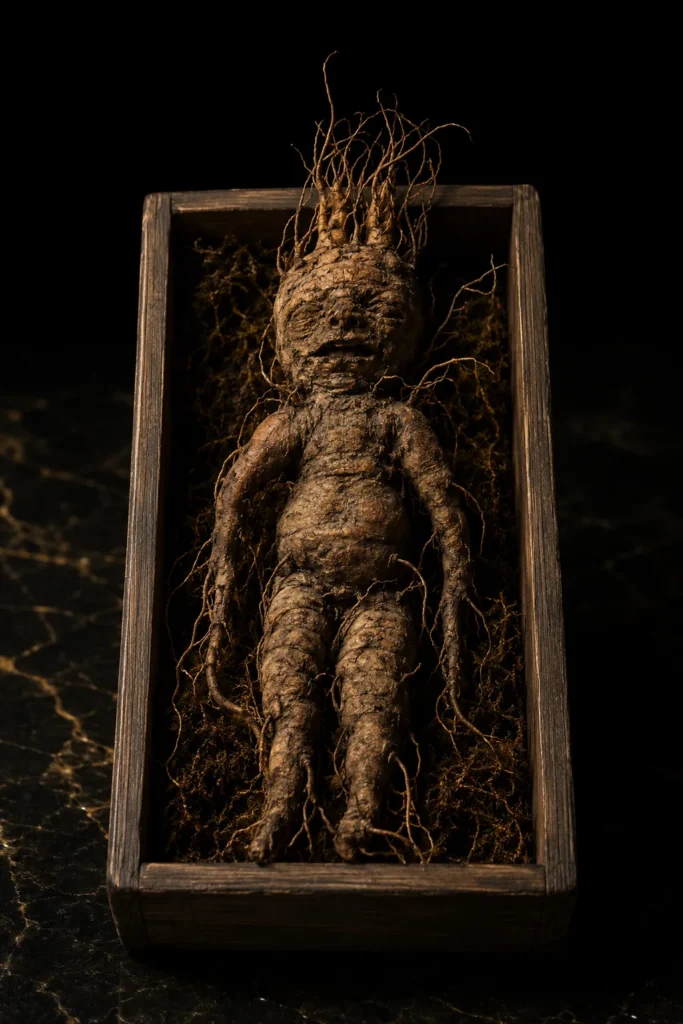
The human-like shape of some mandrake roots gave rise to a wide range of beliefs. A root that resembled a small human being was considered especially valuable and was prized as a lucky and protective object.
The plant bears numerous names. Common ones are mandrake, Mandragora, little gallows man and earth manikin. The name little gallows man points to a particularly well-known origin legend that will be discussed later.
In folkloric terms the mandrake belongs to the lucky and protective objects of folk magic. It stands alongside other natural objects to which special powers were attributed and thus belongs to the family of protective symbols and protective objects.
An important distinction is necessary. The true mandrake is a poisonous plant. In folk magic, however, its root was used not as a medicine but as a lucky and protective object that was worn or kept safe. Any use of the poisonous plant is emphatically warned against.
It must be stressed that the protective and luck-bringing effect of the mandrake describes a historical belief. The root is a folkloric testimony, not an effective means of protection or healing. No promises of healing are associated with it.
The true mandrake should be distinguished from the deadly nightshade often linked with it in legend, which likewise belongs to the nightshade family and is highly poisonous.
The popular conflation of various poisonous plants makes some sources difficult to interpret and underscores that the study of the mandrake belongs to the field of cultural history and not to practical application.
Origin and History
The mandrake has a long history as a plant interpreted as magical. It was already known in antiquity and associated with special beliefs. Ancient authors describe its root and the effects attributed to it.
The true mandrake grows in the Mediterranean region. In Central Europe, where it is not native, it was therefore a rare and precious object. This rarity raised its value and led to other roots being used as substitutes.
In the Middle Ages and the early modern period, the mandrake was a sought-after lucky and protective object. It was traded, inherited and kept within families across generations. Owning one was regarded as a sign of prosperity and luck.
Because of the rarity of the true mandrake, substitute roots came into use in Central Europe. Above all, the root of the white bryony was carved into shape and sold as a mandrake. These counterfeit mandrakes were a widespread market phenomenon.
With the Enlightenment and the decline of popular belief, the mandrake lost its serious significance. In the nineteenth century it increasingly became a subject of folklore studies and literature rather than a believed-in protective object.
The history of the mandrake shows a long continuity from antiquity into the modern age. At the same time it shows how rarity, trade and forgery shaped the handling of an object of folk magic.
The mandrake also appears in biblical tradition, in the Book of Genesis as a plant credited with an effect on fertility. This mention gave the plant additional weight in the Christian world and helped keep the ancient beliefs alive throughout the Middle Ages.
Form, Material and Manufacture
The focus lay on the root of the mandrake. It is fleshy and often forked, so that it can resemble the legs and arms of a small human being. It was precisely this human-like shape that made the root sought after.
Where the true mandrake was lacking, substitute roots took its place. The root of the white bryony, but also other fleshy roots, were chosen because they could easily be shaped into a human-like form.
The manufacture of the mandrakes offered for sale was a craft process. Root sellers carved the root into shape, modelled the head, arms and legs and emphasised the resemblance to a human figure.
Some mandrakes were elaborated further. Grains were set into the root that grew out as hair, or facial features were cut in. Finished mandrakes were sometimes dressed and kept in small boxes.
The keeping of the mandrake followed its own rules. The mandrake was wrapped in a cloth, placed in a small chest or box and kept in a safe place. Some accounts prescribed washing it regularly and dressing it anew.
A special ritual manufacture is attributed in the sources to the dangerous harvesting legend. This legend, however, belongs to the realm of beliefs and is dealt with in the following section.
Folkloric Background and Beliefs
Underlying the mandrake was the belief that its human-like root was a living or ensouled being of its own. The mandrake was imagined as a small household spirit that brought its owner luck and protection.
A well-known origin legend links the mandrake with the gallows. According to this belief, the plant grew from the ground beneath the gallows, at a spot where a hanged man had stood. This is the origin of the name little gallows man.
According to legend, harvesting the mandrake was regarded as dangerous. It was believed that the root let out a scream when pulled up which could kill the harvester. In the legend, a dog was therefore harnessed to pull the root from the ground.
This harvesting legend is an old, widely spread migratory motif. It is found as early as ancient and medieval sources. In folkloric terms it is to be understood as a narrative motif, not as a practical instruction.
Owning a mandrake was considered to bring luck. It was believed to increase prosperity, protect the house and ward off misfortune. Some beliefs held that a coin placed with the root overnight would be doubled by morning.
Ownership also entailed obligations. The mandrake had to be treated well, cared for and provided for. According to belief, a neglected mandrake could withdraw its luck or harm its owner.
Scholarship interprets the human-like root as an example of a widespread mode of thought in folk magic, according to which the outward resemblance of an object points to a hidden power.
Because the root resembled a human being, an ensoulment of human kind was inferred. This logic of resemblance explains why forked roots in particular were so sought after.
Use and Custom
The mandrake was mostly kept in the house rather than worn on the body. It was regarded as a household spirit that brought luck and protection to the entire property. Its place of keeping was often a hidden, safe little spot.
The care of the mandrake was a custom in its own right. It was washed, wrapped in fresh cloths and sometimes dressed anew. This care showed esteem and was meant to secure the goodwill of the root.
A widespread custom was to offer the mandrake food and drink or to place a coin with it. These gifts were meant to satisfy the root and preserve its luck-bringing effect.
The mandrake was inherited. On the death of the owner it passed to an heir, often subject to particular rules. Some accounts held that the mandrake had to be passed on to the youngest child.
A mandrake was acquired by purchase from root sellers or travelling pedlars. Since true mandrakes were rare and expensive, owning one was a sign of prosperity. Poorer households had to make do with substitute roots.
The handling of the mandrake was marked by caution. It was regarded as a useful but also demanding being that had to be treated correctly. This ambivalence distinguishes it from simpler lucky charms.
The trade in mandrakes repeatedly fell under suspicion of fraud. Since true and counterfeit roots were barely distinguishable to laypeople, root sellers could demand high prices for carved white bryony.
Court records of the early modern period note such disputes and prove that the mandrake was not only an object of belief but also a market commodity with risks of its own.
Regional Variants and Related Objects
Mandrake beliefs were widespread across large parts of Europe. In the German-speaking world the names mandrake, little gallows man and earth manikin are common. The basic features of the belief resemble one another across the regions.
In Central Europe, because of the absence of the true mandrake, the substitute root was widespread. Above all the white bryony was used. In these regions the beliefs about the true mandrake and the substitute root merged.
The mandrake is related to other roots interpreted as human-like. In Northern Europe and the Slavic region, similar lucky-spirit beliefs are attested for other plants. The basic idea of an ensouled lucky root is widespread.
There is a thematic kinship with household-spirit beliefs. In its role the mandrake resembles the brownie or kobold, a household spirit that provides for prosperity but wishes to be treated well.
In a broader sense the mandrake belongs to the family of lucky and protective objects. It thus stands alongside the amulet and talisman, but differs through its interpretation as an ensouled being.
Despite regional variety, a common pattern emerges. Everywhere the human-like root is at the centre, everywhere it is regarded as a luck-bringing household spirit, and everywhere its possession is bound up with care and obligations.
The Mandragora was also known as a magical plant in the English-speaking world, and early modern herbals there likewise depicted it as a human-like figure. The agreement of the depictions across language boundaries points to a shared pictorial tradition carried by the learned book tradition.
Significance as a Means of Protection
The protective and luck-bringing significance of the mandrake rests on its interpretation as an ensouled being. Unlike a dead symbol, the mandrake was regarded as a small household spirit that actively provided for the welfare of its owner.
The mandrake was meant above all to bring luck and prosperity. It was credited with increasing the wealth of the house and promoting business success. This luck-bringing function was paramount.
In addition, the mandrake had a protective function. As a household spirit it was meant to guard the property and its inhabitants against misfortune, harmful magic and harmful powers. Protection and the bringing of luck were combined in it.
The human-like form was central to the attributed effect. It made the root a counterpart, a small being with which the owner could enter into a kind of relationship. Care and gifts strengthened this relationship.
For people, the value of the mandrake lay in the hope of prosperity and security. In a world full of economic uncertainty, owning a lucky root gave a sense of support and confidence.
It must be noted that this protective and luck-bringing significance reflects historical beliefs. A real increase in prosperity or warding off of misfortune is not associated with the mandrake. Its value lies in the cultural-historical statement it makes about past thinking.
Source Situation and History of Research
The source situation for the mandrake is broad and ranges from antiquity into the modern age. Ancient natural-history writings, medieval herbals, court records and folkloric collections provide material.
Ancient authors such as Theophrastus and Dioscorides describe the mandrake and the effects attributed to it. The dangerous harvesting legend, too, is already laid out in ancient sources and was carried on into the Middle Ages.
Medieval herbals treat the mandrake in detail and often depict it as a human-like figure. These depictions lastingly shaped the image of the plant.
For the early modern period, court records are also illuminating. The trade in mandrakes and counterfeit roots at times led to trials whose records document the custom.
The Handwörterbuch des deutschen Aberglaubens offers a detailed entry on the mandrake. It orders the beliefs, describes the customs and addresses the question of substitute roots.
The history of research shows that the mandrake is among the best-studied magical plants. Folklore studies, botany and literary scholarship have together drawn a detailed picture of its history.
Reception Today
The mandrake has disappeared from use as a serious lucky and protective object. In the present it lives on above all in literature, film and popular culture.
In literature the mandrake has a rich history of impact. The novel Alraune by Hanns Heinz Ewers from the early twentieth century took up the material and shaped the modern image of the plant as an uncanny being.
In modern fantasy literature and in films the mandrake appears frequently, often linked with the motif of the deadly scream at harvest. These depictions take up the old legend and elaborate it.
In esotericism and in modern paganism the mandrake is occasionally taken up as a magical plant. Because of the toxicity of the true plant, however, great caution is required here. Any use of the poisonous plant is emphatically warned against.
Those interested in the historical background will find reliable information in folkloric and botanical accounts as well as in the overview of protective symbols. Novels and films render the historical context only in free adaptation.
The reception of today thus shows a clear change. From the believed-in household spirit and lucky charm, a literary and cinematic motif has emerged, whose historical significance must be considered separately from it.
From a botanical standpoint it must be noted that the true Mandragora can cause severe symptoms of poisoning. This real toxicity must be strictly separated from the literary and folk-magical beliefs.
Anyone who encounters the plant in a garden or in trade should regard it solely as an object of observation. Any use of the poisonous plant is emphatically warned against.
Literature (Selection)
Related key terms: Mandragora little gallows man lucky root white bryony root manikin household spirit earth manikin nightshade plant folk magic harvesting legend prosperity.
iWell Guard and Protective Traditions
iWell Guard stands in the cultural-historical line of wearable protective objects to which the mandrake also belongs. A modern companion for people who live with protective symbols: made in Germany, 41 layers of solid gold, platinum and silver, with a 30-day right of return.
Personal experiences may vary. Not a medical device. No promise of healing.