Susanoo, god of the Japanese tradition
By Ralf Ittermann · last reviewed on
Susanoo is a god of the Japanese tradition.
Storm god, dragon slayer, wildness tamed. Susanoo is Japan’s mythical god of rebellion: spirited, headstrong, powerful. As the brother of Amaterasu and Tsukuyomi, he carries the demonic energy of the storm, of the chaos wind.
The Kojiki myth first presents him as a destructive ruffian, then as a hero: he subdues the eight-headed dragon Yamata-no-Orochi and rescues the goddess Kushinada-hime. From the dragon’s body he draws the legendary sword *Kusanagi*, one of the three imperial treasures and a symbol of untamed power.
Quick Overview: Susanoo
Type: Japanese principal deity (Shinto), storm and sea god
Pantheon: Shinto
Function: storm and sea, destruction of the dragon Yamata-no-Orochi, source of the imperial sword Kusanagi
Main attributes: sword (Totsuka-no-Tsurugi and Kusanagi), wild hair, storm aura
Main cult sites: Susa shrine in Shimane (main cult site), Yasaka shrine in Kyoto (as Gozu Tenno syncretism)
Siblings: Amaterasu (sun), Tsukuyomi (moon)
Historical Context
Period of the Texts
Susanoo (Jap. Susanoo-no-Mikoto) is attested in literature since the 8th century CE in the Kojiki and Nihon shoki. Main myth: after the conflict with Amaterasu (he defiles her rice fields, kills one of her weaving servants, and she withdraws into the Iwato cave) Susanoo is banished to the earthly world.
In Izumo (present-day Shimane Prefecture) he slays the eight-headed dragon Yamata-no-Orochi; from its tail he cuts the sword Kusanagi-no-Tsurugi, which becomes one of the three imperial regalia.
The main flourishing of Susanoo theology: the Heian and Kamakura periods. In the Middle Ages he was syncretized with the Buddhist-Daoist Gozu Tenno (Yasaka shrine in Kyoto).
Area of Distribution
Main cult sites: Susa shrine in Shimane (main cult site, mythical place of action), Yasaka shrine in Kyoto (with the famous Gion Matsuri, one of the largest Japanese festivals), Hikawa shrine in Saitama (protective shrine of the Tokyo region), and Kumano shrines.
The Susanoo veneration in the Yasaka shrine as Gozu Tenno was the largest cult of Kyoto in the Middle Ages.
Source Situation
Central sources: Kojiki (Book I, detailed Susanoo episodes), Nihon shoki (Book I), Izumo Fudoki (8th-century regional tradition), Engi-shiki.
Secondary literature: Aston, Shinto. The Way of the Gods; Breen/Teeuwen (eds.), Shinto in History; Heldt (trans.), The Kojiki; Bocking, A Popular Dictionary of Shinto; McCullough, Yoshitsune. A Fifteenth-Century Japanese Chronicle (on the Gozu Tenno tradition).
Designation and Spellings
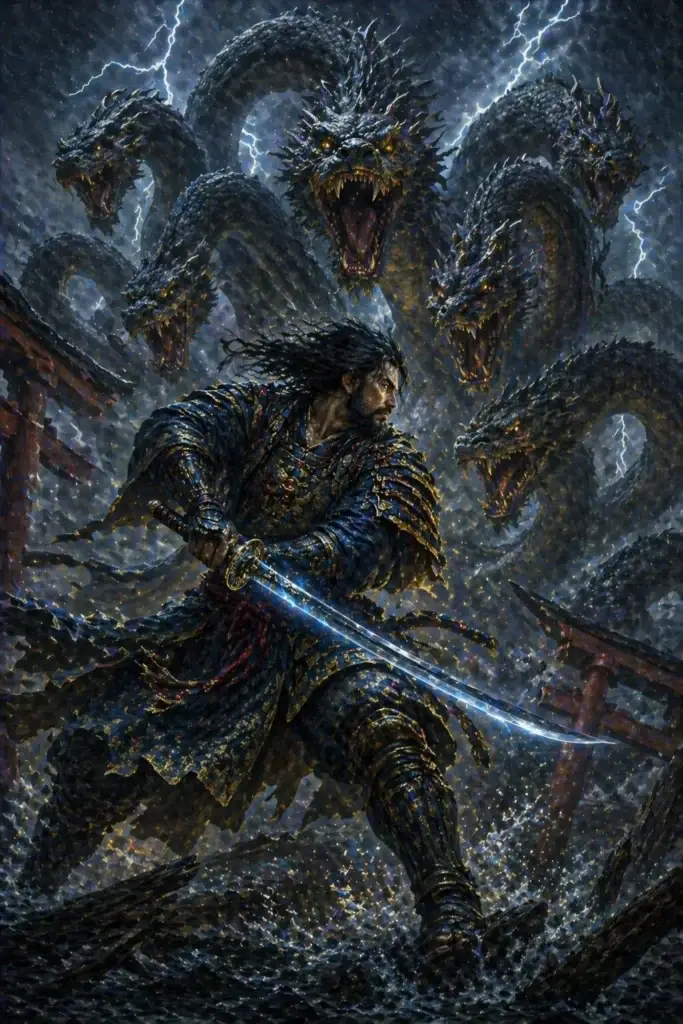
Susanoo is depicted as a powerful, often barbaric-looking god: long hair, a wild and muscular form, lightning around him. He often wears war armor or primitive garments.
The Kusanagi sword (sword of the grass, which can cut the wind) is his primary symbol, not as an emblem of violence but as a mononoke weapon, a supernatural one.
Yamata-no-Orochi, the eight-headed dragon, is shown as a giant serpent with a red underbelly. Rain, thunder and whirlwind are visual signs of Susanoo.
Characteristics
Susanoo is the god of storms, of rain and of disordered chaos, but also of will and of overcoming. In the Izumo-Taisha shrine he is venerated as a witness of marriages (a gentler aspect), as a protector against evil spirits (mononoke) and as a symbol of raw power that can be tamed.
His dragon-fight story is psychological: the hero does not conquer through brutality but through cunning (he makes the dragon drunk). In the myth Susanoo’s descendants are war gods and war ministers, which reinforces his role as a force of chaos under control.
Appearance and symbolism
Susanoo is portrayed as a muscular, sometimes wild-looking man, often with long hair. He carries the legendary sword Kusanagi (“grass-cutting sword”). His body is swirled about by storm clouds or lightning. He is sometimes shown with an evil or grim expression, sometimes fighting against a giant serpent (Yamata no Orochi).
Profile: Susanoo
The most important aspects of Susanoo at a glance. The following fields summarize origin, function, appearance, veneration, symbols and cultural parallels.
Susanoo emerges from Izanagi’s nose as he purifies himself after returning from Yomi, while Amaterasu emerges from the left and Tsukuyomi from the right eye. His character is characteristically wild and ambivalent: on the one hand a destructive storm (the conflict with Amaterasu), on the other a heroic dragon slayer (the Yamata-no-Orochi myth).
Husband of Kushinada-hime (whom he rescues from the dragon). Father of Okuninushi, founder of Izumo and one of the greatest heroes of Japanese mythology.
Storm and sea god. Protection against natural disasters (storm, tsunami) through invocation. In the Gozu Tenno syncretism also a patron against plague and illness (the Yasaka shrine and the Gion Matsuri are originally plague-warding rites). Patron of heroes and warriors through his heroic dragon-slayer myth. In personal cult, invocation in acute emergencies.
A wild masculine body with long, disordered hair, a powerful build, in simple dress or warrior’s garb. Sword in hand (Totsuka-no-Tsurugi or Kusanagi). Frequently depicted in fighting pose against the eight-headed Yamata-no-Orochi dragon.
In Gozu Tenno form: an ox-headed figure with a fiery countenance (Chinese-Buddhist influenced). In folk theater (Kabuki, Noh) often portrayed as a heroically carried figure with dramatic gestures.
Sphere of influence: Susanoo is regularly invoked at his main cult sites, before journeys, in storm threat, against illness.
The Gion Matsuri in Kyoto (July, running 30 days) is one of the largest and most splendid Japanese festivals, originally founded as a plague-warding ritual (869 CE, following an epidemic). In the Hikawa shrine complex, protection for the Tokyo region. In rural Japan also an agricultural protective god.
Sword (Totsuka-no-Tsurugi and Kusanagi-no-Tsurugi), the Yamata-no-Orochi dragon (antagonist), wild hair, warrior’s garb. Sacred plants: none specific. Sacred animals: in Gozu Tenno form the ox. Sacred mountains: Mount Susa in Shimane.
Gozu Tenno (Buddhist-Daoist, medieval syncretism), Thor (Germanic, storm and dragon slayer), Indra (Hinduism, slayer of Vritra), Marduk (Mesopotamia, slayer of Tiamat), Apollo (Greece, slayer of Python), Perseus (Greece, slayer of Medusa and the dragon), Beowulf (Germanic, dragon slayer), St. George (Christian). Susanoo is one of the most famous East Asian dragon-slayer heroes.
Practice of Protection
Rituals of veneration
Susanoo (Jap. 須佐之男, “Wild Man of Susa”) is the storm and sea god, brother of Amaterasu and Tsukuyomi (Kojiki I). His main cult site is the Yasaka shrine (Gion) in Kyoto and the Hikawa shrine in Saitama.
The most famous Susanoo festival is the Gion Matsuri in Kyoto (July, originally established in 869 CE against plague affliction). Further important shrines: Susa shrine in Shimane, Tsushima shrine in Aichi (cf. Picken).
Invocations
The Norito prayer to Susanoo emphasizes his ambivalent character: protection against demons on the one hand, reverent distance before the storm on the other.
The Yamata-no-Orochi myth ritual (the subduing of the eight-headed serpent, Kojiki I, ch. 22-23) is performed in Kagura dances. Susanoo is also considered the inventor of waka poetry, with his poem “Yakumo-tatsu Izumo” at the holy shrine.
Amulets and protective symbols
Susanoo omamori from the Yasaka and Hikawa shrines serve as protection against illness, fire and storm. The Kusanagi sword (Kusanagi-no-Tsurugi), one of the three imperial regalia of Japan, is considered his gift to Amaterasu. Straw ropes (shimenawa) at shrine gates mark the sacred area.
Susanoo, Parallels in Other Cultures
Susanoo resembles the Norse Loki (chaotic, rule-breaker) or the Greek Ares (storm and battle). Unlike these, Susanoo is not portrayed as malevolent but as wild, though he undergoes purification. He shares traits with the Indian Indra (rain, dragon fight) and the Chinese Guan Yu (courage).
His dragon slaying resembles the Germanic Sigurd against Fafnir or the Beowulf story. What is distinctive is his role as the brother of the supreme goddess and his being checked by femininity and love.
The Dragon of Koshi: Susanoo's Central Myth
The most famous narrative about Susanoo is his fight against Yamata no Orochi, the eight-headed and eight-tailed dragon. It appears in the Kojiki (712) and in the Nihon Shoki (720), the two oldest surviving chronicles of Japan.
After his banishment from the heavenly plane, Susanoo descends along the upper course of the Hi River in Izumo Province. There he meets an old couple weeping because the monster has already devoured seven of their daughters and now wants to take the eighth, Kushinada-hime.
Susanoo promises help and asks for the girl’s hand. He transforms her into a comb, which he places in his hair, and has eight vessels of strong rice wine prepared. The dragon lowers its eight heads into the vessels, becomes intoxicated and falls asleep.
Susanoo dismembers it with his sword. In the monster’s tail he finds a sword, which he presents to the sun goddess Amaterasu. This sword, later called Kusanagi no tsurugi, becomes one of the three throne regalia of the Japanese imperial house.
The episode carries several layers of meaning. Read from the perspective of religious studies, it marks Susanoo’s transformation from chaotic disturber into culture hero and founder of order. The handing over of the sword connects the Izumo tradition with the heavenly line of Amaterasu and thus with imperial legitimation.
Several scholars, among them Donald Philippi in his annotated Kojiki translation (1968), have pointed to the possible connection of the dragon to flooding of the Hi River and to the iron-working region of Izumo, where the sword obtained from the dragon’s body might recall the local metal production in concrete terms.
Banishment and Transgression: Susanoo against Amaterasu
Before Susanoo becomes a dragon slayer, he is above all the troublemaker in the chronicles.
Born from the creator god Izanagi, he receives rule over the sea or, in other readings, over the plain of the sea, but refuses to take up his post and weeps so violently that mountains wither and rivers run dry. Izanagi thereupon banishes him.
Before his final descent, Susanoo seeks out his sister Amaterasu in the heavenly plane. The two make an oath and bring forth children from each other’s objects, a process that, depending on the reading, counts as a contest or as a proof of purity.
Susanoo interprets the result as his victory and runs wild. He tears down the boundary ridges of the rice fields, blocks irrigation ditches, defiles the hall of the harvest festival and finally throws a flayed horse into the sun goddess’s weaving hall, whereby a weaver woman is killed.
In horror at these deeds, Amaterasu withdraws into a rock cave, and the world sinks into darkness. Only a ruse of the assembled gods, exuberant dance and the holding up of a mirror, lures her out again. As punishment, Susanoo’s beard, fingernails and toenails are cut and he is finally cast out.
The enumeration of his transgressions is instructive from the perspective of religious studies: it largely coincides with the so-called heavenly sins of Shinto purity thinking, that is, with grave violations of the ritual and agrarian order. Susanoo here embodies personified defilement, whose removal first restores the cosmic order.
Susanoo in Izumo: Ancestor, Sanctuaries and Local Tradition
While the imperial mythology is oriented toward Amaterasu and her descendants, Susanoo belongs above all to Izumo, a region on the Sea of Japan. There he is regarded as the ancestor of his own divine line.
His descendant, depending on the genealogy son or more distant offspring, is Okuninushi, the great land lord of Izumo, who opens up the land and later, in the narrative of the transfer of the land, cedes it to the heavenly gods.
The close bond to Izumo is evident in the cultic landscape. Susanoo is venerated in numerous shrines, among them Yaegaki-jinja, whose name is traced back to the song of the eightfold fence which, according to tradition, Susanoo is said to have composed while building the house for Kushinada-hime.
This song is traditionally regarded as the earliest Japanese poem in the classical 31-syllable form and additionally connects Susanoo with the origin of poetry.
In research on religious history, Izumo is frequently read as a counterpole to the Yamato tradition. The myth complex around Susanoo and Okuninushi could preserve the memory of an independent political or cultic sphere of power that was incorporated by the later central power.
Whether a concrete historical confederation stands behind this or a purely literary construction of the chroniclers remains disputed. What is certain is that the Izumo shrines, foremost the great shrine of Izumo, preserve their own profile to this day, and that Susanoo appears there not as a marginal figure but as a venerated ancestor.
Gozu Tenno and the Merging with the Plague God
A distinct and often overlooked line in the history of Susanoo’s influence leads through medieval syncretism. Within the connection of Shinto and Buddhism, Susanoo was equated with Gozu Tenno, a deity originally derived from continental conceptions, whose name means Ox-Headed Heavenly King and who was regarded as lord over epidemics.
This identification had tangible cultic consequences. The Gion cult, whose center is the Yasaka shrine in Kyoto, venerated Gozu Tenno and thereby Susanoo as a warding power against epidemics.
The famous Gion festival in Kyoto, whose origin in the 9th century goes back to an averting of plague, belongs in this context. The Tsushima cult and numerous so-called Tenno shrines throughout the country also stood in this tradition.
With the state separation of Shinto and Buddhism in the 19th century, Gozu Tenno as a Buddhist-shaped figure was officially pushed back, and the relevant shrines were formally rededicated to Susanoo. The present name Yasaka-jinja instead of Gion shrine is a direct result of this policy.
For research, this episode is a model example of how state religious policy can overwrite historical cult identities.
At the same time it explains why Susanoo is to this day invoked in many places not only as a storm and dragon-slayer god but also as a protective power against illness, a function that could not be derived from the oldest chronicles alone.
History of Interpretation: Storm God, Trickster or Outsider
Susanoo belongs to the most intensively interpreted figures of Japanese mythology, precisely because he fits no simple category. Even the name is explained differently.
A widespread but unconfirmed etymology connects it with the verb for impetuous or raging behavior, which fits the reading as a storm or tempest god. Other proposals tie it to place names or to the province. The chronicles themselves give no unambiguous interpretation.
In older research, Susanoo was frequently classified as a storm god, parallel to Indo-European tempest deities. This equation is today regarded as too schematic.
Other approaches emphasize the trickster character: Susanoo violates rules, sows chaos, yet is at the same time a culture bringer and dragon slayer. This dual nature is typical of trickster figures and has been discussed, among other ways, in connection with comparative mythology.
A third strand reads Susanoo politically. As the brother of Amaterasu but ancestor of the subjugated Izumo line, he embodies the other within the myth system, the non-imperial power that is incorporated but not erased.
Scholars of religion such as Gary Ebersole and translators such as Donald Philippi have pointed out that the chronicles were compiled in the 8th century with clear legitimizing intentions and that Susanoo’s contradictory profile is partly the result of this editorial work.
From several local traditions a figure was formed that must be simultaneously banished, dangerous, heroic and worthy of veneration. Modern popular culture, from manga to video game, has taken up this tension and repeatedly staged Susanoo as an ambivalent warrior.
Further Links
Research Literature
Further standard works in the literature index.
Frequently Asked Questions about Susanoo
Who is Susanoo in Japanese mythology?
Susanoo-no-Mikoto (Japanese 須佐之男命) is, in Japanese Shinto, the god of storms, of the sea and of wild nature, brother of Amaterasu (sun) and Tsukuyomi (moon). He is one of the most ambivalent deities of Shinto: violent, unpredictable, yet also a hero and dragon slayer.
In the myth he is banished from heaven because he drives Amaterasu back into the cave myth. He descends to earth, into the land of Izumo, where he accomplishes his famous deed: the killing of the eight-headed dragon Yamata-no-Orochi.
How did Susanoo kill the dragon Orochi?
Susanoo came to the land of Izumo and met an old married couple weeping over their last daughter; the other seven had already been sacrificed to the eight-headed dragon Yamata-no-Orochi. Susanoo demanded the hand of the daughter (Kushinada-hime) and set up eight large vats of eight-times-brewed rice wine.
The dragon drank from each vat and fell asleep drunk. Susanoo hacked off the eight heads. In the tail he found a wondrous sword, Kusanagi-no-Tsurugi, one of the three imperial treasures of Japan, which was later passed on to Amaterasu and through her to the imperial dynasty.