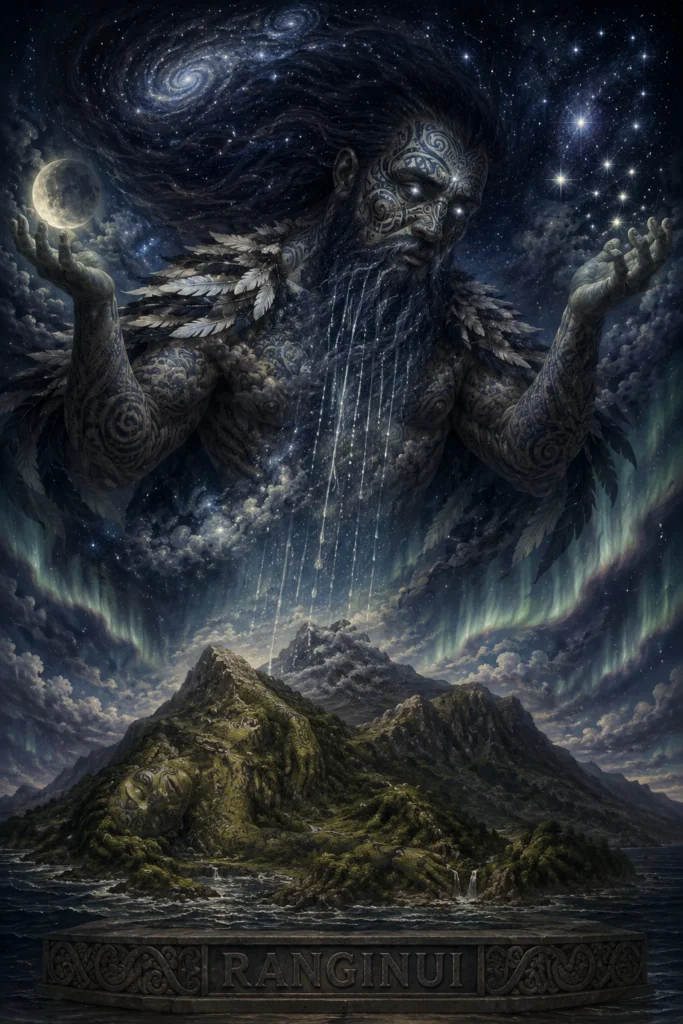
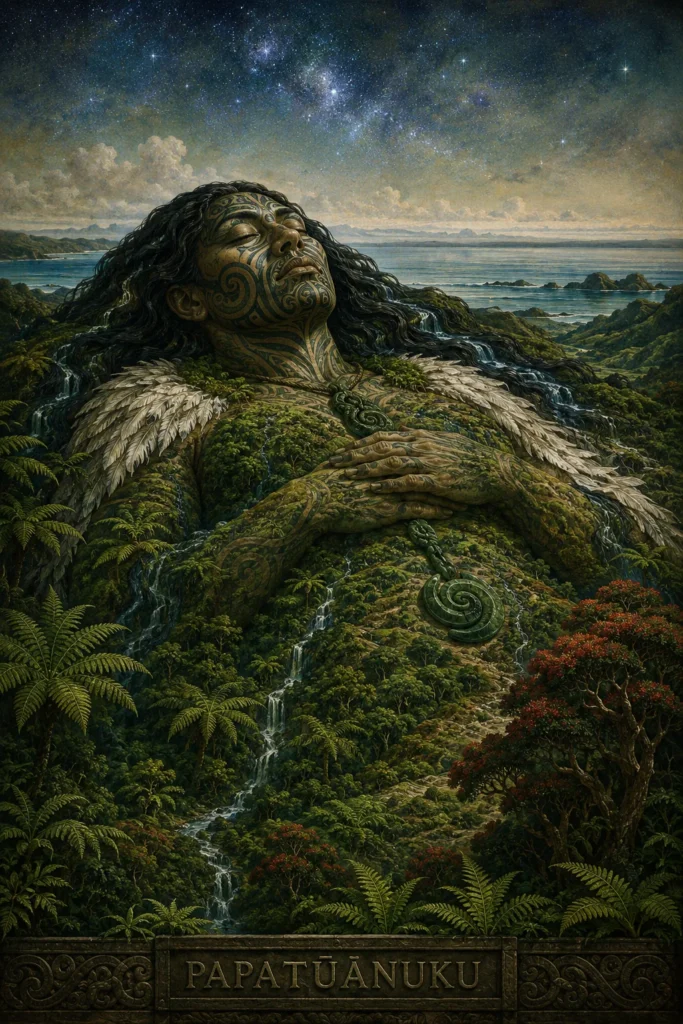
Ranginui is the sky father of Māori cosmology. Together with the earth mother Papatūānuku he forms the primordial parental couple. His sons violently separate him from the earth in order to create light and living space; ever since he remains the weeping sky, turned toward the earth.
Ranginui, often called Rangi for short, is the sky in Māori cosmology, conceived as a male primordial figure and father. Together with the earth mother Papatūānuku he forms the primordial parental couple from which the gods and all living things descend.
As with Papatūānuku, the rule holds: Ranginui does not rule over the sky, he is the sky. Name and thing are one.
Within the religion of the Polynesia / Māori, Ranginui stands at the beginning of the genealogical sequence, the whakapapa, which links gods, land and people.
He thus belongs to the first generation of personified powers. His actual mythical significance derives less from deeds than from his fate: from the embrace with the earth and the painful separation from it.
In religious-studies terms, Ranginui embodies the type of the sky father who forms a cosmic couple with an earth mother. This motif is widespread in Polynesia and is also encountered in numerous other mythologies.
Characteristic of the Māori version is that the world does not arise through an act of creation but through the unfolding and separation of this primordial pair.
The name Ranginui is composed of rangi, sky, and nui, great. It thus means the great sky. The word rangi is widespread in Māori and in the related Polynesian languages and denotes both the visible sky and the day.
In the narratives the short form Rangi usually appears. Alongside it there is a series of epithets that name different aspects of the sky, such as the clear, the distant or the sky spread out over everything.
Some traditions know a sequence or layering of several heavens, in which Ranginui is the lowest, the one turned toward the earth.
Related names for sky figures are found in other parts of Polynesia, which places Ranginui within a shared mythological stock. As with Papatūānuku, the unity of name, personal figure and physical reality must be noted: Ranginui is not a god of the sky, but the sky as a kindred, personal power.
Ranginui is imagined as a male figure lying over the earth, later raised on high. In the time before the separation his body directly covers the body of Papatūānuku, so that no space and no light remain between the two. After the separation he is the sky stretched out high above, arching over the world.
His forms of appearance are the phenomena of the sky. Rain and dew are regarded as his tears, which he sheds out of longing for the separated wife.
In some traditions the celestial bodies are interpreted as adornment with which his son provided him after the separation, in order to console and honour the father. Clouds, mist and the light of day also belong to his visible presence.
Unlike trickster or shape-shifting gods, Ranginui does not appear in changing forms. His presence is the constant presence of the sky over the land. Characteristic is his attitude of turning toward: he remains above, but he is turned toward the earth, and his grief keeps the connection to Papatūānuku alive.
The central myth surrounding Ranginui is the separation of the primordial parental couple. In the beginning Ranginui and Papatūānuku lie in close embrace. Their divine sons, enclosed in the darkness between the parents, deliberate how to gain light and space. They reject the idea of killing the parents and decide to separate them.
Several sons try in vain to push the sky and the earth apart. Only Tāne, the god of the forests, succeeds, by bracing his shoulders against the earth and his feet against the sky and slowly raising Ranginui on high.
Thus the world of light comes into being. Another son, Tāwhirimātea, the god of storms, does not agree with the separation. He follows his father into the heights and from there leads wind and tempest against his brothers, who have remained below.
The separation brings life to the world, but for the parents it remains a lasting pain. Ranginui weeps, and his tears fall as rain and dew onto Papatūānuku; she sends her sigh up to him as mist. In this way the myth explains the unceasing bond between sky and earth.
In some traditions Tāne consoles the father by adorning him with sun, moon and stars. The separation is reported, among other sources, in the creation account that Te Rangikāheke recorded in the 19th century; alongside it there are numerous regional variants with differing details.
One episode developed in several traditions concerns the adornment of Ranginui. After the sky has been raised on high, it appears at first bare and naked.
Tāne tries to adorn it with various lights and finally arranges the celestial bodies over his body: the red light of dawn, the sun, the moon and lastly the stars, which he scatters from a basket.
This narrative at once explains the visible order of the sky and gives it a meaning, for the adornment is an act of atonement and consolation for the separated father.
Some versions also know a prehistory that precedes the separation. They let the world emerge in stages out of the undivided primordial state, out of nothingness, emptiness and night, first thought and seeking and then the primordial parental couple.
Ranginui thus does not stand at the absolute beginning, but as the first male figure at the transition from the formless primordial age to the ordered world.
The number and order of the sons who attempt the separation also vary between the iwi; individual tribes name other gods as the successful lifter or know further siblings absent from the well-known Te Rangikāheke version.

As with Papatūānuku, there was no temple and no separate cult organisation for Ranginui. His worship was part of the comprehensive ritual order that regulated the relationship of people to the divine powers and to nature. Ranginui was invoked in the karakia, the ritual sayings and prayers that accompanied important actions.
Ranginui gained significance especially where weather, rain, celestial bodies and reckoning of time were concerned.
The observation of the sky, the stars and their risings was indispensable for navigation, agriculture and the festival calendar; the knowledge of this was linked to the mythical figure of the sky father. Whoever interpreted the sky was dealing with Ranginui and his signs.
In speeches on the marae, the meeting ground, Ranginui and Papatūānuku are to this day invoked together, often in the opening invocation that greets sky and earth before people are spoken of. In this way the primordial parental couple remains present in the ritual speech of the Māori, even where there is no longer any actual cult.
The close connection of Ranginui and Papatūānuku in prayer reflects the mythical longing of the separated parents.
Protection in connection with Ranginui concerns above all the right order toward the powers of the sky and the weather. Storm, tempest and drought were understood as the working of divine forces, in particular as the work of the storm god Tāwhirimātea, who had drawn up to his father after the separation.
The warding off of such threats took place through karakia, through ritual sayings with which people sought to appease storms or to ask for favourable weather.
An actual apotropaic practice in the sense of amulets or protective objects specifically related to Ranginui is not characteristic.
Protection consisted rather in the right knowledge and in the right conduct: in the knowledge of the celestial signs, the risings of the stars and the weather rules that made the mythical knowledge of Ranginui practically usable. Whoever understood how to read the sky could meet dangers in good time.
In religious-studies terms, the Māori pattern shows itself here too: that protection rests on relationship, knowledge and moderation, and not on isolated magic.
The ritual respect for the sky father, for instance in the opening invocations of sky and earth, itself had a preserving function: it placed the person within the kinship structure of cosmos and community and thus secured the basis of action.
Ranginui is not only a cosmological primordial figure, but also the starting point of a practically used body of knowledge.
The sky layers that some traditions assume above him are regarded as dwelling places of further powers, and the observation of the sky became a highly developed expertise that remained connected to the mythical figure of the sky father.
Star and moon lore was of particular significance. The heliacal rising of the star cluster Matariki, which denotes the Pleiades, or in other tribal areas of the star Puanga, marked the turn of the year and the beginning of a new growing season.
The moon calendar, the maramataka, ordered the nights of the lunar month according to their suitability for fishing, planting and harvest. This knowledge was bound to specialists, the tohunga, and was passed on in precisely transmitted forms.
Navigation on the open sea also relied on Ranginui’s sky. The seafarers who settled the Pacific read their course from the rising points of the stars, from wind and swell.
In religious-studies terms, this shows that the mythical figure of the sky father and the sober observation of the celestial bodies were not separate domains in Māori thought: whoever understood how to interpret the sky moved within the body of a kindred, personal power and at the same time used a precise, experience-saturated knowledge.
The primordial parental couple of sky father and earth mother is widespread throughout Polynesia. In Hawaii, on the Society Islands and elsewhere, related sky figures and narratives of the separation of sky and earth are encountered. These correspondences point to a shared Polynesian stock of myths.
Beyond Polynesia, Ranginui belongs to the type of the sky father attested worldwide. In Greek tradition, Uranus forms a comparable couple with Gaia, whose close bond is violently severed by the children.
This motif of the separation of sky and earth by the offspring comes remarkably close in structure to the Māori narrative. Other Indo-European traditions also know a sky father as a high deity.
In religious-studies terms it must be stressed that such parallels prove no direct dependence. They show that the interpretation of sky and earth as an opposed and at the same time procreative couple is a widespread cosmological pattern.
The Māori version stands out through two features: through its embedding in the whakapapa, which links gods, land and people without gaps, and through the strong emphasis on the longing and grief that continue to bind the separated couple to each other.
Research on Ranginui is closely bound up with research on the whole of Māori cosmology. It began in the 19th century with the collections of George Grey and the ethnographic studies of Elsdon Best. Edward Tregear worked out the Polynesian linguistic connections; later authors such as Margaret Orbell systematised and critically annotated the myths.
Here too it holds that the older tradition is to be read with caution. Colonial editors standardised the narratives and adapted them to European expectations; Te Rangikāheke’s creation account became, through Grey’s publication, the apparently authoritative version, although it is only one of many tribal traditions.
Recent research therefore emphasises the diversity of the regional versions and the importance of the Māori voices themselves.
In the present day, Ranginui and Papatūānuku are firm components of cultural self-understanding. They appear in education, literature, art and public speech, frequently named as a couple.
The myth of the separated parents serves here not only as a memory of an old cosmology, but also as an image for the relationship of people, land and sky.
The debate conducted in New Zealand about the legal recognition of natural beings ties in with this worldview, in which sky and earth are kindred persons and not mere resources.
Related key terms: Ranginui Rangi Papatuanuku Maori sky father Tane Tawhirimatea whakapapa karakia.
iWell Guard ties in with the cultural-historical tradition of portable protective objects, in the tradition of Polynesia / Māori and many other cultures worldwide. 41 layers, solid gold, platinum, silver, made in Germany. 30-day right of return.
Personal experiences may vary. Not a medical device. No promise of healing.