Maui: Polynesian Trickster, Culture Hero and Fisher of Islands
By Ralf Ittermann · last reviewed on
Maui, known in the Maori tradition as Maui-tikitiki-a-Taranga, is the great trickster hero of Polynesian mythology. His stories are attested in nearly all island cultures of Polynesia: Aotearoa, Hawai’i, Tahiti, Samoa, Tonga, the Cook Islands, the Marquesas. This entry describes his religious-studies profile as a demigod, culture bringer, and ambivalent figure.
Profile: Maui
Maui: the most important aspects at a glance. The following fields summarise origin, effect, appearance, function, protection and parallels.
Maui is a demigod and hero with mortal, human descent on his mother’s side. In the Maori tradition he is the prematurely born child of his mother Taranga, wrapped in a topknot (tikitiki), thrown into the sea and raised in the sky by an ancestor or an Atua, often Tama-nui-ki-te-Rangi.
Maui acts on the foundations of human life. He pulls the islands out of the sea as a giant fish, subdues the sun so that the days become longer, and fetches fire from Mahuika. His attempt to win immortality for humankind fails at Hine-nui-te-po.
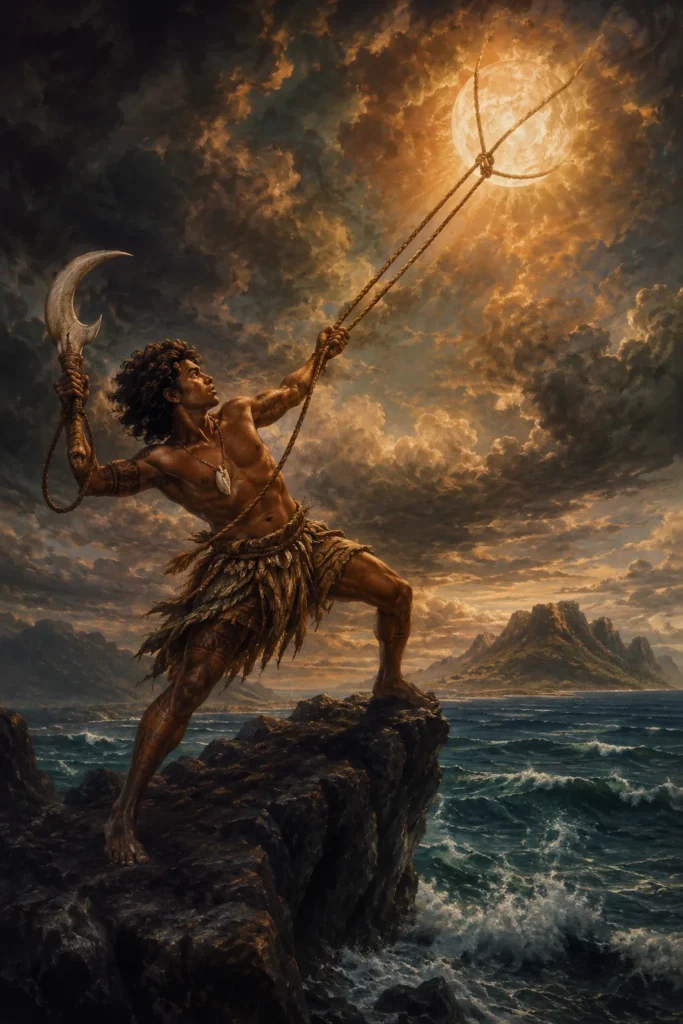
Maui is depicted as a youthful, slender man with a long tuft of hair, often with the mythical fish hook in his hand or with a noose with which he subdues the sun. He is present in carvings on meeting houses and canoes, though less often than the great Atua.
Maui stands beyond the ordering Atua and acts as culture bringer and explainer of the world. He obtains fire by deception and explains the length of the day and the geography of the Polynesian islands. As a demigod he is a mediating figure between the human and divine spheres.
Maui has no institutionalised cult of his own and is invoked in karakia, but rarely as a central figure of reference. He is regarded as patron of fishermen, of travellers and of the cunning. The pendant hei matau of pounamu is a symbol for travellers and surfers.
Maui is compared with tricksters such as Hermes, Loki, Anansi among the Akan, Coyote of the North American prairie and Kaulu in Hawai’i. The fire theft corresponds to the Prometheus type; his failure at immortality is related to Orpheus and Eurydice and to the Mesopotamian Adapa myth.
Classification within the Polynesian Pantheon
Maui is not an Atua in the strict sense, but a demigod (demi-god) and hero. He is of human and mortal descent on his mother’s side, yet divinely and superhuman gifted.
In the Maori tradition he is the premature child of his mother Taranga, wrapped in a topknot (tikitiki); he is cast into the sea and raised in the heavens by an ancestor or an Atua, often Tama-nui-ki-te-Rangi.
Margaret Orbell places Maui alongside other Polynesian trickster figures. From a religious-studies perspective, Maui is a classic trickster figure in the sense of Paul Radin (The Trickster, 1956).
He stands beyond the ordering Atua, yet acts as culture bringer and explainer of the world. His position as a demigod makes him a mediating figure between the human and divine spheres.
Maori theology knows no systematic doctrine, no closed body of teaching, and it is precisely for this reason that a multifaceted figure like Maui has a place within it. Whatever reality the Atua possess, they gain it in enactment: in the karakia, in the gatherings at the marae, in the whakapapa recitations.
Religious studies values this practice-grounded theology as an independent contribution to the discipline; Mary Ann Boord and Edward Tregear have systematically developed it in their religio-ethnographic works on Polynesia.
Whoever researches the Maui tradition encounters a fundamental problem of Polynesian religious research: a large portion of the sources dates from the nineteenth century and is colored by the perceptions of missionaries and ethnologists.
This is especially apparent with an ambivalent trickster figure like Maui. More recent scholarship is therefore continuously working on a decolonization of these holdings: it brings Polynesian voices to the center and critically examines Western ordering concepts.
Name and Etymology
The name Maui is attested pan-Polynesian: Maui in Aotearoa, Tahiti, Hawai’i, and the Cook Islands; Maui-tikitiki, Maui-potiki, Maui-mua, Maui-roto, Maui-taha, and Maui-pae are epithets and designations for brothers. The island of Maui in the Hawaiian archipelago bears his name, which documents the religiohistorical spread.
The etymology itself has not been securely reconstructed. Bruce Biggs proposes a meaning such as “left” or “the awkward one,” which would suit the trickster nature. Other proposals emphasize “the living one” or “the breathing one.” The multiplicity of epithets shows that Maui is not a closed figure but a cluster of designations.
Maui appears under a wealth of epithets, and linguistically this wealth points to an oral tradition that has branched out richly across regions.
How deep such Maori and Hawaiian theonyms extend linguistically is documented in the lexical works of Bruce Biggs and Ross Clark. These studies simultaneously form the basis for grasping the kinship among the Polynesian languages.
Maui’s epithets are in many cases not mere ornament. They encode specific ritual functions and are fixed in the karakia formulas. The tohunga, the ritual specialists, knew precisely which epithet was to be invoked in which situation. Charles Royal and Pou Temara examine this precisely regulated liturgical practice.
Description and Iconography
Maui is depicted iconographically as a youthful, slender man with a long topknot, often holding the mythical fishhook in his hand or a snare with which he tames the sun. He is present in carvings on meeting houses and canoes, though not as frequently as the great Atua.
His fishhook (Maui-tikitiki, Maui-matau) is regarded as a legendary implement; the Maori hei-matau pendant (pounamu fishhook) refers to this mythical background. The snare for the sun is a second iconographic key. In Hawai’i, Maui’s fishhook is associated with the constellation known in the West as the “tail of the Scorpion.”
The carving art of the Maori and Hawaiians has undergone an impressive revival over the past fifty years. Cliff Whiting, Robyn Kahukiwa, Wright Bowman, and Sam Ka’ai are among the artists who have created both traditional forms and modern interpretations.
In their works the Atua and heroes like Maui appear again and again, so that their iconographic presence extends into contemporary art.
Polynesian art cannot be separated from its cosmological significance. A spiral (koru), an ornament, a line, each of these elements carries religio-phenomenological meaning, including where Maui is depicted. Roger Neich, Damian Skinner, and other art historians have systematically unlocked these layers of meaning.
The Creation of the Islands by Maui
The central narrative is Maui’s fishing up of the islands. Using a fishhook made from the jawbone of his ancestress Murirangawhenua, Maui draws an enormous fish out of the sea: the North Island of Aotearoa, Te Ika-a-Maui (“the fish of Maui”).
The South Island is often referred to as his canoe (Te Waka-a-Maui), and Stewart Island as his anchor (Te Punga-o-Maui).
In Hawai’i there is a parallel narrative in which Maui pulls the islands from the sea. Variants also exist in the Cook Islands and Tonga.
From a religious-studies perspective this is a classic creation myth of the “earth-diver” or “earth-pulling” type, which Eliade (Patterns in Comparative Religion, 1958) describes as a pan-regional type. Its distribution across Polynesia shows that the idea is deeply rooted in proto-Polynesian religion.
The narrative of the creation of the islands is not to be understood as a self-contained text either. From a religious-studies perspective, the entire Maui material forms a network of narratives that illuminate one another and are weighted differently in the individual tribal traditions.
This rhizomatic, web-like structure complicates research methodologically, but bestows hermeneutic depth upon it. Divergent versions of a story are not considered “wrong” or “corrupted,” but as equally valid regional expressions.
The story of the island fisher Maui is not merely preserved in memory but actively passed on: in karakia, in speeches at the marae, and in teaching.
It is thus lived practice and not a decommissioned archive. The language programs for Te Reo Maori and Olelo Hawai’i have noticeably strengthened this vitality over the past three decades.
Maui and the Sun
Another central narrative tells how Maui tames the sun. The sun crossed the sky too quickly; people had too little daylight.
Together with his brothers, Maui braids snares from the hair of his sister (or his mother) and lays them at the openings through which the sun rises. When the sun appears, he catches it and beats it until it promises to move more slowly.
In Hawai’i this narrative is associated with the volcano Haleakala on the island of Maui, where Maui is said to have captured the sun. Beckwith documents the Hawaiian variant in detail.
From a religious-studies perspective this is a classic aetiology myth: it explains the length of the day and the regularity of the sun’s movement.
That Maui tames the sun so that days grow longer and work can succeed illustrates a fundamental trait of Maori and Hawaiian religion: ritual and everyday activity are intertwined.
Religious systems that strictly separate the sacred from the profane do not know this; here the Atua references run through the whole of life. This religiosity rooted in the lifeworld itself is the subject of religio-phenomenological studies by Mason Durie, Charles Royal, Lilikala Kame’eleihiwa, and other contemporary Polynesian scholars.
How closely ritual practice and everyday life are connected can also be read in the language: terms such as mana, tapu, aroha, and hauora belong today to the general English of Aotearoa and are used outside religious contexts as well.
That Maori theology has inscribed itself in everyday language to this extent attests to its deep cultural impact.
Maui and Fire
A third famous narrative recounts how Maui fetches fire from Mahuika, the fire goddess and ancestress. Maui visits Mahuika and asks for fire. She gives him one of her fingernails, in which the fire resides. Maui extinguishes it and returns to fetch another.
In this way he takes all her fingernails until she grows furious and hurls the entire fire into the forest. Maui narrowly escapes and the fire survives in certain trees, from which it can be obtained to this day by friction.
This narrative too is pan-Polynesian and corresponds to the pan-regional Prometheus type (fire-theft myth). From a religious-studies perspective Maui is here a classic trickster figure: he obtains fire through deception, not through force.
Polynesian religion remains alive especially at two types of place: the marae and the heiau, which are simultaneously assembly and cult sites. Each marae and each heiau has its own whakapapa, its own traditions, and its own Atua references.
Whoever enters a marae is first received in the powhiri, the ritual by which the tangata whenua formally receive their visitors. This is not ceremonial folklore, but lived religious practice. From a religious-studies perspective, the powhiri ranks among the best-documented Polynesian greeting rituals.
In the twentieth and twenty-first centuries, cult practice has shifted considerably. Whereas the tohunga formerly bore the ritual, this task today falls largely to the kaumatua, the elders, and to the marae committees. From a sociology-of-religion perspective this shift is instructive; Manuka Henare and Mason Durie discuss it in their research.
Maui's Death and Hine-nui-te-po
The death of Maui is the darkest and religiohistorically most significant aspect of his life. Maui wishes to secure immortality for humanity by passing through the body of Hine-nui-te-po, the goddess of the underworld (see Hina), while she sleeps, emerging from within.
He transforms himself into a worm and crawls into her body. But a small bird (piwakawaka, fantail) laughs, Hine-nui-te-po wakes and crushes Maui. From that time on, humans have been mortal.
From a religious-studies perspective this is a classic aetiology myth of mortality. It explains why humans do not live forever. Structurally the narrative is related to other myths (such as Orpheus and Eurydice, or the Mesopotamian Adapa myth), in which a hero narrowly fails to achieve immortality.
Maui, who even in death fails against Hine-nui-te-po, makes clear how little the Polynesian conception of protection has to do with Western amulet magic. From a religious-studies perspective a distinction must be drawn here: protection is not based on magically causal effect, but is constituted relationally and ritually.
Whoever stands in relationship to an Atua and cultivates that relationship is considered “protected,” not because an object works, but because an existing relation lays claim to cosmological validity. In religious anthropology this idea falls under the concept of “relational ontology.”
Cult, Protection, and Invocation
Maui is not an Atua with his own institutionalized cult. He is invoked in karakia, but rarely as the central reference figure of a ritual. His role is more that of an ancestral hero whose inventions first made humanity capable of life.
In protective contexts Maui is the patron of fishers (his fishhook), travelers (his courage), and the cunning. The hei-matau pendant is also a symbol for travelers and surfers. Hirini Mead describes this practice as cultural identification, not as a magical amulet function.
Universal structures of religious experience, such as those that resonate in a trickster figure like Maui, have been systematically illuminated by Joseph Campbell and Mircea Eliade. Their works are foundational, yet must be rethought for the specific Polynesian contexts without sliding into a pan-globalizing simplification. More recent Polynesian scholarship insists emphatically on this context-sensitive reading.
Parallels in Other Cultures
Maui can be compared with other trickster heroes: Hermes (Greek), Loki (Germanic), Anansi (Akan), Coyote (North American Plains), Kaulu in Hawai’i. The common features are: lowly birth, cunning ingenuity, ambivalent effect (benefit and harm), and the bringing of cultural goods.
Joseph Campbell (The Hero with a Thousand Faces, 1949) places Maui within the typical hero pattern.
More important than universals, however, is the specific Polynesian expression. Maui is not only a trickster hero but also a geographer: he explains the concrete geography of the Polynesian islands. This geographical anchoring is a distinguishing feature compared to European or African trickster figures.
In international debate, Polynesian religion is increasingly recognized as an independent religious system and is no longer dismissed merely as “mythology” or “folklore.” The fact that terms such as mana, tapu, mauri, and whakapapa have entered the specialist vocabulary of religious studies attests to this shift.
Their use presupposes, however, a contextual sensitivity that is not self-evident.
Contemporary Reception
Maui is today one of the best-known Polynesian figures in world culture, not least through the Disney film “Moana” (2016), which depicts Maui in a free adaptation.
The reception by Disney was the subject of critical debates in Polynesia; many Maori, Hawaiians, and Samoans criticized the depiction as misguided, while others welcomed the international visibility. Vilsoni Hereniko and other Pacific filmmakers have produced their own Maui adaptations.
In Aotearoa, Maui is present every day: in school books, in Maori language programs, and in geography (Te Ika-a-Maui as the name for the North Island). A deeper contextualization within Polynesian Maori religion connects Maui with the other Atua in a coherent cosmological fabric.
The exchange between Polynesian internal knowledge traditions and academic research is today carried forward by dedicated institutions: the Royal Society of New Zealand, Te Aparangi, the Maori Studies Department of the University of Auckland, the University of Hawai’i at Manoa, and the Te Punga Tipu Foundation.
Their institutional framework ensures not only that research is conducted about Polynesia, but that this research also originates from Polynesia itself.
The Hauling of the Islands from the Sea
Among the most widely distributed Maui narratives is the fishing of an island from the depths of the sea. In the New Zealand Maori tradition, Maui secretly stows away in the canoe of his older brothers, who do not want to take him along.
Out on the open sea he produces a special fishhook, often described as made from the jawbone of his ancestress Murirangawhenua, and baits it with his own blood.
The hook catches on the ocean floor, and Maui hauls up a vast landmass with great effort. In the Maori interpretation this landmass is the North Island of New Zealand, which is therefore called Te Ika-a-Maui, the fish of Maui. The canoe from which the fishing was done is equated with the South Island.
When Maui steps away briefly to appease the gods, his brothers, contrary to his warning, begin to cut and hack at the fish. This, according to the narrative, is the origin of the rugged surface of the island, cut through by valleys and mountains.
The same basic structure, the fishing up of land, is found in numerous other Polynesian regions, for example in Hawai’i, Tonga, and the Society Islands, each time in reference to the local geography.
The narrative is thus simultaneously a piece of landscape interpretation: it explains the origin of specific islands and their shape. The sources vary by region; for New Zealand the primary collections are those of George Grey from the mid-nineteenth century, which are, however, editorially revised and cannot be regarded as an unfiltered rendition.
The Attempt to Overcome Death
A special place in the Maui cycle is held by the final narrative, in which Maui seeks to conquer death itself. Unlike most other episodes, it does not end with a success of the hero but with his death, and it explains why humans are mortal.
In the New Zealand version, Maui wishes to overcome the death goddess Hine-nui-te-po, who sleeps at the edge of the world. His father warns him, yet Maui is resolute. His plan is to enter the body of the sleeping goddess and emerge through her mouth, thereby reversing death and making humans immortal.
He takes various birds as companions and impresses upon them to remain quiet. When Maui has entered the goddess’s body halfway, a small bird, in many versions the fantail tiwaikawa, cannot suppress its laughter. Hine-nui-te-po wakes and kills Maui.
This narrative is religiohistorically significant because it marks the relationship between the trickster and the cosmic order. Maui has previously won fire, islands, and longer days, yet at the boundary between life and death his intervention fails.
Death remains a constant that even the most resourceful hero cannot abolish. The episode was recorded by George Grey and others, with details varying between versions. Some tribal traditions treat parts of this narrative as sensitive knowledge, so that published versions are not unconditionally representative.
Selected Bibliography
- Margaret Orbell: The Illustrated Encyclopedia of Maori Myth and Legend (1995)
- Martha Beckwith: Hawaiian Mythology (1940)
- Antony Alpers: Maori Myths and Tribal Legends (1964)
- Joseph Campbell: The Hero with a Thousand Faces (1949)
- Paul Radin: The Trickster (1956)
- Anne Salmond: Tears of Rangi (2017)
As the culture hero of the Polynesian island world, Maui embodies the tension between cunning, daring, and creative action: he fishes islands from the sea, catches the sun, and brings fire to humanity.
Related key terms: Maui Polynesia trickster Te Ika-a-Maui Haleakala fishhook Mahuika Hine-nui-te-po.
iWell Guard and Protective Traditions
iWell Guard draws on the cultural-historical tradition of portable protective objects, in the tradition of Polynesia / Maori and many other cultures worldwide. 41 levels, real gold, platinum, silver, crafted in Germany. 30-day right of return.
Individual experiences may vary. Not a medical device. No healing promises.